

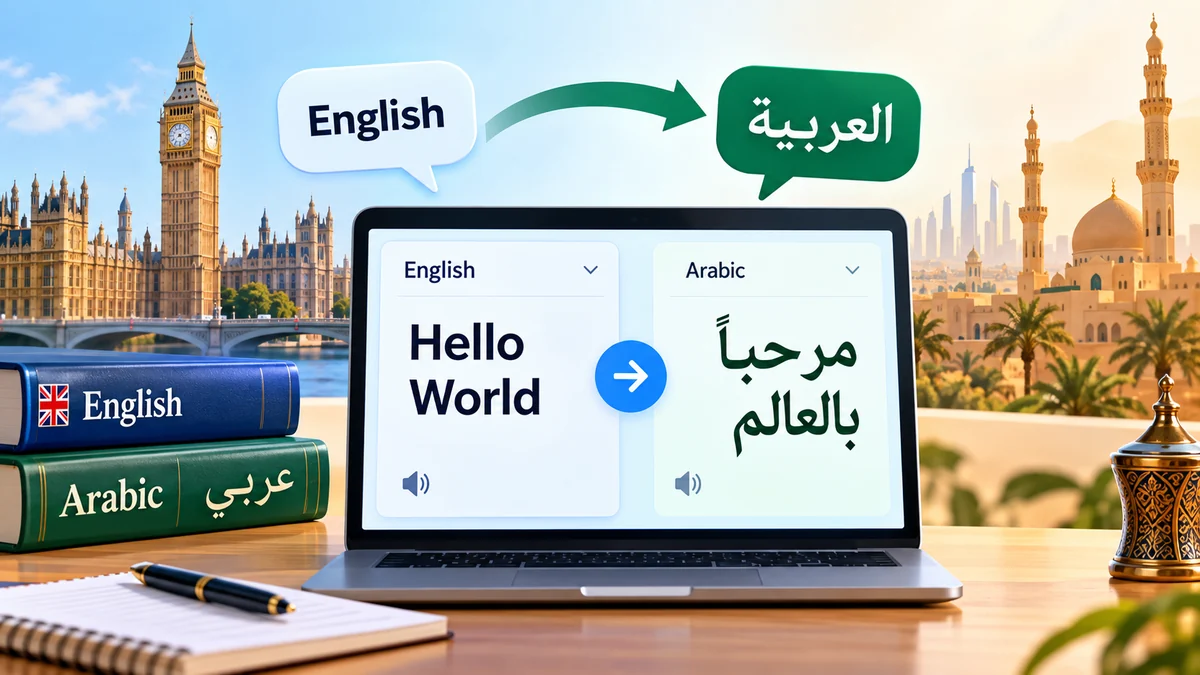
Translating English into Arabic can look simple when you only need a word or short phrase. The challenge appears when meaning, tone, grammar, gender, context, and regional differences start to matter. A literal translation may be grammatically possible yet sound unnatural—or even communicate the wrong idea.
To translate english to arabic accurately, focus on meaning rather than replacing individual words. Choose Modern Standard Arabic for most formal written content and an appropriate regional dialect for conversational material. Good translation also requires correct Arabic grammar, gender agreement, sentence structure, terminology, and right-to-left formatting. Machine Translation
What Does translate english to arabic Mean?
English-to-Arabic translation is the process of transferring the meaning of English text or speech into Arabic while preserving its intended message, context, tone, and purpose.
This is more complicated than substituting one English word with one Arabic word. English and Arabic belong to different language families and use different writing systems. English is generally written from left to right with the Latin alphabet, while Arabic uses Arabic script and is written from right to left. TransWord.AI
Consider a simple example:
English: How are you?
Arabic: كيف حالك؟
The Arabic sentence communicates the same basic meaning, but accurate usage can depend on who is being addressed and the situation in which the phrase appears.
This dependence on context becomes even more important with longer sentences, idioms, technical terminology, marketing copy, and conversational language.
Modern Standard Arabic or an Arabic Dialect?
One of the first decisions when translating English into Arabic is deciding which Arabic you need.
Arabic exists in a diglossic environment. Modern Standard Arabic and numerous colloquial varieties are used for different purposes, and research on Arabic translation highlights the distinction between formal MSA and everyday colloquial Arabic. DOI
Modern Standard Arabic
Modern Standard Arabic, commonly abbreviated as MSA and known as الفصحى, is the standardized form widely used for formal written communication.
It is normally appropriate for:
- News and journalism
- Educational material
- Academic writing
- Formal websites
- Government information
- Business correspondence
- Reports
- Technical documentation
- Official communication
- Cross-country Arabic content
Because MSA can be understood across Arabic-speaking countries, it is usually the safest choice when your audience is not limited to one region. Machine Translation
Regional Arabic Dialects
Everyday spoken Arabic varies substantially by country and region. Common broad dialect groups include Egyptian, Gulf, Levantine, and Maghrebi Arabic. Current machine-translation research continues to treat dialectal Arabic separately because real conversations involve regional vocabulary, register, code-switching, and other variations that standard MSA-focused systems may not capture well. Abdellah EL MEKKI, Ph.D.
For example, content intended specifically for casual conversations in Egypt may sound more natural in Egyptian Arabic than in formal MSA.
A useful rule is:
| Content | Usually Better Choice |
|---|---|
| Formal article | Modern Standard Arabic |
| Academic content | Modern Standard Arabic |
| News report | Modern Standard Arabic |
| Official document | Modern Standard Arabic |
| General Arabic website | Modern Standard Arabic |
| Casual regional dialogue | Relevant dialect |
| Local social media campaign | Relevant dialect |
| Character dialogue | Depends on audience and setting |
The intended reader matters just as much as the original English.
How to Translate English to Arabic Step by Step
A reliable translation workflow begins before the first Arabic word is written.
1. Understand the Complete English Sentence
Read the entire sentence before translating anything.
Consider this English expression:
“Break a leg.”
A word-for-word translation involving physically breaking a leg would miss the intended meaning. In the appropriate context, the expression means something closer to wishing someone good luck before a performance.
Idioms demonstrate why context should come before vocabulary.
2. Identify the Purpose
Ask what the text is trying to accomplish.
Is it an instruction? A casual message? A technical explanation? An advertisement? A contract clause?
The same concept can require different Arabic wording depending on the purpose and level of formality.
3. Identify the Audience
Next, determine who will read the translation.
For a broad Arabic-speaking audience, MSA is generally the practical choice. For highly localized conversational content, a regional variety may communicate more naturally. terratra
4. Translate the Meaning
Translate complete ideas rather than isolated words.
English:
I am looking forward to meeting you.
A translator should first understand that “looking forward to” expresses positive anticipation. Translating each word independently is unlikely to produce the most natural Arabic sentence.
5. Restructure the Sentence
English and Arabic do not always organize information in exactly the same way.
A translation can therefore require changes to:
- Word order
- Pronouns
- Verb forms
- Gender agreement
- Number agreement
- Prepositions
- Articles
- Sentence connections
Restructuring is normal. It does not mean that the translation is inaccurate.
6. Review the Arabic Independently
Once translated, read the Arabic without constantly comparing it with the English.
Ask:
Does this sound like something an Arabic speaker would naturally write?
If the sentence only makes sense when you can see the English beside it, the translation probably needs revision.
Why Word-for-Word English to Arabic Translation Often Fails
English and Arabic differ structurally enough that literal translation can quickly produce awkward results.
One major difference is Arabic’s rich morphology. Words can encode grammatical information differently from English, and Arabic also distinguishes singular, dual, and plural forms.
Gender creates another challenge.
English frequently uses neutral constructions where Arabic grammar requires masculine or feminine forms. Translators may therefore need contextual information that is not explicitly expressed in the English sentence.
Arabic also uses root-based morphology. Related meanings can be built around consonantal roots through different patterns, which makes vocabulary selection more complex than matching isolated dictionary entries.
These differences explain why a dictionary is useful for finding possible meanings but cannot replace contextual translation.
English and Arabic Sentence Structure
English commonly follows a subject-verb-object pattern:
The student read the book.
Arabic permits sentence structures that do not always map directly onto that English pattern. The best Arabic construction depends on emphasis, style, register, and context.
This flexibility means that preserving English word order is not automatically a sign of accuracy.
A translator should preserve the message, then express that message through natural Arabic syntax.
Arabic Gender and Number
Gender deserves particular attention when you translate English to Arabic.
Arabic nouns are grammatically masculine or feminine, and related adjectives, verbs, demonstratives, and pronouns may need to agree accordingly.
Number is also more detailed than in English because Arabic has three grammatical number categories:
Singular: one
Dual: exactly two
Plural: three or more
English generally distinguishes only singular and plural.
Consequently, an English phrase containing “two students” may require grammatical forms that differ from both “one student” and “three students.”
Automatic translation can handle many ordinary examples, but complex agreement remains something worth reviewing carefully.
Right-to-Left Arabic Writing
Arabic is written from right to left (RTL).
That affects much more than where a paragraph starts. When English and Arabic appear together, documents and interfaces may contain bidirectional text: Arabic flows right to left while English terms and many numbers continue to display left to right.
This can create formatting problems with:
- Phone numbers
- Dates
- URLs
- Email addresses
- Tables
- Forms
- Product codes
- Equations
- English brand names
- Mixed-language sentences
Document translation tools therefore need to handle both language translation and RTL layout correctly. Polytranslator
If you copy Arabic translation into Microsoft Word, Google Docs, a content management system, or a design application, verify that paragraph direction is set correctly rather than assuming the software will always detect it.
Arabic Script and Pronunciation
Arabic uses a script in which letters can change their visual form depending on their position within a word.
Another important feature is diacritics, known as harakat. Short vowels can be represented by marks placed above or below letters, but these marks are frequently omitted in ordinary adult Arabic writing.
That can make pronunciation difficult for beginners because readers often infer the intended vowels from vocabulary and context.
For language learning, pronunciation tools and fully or partially vowelled Arabic can therefore be helpful.
For normal professional writing, however, adding every possible vowel mark is generally unnecessary.
Common English to Arabic Translation Examples
Here are several basic examples:
| English | Arabic |
|---|---|
| Hello | مرحباً |
| Thank you | شكراً |
| Good morning | صباح الخير |
| Good evening | مساء الخير |
| Welcome | أهلاً وسهلاً |
| What is your name? | ما اسمك؟ |
| How are you? | كيف حالك؟ |
| I don’t understand | لا أفهم |
| Please | من فضلك |
| Goodbye | وداعاً |
These translations are useful as general examples, but context still matters.
For instance, forms of address can change according to gender, number, formality, and dialect.
How to Translate English to Arabic Online
Online translators make basic translation extremely convenient.
The usual process is straightforward:
- Select English as the source language.
- Select Arabic as the target language.
- Type, paste, speak, or upload your English content.
- Generate the Arabic translation.
- Review the result for context and terminology.
- Correct formatting and RTL direction where necessary.
Many modern translation platforms support more than typed text. Depending on the service, users may be able to translate voice, photographs, PDFs, DOCX documents, presentations, and other formats. Machine Translation
The important distinction is that convenience does not guarantee perfect accuracy.
Machine Translation vs. Human Translation
Machine translation has improved considerably, particularly for common language and Modern Standard Arabic. However, human review still matters when small errors can have serious consequences.
| Factor | Machine Translation | Human Translation |
|---|---|---|
| Speed | Very fast | Slower |
| Basic phrases | Usually useful | Excellent |
| Cost | Often free or inexpensive | Usually paid |
| Context | Improving | Strong |
| Dialects | Variable | Strong with native expertise |
| Creative language | Variable | Usually stronger |
| Legal material | Requires caution | Professional translator preferred |
| Cultural nuance | Can miss subtleties | Usually stronger |
| High-risk documents | Review needed | Specialist recommended |
Machine translation is particularly useful for understanding ordinary content, quick communication, drafts, and low-risk material.
Professional translation or qualified human review is preferable for legal, medical, regulatory, certified, or other high-stakes content. Current translation platforms themselves commonly recommend additional human verification for business-critical and specialized material. Machine Translation
Common English-to-Arabic Translation Mistakes
Several problems repeatedly reduce translation quality.
Translating Idioms Literally
Expressions such as “piece of cake,” “hit the road,” or “under the weather” should be translated according to intended meaning, not their individual words.
Ignoring Gender
English sometimes hides information Arabic grammar requires. A translator may need to know whether the person being addressed is male or female to choose the most appropriate form.
Choosing the Wrong Dialect
A grammatically correct Egyptian Arabic expression may be inappropriate in formal pan-Arab writing.
Choose MSA or a dialect deliberately rather than allowing the choice to happen accidentally.
Preserving English Word Order
An Arabic sentence does not have to imitate the English structure to be faithful.
Natural translation often requires restructuring.
Ignoring Context
A single English word may have several Arabic equivalents.
Consider the word “bank.”
It could refer to a financial institution or the side of a river. Only context identifies the correct meaning.
Forgetting RTL Formatting
Even excellent Arabic wording can look unprofessional if punctuation, numbers, tables, and alignment are broken after copying the translation into another program.
How to Get More Accurate Arabic Translations
Better source English usually produces better Arabic.
Write clearly before translating. Avoid unnecessary ambiguity, excessively long sentences, unexplained abbreviations, and obscure idioms when the text is intended for machine translation.
For longer projects, maintain a terminology list. If a technical term is translated one way on page one and another way on page ten, the reader may assume they refer to different concepts.
Names also deserve special attention.
A personal or brand name may need transliteration rather than translation. Transliteration represents pronunciation in another writing system, while translation transfers meaning.
This distinction is especially important for:
- Personal names
- Company names
- Locations
- Product names
- Technical abbreviations
- Trademarks
Do not automatically translate proper nouns simply because a literal meaning exists.
Translating Documents from English to Arabic
Documents introduce problems that plain text boxes do not.
A PDF, presentation, report, or brochure contains visual structure as well as language. Once Arabic replaces English, the layout may need substantial adjustment because the reading direction changes.
Pay particular attention to:
- RTL paragraph alignment
- Tables and columns
- Headers and footers
- Page numbers
- Charts
- Captions
- Forms
- Bulleted lists
- Mixed English-Arabic content
- Fonts
- Line breaks
Some document translation systems specifically support RTL preservation, but the exported document should still be visually inspected. Polytranslator
A technically correct translation with broken formatting is not a finished document.
Translating Websites and Apps into Arabic
Website translation goes beyond converting paragraphs.
Arabic localization may affect the entire interface because RTL design can require mirroring elements. Navigation, arrows, form fields, menus, icons, and alignment may all need reconsideration.
Do not assume every visual element should be mechanically flipped, though. Numbers, media controls, logos, charts, and other components can have their own directionality requirements.
The content also needs localization.
A phrase that works in an English interface may need shorter or differently structured Arabic wording. Buttons are a good example because limited interface space makes clarity and length important.
Test translated interfaces with real Arabic content rather than designing around placeholder English text.
Translating English Voice to Arabic
Speech translation introduces another layer of processing.
The system must first recognize the spoken English, determine its meaning, translate it, and then potentially generate Arabic speech.
Accuracy can be affected by:
- Background noise
- Accent
- Speaking speed
- Names
- Technical terminology
- Incomplete sentences
- Homophones
For better results, speak clearly and use complete sentences.
When the output will be used in an important conversation, read the Arabic translation before playing or sending it whenever possible.
Translating English Images into Arabic
Camera and image translation can be useful for signs, menus, screenshots, posters, labels, and printed documents.
The process normally combines optical character recognition with machine translation:
Image → recognized English text → Arabic translation
This means there are two opportunities for errors. If the system misreads the English text, even a strong translation engine will be translating the wrong source.
Always compare recognized text with the original image when accuracy matters.
Formal Arabic vs. Conversational Arabic
One of the biggest practical lessons in English-Arabic translation is that correct Arabic is not automatically appropriate Arabic.
Imagine translating dialogue between two close friends.
A formal MSA translation could be grammatically excellent but sound unusually formal for the situation. Conversely, highly colloquial regional Arabic could feel inappropriate in an academic report or government document.
Think in terms of register:
Formal: official documents, academic writing, journalism
Neutral: informational websites, general educational content
Conversational: messages, dialogue, informal social content
Regional: content specifically targeting speakers of a particular dialect
Research into Arabic translation shows that the distinction between MSA and colloquial varieties is substantial enough to influence translation performance itself. DOI
Can AI Accurately Translate English to Arabic?
AI translation is highly useful, but “accurate” depends on the task.
A simple sentence such as “The meeting starts at nine” presents a very different challenge from poetry, a medical report, legal terminology, humor, or dialect-heavy dialogue.
Modern systems are generally strongest when the source text is:
- Grammatically clear
- Contextually complete
- Written in standard language
- Free from excessive slang
- Not intentionally ambiguous
Dialect remains a notable challenge. Current Arabic machine-translation research continues to develop dedicated datasets and systems for Egyptian, Levantine, Gulf, Maghrebi, and other dialectal varieties rather than treating Arabic as a completely uniform target language. Abdellah EL MEKKI, Ph.D.
So AI can be an excellent first translator, but important content still benefits from knowledgeable human review.
How to Check an English to Arabic Translation
Never judge a translation solely because every source word appears to have an Arabic equivalent.
Use a simple quality-control process.
First, check meaning. Does the Arabic communicate the same idea?
Second, check naturalness. Does it sound like genuine Arabic rather than English arranged with Arabic words?
Third, check grammar. Review gender, number, verbs, pronouns, agreement, and prepositions.
Fourth, check terminology. Technical words should remain consistent throughout the document.
Fifth, check register. Formal content should not unexpectedly become slang, while casual dialogue should not sound unnecessarily ceremonial.
Finally, inspect formatting, especially RTL direction, punctuation, numbers, links, and mixed-language passages.
For high-stakes material, have a qualified Arabic translator perform the final review.
English to Arabic Translation for Beginners
If you are learning Arabic, translation tools are most useful when treated as learning aids rather than answer machines.
Translate a short English sentence yourself first. Then compare your version with a machine translation and investigate the differences.
Look for:
- Verb changes
- Gender agreement
- Singular, dual, and plural forms
- Word order
- Definite articles
- Pronouns
- Prepositions
- Vocabulary choices
Listening to Arabic pronunciation can also help connect written script with spoken language, especially because ordinary Arabic writing often omits short-vowel diacritics.
Over time, this approach teaches patterns rather than isolated translations.
Choosing the Right English to Arabic Translation Method
There is no single method that is best for every situation.
For a quick personal message, an online translator may be enough. For learning vocabulary, combine translation with a dictionary and pronunciation resources. For a long document, use a system that properly supports Arabic RTL formatting.
For regional conversations, specify the dialect rather than assuming MSA will sound natural.
For legal, medical, certified, or other consequential material, use professional human translation or qualified review.
The key is matching the translation method to the risk and purpose of the content.
Final Thoughts on translate english to arabic
Learning how to translate english to arabic effectively means looking beyond individual words. English and Arabic differ in script, writing direction, morphology, gender, number, sentence construction, idioms, and cultural usage.
For most formal or general written communication, Modern Standard Arabic provides the broadest reach across Arabic-speaking audiences. Regional dialects are more suitable when conversational authenticity and a specific local audience matter. Machine Translation
Machine translation can handle everyday English-to-Arabic tasks quickly, but context remains essential. Review the meaning, choose the appropriate Arabic variety, check grammar and terminology, and verify right-to-left formatting. When the content carries legal, medical, financial, academic, or other serious consequences, professional human review is the safer approach.
