

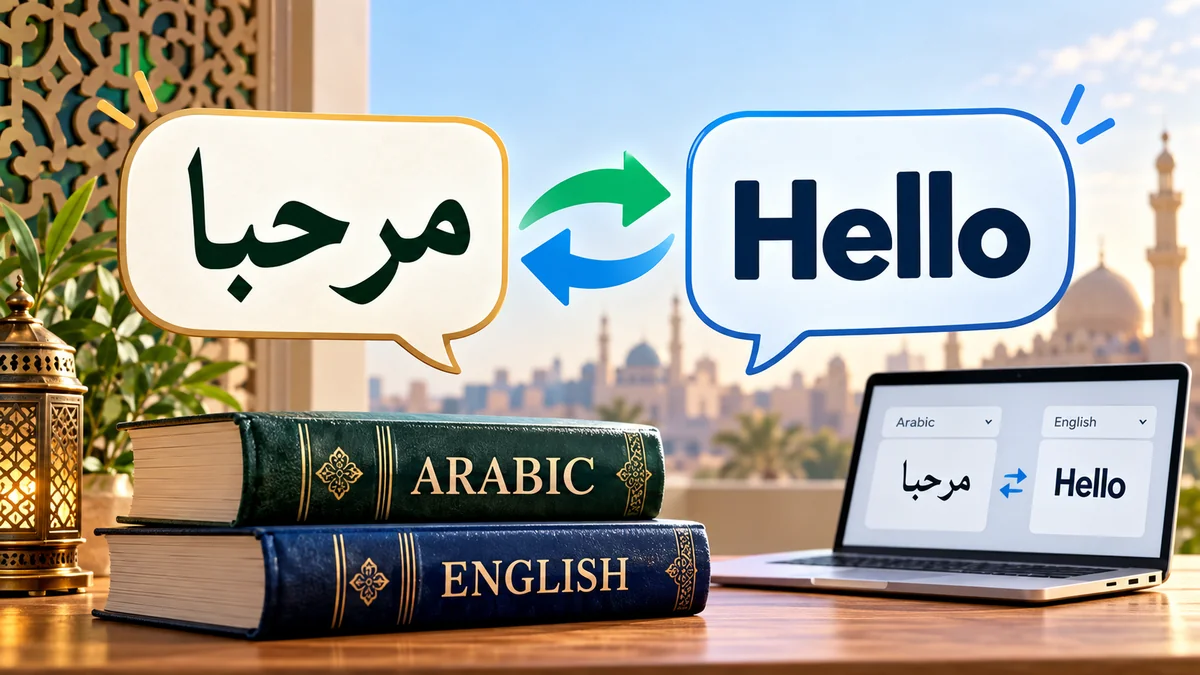
ranslating Arabic into English can look simple until one Arabic word produces several possible English meanings. Arabic relies heavily on context, word roots, grammatical patterns, and sometimes unwritten vowels, so accurate translation involves more than replacing individual words.
Arabic to English translation means converting the meaning of Arabic words, sentences, or documents into natural English while preserving their context and intent. Good translation considers grammar, dialect, idioms, cultural meaning, and sentence structure. Transliteration is different: it represents Arabic sounds with Latin letters rather than translating their meaning.
What Does arabic to english Translation Mean?
Arabic to English translation converts content written or spoken in Arabic into understandable English.
For example:
| Arabic | Transliteration | English |
|---|---|---|
| مرحباً | marhaban | Hello |
| شكراً | shukran | Thank you |
| نعم | na’am | Yes |
| لا | la | No |
| من فضلك | min fadlik | Please |
| كيف حالك؟ | kayfa haluk? | How are you? |
| ما اسمك؟ | ma ismuk? | What is your name? |
| مع السلامة | ma’a as-salama | Goodbye |
These examples also show an important distinction. Translation gives you the meaning, while transliteration shows approximately how Arabic is represented or pronounced using Latin characters.
Cambridge’s Arabic–English translator similarly separates translation from dictionary information, allowing users to translate text and then explore dictionary entries for individual words.
Arabic Translation vs. Transliteration
Translation and transliteration are often confused, especially when someone searches for arabic to english online.
Consider:
Arabic: مرحبا
Transliteration: marhaban
Translation: hello
“Marhaban” does not tell an English reader what the word means. It represents the Arabic pronunciation using Latin letters.
OpenArabic describes transliteration as writing Arabic words with Latin characters so someone can read their approximate pronunciation without reading Arabic script. It also notes that there is no single universal transliteration standard.
Different transliteration systems include:
- Simple English spellings for everyday names and words
- Arabizi or Arabic chat alphabet
- ALA-LC romanization used in many library contexts
- DIN 31635 used particularly in German-language scholarship
- Academic systems such as Hans Wehr transliteration
This explains why the same Arabic name can appear with several English spellings.
For instance, محمد may appear as Muhammad, Mohammed, Mohammad, or another variation. These differences do not necessarily mean that one version is a different Arabic name.
Understanding the Arabic Alphabet
One reason Arabic to English translation requires context is that the writing systems are fundamentally different.
Arabic uses an alphabet of 28 basic letters and is written from right to left. Most letters connect to surrounding letters and may change their visible shape depending on their position within a word.
Some familiar letter-to-Latin representations include:
| Arabic Letter | Name | Common Transliteration |
|---|---|---|
| ب | ba | b |
| ت | ta | t |
| ث | tha | th |
| ج | jim | j |
| خ | kha | kh |
| د | dal | d |
| ر | ra | r |
| س | sin | s |
| ش | shin | sh |
| ف | fa | f |
| ك | kaf | k |
| ل | lam | l |
| م | mim | m |
| ن | nun | n |
| ه | ha | h |
| و | waw | w / long u |
| ي | ya | y / long i |
Several Arabic sounds do not have simple one-letter English equivalents. Transliteration systems therefore use combinations such as kh, gh, sh, th, and dh, or special characters such as ḥ, ṣ, ḍ, ṭ, and ʿ.
Arabic Is Written from Right to Left
Arabic text runs from right to left, whereas English runs from left to right.
This difference matters particularly when Arabic and English appear together in:
- websites
- spreadsheets
- forms
- subtitles
- presentations
- databases
- PDFs
- mobile applications
Numbers, brackets, punctuation, URLs, and English words embedded within Arabic can create bidirectional-text formatting problems if software does not handle right-to-left text correctly.
Why Arabic to English Translation Can Be Difficult
Arabic and English differ in writing, grammar, vocabulary, pronunciation, and cultural conventions. Several issues make word-for-word translation unreliable.
Short Vowels Are Often Not Written
One of the biggest challenges is that ordinary Arabic frequently omits short-vowel marks.
Arabic uses diacritics known as harakat to indicate certain vowel sounds. Common marks include:
- fatḥa for a short a
- kasra for a short i
- ḍamma for a short u
In most everyday adult Arabic writing, these marks are frequently omitted. They are more commonly encountered in material such as children’s learning texts, language textbooks, and fully vocalized religious text.
Context therefore helps determine how an unvowelled word should be interpreted.
A classic example is:
كتب
Depending on its vowels and context, the same consonantal sequence can correspond to meanings such as “he wrote” or “books.” OpenArabic uses this example to demonstrate why a transliteration system cannot reliably restore short vowels that were never supplied in the original text.
Arabic Words Are Morphologically Rich
Arabic often packs information into a single word that English expresses using multiple words.
Prefixes and suffixes may indicate concepts such as:
- person
- number
- gender
- possession
- tense or aspect
- conjunctions
- prepositions
- definite articles
As a result, translating isolated Arabic words without their surrounding sentence can produce misleading English.
Arabic Uses a Root-and-Pattern System
A large part of Arabic vocabulary is organized around consonantal roots.
For example, the root ك-ت-ب (k-t-b) is associated broadly with writing.
Related words include:
| Arabic | Transliteration | Meaning |
|---|---|---|
| كتب | kataba | he wrote |
| كتاب | kitab | book |
| كاتب | katib | writer |
| مكتبة | maktaba | library/bookstore |
| مكتوب | maktub | written |
Recognizing roots can help learners understand relationships between words, but the root alone does not provide the complete translation. The grammatical pattern and context remain essential.
Modern Standard Arabic and Arabic Dialects
There is no single spoken form of Arabic used identically in every Arabic-speaking community.
A useful distinction is between Modern Standard Arabic (MSA) and regional colloquial varieties.
Modern Standard Arabic is widely used in formal contexts such as:
- news
- education
- official communication
- formal speeches
- books
- informational writing
Everyday conversations, however, commonly use regional dialects.
These include varieties associated with Egypt, the Levant, the Gulf, Iraq, the Maghreb, and other regions. Vocabulary and pronunciation can differ considerably. Kent State University’s discussion of Arabic–English translation highlights dialect variation as a significant translation challenge and distinguishes classical, Modern Standard, and colloquial forms.
Why Dialect Matters
A translator may accurately understand Modern Standard Arabic but still encounter unfamiliar expressions in Moroccan Darija or another regional variety.
Even common ideas can be expressed differently across dialects.
That means an online Arabic translator may perform well with formal Arabic yet struggle with:
- slang
- local expressions
- social-media posts
- jokes
- informal conversations
- dialect-specific vocabulary
When accuracy matters, identifying the dialect before translating can substantially improve interpretation.
Common Arabic to English Words and Phrases
Basic phrases are useful for learners, travelers, and anyone trying to understand everyday Arabic.
Greetings and Polite Expressions
| Arabic | Transliteration | English Meaning |
|---|---|---|
| مرحباً | marhaban | Hello |
| أهلاً وسهلاً | ahlan wa sahlan | Welcome |
| السلام عليكم | as-salamu alaykum | Peace be upon you / greeting |
| صباح الخير | sabah al-khayr | Good morning |
| مساء الخير | masa al-khayr | Good evening |
| شكراً | shukran | Thank you |
| عفواً | afwan | You’re welcome / excuse me |
| من فضلك | min fadlik | Please |
| إلى اللقاء | ila al-liqa | See you |
| مع السلامة | ma’a as-salama | Goodbye |
Several of these standard phrases also appear in references describing Modern Standard Arabic.
Useful Questions
| Arabic | Transliteration | English |
|---|---|---|
| كيف حالك؟ | kayfa haluk? | How are you? |
| ما اسمك؟ | ma ismuk? | What is your name? |
| أين؟ | ayna? | Where? |
| لماذا؟ | limadha? | Why? |
| ماذا؟ | madha? | What? |
| متى؟ | mata? | When? |
| كم؟ | kam? | How much?/How many? |
The exact form of some questions can change according to gender, number, dialect, and conversational context.
How to Translate Arabic to English Accurately
A reliable translation process starts with meaning rather than individual words.
1. Read the Complete Sentence
Avoid translating every Arabic word independently.
Read the full sentence—or preferably the surrounding paragraph—to establish:
- who is speaking
- what is happening
- tense and time
- subject matter
- tone
- intended audience
The same Arabic word may require different English equivalents in different contexts.
2. Identify Formal Arabic or Dialect
Determine whether the text is Modern Standard Arabic, Classical Arabic, or a regional dialect.
Formal documents and news articles are more likely to use MSA. Social posts, text messages, dialogue, and casual speech are more likely to contain dialect.
3. Find the Core Meaning
Ask what the sentence communicates rather than how each word maps into English.
A literal translation can be useful during analysis, but the final English should normally sound natural while retaining the original meaning.
4. Check Ambiguous Words
When one word has several meanings, examine:
- surrounding words
- grammatical structure
- topic
- dialect
- speaker
- situation
A dictionary entry should be treated as a set of possible meanings, not an instruction to choose the first definition.
5. Rewrite in Natural English
Arabic and English do not always organize information in the same way.
A grammatically faithful word-for-word version may sound unnatural in English. After understanding the Arabic, restructure the sentence where necessary without changing its meaning.
6. Review Names and Technical Terms
Names deserve particular attention because transliteration conventions vary.
The same applies to:
- organizations
- geographical names
- government agencies
- academic terminology
- medical terminology
- legal terminology
- religious terminology
- product names
For important documents, check whether the person or organization already uses an established English spelling.
7. Verify the Final Translation
Compare the English version with the original Arabic.
Ask:
Did anything disappear?
Important qualifications, negatives, dates, quantities, and names should remain intact.
Was anything added?
A translator should not introduce an interpretation unsupported by the source.
Does it sound natural?
Accurate translation should preserve meaning without unnecessarily copying Arabic sentence structure.
Literal Translation vs. Natural English Translation
Understanding the difference between literal and natural translation is particularly useful for language learners.
Take a hypothetical phrase whose literal structure resembles:
Literal gloss: “What is your name?”
In this case, English happens to follow the meaning naturally.
Other Arabic expressions do not transfer so neatly. Greetings, blessings, idioms, and culturally specific formulas may carry meanings that sound awkward when every component is translated independently.
A useful learning method is to compare three layers:
Arabic → literal gloss → natural English
This approach helps learners see grammatical structure while still understanding how the idea would actually be expressed in English. A recent learner-focused Arabic translation guide similarly recommends comparing Arabic text, word-level glosses, and natural English rather than relying exclusively on isolated dictionary equivalents.
What Is Arabizi?
Arabizi, sometimes called Franco Arabic or Arabic chat alphabet, represents Arabic using Latin letters and numbers.
For example:
3 commonly represents ع
7 commonly represents ح
So an Arabic speaker might write a word using a mixture of English letters and numbers rather than Arabic script.
Arabizi developed largely in digital communication where Arabic keyboards or character support were inconvenient. It remains common in some informal online conversations.
There is no completely standardized Arabizi spelling. The meaning of particular numbers and spelling conventions can vary by country and community.
This makes automatic Arabizi-to-English translation particularly difficult because the system first has to infer the intended Arabic word before translating its meaning.
Arabic Names in English
Arabic names frequently have multiple accepted English spellings because Arabic and English do not share identical sound systems.
For example, محمد can be rendered in several Latin-script forms.
Similar variation occurs with geographical names and family names.
When translating a person’s name for an official purpose, avoid creating your own preferred transliteration if an authoritative English spelling already exists. Instead, check the spelling used on the relevant passport, identification document, institution record, publication, or official website.
This matters particularly for:
- immigration documents
- university applications
- contracts
- certificates
- banking records
- airline bookings
- academic citations
A translation can be linguistically reasonable and still create administrative problems if the English spelling differs from the person’s official records.
When Machine Translation Works Well
Modern translation tools can be extremely useful for everyday Arabic to English tasks.
They are particularly practical for:
- getting the general meaning of a message
- understanding straightforward MSA
- translating common phrases
- reading simple web content
- checking basic vocabulary
- producing a rough first draft
A dictionary-based resource can then help clarify individual words or alternative meanings.
For learners, this combination is often more useful than accepting the first machine-generated sentence without examining it.
When Machine Translation Needs Human Review
Automatic translation becomes less dependable when meaning depends heavily on context.
Human review is especially valuable for:
- contracts
- court documents
- immigration paperwork
- medical information
- academic research
- literature
- poetry
- historical documents
- religious material
- dialect-heavy conversations
- marketing copy
- idioms and humor
Arabic’s dialect diversity, contextual communication, and literary devices can make direct translation difficult. Kent State’s overview, for example, identifies dialects, cultural context, metaphor, irony, repetition, and polysemy among the challenges Arabic–English translators may encounter.
The higher the consequences of misunderstanding the text, the less appropriate it is to depend on unreviewed machine translation.
Common Arabic to English Translation Mistakes
Several mistakes repeatedly cause inaccurate translations.
Translating Every Word Literally
Word-for-word translation ignores context and natural English syntax.
Use literal translation to investigate the structure, not automatically as the final result.
Ignoring Dialect
A colloquial Arabic expression may not mean what its formal dictionary components suggest.
Identify the region or dialect whenever possible.
Confusing Transliteration with Translation
Writing shukran does not translate شكراً. It transliterates it.
The English translation is thank you.
Guessing Missing Vowels
Unvowelled Arabic can sometimes support more than one reading.
Context should determine the intended interpretation rather than an arbitrary transliteration.
Using One English Meaning for Every Occurrence
Arabic words, like English words, can be polysemous. A dictionary may list several meanings because the correct choice depends on usage.
Ignoring Gender and Number
Arabic grammar distinguishes grammatical features that may affect pronouns, adjectives, verbs, and other elements.
Those distinctions should be understood before producing natural English.
Mishandling Names
An unofficial transliteration can create inconsistency across records.
Use an established English spelling whenever one is available.
How Arabic Learners Can Improve Translation Skills
If you are learning Arabic, translation is most useful when it teaches you why a sentence means what it means.
Start with short Arabic sentences and work through them in stages.
First, identify familiar words and grammatical markers. Then find the root of unfamiliar vocabulary when useful. Determine the sentence’s subject and verb, and notice prefixes, suffixes, gender, and number.
Next, create a rough literal gloss.
Only after understanding the structure should you write natural English.
For example:
Arabic: أنا أتعلم العربية
Transliteration: ana ata’allam al-arabiyya
Natural English: I am learning Arabic.
Over time, rely less on transliteration and become comfortable reading the Arabic script directly. Transliteration is helpful at the beginning, but it cannot fully represent everything encoded—or omitted—in ordinary Arabic writing.
Choosing the Right Arabic to English Method
The best method depends on what you are translating.
| Situation | Useful Approach |
|---|---|
| One unfamiliar word | Arabic-English dictionary |
| Common phrase | Dictionary or translation tool |
| Simple message | Machine translation plus context check |
| Learning Arabic | Arabic + gloss + natural translation |
| Dialect conversation | Dialect-aware speaker or resource |
| Official document | Qualified professional translator |
| Technical material | Subject specialist + language review |
| Names | Verify established official spelling |
| Academic romanization | Use a consistent recognized system |
| Arabizi message | Convert/infer Arabic first, then translate |
There is no single method that is equally reliable for every text.
How to Get Better Results from an Arabic to English Translator
If you use an online translator, give it enough context.
Instead of entering a single ambiguous word, provide the complete sentence whenever privacy and confidentiality permit.
Preserve punctuation and avoid unnecessarily splitting connected sentences. If you know that the content is Egyptian, Gulf, Levantine, Iraqi, Moroccan, or another dialect, that information can help when using a system that supports dialect-aware translation.
After receiving the translation, check important names, numbers, dates, negatives, and technical terms separately.
For unfamiliar vocabulary, consult dictionary entries rather than assuming the machine’s first interpretation is the only possible one.
This simple workflow—translate, check context, verify key terms, then rewrite naturally—is far more dependable than blind copy-and-paste translation.
Final Thoughts on arabic to english
Accurate arabic to english translation is about transferring meaning, not mechanically replacing Arabic words with English ones. Arabic’s right-to-left script, omitted short vowels, rich morphology, regional dialects, idioms, and transliteration variations all influence how a passage should be interpreted.
For everyday phrases and straightforward Modern Standard Arabic, online translators and dictionaries can provide useful results. For ambiguous, dialect-heavy, technical, legal, medical, academic, or official material, context and knowledgeable human review become much more important.
The most reliable approach is simple: understand the complete Arabic message first, identify its context and variety, verify ambiguous terms, and then express the same meaning in clear, natural English.
