

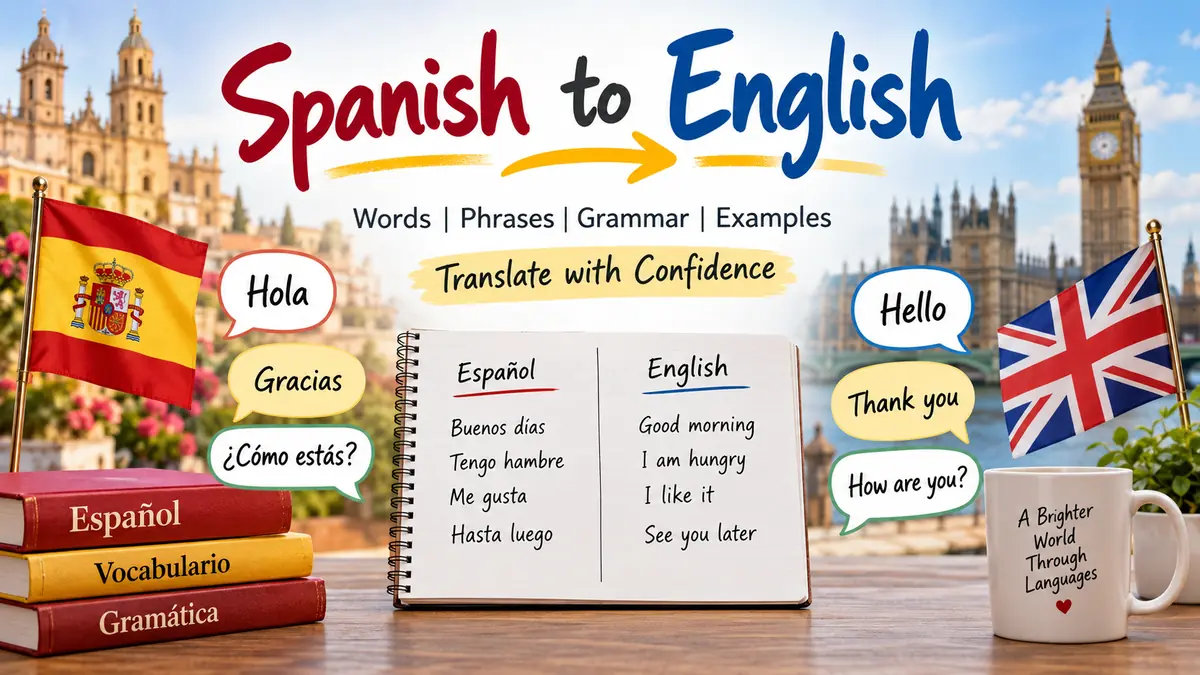
Translating Spanish can look deceptively simple. You recognize the vocabulary, replace each Spanish word with an English equivalent, and expect the sentence to work. Then you meet expressions such as tener hambre, me gusta, hace calor, or estar de acuerdo and discover that literal translation can produce awkward—or completely wrong—English.
spanish to english translation means converting Spanish words, phrases, sentences, or documents into natural English while preserving their original meaning, context, tone, and intent. Accurate translation requires more than replacing individual words: grammar, verb conjugation, idioms, regional vocabulary, pronunciation, and cultural context can all affect the correct English equivalent.
Modern translators make basic translation remarkably quick, but understanding how Spanish and English differ helps you recognize errors and produce much more natural results.
How spanish to english Translation Works
Spanish and English share thousands of related words, but they are structurally different languages. Good translation therefore focuses on meaning rather than word-for-word substitution.
Consider:
Tengo hambre.
A literal rendering might suggest “I have hunger.”
Natural English is:
I am hungry.
The meaning stays the same even though the grammatical construction changes.
Another example is:
Me gusta el café.
The natural translation is:
I like coffee.
Trying to preserve the Spanish structure mechanically would make the English sentence unnecessarily confusing.
This distinction between literal translation and meaning-based translation is fundamental.
Translation Is More Than Vocabulary
A translator usually has to consider several things at once:
- the dictionary meaning of each word
- grammatical structure
- verb tense and conjugation
- singular and plural forms
- gender where relevant
- idiomatic expressions
- regional Spanish vocabulary
- punctuation
- tone and formality
- the wider context of the sentence
A Spanish-English dictionary is excellent for understanding individual words. Full sentences, however, usually require contextual interpretation.
That is why established resources combine translations with examples, pronunciation, phrases, grammar information, and other language-learning material. SpanishDictionary, for example, provides conjugations, examples, pronunciation, and regional translations, while Collins includes extensive translations, idioms, examples, and pronunciation resources.
Spanish to English Words and Everyday Phrases
Learning frequently used vocabulary provides a useful foundation for both translation and conversation.
| Spanish | English |
|---|---|
| Hola | Hello |
| Adiós | Goodbye |
| Sí | Yes |
| No | No |
| Gracias | Thank you |
| Por favor | Please |
| Perdón | Sorry / Excuse me |
| Agua | Water |
| Comida | Food |
| Casa | House / Home |
| Amigo | Friend |
| Familia | Family |
| Trabajo | Work / Job |
| Escuela | School |
| Libro | Book |
| Dinero | Money |
| Tiempo | Time / Weather |
| Día | Day |
| Noche | Night |
| Bueno | Good |
Notice that one Spanish word can have multiple English meanings.
Tiempo, for instance, can refer to time or weather depending on context.
That is precisely why translating isolated vocabulary without seeing the surrounding sentence can be unreliable.
Common Spanish Sentences in English
| Spanish | Natural English |
|---|---|
| Buenos días. | Good morning. |
| Buenas noches. | Good evening / Good night. |
| ¿Cómo estás? | How are you? |
| Estoy bien. | I am fine. |
| Muchas gracias. | Thank you very much. |
| No entiendo. | I don’t understand. |
| ¿Hablas inglés? | Do you speak English? |
| ¿Dónde está el baño? | Where is the bathroom? |
| ¿Cuánto cuesta? | How much does it cost? |
| Necesito ayuda. | I need help. |
| Tengo hambre. | I am hungry. |
| Tengo sed. | I am thirsty. |
| Hasta mañana. | See you tomorrow. |
| Nos vemos. | See you. |
| ¿Qué significa esto? | What does this mean? |
These examples demonstrate why phrases are often more useful than individual vocabulary items. You see not only what a word means but how Spanish speakers actually construct an idea.
Why Word-for-Word Spanish Translation Often Fails
One of the biggest mistakes beginners make is assuming that every Spanish word has one fixed English equivalent.
Languages do not work that way.
Word Order Can Change
Spanish permits sentence structures that sound unnatural when copied directly into English.
For example:
Me compré un coche nuevo.
Natural English:
I bought myself a new car.
You should preserve the message rather than mechanically reproduce the original sequence of words.
Spanish also commonly places adjectives after nouns:
una casa grande
English normally reverses that order:
a big house
There are exceptions, and adjective placement in Spanish can sometimes affect meaning or emphasis.
Subjects May Be Omitted in Spanish
English usually requires an explicit subject.
Spanish frequently does not because the verb conjugation already provides information about who performs the action.
Estoy cansado.
means:
I am tired.
The word yo does not have to appear because estoy already indicates the first-person singular form.
Similarly:
Queremos comer.
becomes:
We want to eat.
The translator has to supply the English subject even though Spanish leaves it unstated.
Spanish Verb Conjugation and English Translation
Verbs are one of the most important parts of spanish to english translation.
Spanish verbs change form according to person, number, tense, and mood. A dictionary may tell you that hablar means “to speak,” but actual sentences contain forms such as:
- hablo
- hablas
- habla
- hablamos
- hablaron
- hablaba
- hablaré
- hablaría
You therefore need to identify the conjugated form before choosing the English translation.
For example:
Hablo español.
means:
I speak Spanish.
While:
Hablamos español.
means:
We speak Spanish.
And:
Hablé con María.
means:
I spoke with María.
The base verb is the same, but person and tense change.
Resources such as SpanishDictionary specifically provide Spanish verb conjugations alongside dictionary and translation features, which can be useful when identifying unfamiliar forms.
Ser vs. Estar: Why Both Can Mean “To Be”
Few Spanish grammar topics demonstrate the limitations of direct translation better than ser and estar.
Both can translate as forms of English “to be,” but they are not interchangeable.
Compare:
Soy estudiante.
I am a student.
Estoy cansado.
I am tired.
Broadly, ser is associated with identity, characteristics, origin, profession, and similar concepts, while estar frequently describes states, conditions, and locations. The complete distinction has additional rules and exceptions.
Context is essential because English hides this difference by using the same verb.
Spanish Gender and Articles
Spanish nouns have grammatical gender.
Common definite articles include:
| Spanish | Typical English |
|---|---|
| el | the |
| la | the |
| los | the |
| las | the |
English does not normally preserve these gender distinctions.
For example:
el libro → the book
la mesa → the table
The grammatical gender disappears in English.
Indefinite articles work similarly:
un libro → a book
una casa → a house
Adjectives may also change according to gender and number in Spanish.
niño pequeño → small boy
niña pequeña → small girl
niños pequeños → small boys
English adjectives generally remain unchanged.
Translating Spanish Idioms into Natural English
Idioms are expressions whose meaning cannot always be understood by translating every word separately.
This is one of the most common sources of poor machine and beginner translations.
Consider:
Estar como una cabra.
A literal translation involving a goat would usually miss the intended meaning. Depending on context, the expression describes someone as being crazy or eccentric.
Other useful examples include:
| Spanish expression | Natural English meaning |
|---|---|
| Costar un ojo de la cara | Cost an arm and a leg |
| Estar de acuerdo | To agree |
| Tener razón | To be right |
| Tener prisa | To be in a hurry |
| Tener sueño | To be sleepy |
| Echar de menos | To miss someone/something |
| De vez en cuando | From time to time |
| Poco a poco | Little by little |
| Dar una mano | Give someone a hand |
The goal is semantic equivalence: preserve what the speaker means rather than the literal imagery whenever the English equivalent uses a different expression.
False Friends Can Cause Translation Mistakes
Spanish and English contain many words that look similar because of their shared linguistic history. Some are genuine cognates.
Others are false friends.
For example, Spanish pretender does not normally mean the English verb pretend. Depending on context, it can mean intend, try, seek, or claim. Larousse specifically highlights this false-friend distinction in its Spanish-English dictionary material.
Another familiar example is:
embarazada
It means pregnant, not embarrassed.
Similarly:
actualmente
usually means currently, not actually.
When a Spanish word looks suspiciously familiar, checking a bilingual dictionary can prevent an easy mistake.
Regional Spanish Can Change the English Translation
Spanish is spoken across a vast geographic area, so vocabulary varies substantially between countries and regions.
A word used in Spain may differ from the everyday term used in Mexico, Argentina, Colombia, Puerto Rico, or another Spanish-speaking community.
Take the English word car.
Depending on location, you may encounter terms such as:
- coche
- carro
- auto
- automóvil
They can refer to the same basic concept but differ in regional preference and context.
The same issue appears with everyday objects, food, clothing, transportation, slang, and informal expressions.
SpanishDictionary explicitly offers regional translations, including distinctions associated with Spain, Mexico, and other Spanish-speaking countries.
Quick takeaway: When a translation looks strange even though every individual word seems correct, check the region. You may be dealing with local vocabulary, slang, or an idiom rather than standard textbook Spanish.
How to Translate Spanish to English Accurately
For everyday material, a simple translation process works well.
- Read the entire sentence first. Do not immediately translate individual words.
- Identify the main verb. Determine its infinitive, person, tense, and mood when relevant.
- Find the subject. Remember that Spanish frequently omits subject pronouns.
- Identify phrases rather than isolated words. Expressions such as tener que or darse cuenta function as units.
- Check unfamiliar vocabulary in a Spanish-English dictionary.
- Translate the meaning into English.
- Rewrite unnatural word order.
- Check idioms and regional vocabulary.
- Read the English sentence independently. Ask whether an English speaker would naturally say it that way.
- Verify important translations separately.
The final step matters most when translating legal, medical, academic, financial, immigration, or professional documents. A fluent-looking machine translation is not proof that the underlying meaning is correct.
Dictionary vs. Online Translator: Which Should You Use?
A bilingual dictionary and an automatic translator solve different problems.
| Feature | Spanish-English Dictionary | Machine Translator |
|---|---|---|
| Individual words | Excellent | Good |
| Definitions | Excellent | Limited |
| Full sentences | Limited to examples | Excellent |
| Verb forms | Often detailed | Usually interpreted automatically |
| Idioms | Often explained | Usually translated contextually |
| Pronunciation | Often available | Often available |
| Long text | Slow | Fast |
| Context explanation | Strong | Variable |
| Learning vocabulary | Excellent | Useful |
| Instant translation | Limited | Excellent |
A dictionary is particularly useful when you want to understand why something means what it does.
A translator is useful when you need the meaning of a complete passage quickly.
For difficult sentences, using both can be more effective than relying exclusively on either one.
Using Online spanish to english Translators
Several major language resources support Spanish-English translation.
Cambridge Dictionary provides a Spanish-English translator alongside links to dictionary entries. Its Spanish-English dictionary draws on bilingual dictionary resources and supplies translations of thousands of words.
SpanishDictionary.com combines translation with dictionary entries, examples, verb conjugation, pronunciation, vocabulary, grammar, and regional usage. Its translation interface also emphasizes comparing contextual translations rather than treating translation as simple word replacement.
DeepL Translator supports text translation as well as document translation for formats including PDF, Word, and PowerPoint.
Collins Spanish Dictionary provides extensive bilingual dictionary coverage, phrases, idioms, examples, and pronunciation material. Collins states that its online Spanish dictionary contains more than 420,000 translations.
The right resource depends on the task. A short message, an unfamiliar verb, a regional expression, and a long document present different translation problems.
How to Check Whether a Translation Is Correct
A translation can be grammatically correct yet still communicate the wrong meaning.
Use three checks.
1. Meaning Check
Ask:
Does the English sentence communicate the same idea as the Spanish sentence?
Do not worry initially about matching every word.
2. Naturalness Check
Read the English result without looking at the Spanish original.
Would an English speaker actually phrase the idea that way?
For example:
Tengo 25 años.
Literal:
I have 25 years.
Natural:
I am 25 years old.
The literal version is understandable but incorrect in normal English.
3. Context Check
Look beyond the sentence.
The same word can change meaning depending on the situation.
For example, banco may mean a bank in a financial context, but it can also refer to a bench.
Likewise, capital might concern money or a capital city.
Context determines which definition belongs in the translation.
Spanish Pronunciation and Translation
Pronunciation does not normally change the written meaning of a Spanish word, but learning pronunciation can make dictionaries and translation resources more useful for spoken communication.
Spanish spelling is relatively systematic compared with English. Once you understand its basic sound patterns, unfamiliar words often become easier to pronounce.
Several letters deserve special attention.
Spanish J
The Spanish j does not sound like the English j in job. It typically has a stronger breathy or guttural sound, though pronunciation varies by region.
Spanish H
The letter h is normally silent.
For example:
hola
begins with a vowel sound rather than an English-style h sound.
Spanish Ñ
ñ represents a distinct sound, roughly comparable to the ny sound in the English word canyon.
niño → boy / child
The accent and special characters matter in written Spanish as well.
Accent Marks Can Affect Meaning
Spanish accent marks are not decorative.
They can identify stress, distinguish words, and provide grammatical information.
Compare:
| Spanish | English |
|---|---|
| si | if |
| sí | yes |
| tu | your |
| tú | you |
| el | the |
| él | he |
| mi | my |
| mí | me |
| que | that / which |
| qué | what |
Missing an accent does not always make a sentence impossible to understand, but it can change meaning.
Question words commonly carry written accents in interrogative uses:
¿Qué quieres?
What do you want?
¿Dónde estás?
Where are you?
¿Cómo te llamas?
What is your name?
Good translation software usually handles accents correctly, but learners should still understand their function.
Common Mistakes When Translating Spanish into English
Translating Every Word Separately
This destroys idioms and often creates incorrect English syntax.
Translate complete ideas whenever possible.
Ignoring Verb Tense
Hablo, hablé, hablaba, and hablaré all derive from hablar, but they do not describe the same time or aspect.
Assuming Similar-Looking Words Mean the Same Thing
False friends such as embarazada, actualmente, and pretender can completely change a sentence.
Ignoring Regional Usage
A translation that works perfectly for Spanish from one country may miss slang or vocabulary from another.
Keeping Spanish Word Order
The English translation should sound like English, not Spanish with English vocabulary inserted into it.
Trusting Machine Translation Without Review
Modern translation systems can produce impressively fluent sentences. Fluency and accuracy, however, are different things.
Names, specialized terminology, abbreviations, idioms, ambiguous words, and culturally specific references still deserve manual checking.
Translating Spanish Documents into English
Long documents require more care than short phrases because terminology must remain consistent across paragraphs.
Start by determining what kind of document you have:
- academic
- business
- personal
- technical
- medical
- financial
- legal
- government
- immigration
Then identify specialized terminology before translating the full text.
For an ordinary personal document, machine translation may be sufficient to understand the general meaning. For an official document, the receiving institution may require a professional or certified translation rather than an automatically generated version.
Never assume that a translated document satisfies an institution’s requirements simply because the English appears accurate.
How AI and Machine Translation Handle Spanish
Modern machine translation systems generally analyze sentences in context rather than replacing every word independently.
This helps them handle:
- grammatical relationships
- sentence structure
- common idioms
- verb forms
- contextual vocabulary
- natural word order
Some services now support more than plain text. DeepL, for example, offers text, file, and speech-related translation modes and supports document workflows.
SpanishDictionary also describes its translation experience as AI-powered and allows users to compare different translation results.
Even sophisticated systems can struggle when context is missing. A single Spanish word might have several legitimate English translations, and an algorithm cannot always determine the intended one from an isolated fragment.
That is why complete sentences generally produce better results than disconnected words.
Practical Example of Spanish to English Translation
Consider:
Ayer fui al mercado porque necesitaba comprar comida para la cena.
Breaking it into meaningful components:
- Ayer — yesterday
- fui — I went
- al mercado — to the market
- porque — because
- necesitaba — I needed
- comprar comida — to buy food
- para la cena — for dinner
Natural translation:
Yesterday I went to the market because I needed to buy food for dinner.
Notice that understanding the conjugated verbs fui and necesitaba is more valuable than mechanically replacing each individual word.
Now consider:
Hace dos años que vivo aquí.
A mechanical translation might produce awkward English because Spanish expresses elapsed time differently.
Natural English would be:
I have lived here for two years.
This is the central lesson of accurate translation: preserve meaning first and structure second.
How to Improve Your Spanish-English Translation Skills
If you regularly translate Spanish, avoid memorizing endless isolated word pairs.
Learn vocabulary inside sentences.
Instead of memorizing:
cuenta = account
learn phrases such as:
cuenta bancaria — bank account
darse cuenta — to realize
tener en cuenta — to take into account
You immediately see how the surrounding words change the meaning.
The same approach works for verbs.
Instead of learning only:
hacer = to do / make
study expressions:
hacer ejercicio — to exercise
hacer una pregunta — to ask a question
hacer frío — to be cold
hacer calor — to be hot
Real language is built from patterns, collocations, phrases, and context—not isolated dictionary entries.
Use Example Sentences
Example sentences reveal information that a simple definition cannot.
They show:
- natural word order
- prepositions
- verb tense
- article usage
- common collocations
- register
- context
This is why established dictionaries emphasize real usage examples. Cambridge describes its learner dictionaries as corpus-informed, while Collins and SpanishDictionary also provide examples and phrase-level information.
When Human Translation Matters
Automatic translation is useful for understanding everyday messages, websites, signs, emails, and study material.
Human review becomes more valuable as the consequences of an error increase.
That is especially relevant for:
- contracts
- court documents
- medical information
- immigration documents
- academic records
- technical manuals
- published material
- marketing copy
- sensitive business communication
A professional translator can consider ambiguity, terminology, cultural nuance, audience, and tone in ways that an instant translation result may not reliably capture.
For casual communication, that level of precision may be unnecessary. For official or high-stakes material, it can be essential.
Final Thoughts on spanish to english Translation
Accurate spanish to english translation is not about matching Spanish and English words one by one. It is about carrying the original meaning into natural English while accounting for grammar, verb conjugation, idioms, regional vocabulary, false friends, accent marks, tone, and context.
For a quick sentence, a modern translator can provide an excellent starting point. For vocabulary and grammar, use a reliable bilingual dictionary with definitions and examples. When a sentence sounds unnatural, examine the complete phrase instead of individual words.
The most useful habit is simple: translate the meaning, then make sure the result sounds like something an English speaker would naturally say.
