

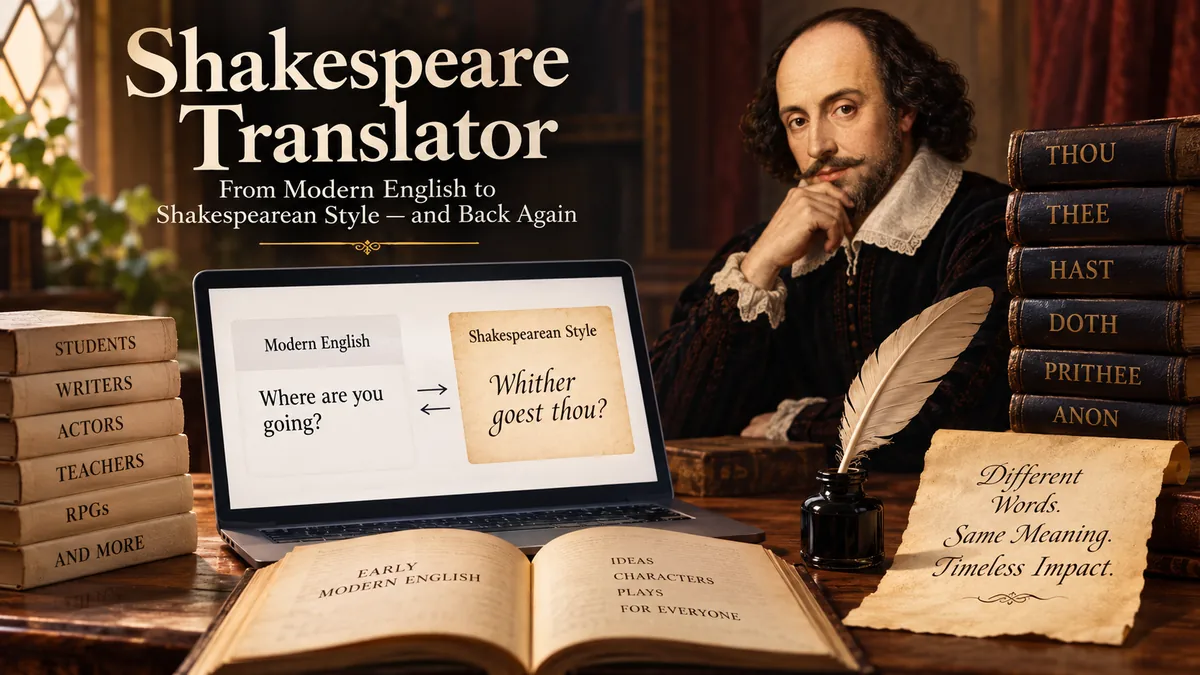
A shakespeare translator can make an ordinary sentence sound as though it belongs on an Elizabethan stage—or help turn difficult Shakespearean wording into language a modern reader can understand. Yet convincing Shakespearean English involves far more than replacing “you” with “thou” and scattering “forsooth” through every sentence.
A shakespeare translator converts modern English into Shakespeare-inspired Early Modern English, or translates Shakespearean wording into clearer modern English. Good results account for pronouns such as thou and thee, verb forms such as art, hast, and doth, archaic vocabulary, sentence structure, context, rhythm, and dramatic tone.
Understanding those elements makes any translator more useful, especially for students, writers, actors, teachers, role-playing games, themed invitations, and readers trying to understand William Shakespeare’s plays.
What Is a shakespeare translator?
A shakespeare translator is a language-conversion tool that rewrites contemporary English using vocabulary and grammatical features associated with William Shakespeare’s period.
Most online tools work in one or both of these directions:
- Modern English → Shakespearean-style English
A sentence such as “Where are you going?” might become “Whither goest thou?” - Shakespearean English → modern English
A line containing unfamiliar words, pronouns, or inverted syntax is rewritten in straightforward contemporary language.
Current translator tools commonly emphasize thou, thee, thy, thine, art, hast, hath, dost, doth, prithee, ere, and anon. Some use simple substitution rules, while more sophisticated versions consider entire sentences and attempt to preserve meaning, tone, and grammatical relationships.
That distinction matters because Shakespeare did not write by swapping modern words for archaic equivalents. His language relied on grammar, rhetoric, imagery, rhythm, character, wordplay, and flexible sentence construction.
Is Shakespearean English actually Old English?
No.
Calling Shakespearean language “Old English” is one of the most common misunderstandings surrounding the subject.
William Shakespeare wrote during the Early Modern English period. Old English belongs to a much earlier stage of the language, while Middle English sits between Old English and Early Modern English.
A useful simplified timeline is:
| Language period | Approximate era | Famous association |
|---|---|---|
| Old English | c. 450–1100 | Beowulf |
| Middle English | c. 1100–1500 | Geoffrey Chaucer |
| Early Modern English | c. 1500–1700 | William Shakespeare |
| Modern English | c. 1700 onward | Contemporary English |
Shakespearean English is therefore far closer to the English spoken today than Anglo-Saxon Old English. Modern readers can recognize much of Shakespeare’s vocabulary even when his syntax or historical meanings cause difficulty. The Folger Shakespeare Library notes that much of Shakespeare’s vocabulary remains familiar, although some words disappeared and others changed meaning over the intervening four centuries.
Quick Takeaway: A Shakespeare translator is really an Early Modern English style translator or interpreter, not an Old English translator.
How a shakespeare translator Changes Modern English
A convincing shakespeare translator needs to change several features at the same time. Pronouns receive most of the attention, but verb agreement, vocabulary, syntax, rhythm, and context matter just as much.
Thou, thee, thy, and thine
Modern English uses “you” for several grammatical roles. Earlier English retained more distinctions.
| Shakespearean form | Modern meaning | Typical function | Example |
|---|---|---|---|
| thou | you | subject | Thou art kind. |
| thee | you | object | I thank thee. |
| thy | your | possessive determiner | Thy sword is ready. |
| thine | yours / your | possessive | The victory is thine. |
| ye | you | historically plural/subject form | Ye know the truth. |
The key rule is simple: thou performs an action; thee generally receives it.
So:
“You love me” → “Thou lovest me.”
“I love you” → “I love thee.”
Randomly replacing every instance of “you” with “thee” produces grammatical errors. This is one reason basic word-replacement converters often sound less convincing than context-sensitive tools.
Art, hast, hath, dost, and doth
Pronouns also affect verbs.
Common forms include:
- thou art → you are
- thou hast → you have
- thou dost → you do
- he/she hath → he/she has
- he/she doth → he/she does
With other verbs, the second-person singular may take an -st or -est ending.
For example:
“You know the answer.”
becomes:
“Thou knowest the answer.”
Likewise:
“You speak wisely.”
may become:
“Thou speakest wisely.”
A good modern English to Shakespearean converter handles the relationship between the pronoun and verb instead of modifying each word independently.
Archaic and period-flavored vocabulary
Certain words immediately create an Early Modern atmosphere:
| Word | Modern meaning |
|---|---|
| anon | soon |
| ere | before |
| hence | from here / away |
| hither | to here |
| thither | to there |
| whither | to where |
| prithee | please / I pray you |
| morrow | following day / morning |
| methinks | it seems to me |
| perchance | perhaps |
| behold | look / see |
| fare | get along / do |
| wherefore | why |
One particularly famous mistake is treating wherefore as “where.”
In Shakespearean usage, wherefore means why. Juliet’s question about Romeo asks why he must be Romeo—particularly why he bears the name and family identity that makes their relationship impossible—not where he is standing.
That is exactly the kind of contextual meaning a simple dictionary substitution can miss.
Modern English to Shakespearean Translation Examples
Seeing complete sentences makes the patterns easier to understand.
Everyday greeting
Modern English:
Hello, how are you today?
Shakespearean style:
Good morrow! How dost thou fare this day?
Here, “good morrow” provides the older greeting while “dost thou fare” replaces the modern construction “are you doing.”
Asking someone to wait
Modern English:
Please wait here until I return.
Shakespearean style:
Prithee, tarry here until I return.
“Tarry” means to remain or wait, while prithee functions as a polite request.
Romantic language
Modern English:
I love you more than words can describe.
Shakespearean style:
I love thee beyond what words may tell.
Notice that a natural translation does not need to replace every modern word. The changed pronoun, phrasing, and rhythm already create a theatrical effect.
Asking a question
Modern English:
Where are you going?
Shakespearean style:
Whither goest thou?
This demonstrates three simultaneous changes: where becomes whither, the verb changes to goest, and you becomes thou.
Expressing frustration
Modern English:
Why won’t you tell me the truth?
Shakespearean style:
Wherefore wilt thou not tell me the truth?
A translator that simply replaces vocabulary may produce something understandable, but grammatical agreement makes the result considerably more convincing.
Shakespearean English to Modern English
The reverse direction is often more useful for students.
Shakespeare’s plays can be challenging because unfamiliar vocabulary is only part of the problem. Readers also face unusual sentence order, omitted words, compressed poetic expressions, puns, figurative language, and words whose meanings have shifted over time.
The Folger Shakespeare Library specifically recommends learning to untangle unusual sentence structures, poetic compression, omissions, and wordplay when reading Shakespeare.
Consider this invented Shakespearean-style sentence:
“Prithee, tell me whither thou goest ere the sun descend.”
A straightforward modern rendering would be:
“Please tell me where you’re going before the sun goes down.”
The purpose is not to preserve an old-fashioned voice. It is to make the meaning immediately clear.
Why sentence order matters
English depends heavily on word order, but Shakespeare often rearranged or separated sentence elements for rhythm, emphasis, characterization, and dramatic effect.
A reader may therefore understand every individual word and still struggle with the sentence.
Folger’s guidance on Romeo and Juliet explains that rearranging words into a more familiar modern order can improve clarity, although doing so may sacrifice some rhythm or emphasis.
For study purposes, that leads to a useful method:
- Identify the subject.
- Locate the main verb.
- Find the object or complement.
- Temporarily remove interruptions.
- Rearrange the core sentence into modern order.
- Define unfamiliar words.
- Put the line back into its dramatic context.
This usually teaches you more than a word-for-word conversion.
How to Use a shakespeare translator Accurately
The best results begin with clear input.
1. Translate complete sentences
A word such as “you” gives a translator very little grammatical context. A complete sentence tells it whether “you” acts as a subject, object, or possessive relationship.
Instead of entering:
“You”
enter:
“You have forgotten your promise.”
That allows a translator to make more intelligent decisions about thou, hast, and thy.
2. Keep related sentences together
For dialogue or paragraphs, context helps establish who is speaking to whom.
This is particularly useful when pronouns appear repeatedly.
However, an entire scene may contain too many shifts in speaker, tone, metaphor, and syntax for an automated converter to process elegantly. Translating a few connected sentences at a time often produces results that are easier to review. Current translator tools similarly recommend preserving enough context while breaking very long passages into manageable sections.
3. Preserve punctuation and line breaks
If you are working with dialogue or verse, punctuation and lineation can affect interpretation.
Keep meaningful pauses, quotation marks, speaker divisions, and line breaks intact.
4. Compare meaning, not just vocabulary
After translation, ask:
Does this sentence still communicate the same thought?
A result may sound wonderfully theatrical while subtly changing the original message.
Meaning should come first.
5. Read Shakespearean-style output aloud
Shakespeare wrote drama to be performed.
Reading a generated sentence aloud immediately exposes awkward phrasing, excessive archaic vocabulary, unnatural repetition, and rhythm problems.
6. Edit instead of blindly accepting the first result
Machine-generated Shakespearean text is best treated as a draft.
If the output sounds like someone attached -eth to every available verb, simplify it.
Convincing Shakespeare-inspired writing often uses fewer archaic words than people expect.
Quick Takeaway: Give the translator grammatical context, preserve the original meaning, and read the output aloud before using it.
What Makes Shakespearean Writing Sound Authentic?
Pronouns are only the surface.
If you are writing dialogue rather than merely converting vocabulary, several deeper techniques produce a more convincing Shakespeare-inspired voice.
Strong imagery
Shakespearean drama frequently communicates emotion through images rather than plain statements.
Compare:
“I am very sad.”
with:
“Sorrow sits heavy upon my heart.”
The second line does not depend on thee, thou, or forsooth. Its metaphor creates the dramatic quality.
Contrast
Oppositions such as these naturally create rhetorical tension:
- love and hate
- light and darkness
- life and death
- sweetness and bitterness
- loyalty and betrayal
- appearance and reality
Shakespeare’s plays repeatedly build arguments and emotions through contrasts.
Flexible sentence structure
Modern English might say:
“What news are you bringing?”
A more theatrical version could become:
“What news bringest thou?”
The change is small but effective.
Folger’s language notes point out that Shakespeare frequently shifts normal sentence arrangements for rhythm or emphasis, so syntax is a genuine part of the style rather than decorative archaism.
Rhythm
Not every Shakespearean sentence is written in iambic pentameter, and not every line should be forced into it.
Iambic pentameter typically consists of five metrical feet built around alternating unstressed and stressed syllables. Shakespeare used it extensively in verse, but his plays also contain prose and purposeful variations in meter.
For casual Shakespeare-style writing, natural rhythm matters more than mechanically counting ten syllables.
Can a shakespeare translator Reproduce Shakespeare Exactly?
No automated shakespeare translator can reliably reproduce William Shakespeare’s writing exactly.
That is not a failure of the concept; it reflects how complex literary style is.
Shakespeare’s language involves:
- character-specific speech
- social relationships
- rhetorical devices
- puns and double meanings
- metaphor
- dramatic context
- verse and prose
- meter
- sound patterns
- historical meanings
- flexible syntax
Some current translators explicitly describe their results as Shakespeare-inspired or Early Modern-style drafts rather than genuine historical quotations. Others disclose that they primarily use pattern or vocabulary substitution.
That distinction is crucial.
A generated sentence such as:
“Thou art the brightest star within my heaven”
may sound Shakespearean, but that does not mean William Shakespeare wrote it.
Can you cite translator output as Shakespeare?
No.
If you are writing an essay, academic paper, article, or presentation, never place generated Shakespeare-style text in quotation marks and attribute it to Shakespeare.
Use the actual play, poem, or sonnet and verify the wording against a reliable edition.
A translator can help explain a passage or experiment with style. It cannot turn generated language into an authentic quotation.
Shakespeare Translator for Students and Readers
For students, the most useful function is often not “make this sound old.”
It is:
What does this line actually mean?
A Shakespearean-to-modern-English converter can provide a useful first interpretation when reading works such as Hamlet, Macbeth, Romeo and Juliet, Othello, King Lear, A Midsummer Night’s Dream, or the sonnets.
But use the translated version alongside the original.
A better study workflow
Read the original passage once without stopping.
Then:
- Identify unfamiliar vocabulary.
- Translate or paraphrase the sentence.
- Examine unusual word order.
- Identify metaphors, puns, or imagery.
- Consider who is speaking.
- Ask what the character wants at that moment.
- Return to the original wording.
This prevents the modern translation from replacing the literature itself.
The Folger Shakespeare Library notes that actors effectively perform this same interpretive work: they study difficult language until its meaning and dramatic function become clear.
A plain-English version provides the doorway. The original text contains the literary experience.
Common Mistakes When Writing Shakespearean English
Most weak translations fail in predictable ways.
Replacing every “you” with “thee”
Remember:
thou = subject
thee = object
“I see you” becomes “I see thee,” not “I see thou.”
Using “thou” without changing the verb
“You are” does not become “thou are.”
It becomes:
“Thou art.”
Likewise:
“You have” → “Thou hast.”
“You do” → “Thou dost.”
Adding -eth everywhere
The ending -eth is associated primarily with certain third-person singular verb forms.
For example:
“He speaks” → “He speaketh.”
It should not simply be attached to random verbs for atmosphere.
Assuming “wherefore” means “where”
It means why.
For location, words such as where, whither, or hither may be appropriate depending on meaning.
Using too many archaic words
A sentence overloaded with forsooth, verily, prithee, methinks, hark, and anon quickly turns into parody.
Shakespeare’s writing contains plenty of vocabulary that remains normal English today. Folger notes that most of his vocabulary is still in use, despite several centuries of linguistic change.
Treating Elizabethan English as a costume
The strongest Shakespeare-inspired writing focuses on thought, imagery, conflict, and rhythm first.
Archaic vocabulary comes second.
When a Shakespeare Translator Is Most Useful
A translator can be genuinely helpful when its limitations are understood.
Common uses include:
- understanding difficult passages from Shakespeare’s plays
- converting modern English into theatrical dialogue
- practicing Early Modern English pronouns and verbs
- creating drama-class exercises
- writing Renaissance-themed invitations
- developing fantasy or role-playing dialogue
- experimenting with character voices
- paraphrasing difficult quotations for study notes
- comparing historical and modern English
- exploring how language changes over time
Actors may use plain-English paraphrases to clarify a character’s intention before returning to the original script. Writers can use generated Shakespearean wording as raw material before editing it for consistency and rhythm.
Teachers can also compare automated output with authentic passages and ask students to identify where the imitation succeeds or fails.
That exercise reveals something important: Shakespeare’s style cannot be reduced to thee, thou, and hath.
Shakespearean English vs Modern English at a Glance
| Feature | Modern English | Shakespearean/Early Modern style |
|---|---|---|
| Subject pronoun | you | thou |
| Object pronoun | you | thee |
| Possessive | your/yours | thy/thine |
| “You are” | you are | thou art |
| “You have” | you have | thou hast |
| “You do” | you do | thou dost |
| “He has” | he has | he hath |
| “He does” | he does | he doth |
| Before | before | ere |
| Soon | soon | anon |
| Perhaps | perhaps | perchance |
| Please | please | prithee |
| Why | why | wherefore |
| To where | where | whither |
These correspondences are useful, but they are guidelines rather than a formula for reproducing Shakespeare’s complete literary style.
Getting Better Results From a shakespeare translator
The most effective way to use a shakespeare translator is to decide what you want from it before translating.
If your goal is comprehension, prioritize a plain modern paraphrase and preserve the meaning of the original passage.
If your goal is creative writing, pay attention to pronouns, verb agreement, imagery, rhythm, and dramatic voice rather than piling up obsolete vocabulary.
If your goal is academic study, use the tool as an aid—not as the final authority. Verify quotations against an authoritative edition, consider the entire scene, and remember that Shakespeare’s words can carry historical meanings, jokes, double meanings, or rhetorical effects that a simple converter may flatten.
A good translator can turn “Please tell me where you’re going” into something resembling “Prithee, tell me whither thou goest.” Understanding why those changes work is far more valuable than memorizing the conversion.
That is ultimately what makes a shakespeare translator useful: not pretending that modern software can become the Bard, but giving readers and writers a practical bridge between modern English and the distinctive language of Shakespeare’s stage.
