

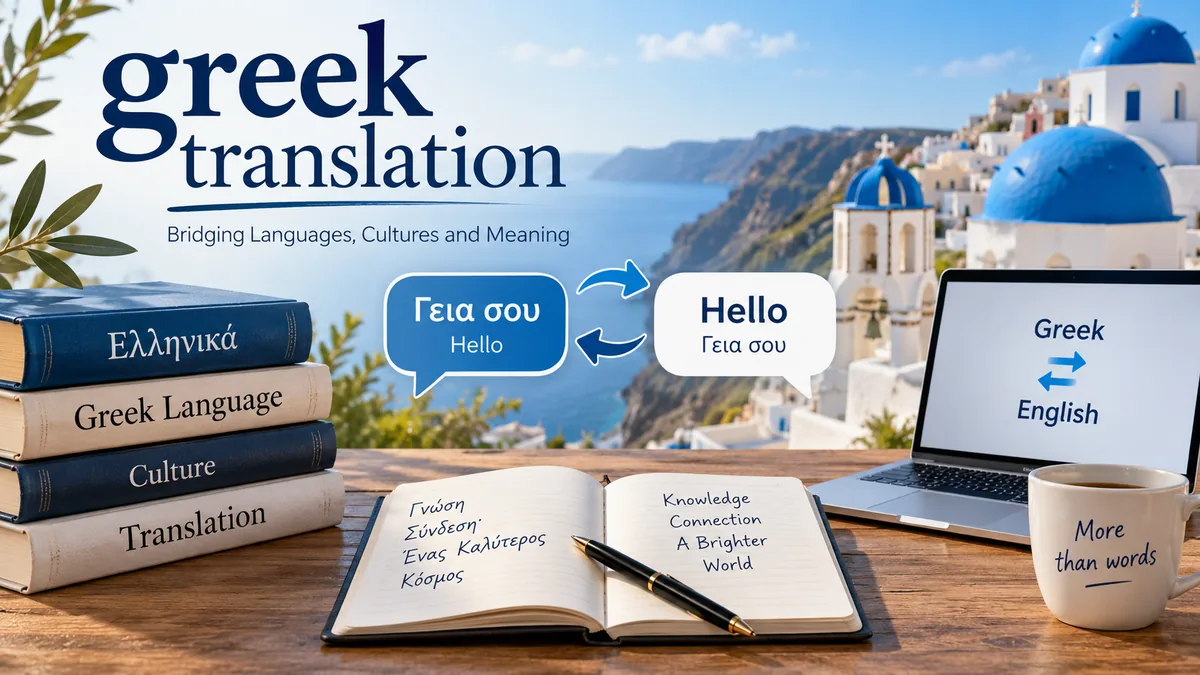
A single Greek word can change meaning depending on its ending, grammatical role, context, and even the speaker’s tone. That is why greek translation involves more than replacing Greek words with their nearest English equivalents.
Greek translation converts written or spoken Greek into another language, most commonly English, while preserving meaning, grammar, context, and tone. Accurate translation requires understanding the Greek alphabet, inflection, sentence structure, idioms, and cultural usage. Modern Greek and Ancient Greek also require different approaches because their vocabulary and grammar are not identical.
This guide explains how Greek-to-English and English-to-Greek translation works, where automatic translators perform well, where they struggle, and how to produce more natural results.
What Does greek translation Mean?
Greek translation is the process of transferring meaning between Greek and another language. For English-speaking users, this normally means one of two directions:
- Greek to English translation
- English to Greek translation
The task can involve a single word, everyday phrase, email, document, website, academic passage, subtitle, image, or spoken conversation.
Modern Greek is the principal language used in contemporary Greece and is also an official language of Cyprus. It belongs to the Hellenic branch of the Indo-European language family and uses its own alphabet rather than the Latin alphabet used for English.
That difference in writing system is immediately visible:
| English | Greek | Approximate Pronunciation |
|---|---|---|
| Hello | Γεια σου | ya soo |
| Good morning | Καλημέρα | kali-ME-ra |
| Thank you | Ευχαριστώ | ef-ha-ri-STO |
| Please / You’re welcome | Παρακαλώ | para-ka-LO |
| How are you? | Πώς είσαι; | pos EE-se |
| Yes | Ναι | ne |
| No | Όχι | O-hi |
Pronunciation guides are only approximations. They help travelers and beginners, but they do not replace learning actual Greek sounds.
How Greek to English Translation Works
A Greek-to-English translator begins with Greek text and attempts to determine its meaning before expressing that meaning naturally in English.
At a basic level, the process looks simple:
- Identify the Greek words.
- Analyze their grammatical forms.
- determine how the words relate to one another.
- Interpret the sentence in context.
- Produce an equivalent English sentence.
- Review the result for meaning, tone, and natural English usage.
The difficult part is steps three through six.
Greek Is an Inflected Language
English often relies heavily on word order. Greek communicates substantial grammatical information through changes to word forms.
Nouns, adjectives, articles, pronouns, and verbs can change according to their grammatical function. Greek uses grammatical gender and cases, while verbs encode information such as person and number.
For example, a translator cannot always determine the best English equivalent of a Greek word simply by finding it in a dictionary. Its ending and relationship with surrounding words matter.
This is one reason literal word-for-word translation can produce awkward results. Greek and English do not organize every sentence in the same way, and automated word substitution may fail to create natural English.
Context Determines Meaning
Consider the Greek word:
παρακαλώ
Depending on context, it can correspond to expressions such as:
- please
- you’re welcome
- pardon?
- go ahead
A dictionary entry alone therefore does not always tell you which English phrase belongs in a sentence.
The translator must ask what the speaker is actually doing with the word.
The same principle applies to idioms, informal expressions, professional terminology, and words with several possible definitions.
Word Order Is Not Always Parallel
Greek allows more flexibility in sentence structure than English in many situations because grammatical endings help indicate relationships between words.
A sentence translated mechanically in its original order may consequently sound unnatural in English.
Good translation preserves the meaning, not necessarily the original sequence of every word.
Quick Takeaway: For Greek to English translation, translate the complete idea first. Treat individual dictionary definitions as evidence rather than as a finished sentence.
English to Greek Translation Requires More Than Substitution
English-to-Greek translation presents the same problem in reverse.
Suppose you want to translate:
“Thank you very much.”
A natural Modern Greek equivalent is:
Ευχαριστώ πολύ.
A system that translates each English word independently may occasionally reach the correct answer, but that method becomes unreliable as sentences become more complicated.
Formal and Informal Greek Matter
Greek distinguishes between familiar and more formal or plural forms of address.
For example:
- Γεια σου — hello, generally addressing one person informally
- Γεια σας — hello, addressing multiple people or used more formally
That distinction matters in conversations, emails, customer communication, and professional writing.
An English sentence containing “you” does not automatically reveal which Greek form is appropriate. Context supplies the answer.
Gender and Agreement Matter
Greek has grammatical gender, and related words often need to agree grammatically.
English does not mark gender in the same way. Therefore, an English-to-Greek translator sometimes needs contextual information that is not explicitly present in the source sentence.
This becomes especially noticeable with adjectives, articles, nouns, and pronouns.
Verbs Carry More Information
Greek verbs change according to grammatical person and number, among other distinctions.
English frequently requires a visible subject:
I speak.
Greek can express the same basic idea as:
Μιλάω.
The verb form already indicates the first-person meaning, so the explicit pronoun εγώ (“I”) may be unnecessary.
Good English-to-Greek translation therefore does not mechanically reproduce every English word.
The Greek Alphabet and Why It Matters for Translation
Modern Greek uses the Greek alphabet. Familiarity with the script makes translation much easier because it allows you to recognize words rather than relying entirely on transliteration.
The modern alphabet has 24 letters:
| Uppercase | Lowercase | Name |
|---|---|---|
| Α | α | Alpha |
| Β | β | Beta |
| Γ | γ | Gamma |
| Δ | δ | Delta |
| Ε | ε | Epsilon |
| Ζ | ζ | Zeta |
| Η | η | Eta |
| Θ | θ | Theta |
| Ι | ι | Iota |
| Κ | κ | Kappa |
| Λ | λ | Lambda |
| Μ | μ | Mu |
| Ν | ν | Nu |
| Ξ | ξ | Xi |
| Ο | ο | Omicron |
| Π | π | Pi |
| Ρ | ρ | Rho |
| Σ | σ/ς | Sigma |
| Τ | τ | Tau |
| Υ | υ | Upsilon |
| Φ | φ | Phi |
| Χ | χ | Chi |
| Ψ | ψ | Psi |
| Ω | ω | Omega |
Notice that sigma has two lowercase forms. σ normally appears within a word, while ς is used at the end.
Greek Accents Are Meaningful
Modern Greek uses an accent mark to indicate stress.
For example:
ευχαριστώ
The accent shows that stress falls on the final syllable.
Removing accents may make text less correct or create ambiguity in some situations. When translating into Greek, preserving correct spelling and accentuation is part of producing polished output.
Transliteration Is Not Translation
This distinction causes frequent confusion.
Translation changes meaning from one language to another:
Ευχαριστώ → Thank you
Transliteration represents a word using another writing system:
Ευχαριστώ → efcharistó
The transliterated form is still Greek linguistically; it has simply been represented with Latin characters.
If you need to understand what Greek text means, you need translation. If you already know the meaning but want help reading or typing the Greek pronunciation with Latin letters, transliteration may be useful.
Modern Greek vs Ancient Greek Translation
One of the most important distinctions in greek translation is the difference between Modern Greek and Ancient Greek.
They are related, but they should not be treated as interchangeable.
Ancient Greek is a broad term covering historical forms of the language. Classical Greek includes dialects such as Attic, Ionic, Doric, and Aeolic, while Koine Greek became a widely used common form in the Hellenistic and later periods. Modern Greek has changed in vocabulary, grammar, pronunciation, and usage over the centuries.
| Feature | Modern Greek | Ancient Greek |
|---|---|---|
| Main use | Contemporary communication | Historical texts and scholarship |
| Native speakers | Yes | No |
| Alphabet | Greek | Greek |
| Grammar | Comparatively simplified | More complex inflectional system |
| Typical material | News, travel, conversation, business | Classics, philosophy, historical texts |
| Translation needs | Contemporary linguistic context | Historical and philological context |
What Is Koine Greek?
Koine Greek developed as a widely shared variety following the Classical period and is particularly important for readers of Hellenistic and early Christian texts.
Someone researching the New Testament, Septuagint, or other ancient sources therefore should not assume that a translator designed primarily for contemporary Greek conversation will interpret every construction correctly.
Can Modern Greek Speakers Understand Ancient Greek?
There is substantial continuity between historical and contemporary Greek, but understanding varies according to the period, dialect, vocabulary, and reader’s education.
The older the variety, the greater the differences can become. Although the alphabet retains strong continuity, grammar and accentuation have changed considerably.
For serious historical, theological, philosophical, or literary work, use resources designed for the relevant form of Greek rather than treating Ancient Greek as ordinary Modern Greek.
How to Get More Accurate greek translation
Online translation can be extremely useful for everyday communication, but the quality of the result depends partly on the quality of the input.
Several practical habits improve results.
1. Provide Complete Sentences
A standalone word may have several meanings.
Instead of translating only:
φύλλο
provide the complete sentence in which it occurs. Context helps determine which interpretation fits.
2. Keep Punctuation
Do not unnecessarily remove commas, question marks, quotation marks, or sentence boundaries.
Punctuation gives a translation system clues about structure and meaning.
Greek uses a semicolon-shaped character (;) as its question mark, so punctuation conventions are not completely identical to English.
3. Use Greek Characters When Possible
If your source is already written in Greek, paste the original characters rather than manually converting everything into Latin letters.
Translation systems generally have clearer information when they receive the original script. Some online Greek translators explicitly recommend pasting Greek characters rather than phonetically respelling them.
4. Break Difficult Material Into Logical Sections
For a long document, work with coherent paragraphs or sections rather than isolated words.
There is a balance here: extremely short fragments can lose context, while very large passages can make errors harder to identify.
Keep each sentence connected to the surrounding idea.
5. Translate, Then Review
Never assume fluent-looking output is automatically correct.
Check:
- names
- dates
- numbers
- negation
- pronouns
- technical terminology
- formal versus informal address
- idioms
- repeated terminology
- subject-object relationships
An incorrect translation can sound perfectly grammatical.
6. Reverse-Check Important Sentences Carefully
Translating a result back into the source language can sometimes reveal obvious problems, but back-translation is not proof of accuracy.
Two translation errors can occasionally cancel each other out.
Use it as a warning system, not a certification method.
7. Compare the Meaning, Not Just the Words
Ask:
Would a native speaker understand the same message and intention?
That question is more useful than asking whether every source word has an obvious equivalent in the translated sentence.
Common Greek Translation Mistakes
Translation problems tend to appear in predictable places.
Translating Idioms Literally
Idioms are expressions whose intended meaning cannot always be reconstructed from each individual word.
If a Greek expression sounds strange when translated literally, investigate whether it has an idiomatic meaning before accepting the result.
Ignoring Context
One Greek word can correspond to several English words and vice versa.
For example, the best translation of a term in a restaurant menu may differ from its meaning in a legal document or casual conversation.
Confusing Greek With Ancient Greek
Modern Greek, Classical Greek, and Koine Greek are not simply interchangeable labels.
Choose resources appropriate to the text’s historical period.
Treating Transliteration as a Finished Translation
A Latin-script version of Greek tells you approximately how the Greek is represented or pronounced. It does not necessarily tell you what the sentence means.
Ignoring Tone
A grammatically correct translation can still sound wrong.
Professional emails, friendly messages, tourism phrases, academic prose, literature, and legal writing use different registers. A good translator preserves that distinction.
Trusting a Fluent Result Too Quickly
Modern machine translation is often impressively natural. That creates a subtle risk: readers may trust an incorrect sentence because it sounds polished.
Accuracy and fluency are related, but they are not the same thing.
Online Greek Translators, Dictionaries, and AI Tools
Different language tools solve different problems.
Machine Translation
Services such as Google Translate, DeepL, and Microsoft Translator can provide rapid translations for everyday text.
They are especially useful for:
- messages
- basic travel communication
- short articles
- general comprehension
- simple emails
- unfamiliar phrases
Comparison resources such as Lexilogos also provide access to multiple translation systems, making it easier to compare outputs.
Greek-English Dictionaries
A dictionary is better when you need to investigate an individual word in depth.
Depending on the dictionary, you may find:
- definitions
- grammatical information
- alternative meanings
- example sentences
- pronunciation
- word forms
- etymology
For language learning, a translator and dictionary work better together than either one alone.
AI Translation
Context-aware AI systems can interpret larger passages and may produce more natural phrasing than simple word substitution. Current translation platforms increasingly support not only plain text but also documents, images, audio, websites, and other formats.
The limitation remains the same: plausible language is not guaranteed to be factually or linguistically correct.
Human Translation
Human review becomes much more valuable when wording has legal, financial, medical, academic, literary, or reputational consequences.
A skilled translator can evaluate ambiguity, audience, cultural implications, specialized terminology, and intended tone in ways that automated systems may miss.
Greek Translation for Travel and Everyday Conversation
Travel is one of the situations where quick translation is especially useful.
A few common expressions provide a helpful starting point:
| Greek | English |
|---|---|
| Γεια σας | Hello |
| Καλημέρα | Good morning |
| Καλησπέρα | Good evening |
| Ευχαριστώ | Thank you |
| Παρακαλώ | Please / You’re welcome |
| Συγγνώμη | Excuse me / Sorry |
| Πόσο κάνει; | How much does it cost? |
| Πού είναι η τουαλέτα; | Where is the bathroom? |
| Δεν καταλαβαίνω | I don’t understand |
| Μιλάτε αγγλικά; | Do you speak English? |
Common greeting and travel expressions also appear frequently in Greek-English translation resources because they are short, context-specific, and immediately useful.
For spoken communication, pronunciation matters as much as the written translation. Listening to native audio is preferable to relying solely on an English-style phonetic spelling.
Translating Greek Documents, Images, and Audio
Greek translation is no longer limited to manually typed text.
Modern systems can process several content formats.
Documents
PDFs and word-processing files can often be translated directly. This is convenient, but check tables, headers, footnotes, names, and formatting after translation.
Document layout preservation and linguistic accuracy are separate problems.
Images
For menus, signs, screenshots, scanned letters, or photographs, the system normally needs to recognize the Greek characters before translating them.
Poor lighting, decorative fonts, handwriting, blur, or damaged text can cause recognition errors that then become translation errors.
Audio and Speech
Speech translation adds another layer: the system must first recognize what was said.
Background noise, regional accents, overlapping speakers, names, and technical vocabulary can affect transcription and therefore the final translation.
For an important recording, check the Greek transcript before trusting the English version.
How Accurate Are Greek Translators?
There is no meaningful universal percentage for Greek translation accuracy.
Performance changes with:
- sentence complexity
- source quality
- amount of context
- subject matter
- language variety
- idioms
- terminology
- spelling
- historical period
- translation direction
Simple contemporary sentences usually present fewer challenges than literature, legal agreements, poetry, Ancient Greek, or highly specialized material.
A practical way to think about accuracy is by risk:
| Content | Automatic Translation Use |
|---|---|
| Simple greeting | Usually suitable |
| Restaurant menu | Useful, but verify unclear items |
| Casual message | Usually useful |
| News comprehension | Useful with contextual checking |
| Business email | Review recommended |
| Academic quotation | Careful verification needed |
| Ancient Greek text | Specialist resources recommended |
| Contract or official document | Professional review advisable |
| Literary translation | Human interpretation strongly preferred |
Automated translation resources themselves commonly warn that simple translations may still require correction, especially because Greek and English differ structurally.
Greek Translation and Cultural Meaning
The hardest translations are often not the longest ones.
Greetings, humor, politeness, food names, religious terminology, historical references, and idiomatic expressions can carry cultural information that has no perfect one-to-one English equivalent.
A translator then has several choices:
- translate literally
- translate the intended meaning
- use the closest cultural equivalent
- preserve the Greek term and explain it
- combine translation with a short note
The best choice depends on the purpose.
A tourist needs immediate comprehension. An academic reader may need linguistic precision. A literary reader may care about rhythm and ambiguity. A legal reader needs consistent terminology.
There is therefore rarely a single translation strategy that works for every Greek text.
A Reliable Workflow for greek translation
For everyday Greek-to-English or English-to-Greek work, use this process:
- Identify the language variety. Determine whether the text is Modern Greek, Koine Greek, Classical Greek, or another historical variety.
- Preserve the original text. Keep Greek spelling, accents, and punctuation intact.
- Translate complete ideas. Use sentences or coherent passages rather than disconnected words.
- Review ambiguous vocabulary. Check words that have several possible meanings in a dictionary.
- Check grammar and relationships. Pay particular attention to subjects, objects, pronouns, gender, verb forms, and negation.
- Adjust register. Make sure the result fits casual, formal, academic, professional, or literary communication.
- Verify names and technical terms. Do not assume automated output handled them correctly.
- Read the final translation naturally. It should communicate the original meaning without sounding unnecessarily tied to the source-language word order.
- Use specialist review when the stakes are high. Important official, legal, scholarly, or literary texts deserve deeper verification.
Final Thoughts on greek translation
Accurate greek translation is about transferring meaning, not merely exchanging Greek words for English ones. The Greek alphabet, grammatical inflection, flexible sentence structure, contextual vocabulary, register, and cultural expressions all influence the final result.
For everyday phrases and general comprehension, online translators can provide fast and useful assistance. Combine them with dictionaries, original Greek spelling, and careful contextual review for better results. When working with Ancient or Koine Greek, specialized terminology, literature, or high-stakes documents, use resources and expertise appropriate to that specific kind of text.
The simplest rule is also the most useful: translate the message in context, then verify that the result means what the original actually intended.
