

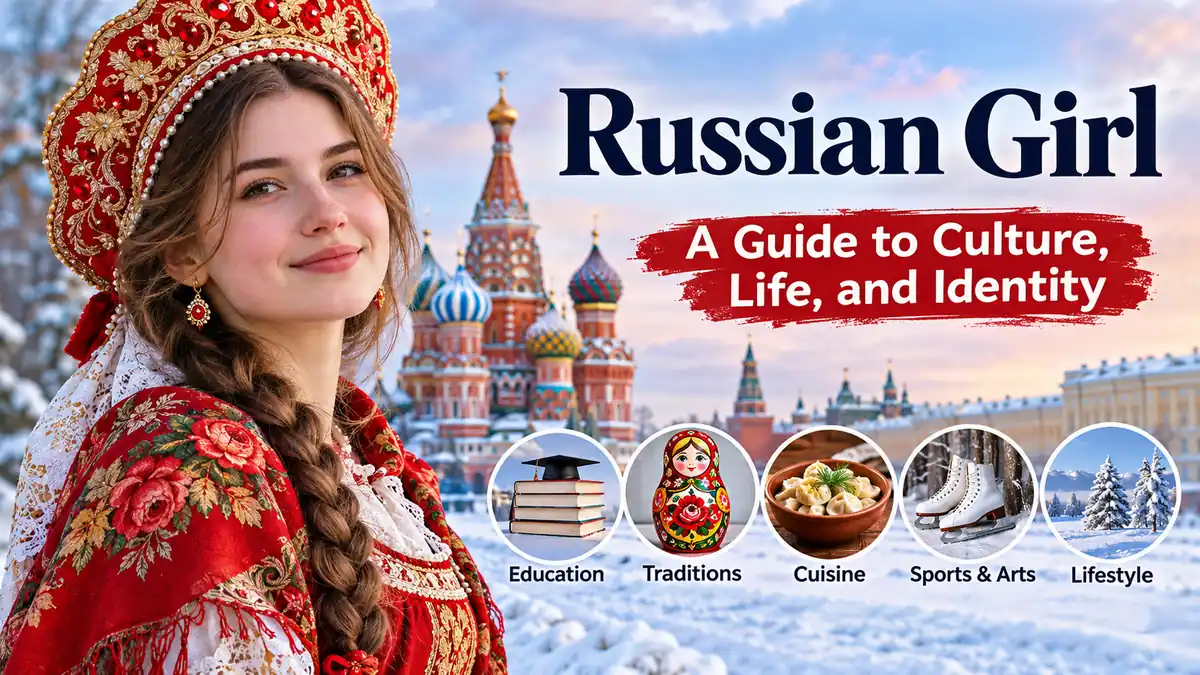
What comes to mind when someone searches for “russian girl”? For some, it’s Russian fashion, beauty, or traditional clothing. Others want to understand everyday life, cultural values, education, or the experiences of young women growing up in Russia.
A russian girl is generally a girl or young woman from Russia, although the phrase can refer to nationality, ethnicity, cultural background, or identity. Russian girls have diverse lifestyles shaped by family, education, regional traditions, language, and personal experiences. No single appearance, personality, or set of customs represents everyone.
Understanding Russian girls and women means looking beyond familiar stereotypes and exploring the country’s history, geography, cultural diversity, and modern social life.
What Does russian girl Mean?
The phrase “russian girl” commonly describes a female child, teenager, or young adult who comes from Russia or identifies with Russian culture.
However, the word Russian has several meanings.
A person may be Russian by citizenship, ethnic heritage, language, or cultural identity. These categories often overlap, but they are not interchangeable.
Russian Nationality vs. Russian Ethnicity
Russia is a multinational country with numerous ethnic communities and regional identities.
| Identity | Meaning |
|---|---|
| Russian citizen | A person who holds citizenship of the Russian Federation |
| Ethnic Russian | A person who identifies with the ethnic Russian community |
| Russian-speaking girl | Someone who speaks Russian, regardless of nationality |
| Russian heritage | Someone with Russian family ancestry or cultural connections |
| Russian diaspora | People of Russian origin living outside Russia |
A girl growing up in Moscow may have a different cultural background from someone raised in Kazan, Yakutsk, or Makhachkala.
For example, ethnic Tatars, Bashkirs, Chechens, and Yakuts may be Russian citizens while maintaining distinct languages, traditions, and cultural identities.
This distinction matters because the Russian Federation includes a wide variety of communities rather than one uniform cultural group.
Russian Girl Culture and Everyday Life
Daily life for Russian girls depends on their age, family circumstances, education, location, and individual interests.
Russia stretches across Europe and Asia, covering eleven time zones. Its geography influences climate, transportation, local customs, and opportunities.
Growing Up in Russian Cities
Large cities such as Moscow and Saint Petersburg offer universities, museums, theaters, shopping centers, public transportation, and cultural events.
Young women in these cities may spend their time studying, working, socializing, attending concerts, visiting cafés, or participating in sports.
Digital technology also plays an important role in communication, entertainment, and education.
Social networks, messaging applications, and online communities connect young Russians with friends and interests beyond their immediate neighborhoods.
However, access to particular digital platforms can change because of government restrictions, service availability, and other factors.
Life in Smaller Towns and Rural Areas
Girls growing up in smaller Russian towns may experience different educational, employment, and recreational opportunities.
Family connections and local community traditions can be particularly visible in smaller settlements, although this varies considerably.
Some young people move to larger cities for university or employment. Others prefer to remain near their families or build careers within their home regions.
Neither experience represents every Russian girl.
Regional Differences
Moscow! | Skyline, Cities in germany, Trip
Moscow
Russia’s capital is known for its universities, business districts, extensive metro system, museums, and urban cultural life.
Автобусная экскурсия по Санкт-Петербург и водная прогулка 2024. Расписание, цены.
Saint Petersburg
The city is associated with classical architecture, literature, performing arts, museums, and artistic traditions.
Kazan
The capital of Tatarstan reflects a combination of Russian and Tatar cultural influences, including distinctive linguistic and religious traditions.
A Look at Winter in the World’s Coldest City | Bloomberg Media Distribution
Yakutsk
Located in the Sakha Republic, Yakutsk experiences extremely cold winters and has strong connections to Sakha culture.
These examples demonstrate why regional context is essential when discussing Russian lifestyles.
Russian Girl Appearance, Beauty, and Fashion
Searches about Russian girls frequently focus on physical appearance, hairstyles, clothing, and beauty traditions.
However, there is no single Russian appearance.
Russia’s population includes people with different facial features, skin tones, hair colors, eye colors, and ethnic backgrounds.
Are All Russian Girls Blonde?
No. This is one of the most common misconceptions.
Some ethnic Russians have naturally blonde hair and light-colored eyes, but many have brown, black, or other hair colors.
The country’s ethnic diversity makes generalizations about appearance especially unreliable.
Hair color also says nothing about someone’s nationality, personality, or cultural identity.
Traditional Russian Clothing
Couleurs du sarafane russe : motifs et teintures (2026)
узоры на русских народных костюмах 46 фото
12
Traditional Russian clothing reflects historical lifestyles, regional customs, and folk craftsmanship.
Several well-known garments and accessories include:
- Sarafan: A traditional sleeveless dress associated with Russian women’s folk clothing.
- Kokoshnik: A decorative headdress found in several historical and regional styles.
- Rubakha: A traditional shirt or tunic, sometimes decorated with embroidery.
- Pavlovo Posad shawl: A patterned textile accessory known for colorful floral designs.
- Valenki: Traditional felt winter boots designed for cold weather.
These garments are not typical everyday clothing for most young women today. They are more commonly encountered in folk performances, museums, festivals, historical celebrations, and cultural presentations.
Modern Russian Fashion
Modern fashion in Russia includes streetwear, business attire, casual clothing, designer fashion, and practical seasonal outfits.
In major cities, international trends coexist with local designers and individual styles.
Cold winters influence clothing choices. Insulated coats, scarves, hats, and weather-resistant footwear are practical necessities in many regions.
Fashion preferences also differ by generation, income, climate, and personal taste.
Beauty Standards and Social Expectations
Beauty standards are shaped by media, family influences, peer groups, advertising, and individual preferences.
Some Russian women enjoy cosmetics, skincare, hairstyling, and carefully coordinated clothing. Others prefer minimal makeup or practical fashion.
It would be inaccurate to assume that Russian girls are universally concerned with appearance or that they follow one beauty standard.
Education and Career Opportunities for Russian Girls
Education plays a significant role in the lives of many young women in Russia.
The Russian education system includes primary education, basic general education, secondary education, vocational training, and higher education.
School Life in Russia
Children generally begin formal schooling around the age of six or seven.
The school system commonly includes:
- Primary general education, typically grades 1–4.
- Basic general education, typically grades 5–9.
- Secondary general education, typically grades 10–11.
After grade nine, students may continue general schooling or pursue vocational education.
Subjects commonly include Russian language, literature, mathematics, history, science, and foreign languages.
Extracurricular interests can include music, dance, sports, art, and academic competitions.
Higher Education
Russian universities offer programs in engineering, medicine, economics, education, technology, humanities, and other fields.
Well-known institutions include Lomonosov Moscow State University and Saint Petersburg State University.
Admission requirements and academic pathways vary by institution and program.
Some students pursue university degrees immediately after school, while others begin with vocational training or employment.
Women in Professional Life
Russian women work across a wide range of industries, including healthcare, education, research, technology, finance, business, journalism, and public administration.
Historically, women have made important contributions to Russian science, literature, and the arts.
One notable example is Sofia Kovalevskaya, a pioneering nineteenth-century mathematician.
Another is Valentina Tereshkova, who became the first woman to travel into space in 1963.
Their achievements illustrate significant aspects of women’s history, although individual opportunities and challenges continue to vary.
Russian Family Values, Traditions, and Celebrations
Family life is an important part of Russian society, but household structures and expectations are not identical across the country.
Some families emphasize close relationships between generations, while others prioritize independence and individual decision-making.
Family Relationships
Russian households may include parents and children, single parents, extended relatives, or multigenerational families.
Grandparents sometimes play a substantial role in childcare and family support.
Respect for older relatives is a familiar cultural value in many households, although its expression differs between families.
Young women may balance family responsibilities with school, careers, friendships, and personal goals.
Major Russian Celebrations
Как нарядить елку в 2025 году: три модных решения
New Year — January 1
One of Russia’s most widely celebrated holidays, often involving family gatherings, decorated trees, gifts, and festive meals.
Масленица 2026: традиции, дни недели, рецепт тонких блинов с начинками
Maslenitsa — Variable dates
A traditional festival associated with the end of winter, pancakes called blini, and community celebrations.
Пасхальная корзинка — какие продукты можно освящать в храме | Megapoisk.com
Orthodox Easter — Variable dates
Observed by many Orthodox Christians through religious services, decorated eggs, and traditional foods.
Купить Букет с праздником 8 марта с доставкой | Заказать цветы дешево в магазине Iziflo
International Women’s Day — March 8
A public holiday when women are commonly recognized with greetings, flowers, and family or workplace celebrations.
Not everyone celebrates these occasions in the same way. Religious beliefs, ethnic traditions, and personal preferences influence participation.
Traditional Russian Food
Russian cuisine includes dishes associated with family meals, holidays, and regional traditions.
Examples include borscht, pelmeni, blini, shchi, and syrniki.
Borscht is a beet-based soup with a wider Eastern European history, while pelmeni are filled dumplings particularly associated with Russian cuisine.
Food traditions differ considerably across Russia. Tatar, Caucasian, Siberian, and other regional cuisines contribute to the country’s culinary diversity.
Russian Language and Communication
Russian is the country’s principal official language and is widely used in education, government, media, and everyday communication.
However, many people in Russia also speak regional or heritage languages.
These include Tatar, Bashkir, Chechen, Sakha, and numerous others.
Common Russian Words and Greetings
| Russian | Pronunciation | English meaning |
|---|---|---|
| Привет | Privet | Hi |
| Здравствуйте | Zdravstvuyte | Hello (formal) |
| Спасибо | Spasibo | Thank you |
| Пожалуйста | Pozhaluysta | Please / You’re welcome |
| Как дела? | Kak dela? | How are you? |
| До свидания | Do svidaniya | Goodbye |
| Меня зовут… | Menya zovut… | My name is… |
Russian uses the Cyrillic alphabet, which differs from the Latin alphabet used in English.
Learning even a few basic phrases can make conversations more comfortable and demonstrate respect for another person’s language.
Communication Styles
Russian communication styles vary by context, personality, age, and social relationship.
Formal interactions may involve polite forms of address, while close friends commonly use informal language.
Russian distinguishes between the informal singular pronoun ты and the formal or plural вы.
Understanding this difference is useful for anyone learning the language.
It is misleading to describe all Russian girls as reserved, direct, friendly, or serious. Communication habits are individual and situational rather than fixed national traits.
Russian Girl Stereotypes vs. Reality
Online portrayals of Russian girls often rely on generalizations about beauty, personality, relationships, and family life.
These stereotypes may come from movies, television, social media, advertising, and popular culture.
Understanding their limitations helps distinguish cultural observations from unsupported assumptions.
| Common stereotype | More accurate perspective |
|---|---|
| All Russian girls are blonde | Russian women have diverse physical appearances and ethnic backgrounds |
| Russian girls are always fashionable | Fashion preferences depend on personality, lifestyle, and circumstances |
| All Russian women are traditional | Views about family, careers, and relationships vary |
| Russian girls are naturally reserved | Communication styles differ among individuals |
| Every Russian girl wants to marry young | Marriage and family goals are personal choices |
| Russian girls share one culture | Russia includes numerous ethnic and regional communities |
Are Russian Girls Different From Other European Girls?
Russian girls may share certain cultural experiences, languages, and historical influences with people from other European countries.
However, nationality alone cannot predict personality, behavior, intelligence, or interests.
A Russian university student may have more in common with a student in Germany or Canada who shares her interests than with someone from her own country who leads a very different life.
Are Russian Girls Slavic?
Some are, but not all.
Ethnic Russians belong to the East Slavic ethnolinguistic group, alongside Ukrainians and Belarusians.
Russia also includes many non-Slavic communities, including Turkic, Caucasian, and other peoples.
The distinction between Russian citizenship and ethnic Russian identity is recognized in academic discussions of Russian national identity. journals.rudn.ru+1
Are Russian Girls Family-Oriented?
Family relationships are meaningful to many people in Russia, just as they are elsewhere.
Nevertheless, there is no reliable basis for claiming that every Russian girl prioritizes marriage, children, or traditional family roles.
Personal values are influenced by upbringing, education, religious beliefs, economic conditions, and individual aspirations.
Russian Girls in Modern Society and Popular Culture
Russian girls and women participate in contemporary culture through literature, sports, music, visual arts, film, technology, and online communities.
Their experiences reflect both local traditions and broader international influences.
Literature and Cultural Identity
Russian literature has a long history of exploring identity, social expectations, family relationships, and women’s lives.
Writers such as Anna Akhmatova and Marina Tsvetaeva contributed significantly to twentieth-century Russian poetry.
Their work offers insights into personal expression, cultural history, and the changing circumstances of women.
Contemporary Russian literature continues to explore questions of identity, migration, social change, and generational differences.
Sports and Performing Arts
Russian women have achieved international recognition in figure skating, gymnastics, tennis, ballet, and other disciplines.
Ballet has a particularly prominent place in Russian cultural history.
Institutions such as the Bolshoi Ballet and Mariinsky Ballet are internationally recognized for their performing arts traditions.
However, professional athletes and performers represent specialized careers, not typical experiences shared by all Russian girls.
Social Media and Youth Culture
Social media influences fashion, entertainment, communication, and creative expression among many young people.
Russian-speaking creators produce content about education, travel, food, gaming, art, technology, and everyday life.
Some use platforms such as VK and Telegram, while others participate in international online communities where access is available.
Digital culture also creates challenges involving privacy, misinformation, unrealistic beauty standards, and online harassment.
These issues are not unique to Russia, but local regulations and platform restrictions can affect how people experience them.
Russian Girls Living Abroad
Russian-speaking communities exist in countries across Europe, Asia, North America, and elsewhere.
Girls and young women with Russian heritage may grow up speaking multiple languages and participating in more than one cultural tradition.
Some maintain strong connections with Russian customs, while others identify primarily with their country of residence.
Research on Russian youth living abroad highlights how national, ethnic, and personal identities can change through migration and social experiences. MDPI
Understanding Russian Girls Beyond Cultural Assumptions
The most useful way to understand someone from Russia is to recognize the difference between cultural background and individual identity.
Culture provides context, but it does not determine someone’s character.
Respect Individual Identity
Avoid assuming that someone follows a particular religion, speaks only Russian, or shares specific political or social views.
A person’s citizenship does not automatically reveal their ethnicity, beliefs, or values.
Learn About Regional and Cultural Diversity
Russia includes communities with different languages, traditions, histories, and religious practices.
The country’s educational and legal framework recognizes linguistic diversity, although the experiences of minority communities and the practical protection of their rights can vary. Education Profiles+1
Understanding these differences provides a more accurate picture of Russian society.
Avoid Generalizing From Social Media
A photograph, viral video, or influencer account cannot represent an entire population.
Online content is often selected, edited, or presented to attract attention.
It may emphasize fashion, luxury, beauty, or unusual lifestyles while leaving out ordinary experiences.
For a more balanced perspective, explore cultural history, credible research, literature, and accounts from people with different backgrounds.
Use Respectful Language
When discussing an adult, the phrase Russian woman is generally more appropriate in formal writing than Russian girl.
The word girl is suitable for children and may also appear informally when referring to young adults, depending on context.
Respectful descriptions should prioritize a person’s individuality rather than reducing them to nationality or appearance.
Final Thoughts on russian girl Culture and Identity
The phrase “russian girl” describes a broad and diverse group of people connected to Russia through nationality, ethnicity, heritage, or culture.
Russian girls grow up in different regions, speak different languages, pursue different educational and professional goals, and maintain different personal traditions.
Their experiences cannot be accurately summarized through stereotypes about beauty, fashion, personality, or relationships.
The best way to understand Russian girls and women is to explore Russia’s cultural diversity, learn about its history and language, and recognize each person as an individual rather than an example of a national stereotype.
