

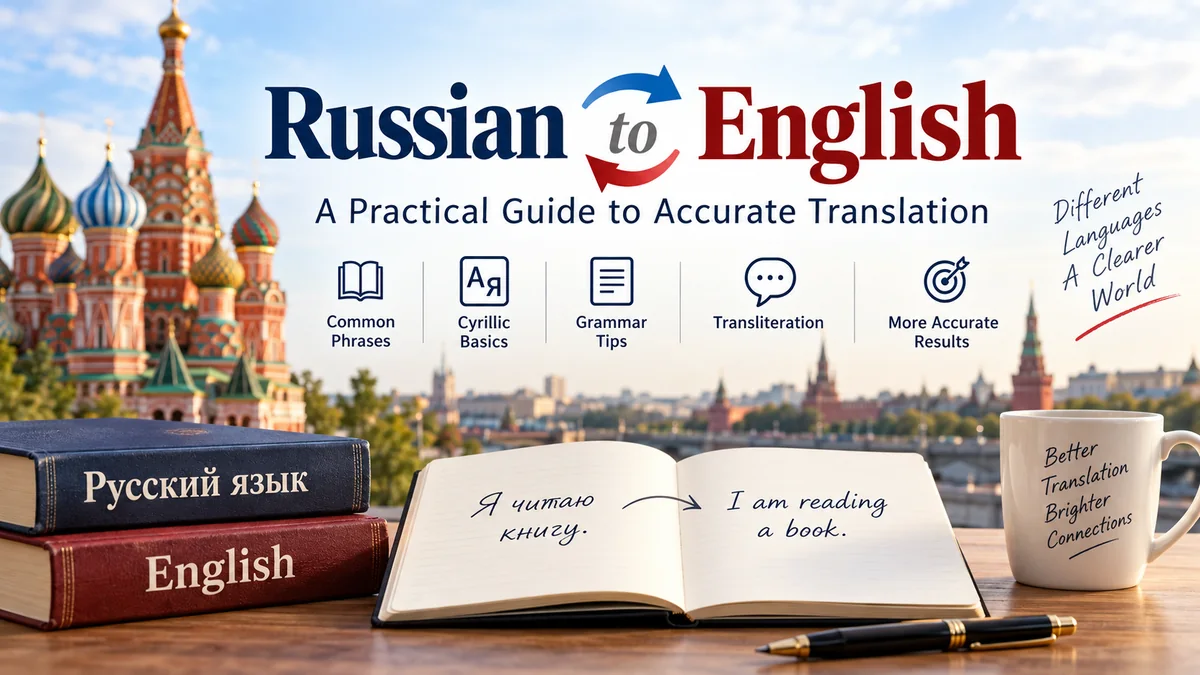
Russian text can look intimidating if you do not read the Cyrillic alphabet. Yet recognizing the letters is only the first challenge. Good russian to english translation also requires understanding Russian grammar, context, verb aspect, cases, idioms, word order, and the meaning a speaker intends.
Russian to English translation converts Russian words, sentences, or documents written mainly in Cyrillic into natural English while preserving their original meaning. Accurate translation requires more than replacing individual words: Russian and English differ significantly in grammar, articles, cases, verb systems, sentence structure, and cultural expressions.
Modern machine translation can handle everyday Russian surprisingly well, particularly when sentences contain enough context. However, legal documents, literature, technical material, slang, handwritten text, and ambiguous sentences often require careful human review.
This guide explains how Russian-to-English translation works, where mistakes happen, how transliteration differs from translation, and how to produce English that sounds natural rather than mechanically converted.
How russian to english Translation Works
At the simplest level, translation answers one question:
What does this Russian text mean in English?
Suppose you see:
Спасибо.
The natural English translation is:
Thank you.
That example is straightforward because the Russian word has a clear equivalent. Longer sentences become more complicated.
Consider:
Я читаю книгу.
A natural translation is:
I am reading a book.
A mechanical word-by-word conversion might produce something closer to “I read book.” The English version needs an article and, depending on context, an appropriate verb form.
This difference illustrates an essential principle: translation transfers meaning, not merely words.
Modern translation systems analyze surrounding words and sentence structure before choosing an English equivalent. Context matters because one Russian word can have several English meanings.
Translation usually involves four basic steps
- Identify the Russian words and grammatical forms.
- Determine their meaning from the surrounding context.
- Restructure the sentence according to English grammar.
- Review the English output for meaning, tone, terminology, and naturalness.
For a simple message, these steps can happen automatically within seconds. Complex documents need more careful review.
Understanding the Russian Cyrillic Alphabet
Russian uses the Cyrillic alphabet, while English uses the Latin alphabet. Modern Russian has 33 letters.
Some Cyrillic characters resemble Latin characters and even represent similar sounds. Others look familiar but represent completely different sounds.
| Cyrillic | Common Latin representation | Approximate sound |
|---|---|---|
| А а | A | a |
| Б б | B | b |
| В в | V | v |
| Г г | G | g |
| Д д | D | d |
| Е е | E / Ye | ye/e |
| Ё ё | Yo | yo |
| Ж ж | Zh | sound in “measure” |
| З з | Z | z |
| И и | I | ee |
| Й й | Y / I | short y |
| К к | K | k |
| Л л | L | l |
| М м | M | m |
| Н н | N | n |
| О о | O | o |
| П п | P | p |
| Р р | R | rolled/trilled r |
| С с | S | s |
| Т т | T | t |
| У у | U | oo |
| Ф ф | F | f |
| Х х | Kh | throaty h/kh |
| Ц ц | Ts | ts |
| Ч ч | Ch | ch |
| Ш ш | Sh | sh |
| Щ щ | Shch | softer/long sh sound |
| Ъ | hard sign | no independent sound |
| Ы | Y | Russian vowel without exact English equivalent |
| Ь | soft sign | softens preceding consonant |
| Э э | E | e |
| Ю ю | Yu | yu |
| Я я | Ya | ya |
Be particularly careful with characters that resemble English letters.
For example, Russian Р corresponds roughly to R, not English P. Russian С represents an S sound, while Н represents N.
That is why guessing a Russian word simply from the appearance of its letters often fails.
Translation vs Transliteration: They Are Not the Same
One of the most common sources of confusion is treating translation and transliteration as interchangeable.
They perform different jobs.
Translation changes the language
Russian:
Москва
English translation:
Moscow
Transliteration changes the writing system
Russian:
Москва
Latin-script transliteration:
Moskva
The transliterated version represents how the Russian word can be written using Latin characters. The translated conventional English place name is Moscow.
Another example makes the distinction even clearer:
Russian:
Спасибо
Transliteration:
Spasibo
Translation:
Thank you
“Spasibo” does not tell an English reader what the word means. It represents the Russian pronunciation using Latin letters.
When should you use transliteration?
Transliteration is particularly useful for:
- personal names
- geographic names
- addresses
- pronunciation assistance
- passports and identity records
- bibliographic references
- language learning
- situations where the original Russian word needs to remain identifiable
Official documents deserve extra attention because the required spelling of a person’s name may need to match an existing passport or other identity document rather than a translator’s preferred transliteration.
Common Russian Words and Phrases in English
Learning a small group of everyday expressions can make basic Russian communication much easier.
| Russian | Transliteration | English |
|---|---|---|
| Привет | Privet | Hi |
| Здравствуйте | Zdravstvuyte | Hello |
| Спасибо | Spasibo | Thank you |
| Пожалуйста | Pozhaluysta | Please / You’re welcome |
| Да | Da | Yes |
| Нет | Net | No |
| Доброе утро | Dobroye utro | Good morning |
| Добрый вечер | Dobryy vecher | Good evening |
| До свидания | Do svidaniya | Goodbye |
| Как дела? | Kak dela? | How are you? |
| Извините | Izvinite | Excuse me / Sorry |
| Я не понимаю | Ya ne ponimayu | I don’t understand |
| Как вас зовут? | Kak vas zovut? | What is your name? |
| Сколько это стоит? | Skolko eto stoit? | How much does this cost? |
| Где метро? | Gde metro? | Where is the metro? |
| Я тебя люблю | Ya tebya lyublyu | I love you |
These examples also demonstrate why context matters.
Пожалуйста, for instance, can mean “please” in one situation and “you’re welcome” in another. A system that blindly assigns one English word to every Russian word will therefore make mistakes.
Why Russian Grammar Makes English Translation Challenging
Russian and English belong to different branches of the Indo-European language family.
Russian is an East Slavic language, while English is a West Germanic language. Their grammatical systems therefore differ considerably.
Several differences have a direct effect on translation quality.
Russian uses grammatical cases
Russian nouns, pronouns, and adjectives can change their endings according to their grammatical roles.
Modern Russian traditionally recognizes six main cases:
- nominative
- genitive
- dative
- accusative
- instrumental
- prepositional
English relies much more heavily on word order and prepositions.
Consider:
Иван дал мне книгу.
A natural English translation is:
Ivan gave me a book.
Russian grammatical endings help indicate relationships between words. English usually communicates those relationships through position and sentence structure.
This is one reason literal word-for-word translation can produce awkward results.
Russian Word Order Is More Flexible Than English Word Order
English normally favors a relatively predictable subject–verb–object structure.
Russian can rearrange sentence elements more freely because grammatical endings provide information about each word’s role.
Changes in Russian word order may instead emphasize a particular piece of information.
A translator therefore has to ask:
What is the sentence communicating, and what is being emphasized?
The answer may require reorganizing the entire sentence in English.
A technically literal translation can preserve every word and still sound unnatural.
Russian Has No Articles
English uses:
- a
- an
- the
Russian does not have equivalent grammatical articles.
That creates a major challenge when translating Russian into English.
Consider a simple Russian noun such as:
книга
Depending on context, English might require:
- a book
- the book
- book
The translator has to infer definiteness from context.
This becomes particularly noticeable in machine-generated English. A translation may communicate the general meaning correctly while using the wrong article or omitting one entirely.
When reviewing a translation, check articles carefully rather than assuming the source text provides all the information explicitly.
Russian Verb Aspect Does Not Map Directly to English
Russian verbs commonly distinguish between imperfective and perfective aspect.
In broad terms, imperfective verbs often focus on an action as an ongoing, repeated, or general process, while perfective verbs commonly present an action as completed or bounded.
For example, Russian learners encounter aspectual pairs such as:
делать / сделать
Both can relate to “doing” or “making,” but they are not interchangeable.
English communicates similar distinctions through tense, auxiliary verbs, vocabulary, and context rather than through exactly the same grammatical system.
As a result, a Russian verb should not automatically be assigned one English tense.
The translator needs to understand:
- whether the action was completed
- whether it was repeated
- whether it was ongoing
- when it occurred
- what surrounding sentences establish about time
This becomes especially important in narratives, instructions, reports, and literature.
Russian Often Omits Information English Needs
Russian can communicate naturally without explicitly stating elements that English normally requires.
English sentences often need an explicit subject.
For example:
Не знаю.
A natural translation is:
I don’t know.
There is no explicit Russian word corresponding to “I” in that sentence. The verb form and conversational context provide enough information.
A literal system that tries to preserve only visible words can therefore produce incomplete English.
Good translation reconstructs what English grammar requires without unnecessarily changing the original meaning.
Context Determines the Correct English Meaning
Dictionary definitions are starting points, not complete translations.
Consider the Russian word:
мир
Depending on context, мир can mean “world” or “peace.”
Compare:
мир во всём мире
A natural translation is:
peace throughout the world
The same written Russian word appears twice but represents two different English concepts.
This illustrates why translating isolated words can be harder than translating complete sentences.
Give a translator enough context
Instead of translating:
ключ
provide the complete sentence containing it.
Depending on context, ключ could refer to a key, a spring of water, or another specialized meaning.
Full sentences allow humans and machine translation systems to resolve ambiguity much more reliably.
How to Translate russian to english Accurately
For everyday material, an effective process is simple.
1. Preserve the original Russian text
Copy the source accurately.
Cyrillic characters should not be manually replaced with similar-looking Latin letters. Even a single incorrect character can change a word or prevent proper recognition.
2. Translate complete sentences
Avoid dividing text into individual words unless you are specifically studying vocabulary.
Sentence-level context helps determine:
- word meaning
- grammatical relationships
- verb tense
- pronouns
- articles
- idioms
- tone
3. Read the entire English result
Ask whether the English actually makes sense.
Do not accept a sentence simply because every Russian word appears to have an English counterpart.
4. Compare questionable terms
If one word looks unusual, check its possible meanings separately and then return to the full sentence.
Context should determine the final choice.
5. Rewrite awkward English without changing meaning
A literal translation may need editing.
The objective is not to imitate Russian sentence structure. It is to express the same information naturally in English.
6. Verify names, numbers, and terminology
Double-check:
- personal names
- addresses
- dates
- measurements
- currencies
- company names
- technical terminology
- abbreviations
- legal references
These details can be more consequential than stylistic imperfections.
7. Use human review for high-stakes material
Machine translation is useful for understanding ordinary content, but legal, medical, immigration, academic, contractual, and other consequential documents may require a qualified translator or specialist review.
Quick Takeaway: Translate complete ideas rather than isolated words. Preserve the Russian source, use context to resolve ambiguity, then edit the result according to normal English grammar.
Using Online Russian to English Translators
Online translators generally follow the same workflow: enter Russian text, select English as the target language, generate the translation, and review the output.
Current translation platforms increasingly use neural or AI-based systems designed to analyze context rather than simply matching words individually. Online tools commonly support anything from individual words to paragraphs and documents, although limits and features vary by service.
A typical process is:
- Copy the original Russian text.
- Paste it into the source field.
- Confirm Russian is selected or correctly detected.
- Select English as the output language.
- Generate the translation.
- Read the entire English version.
- Verify ambiguous words, names, dates, and specialized terminology.
Tools such as Google Translate, DeepL, and Reverso Context can be useful for different translation tasks.
Context-oriented resources are especially useful when you want to see how a word or expression is used in real sentences rather than obtaining only a dictionary-style equivalent. Reverso, for example, specifically presents Russian-English translations alongside contextual examples.
How Accurate Is Machine Translation?
There is no meaningful universal percentage for Russian-to-English accuracy.
Performance depends heavily on the source material.
Machine translation tends to work better when the Russian text contains:
- complete sentences
- conventional grammar
- clear context
- standard vocabulary
- straightforward informational writing
It becomes less dependable with:
- slang
- sarcasm
- jokes
- poetry
- idioms
- dialect
- deliberate wordplay
- handwritten text
- specialized terminology
- poorly punctuated messages
- ambiguous sentences
Modern systems can produce English that sounds extremely fluent. That creates an unusual problem: fluency does not guarantee accuracy.
A translation can read beautifully while subtly changing who performed an action, whether something happened, or what a technical term means.
For consequential material, verify meaning against the Russian original.
Why Literal Russian-to-English Translation Often Sounds Wrong
Literal translation attempts to keep the source structure as closely as possible.
Sometimes that works.
Often it does not.
Russian grammar allows structures that would sound unusual when reproduced directly in English.
Imagine translating an idiom word by word. You may understand every individual word yet completely miss what the speaker meant.
The better question is not:
“What does each word mean?”
It is:
“How would an English speaker naturally express this same idea?”
That distinction separates basic conversion from effective translation.
Literal translation still has a purpose
It can be useful when:
- studying Russian grammar
- comparing sentence structures
- identifying vocabulary
- analyzing literature
- checking exactly how a source sentence was constructed
For normal communication, however, natural translation is usually more useful.
Russian Idioms Need Meaning-Based Translation
Idioms are a classic example of why word-for-word translation fails.
Consider:
Ни пуха ни пера!
A literal rendering involves “neither fur nor feather,” which tells an English reader very little about the expression’s conversational function.
Depending on context, an English equivalent is closer to:
Good luck!
This does not mean every cultural expression should be replaced aggressively with an English idiom. Sometimes preserving cultural flavor is desirable, especially in literature.
The translator has to decide what matters most:
- literal wording
- intended meaning
- tone
- cultural information
- readability
There is rarely one rule that works for every genre.
Formal and Informal Russian Matter
Russian distinguishes levels of formality that may not transfer neatly into English.
For example, Russian has two common forms corresponding to “you”:
ты — informal singular
вы — formal singular or plural
English generally uses you for both.
That means part of the social relationship encoded in Russian grammar can disappear in translation.
A translator may compensate through vocabulary and tone.
A formal Russian business message should normally become appropriately professional English, even though English lacks the exact ты/вы distinction.
This is another reason translating individual words without understanding the relationship between speakers can lose information.
Translating Russian Names into English
Names create a special challenge because they usually require transliteration, not semantic translation.
A Russian name written in Cyrillic may have multiple plausible Latin spellings depending on the transliteration convention.
For casual text, minor spelling differences may not matter.
For official records, they can matter greatly.
When translating:
- passports
- visas
- birth certificates
- diplomas
- contracts
- immigration documents
- academic records
use the spelling already established in the person’s official Latin-script documents whenever the applicable requirements call for consistency.
Do not casually “correct” a person’s established legal spelling because another transliteration appears linguistically preferable.
Translating Russian Documents to English
Document translation introduces problems that short text translation does not.
The translator may need to preserve:
- headings
- tables
- footnotes
- page references
- signatures
- stamps
- dates
- document numbers
- names
- abbreviations
- formatting relationships
A PDF or scanned document may also require text recognition before translation.
This creates several stages:
image → recognized Russian text → interpreted meaning → English translation
An error during text recognition can therefore become a translation error.
If a scanned Cyrillic character is recognized incorrectly, even a strong translation system may faithfully translate the wrong source text.
Always compare important translated passages against the original scan.
Translating Russian Images and Screenshots
Russian frequently appears in photographs rather than selectable text:
- street signs
- menus
- screenshots
- product labels
- notices
- social media posts
- handwritten notes
Image translation normally relies on optical character recognition to identify Cyrillic characters before translation.
For better results:
- use a sharp image
- avoid glare
- keep text horizontal
- crop unnecessary background
- capture the full sentence
- use the highest practical resolution
After recognition, check names and numbers particularly carefully.
A visually similar Cyrillic character can cause a recognition mistake that changes the resulting English.
Translating Russian Audio and Speech
Spoken translation adds another layer to the process.
The system must first perform speech recognition:
Russian speech → Russian text → English meaning
Background noise, overlapping speakers, unusual names, regional pronunciation, and poor microphones can affect the transcription before translation even begins.
If an English translation seems strange, inspect the Russian transcription when available.
The translation engine may not be the source of the error; the Russian speech may have been transcribed incorrectly.
For interviews, lectures, and recordings, reviewing the transcript first can save considerable time.
Russian Pronunciation and Romanization
Someone searching for russian to english may actually want to know how a Russian word is pronounced rather than what it means.
These are separate tasks.
For example:
Привет
Meaning:
Hi
Approximate transliteration:
Privet
A pronunciation-oriented representation might emphasize sounds differently from a formal transliteration standard.
This distinction matters when learning Russian. Transliteration is helpful at first, but depending on Latin letters for too long can reinforce inaccurate pronunciation.
Learning Cyrillic directly is usually more useful once you move beyond a handful of travel phrases.
Common Translation Mistakes to Avoid
Even good translation technology cannot eliminate every mistake.
Translating every word independently
This destroys context and frequently produces the wrong meaning.
Better: translate complete sentences.
Confusing transliteration with translation
“Spasibo” is not an English translation of Спасибо. It is a Latin-script representation.
Better: decide whether you need meaning or pronunciation.
Keeping Russian word order
Russian syntax can be flexible.
Better: restructure sentences according to natural English grammar.
Forgetting English articles
Russian does not use a/an/the.
Better: add articles based on context.
Ignoring verb aspect
Russian aspect may contain information that requires a different English tense or construction.
Better: determine whether the action is completed, ongoing, habitual, or repeated.
Assuming fluent output must be correct
AI-generated translations can sound polished even when a subtle meaning has shifted.
Better: verify important claims, terminology, names, and numbers.
Translating idioms literally
The resulting English can be confusing or unintentionally humorous.
Better: identify the expression’s intended meaning before choosing an English equivalent.
How to Improve Russian to English Translation Quality
You can improve results substantially before translation even begins.
Provide complete context
Instead of submitting a mysterious fragment, include the surrounding sentence or paragraph.
Preserve punctuation
Punctuation helps systems recognize sentence boundaries and relationships.
Fix obvious source errors carefully
Typos can confuse automated translation, especially when they create another valid Russian word.
Keep the original available so any corrections remain traceable.
Separate unrelated material
Do not combine disconnected sentences into one paragraph simply to translate everything at once.
Specify specialized context when possible
A Russian term used in engineering may have a different English equivalent in finance or medicine.
Domain context narrows the possible meanings.
Review the translation as English
After checking accuracy, temporarily stop thinking about Russian.
Ask:
Would a native English speaker naturally write this sentence?
If not, edit the English while preserving the original information.
Russian to English for Language Learning
Translation tools can help Russian learners, but simply copying the answer provides limited educational value.
A better method is to compare the languages.
Take:
Я работаю дома.
Translation:
I work at home.
Then identify:
- Я — I
- работаю — work/am working
- дома — at home
Notice that the English preposition “at” does not correspond to a separate Russian word in the same straightforward way.
This comparison teaches grammatical structure instead of merely providing an answer.
Use translation as a checking tool
Try translating the sentence yourself first.
Then compare your version with one or more reliable translations. Investigate differences rather than automatically assuming the machine output is the only possible answer.
Many sentences legitimately have several good translations.
Can One Russian Sentence Have Multiple Correct English Translations?
Yes.
Translation is not always a one-to-one conversion.
Consider a conversational statement. Depending on tone and context, one English version might be:
I don’t know.
Another could be:
I’m not sure.
A third might require a more formal construction.
The most appropriate version depends on what the Russian speaker intended.
This is particularly important with:
- literature
- dialogue
- humor
- marketing copy
- informal messages
- emotionally expressive writing
Accuracy means preserving meaning and function, not forcing every sentence into one predetermined English wording.
When Should You Use a Human Translator?
Machine translation is often sufficient when your goal is simply to understand an ordinary Russian message, webpage, or passage.
Human expertise becomes more valuable as the consequences of an error increase.
Consider professional review for:
- legal agreements
- court documents
- immigration records
- medical material
- academic publications
- certified documents
- financial documents
- technical manuals
- literary translation
- public-facing professional content
A qualified translator can resolve ambiguity, maintain terminology consistently, interpret cultural meaning, and recognize when apparently straightforward wording has a specialized meaning.
Certification requirements also vary by authority and purpose, so a machine-generated translation should not automatically be assumed to satisfy an institution’s official-document requirements.
A Simple Accuracy Checklist
Before relying on a translated passage, compare it with this checklist:
| Check | What to verify |
|---|---|
| Meaning | Does the English preserve the original message? |
| Context | Were ambiguous words interpreted correctly? |
| Grammar | Does the English read naturally? |
| Articles | Are a, an, and the used correctly? |
| Tense | Does the timing of actions remain accurate? |
| Aspect | Is completion or continuation represented correctly? |
| Names | Do spellings match established records? |
| Numbers | Are dates, amounts, and measurements unchanged? |
| Terminology | Are specialized terms appropriate to the field? |
| Tone | Is formal/informal meaning preserved where possible? |
| Idioms | Were expressions translated by meaning rather than blindly? |
| Completeness | Was anything accidentally omitted? |
For ordinary conversation, you may complete this review in seconds.
For important documents, perform it systematically.
The Best Approach to russian to english Translation
The strongest russian to english translation preserves meaning first and wording second.
Start with clean Russian text, keep full sentences together, distinguish translation from transliteration, and give ambiguous words enough context. Then review the English for articles, word order, tense, names, terminology, and natural phrasing.
Online translators are excellent for quick comprehension and everyday communication, especially when the source text is clear and contextual. But language is more than vocabulary matching. Russian cases, flexible word order, verb aspect, omitted subjects, idioms, and cultural context all influence what the best English translation should be.
For casual text, machine translation plus a careful review is usually the practical approach. For consequential material, compare the translation with the original and use appropriate human expertise when accuracy must be dependable.
