

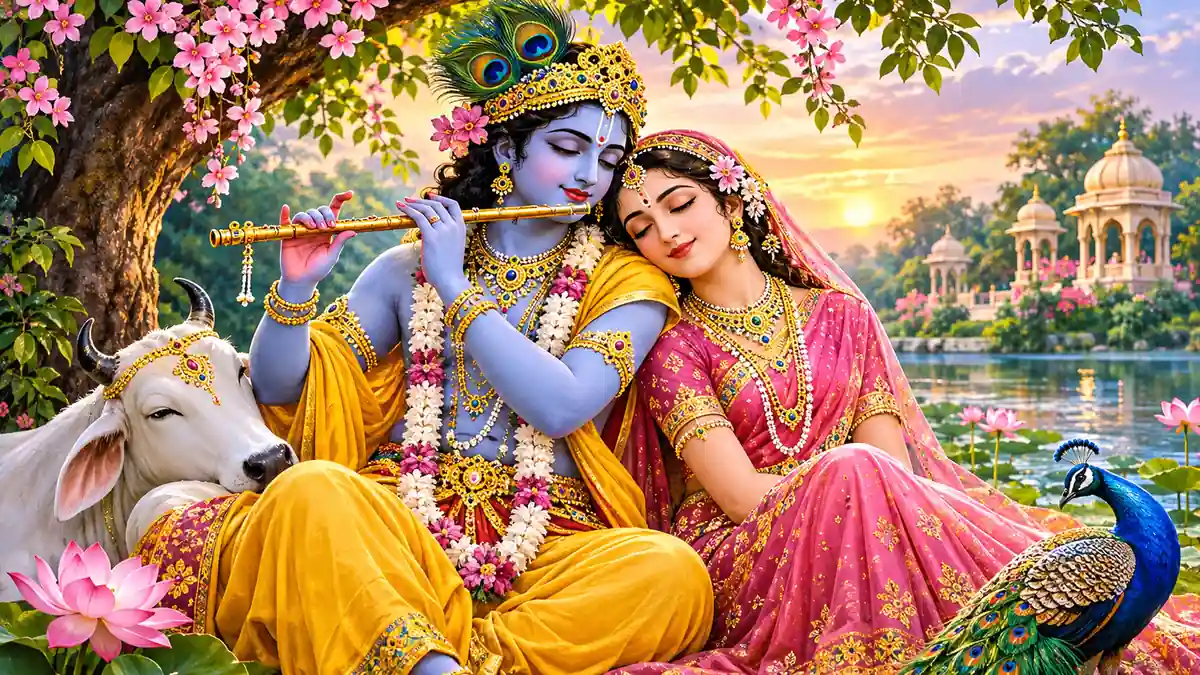
The love of radha krishna is one of the most cherished spiritual traditions in Hinduism. Their relationship is celebrated not simply as a romantic story but as a profound expression of devotion, selfless love, and the eternal connection between the human soul and the divine.
radha krishna represents the sacred union of Radha, the embodiment of loving devotion, and Krishna, a manifestation of the Supreme Divine in many Hindu traditions. Their relationship, especially celebrated in the devotional traditions of Vrindavan and Braj, symbolizes pure love that transcends worldly attachment and inspires the spiritual path of bhakti, or devotion to God.
Their stories appear in devotional poetry, sacred literature, temple worship, classical dance, music, and religious festivals. Understanding their significance offers insight into Hindu philosophy, the bhakti movement, and the enduring appeal of divine love.
Who Are radha krishna in Hinduism?
Miniature Painting and Art History, Schools.
Top 999+ vrindavan krishna images – Amazing Collection vrindavan krishna images Full 4K
11
Radha and Krishna are central figures in several Vaishnava devotional traditions, particularly those associated with Krishna worship.
Krishna is revered as an avatar of Lord Vishnu in many Hindu traditions. In others, including Gaudiya Vaishnavism, he is worshipped as the original Supreme Personality of Godhead, or Svayam Bhagavan.
Radha, also known as Radharani, is honored as Krishna’s supreme devotee and divine beloved. Many theological traditions understand her as the manifestation of Krishna’s internal spiritual energy, especially his pleasure potency, known as hladini shakti.
Who Is Radha?
Radha is celebrated as the highest expression of loving devotion to Krishna.
In later devotional literature, she is closely associated with Barsana and the Braj region of northern India. Traditional narratives commonly identify Vrishabhanu and Kirtida as her parents.
Her spiritual importance extends beyond her identity as Krishna’s beloved. In several Vaishnava traditions, she embodies the ideal devotee whose entire existence is dedicated to divine love.
Radha is associated with:
- Prema: Pure, unconditional spiritual love.
- Bhakti: Deep personal devotion to God.
- Viraha: The longing experienced during separation from the beloved.
- Mahabhava: The highest intensity of divine love in certain Vaishnava theological systems.
- Selfless surrender: Loving devotion without seeking personal reward.
The honorific Radharani expresses the reverence devotees hold for her.
Who Is Lord Krishna?
Krishna is among the most widely worshipped deities in Hinduism.
His life and teachings are narrated in texts including the Mahabharata, Bhagavad Gita, Harivamsa, and Bhagavata Purana.
According to Hindu sacred narratives, Krishna was born in Mathura to Devaki and Vasudeva and raised in Gokul by Yashoda and Nanda.
His childhood stories describe his playful activities, love of butter, protection of villagers, and enchanting flute music.
Krishna’s identity has several interconnected dimensions:
| Aspect of Krishna | Spiritual significance |
|---|---|
| Child Krishna (Bal Gopal) | Innocence, joy, and divine affection |
| Flute-playing Krishna | Divine attraction and the call of devotion |
| Govinda | Protector and nurturer of living beings |
| Gopala | Protector of cows and the pastoral community |
| Parthasarathi | Guide and charioteer of Arjuna |
| Jagadguru | Divine teacher of spiritual wisdom |
While the Bhagavad Gita emphasizes Krishna’s teachings on duty, knowledge, devotion, and liberation, the devotional traditions of Braj especially celebrate his loving relationships with Radha and the gopis.
The Story of radha krishna and Their Divine Love
The stories of Radha and Krishna are primarily associated with Vrindavan, Barsana, Nandgaon, and other places in the sacred Braj region.
Their relationship has been interpreted through centuries of poetry, theology, and religious practice.
How Did Radha and Krishna Meet?
Popular devotional traditions describe Radha and Krishna encountering each other during their youth in the forests and villages of Braj.
One well-known narrative places their meeting near the Yamuna River, where Krishna’s flute music draws Radha and the other gopis toward him.
Different texts and regional traditions describe their first meeting differently. There is no single universally accepted historical account.
In devotional interpretations, their meeting represents the awakening of spiritual love: the soul recognizes the divine presence and becomes drawn toward it.
The Flute and the Call of Divine Love
Krishna’s flute, known as the murali or bansuri, is one of the most recognizable symbols in Hindu devotional art.
In the stories of Vrindavan, its music captivates the gopis, cows, birds, and surrounding natural world.
The flute carries a deeper symbolic meaning. Devotional teachers often interpret its hollow form as a representation of freedom from ego.
Just as the flute produces music when Krishna breathes through it, the devotee becomes an instrument of divine love through surrender.
This symbolism is especially prominent in Krishna bhakti poetry and spiritual commentary.
The Raas Leela
The Raas Leela, or Rasa Lila, is a sacred dance associated with Krishna and the gopis of Vrindavan.
It is prominently described in the tenth book of the Bhagavata Purana, particularly in chapters 29–33, often called the Rasa Panchadhyayi.
The narrative describes Krishna dancing with the gopis in a divine celebration of love and devotion.
Radha is especially prominent in later devotional interpretations, although the Bhagavata Purana does not explicitly name her in its account of the dance.
In Gaudiya Vaishnava theology, the Raas Leela expresses the highest form of loving devotion, in which each devotee experiences a deeply personal relationship with Krishna.
The dance is not understood merely as a worldly romantic event. Within the tradition, it symbolizes spiritual intimacy and the soul’s longing for God.
Why Were Radha and Krishna Separated?
The separation of Radha and Krishna is among the most emotionally powerful themes in devotional literature.
According to the broader Krishna narrative, Krishna eventually leaves the pastoral world of Braj and travels to Mathura, where he confronts the tyrannical ruler Kamsa.
His departure creates profound sorrow among the residents of Vrindavan, especially the gopis.
Later devotional traditions place particular emphasis on Radha’s experience of separation.
This longing is called viraha bhakti or vipralambha bhava.
Rather than treating separation as the end of love, devotional theology understands it as an intensification of remembrance, surrender, and spiritual attachment.
Radha’s longing becomes an example of devotion that continues even without physical closeness.
Why Did Radha and Krishna Not Marry?
One of the most frequently asked questions about their relationship is why Radha and Krishna did not marry.
The answer depends on the religious text and devotional tradition being followed.
In many widely known narratives, Radha and Krishna’s relationship is celebrated as divine love rather than a conventional marriage.
Some traditions interpret their union as eternal and spiritual, existing beyond social institutions and worldly relationships.
Other traditions, including accounts associated with the Brahma Vaivarta Purana and later devotional literature, describe a divine marriage involving Radha and Krishna.
Consequently, the claim that they never married is not universally accepted across Hindu traditions.
Spiritual Love Versus Worldly Marriage
In Vaishnava theology, Radha and Krishna’s relationship is often understood through the distinction between ordinary attachment and divine love.
Ordinary attachment can involve possession, expectation, and personal desire.
Divine love, by contrast, is described as unconditional devotion directed toward the happiness of the beloved.
This distinction helps explain why their relationship is not always interpreted according to conventional social expectations.
Was Radha Married to Someone Else?
Some regional narratives and later devotional works identify Radha’s husband as Ayan, also called Abhimanyu in certain traditions.
However, these accounts are not presented consistently across Hindu scriptures.
Their significance varies depending on the religious community and literary source.
For theological traditions emphasizing parakiya bhava, or love outside conventional marital relationships, the narrative serves as a symbolic expression of devotion that transcends worldly obligations.
Other Vaishnava traditions emphasize svakiya bhava, understanding Radha and Krishna as eternally united divine consorts.
These interpretations belong to different theological frameworks and should not be treated as a single uniform account.
The Spiritual Meaning of radha krishna
The importance of Radha and Krishna extends beyond their stories.
Their relationship expresses major concepts in Hindu devotional philosophy, especially the nature of divine love and the relationship between the individual soul and God.
Radha as the Soul and Krishna as the Divine
A popular spiritual interpretation views Radha as representing the devoted soul and Krishna as representing the Supreme Divine.
Their relationship illustrates the soul’s desire to reconnect with its divine source.
This is a symbolic interpretation rather than a complete definition of Radha’s identity in every tradition. In Gaudiya Vaishnavism, for example, Radha is understood as Krishna’s eternal divine energy, not simply as an ordinary individual soul.
The symbolism nevertheless helps explain why their love stories resonate with devotees.
What Is Prema Bhakti?
Prema bhakti refers to loving devotion toward God.
Unlike religious practice motivated primarily by material rewards, prema bhakti emphasizes love as an end in itself.
Radha is regarded as the supreme example of this devotion in many Krishna-centered traditions.
Its essential qualities include humility, remembrance of God, surrender, compassion, and the absence of selfish expectations.
The Meaning of Radha and Krishna as One
Many devotional teachings describe Radha and Krishna as simultaneously one and distinct.
In Gaudiya Vaishnava theology, this relationship is explained through the idea of shakti and shaktiman.
Krishna is the possessor of divine energy, while Radha personifies his supreme internal pleasure potency.
Their unity does not erase their distinct personalities. Instead, it expresses an inseparable relationship between divine love and its source.
This understanding is connected with the broader theological concept of achintya bheda abheda, or inconceivable simultaneous oneness and difference, taught within the tradition of Chaitanya Mahaprabhu.
Why Is Radha’s Name Often Spoken Before Krishna’s?
Devotees frequently use expressions such as “Radhe Krishna” and “Radhe Radhe.”
In several devotional communities, Radha is honored as the highest devotee and the embodiment of the divine energy through which Krishna’s loving nature is revealed.
Speaking her name first expresses reverence for her devotion and spiritual position.
However, the practice varies across Hindu communities. It is not a universal rule that Radha’s name must always precede Krishna’s.
Sacred Scriptures and Literature About Radha Krishna
The development of Radha-Krishna devotion spans many centuries and literary traditions.
Different texts emphasize different aspects of their relationship.
| Scripture or literary work | Main contribution |
|---|---|
| Bhagavata Purana | Krishna’s childhood, the gopis, and the Rasa Lila |
| Gita Govinda | Poetic celebration of Radha and Krishna’s love, longing, and reunion |
| Brahma Vaivarta Purana | Expanded theological narratives concerning Radha and Krishna |
| Brahma Samhita | Krishna-centered theology, influential in Gaudiya traditions |
| Chaitanya Charitamrita | Gaudiya Vaishnava understanding of Radha, Krishna, and divine love |
| Poetry of Surdas | Devotional portrayals of Krishna’s childhood and Braj |
| Poetry of Mirabai | Personal devotion and surrender to Krishna |
The Importance of Gita Govinda
The Gita Govinda, composed by the twelfth-century poet Jayadeva, is one of the most influential works in the history of Radha-Krishna devotion.
Written in Sanskrit, it explores love, longing, separation, reconciliation, and spiritual union.
Its lyrical structure made it especially important in Indian classical music and dance.
The work also contributed to the development of Radha’s prominence in medieval devotional culture.
Radha in Early and Later Literature
Although Krishna appears in major early Hindu texts, Radha’s theological and literary prominence developed more fully in later devotional traditions.
The Bhagavata Purana celebrates Krishna’s relationship with the gopis without explicitly naming Radha in the Rasa Lila narrative.
Later Sanskrit and vernacular works increasingly identify Radha as Krishna’s supreme beloved.
This literary development is essential for understanding why different Hindu traditions describe her role differently.
Chaitanya Mahaprabhu and Gaudiya Vaishnavism
Chaitanya Mahaprabhu, who lived from 1486 to 1533, played a major role in the expansion of Krishna-centered devotional practice.
His followers developed a sophisticated theology of Radha and Krishna’s divine love.
The tradition emphasizes congregational chanting, or sankirtana, especially the chanting of Krishna’s holy names.
Important Gaudiya theologians include Rupa Goswami, Sanatana Goswami, and Jiva Goswami.
Their works helped establish Vrindavan as a major center of Krishna devotion and explained the different emotional relationships, or rasas, through which devotees worship the divine.
Famous radha krishna Temples and Sacred Places
The Braj region of Uttar Pradesh, India, is the geographical and spiritual heart of Radha-Krishna devotion.
Pilgrims visit its temples, rivers, forests, and sacred ponds to remember the divine pastimes described in religious literature.
Prem Mandir
This white-marble temple is dedicated to Radha-Krishna and Sita-Ram. Inaugurated in 2012, it features elaborate carvings depicting Krishna’s divine pastimes. Radhe Radhe+1
Radha Rani Temple: Embracing Divine Love and Devotion – Brij Ke Rasiya
Radha Rani Temple
Located in Barsana, this temple honors Radha as the beloved daughter of Vrishabhanu. It is particularly significant during Radhashtami and traditional Braj celebrations.
उत्तर प्रदेश में घूमने की जगह – Anjaan Raste
Banke Bihari Temple
Associated with the saint Swami Haridas, this celebrated temple is known for its distinctive worship traditions and intermittent viewing of the deity, called jhanki. Bhogdak+1
Radha Raman Temple
This historic temple is associated with Gopala Bhatta Goswami and a sacred Krishna deity traditionally believed to have manifested from a shaligram stone. Its worship tradition dates to the sixteenth century.
Beautiful view of Krishna Balram Temple, Vrindavan ISKCON
ISKCON Krishna Balaram Mandir
Established in 1975, this temple is associated with A. C. Bhaktivedanta Swami Prabhupada. It is an important international center for Krishna devotion, congregational chanting, and worship of Radha-Shyamasundar.
Other sacred locations include Radha Kund, Shyam Kund, Govardhan Hill, Seva Kunj, Nidhivan, and the banks of the Yamuna River.
These places are revered because of their associations with Krishna’s pastimes and the devotional traditions that developed around them.
Festivals Celebrating Radha and Krishna
Religious festivals provide opportunities for devotees to remember the divine couple through worship, music, storytelling, and community gatherings.
Janmashtami: Celebrating Krishna’s Birth
Janmashtami commemorates the birth of Lord Krishna.
It is generally observed during the Hindu lunar month of Bhadrapada, although the corresponding Gregorian date changes annually.
Common observances include fasting, midnight prayers, devotional singing, scripture recitation, and ceremonial bathing of Krishna deities.
Temples often decorate their altars with flowers, lights, and elaborate clothing.
In Mathura and Vrindavan, celebrations are especially significant because of the region’s association with Krishna’s life.
Radhashtami: Celebrating Radha’s Appearance
Radhashtami honors the divine appearance of Radha.
It occurs on the eighth lunar day of the bright fortnight of Bhadrapada, traditionally fifteen days after Krishna Janmashtami.
Barsana is particularly associated with the celebration.
Devotees perform special worship, sing Radha’s names, offer flowers, and reflect on her example of unconditional devotion.
Holi and the Traditions of Braj
Holi is closely associated with the playful pastimes of Radha and Krishna.
The celebrations in Barsana, Nandgaon, and Vrindavan are especially famous.
One distinctive regional tradition is Lathmar Holi, associated with Barsana and Nandgaon.
Devotional songs, colored powders, and community festivities recall the playful interactions described in Braj folklore.
Kartik and the Month of Damodar
The Hindu month of Kartik is considered especially sacred in many Vaishnava traditions.
Devotees may offer lamps, sing devotional songs, and remember Krishna’s childhood pastimes.
In Gaudiya Vaishnavism, Kartik is also associated with special remembrance of Radha and is sometimes called the month of Urja.
Radha Krishna Symbols and Their Meanings
Traditional representations of Radha and Krishna contain several visual symbols that communicate spiritual ideas.
100+ Happy New Year 2026 Wishes: Spiritual Quotes, Messages & WhatsApp Status
Radha Krishna | Krishna art, Radha krishna art, Radha krishna images
Resultados de búsqueda para “1279139857” – Sigra
12
Krishna’s Peacock Feather
Krishna is commonly depicted wearing a peacock feather in his crown.
In devotional art, the feather is associated with beauty, playfulness, and the natural environment of Vrindavan.
Some spiritual interpretations also connect it with humility and harmony with creation.
The Flute
The flute represents Krishna’s enchanting divine presence.
Its music is interpreted as a spiritual invitation that draws devotees toward God.
The image of the hollow flute also inspires teachings about surrendering the ego.
The Lotus Flower
The lotus is a widespread symbol in Hindu religious art.
Because it grows from muddy water while remaining visually pure, it is often associated with spiritual purity, beauty, and transcendence.
When used in Radha-Krishna imagery, it can symbolize divine love and spiritual awakening.
The Yamuna River
The Yamuna is closely associated with Krishna’s childhood and youthful pastimes.
Many devotional narratives unfold along its banks.
For pilgrims, the river is both a sacred geographical feature and a reminder of Krishna’s presence in Braj.
Traditional Clothing and Colors
Krishna is frequently portrayed with a dark-blue complexion and yellow garments, often called pitambara.
Radha is commonly depicted wearing colorful clothing, flowers, and ornaments.
These artistic conventions vary by region and historical period, but they help distinguish the divine figures in paintings, sculptures, and temple iconography.
Radha Krishna Mantras and Devotional Practices
Devotion to Radha and Krishna is expressed through prayer, chanting, meditation, temple worship, and everyday spiritual discipline.
These practices are commonly described as forms of bhakti yoga.
The Hare Krishna Maha Mantra
One of the most widely recognized mantras in Krishna devotional traditions is:
Hare Krishna Hare Krishna, Krishna Krishna Hare Hare
Hare Rama Hare Rama, Rama Rama Hare Hare
This sixteen-name mantra is especially important in Gaudiya Vaishnavism and the International Society for Krishna Consciousness (ISKCON).
Devotees chant it individually through japa or collectively through kirtan.
Within Gaudiya theology, “Hare” is commonly understood as an invocation of the divine energy, associated with Radha.
Radhe Radhe and Radhe Krishna
“Radhe Radhe” is a familiar devotional greeting in Vrindavan and surrounding communities.
It serves as an expression of reverence, remembrance, and affection for Radha.
“Radhe Krishna” similarly invokes the divine couple.
These expressions are used during prayer, pilgrimage, devotional music, and ordinary social interactions in Braj.
How to Practice Radha Krishna Bhakti
A simple devotional routine may include:
- Begin the day with a short prayer or remembrance of Radha and Krishna.
- Chant a traditional mantra with attention and sincerity.
- Read a passage from a respected devotional text.
- Reflect on qualities such as humility, kindness, and selfless love.
- Participate in kirtan or temple worship when possible.
- Practice compassion and service in daily life.
There is no single routine followed by every Vaishnava community. Practices vary according to tradition, family customs, and personal spiritual guidance.
The Role of Japa and Kirtan
Japa is the repeated chanting of a sacred name or mantra, often using prayer beads.
Kirtan is devotional singing, frequently performed with musical accompaniment.
Both practices encourage remembrance of the divine.
In Krishna-centered traditions, chanting is understood as a means of cultivating devotion rather than merely repeating words.
The emphasis is on sincerity, concentration, and the gradual development of spiritual awareness.
Radha Krishna in Indian Art, Music, and Culture
The influence of Radha and Krishna extends far beyond temple worship.
Their stories have inspired some of India’s most celebrated artistic traditions.
Radha Krishna Paintings
Radha-Krishna imagery appears in numerous schools of Indian miniature painting, including Rajasthani and Pahari traditions.
The Kangra school is particularly known for lyrical portrayals of Krishna, Radha, flowering landscapes, and scenes inspired by the Gita Govinda.
Artists frequently use gardens, moonlit forests, monsoon clouds, and rivers to express emotional states such as longing and reunion.
The Metropolitan Museum of Art and other major museum collections preserve paintings that illustrate the enduring artistic importance of these narratives. Metropolitan Museum of Art Resources+1
Classical Dance and Raas Leela Performances
Radha and Krishna are important subjects in Indian classical dance.
Odissi performances frequently draw upon the Gita Govinda, while Kathak incorporates themes associated with Krishna’s playful pastimes and the Raas Leela.
Manipuri dance also has a rich tradition of devotional Ras performances.
In these art forms, facial expressions, gestures, rhythm, and movement communicate the emotional dimensions of divine love.
Bhajans and Devotional Poetry
Radha-Krishna devotion has inspired an extensive tradition of bhajans, songs, and poetry.
Poets such as Surdas, Vidyapati, Chandidas, and later Braj-language devotional writers contributed to the development of Krishna bhakti literature.
Their works explore affection, longing, surrender, and the joy of remembering God.
Many compositions remain part of temple singing and household worship.
Radha Krishna in Contemporary Culture
Today, Radha and Krishna continue to appear in television dramas, devotional films, music recordings, paintings, and digital illustrations.
Their images are commonly displayed in homes, temples, cultural centers, and religious celebrations.
Although modern adaptations sometimes emphasize romance, the traditional religious context also includes complex theological ideas about divine energy, devotion, and spiritual liberation.
Understanding that context helps distinguish sacred symbolism from purely fictional storytelling.
Life Lessons From Radha Krishna’s Love
The stories of Radha and Krishna offer teachings that devotees apply to relationships, spiritual practice, and personal conduct.
Love Without Possession
Radha’s devotion is frequently interpreted as love without a desire to control or possess the beloved.
This idea encourages respect, generosity, and freedom from excessive attachment.
In everyday relationships, it can inspire care for another person’s well-being rather than treating love as ownership.
Faith During Separation
The theme of viraha teaches that spiritual connection need not disappear during physical separation.
In devotional literature, Radha’s longing strengthens her remembrance of Krishna.
As a broader lesson, the narrative encourages patience and steadfastness during difficult periods.
Humility and Surrender
The symbolism of Krishna’s flute illustrates the value of humility.
By letting go of pride and selfishness, devotees seek to become more receptive to spiritual guidance.
This teaching is also connected with the broader bhakti emphasis on service and sincere devotion.
Finding Joy in Simple Experiences
Krishna’s childhood stories frequently take place among forests, rivers, animals, and village communities.
Their pastoral setting celebrates playfulness, friendship, affection, and the beauty of ordinary life.
These narratives remind devotees that spiritual meaning can be discovered through simple acts of kindness and gratitude.
Devotion Beyond Social Differences
The bhakti movement often emphasized the accessibility of devotion across social boundaries.
Different saints and traditions approached this principle in distinct ways, but many taught that sincere love of God is more important than external status.
Radha-Krishna devotion became an important expression of this religious ideal.
Common Misunderstandings About Radha Krishna
Because their stories have developed across numerous religious traditions, several misconceptions frequently appear in popular discussions.
Were Radha and Krishna Historical People?
Krishna is a sacred figure whose life is narrated in major Hindu religious texts. Radha’s prominence developed through devotional literature and theology.
Believers understand them through religious faith, while historians study the development of their narratives, worship, and literary representations.
There is no universally accepted historical evidence establishing every event in their traditional biographies.
Religious belief and historical verification are therefore distinct ways of approaching their stories.
Is Radha Krishna’s Wife?
The answer varies by tradition.
Some devotional narratives describe an eternal divine marriage, while others emphasize their relationship beyond conventional marriage.
Radha’s theological status also differs among Vaishnava schools.
It is inaccurate to present one interpretation as the belief of all Hindus.
Is Radha an Incarnation of Lakshmi?
Some Hindu traditions identify Radha with Lakshmi or understand her as a manifestation of the divine feminine.
Gaudiya Vaishnavism particularly emphasizes Radha as Krishna’s supreme internal spiritual energy.
These views are related but not identical, and different theological schools explain them in different ways.
Did Krishna Love Radha More Than Rukmini?
Radha and Rukmini occupy different positions in Krishna devotional narratives.
Rukmini is Krishna’s principal queen in Dvaraka and is widely associated with Lakshmi.
Radha is especially prominent in the devotional traditions of Vrindavan.
Some theological schools distinguish their relationships through different forms of divine love rather than treating them as ordinary romantic rivals.
Comparisons depend on the particular tradition’s teachings.
Why Is Radha Not Mentioned by Name in the Bhagavata Purana?
The Bhagavata Purana describes Krishna’s relationships with the gopis but does not explicitly name Radha in its Rasa Lila narrative.
Some Vaishnava commentators interpret particular verses as referring indirectly to her.
Her identity and spiritual significance become much more explicit in later literature, including Jayadeva’s Gita Govinda and Gaudiya Vaishnava theological works.
This distinction is important for understanding the historical development of Radha devotion.
The Enduring Significance of radha krishna
The spiritual influence of radha krishna rests on a central idea: divine love is not merely an emotion but a transformative relationship grounded in devotion, humility, and surrender.
Their stories connect religious philosophy with poetry, music, sacred geography, and everyday worship. From the temples of Vrindavan to the devotional songs heard around the world, Radha and Krishna continue to inspire millions of followers.
Their relationship is understood differently across Hindu traditions, yet its central themes remain recognizable: selfless affection, unwavering devotion, longing for the divine, and the pursuit of spiritual union.
For readers seeking a deeper understanding, the Bhagavata Purana, Jayadeva’s Gita Govinda, and the devotional writings of the Vaishnava traditions provide valuable starting points for exploring the meaning of Radha and Krishna’s eternal love.
