

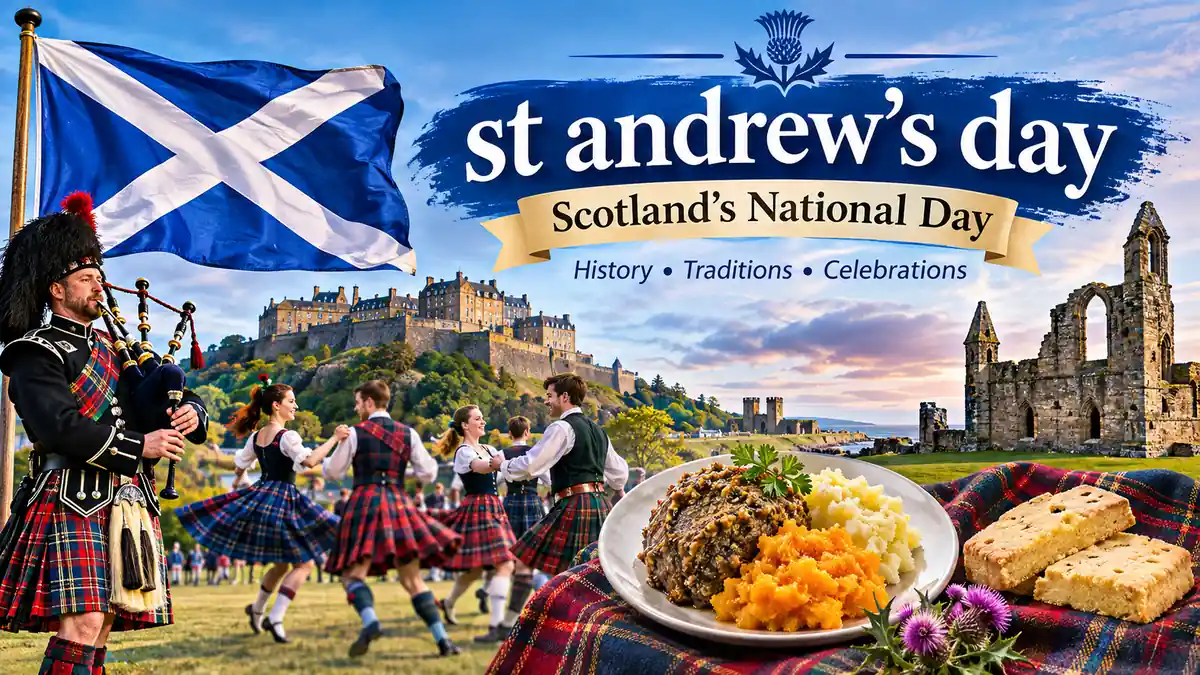
Every November 30, Scotland celebrates a saint who never visited the country but became one of its most recognizable national symbols. From the blue-and-white Saltire flying over historic buildings to traditional ceilidh dancing, the occasion brings together centuries of history, folklore, faith, and Scottish identity.
st andrew’s day is Scotland’s national day, celebrated annually on November 30 in honor of Saint Andrew, the country’s patron saint. The occasion recognizes Scotland’s cultural heritage through traditional music, dancing, food, community gatherings, and religious observances. It is also a bank holiday in Scotland, although businesses and schools do not necessarily close.
While the celebration has Christian origins, modern events welcome people of different backgrounds. For many Scots, the day offers an opportunity to explore their history, share cultural traditions, and celebrate the country’s contribution to the wider world.
When Is st andrew’s day Celebrated?
st andrew’s day falls on November 30 every year, regardless of which day of the week it lands on.
The date is traditionally associated with the feast of Saint Andrew in the Christian calendar. It has been observed for centuries, long before becoming an official bank holiday in Scotland.
In 2026, November 30 falls on a Monday.
| Year | Date | Day |
|---|---|---|
| 2026 | November 30 | Monday |
| 2027 | November 30 | Tuesday |
| 2028 | November 30 | Thursday |
| 2029 | November 30 | Friday |
| 2030 | November 30 | Saturday |
Is st andrew’s day a Public Holiday in Scotland?
Yes. The St Andrew’s Day Bank Holiday (Scotland) Act 2007 established November 30 as an official bank holiday in Scotland.
However, it is not a compulsory day off for every employee.
Employers may operate normally, and workers do not automatically receive paid leave simply because the date is a bank holiday. Entitlements depend on employment contracts and workplace policies.
Schools, shops, public transport, and other services may follow their usual schedules, although some organizations choose to close or arrange special activities.
When November 30 falls on a weekend, a substitute bank holiday is generally observed on the following Monday.
The distinction matters for visitors planning a trip to Scotland. A bank holiday does not mean every attraction, restaurant, or public service will be unavailable.
Who Was Saint Andrew?
Δευτέρα 30 Νοεμβρίου: Άγιος Ανδρέας ο Απόστολος και Πρωτόκλητος
Fratele Sfântului Petru creștinează românii. Sfântul Andrei – Evenimentul Istoric
7
Saint Andrew was one of the twelve apostles of Jesus Christ and the brother of Simon Peter, commonly known as Saint Peter.
According to the New Testament, Andrew and Peter worked as fishermen before becoming followers of Jesus.
Andrew is traditionally recognized as one of the earliest disciples called to follow Christ. The Gospel of John also identifies him as a disciple who introduced his brother Simon Peter to Jesus.
His name comes from the Greek Andreas, associated with the idea of manliness or courage.
How Did Saint Andrew Die?
Christian tradition holds that Saint Andrew was martyred at Patras, in Greece, during the first century AD.
Later accounts describe his crucifixion on an X-shaped cross, sometimes called a saltire or St Andrew’s Cross.
The exact circumstances of his death cannot be established with certainty from contemporary historical evidence. The distinctive X-shaped cross became particularly important in medieval religious art and Scottish symbolism.
Why Is Saint Andrew the Patron Saint of Scotland?
The connection between Saint Andrew and Scotland developed through a combination of religious traditions, medieval legends, and political history.
One well-known legend tells of a monk named Saint Regulus, also called Saint Rule, who received a divine instruction to carry relics of Saint Andrew away from their original resting place.
According to the story, Regulus brought the relics to the eastern coast of Scotland, where the town of St Andrews eventually developed into a major religious center.
Historians generally regard this account as a legend rather than a verified description of events.
Another tradition connects Saint Andrew with King Óengus, sometimes called Angus, a Pictish ruler who reportedly saw a white diagonal cross against a blue sky before a battle.
The story claims that the vision inspired the king’s forces and helped establish Saint Andrew as a protector of Scotland.
Although these stories are difficult to verify historically, they demonstrate how strongly the saint became associated with Scottish identity.
By the medieval period, devotion to Saint Andrew had become deeply established in Scotland, and he was recognized as its patron saint.
The History and Origins of st andrew’s day
The origins of the celebration stretch back to the early development of Christianity in Scotland.
Religious communities commemorated Saint Andrew’s feast day as part of the Christian liturgical calendar. Over time, the observance became closely connected with the country’s emerging national identity.
Early Christian Connections
Christianity spread across parts of Scotland during the early medieval period through missionaries, monasteries, and religious communities.
The settlement that became St Andrews, historically known as Kilrymont or Cennrígmonaid, developed into an important ecclesiastical center.
Its association with relics attributed to Saint Andrew helped strengthen its religious significance.
The town later became a major destination for medieval pilgrims, attracting visitors who traveled to honor the apostle.
Saint Andrew and Medieval Scotland
By the Middle Ages, Saint Andrew had become an important symbol of Scottish religious and political independence.
The Declaration of Arbroath, issued in 1320 during the reign of Robert the Bruce, invoked Saint Andrew as Scotland’s patron saint.
The declaration was addressed to Pope John XXII and argued for Scotland’s independence from England.
Its references to Saint Andrew demonstrate that the saint’s symbolic importance was already well established by the early fourteenth century.
From Religious Feast to National Celebration
Following the Scottish Reformation in the sixteenth century, many traditional Catholic religious practices changed.
Nevertheless, Saint Andrew remained an important national figure.
The modern celebration gradually expanded beyond church observances to include cultural festivals, Scottish music, traditional food, and community events.
In 2006, the Scottish Parliament passed legislation establishing the annual bank holiday, which received Royal Assent in 2007.
Today, November 30 combines religious heritage with a broader celebration of Scotland’s culture and history.
Why Is the Scottish Flag Associated With Saint Andrew?
Scottish Saltire flag (St. Andrew’s Cross) blowing in the wind
St Andrew & the Saltire, the Scottish Flag | VisitScotland
The Flag Of Scotland – Origins & History Of The Saltire
8
Scotland’s national flag, known as the Saltire, features a white diagonal cross against a blue background.
The design represents the cross traditionally associated with Saint Andrew’s martyrdom.
It is one of Scotland’s most recognizable national symbols.
The Legend Behind the Saltire
A popular Scottish legend describes a battle in which King Óengus and his forces faced a powerful enemy.
Before the fighting began, the king reportedly prayed for divine assistance.
According to the story, white clouds formed a diagonal cross against the blue sky, resembling the cross of Saint Andrew.
The king interpreted the sign as a promise of protection.
The story is commonly linked to a battle near Athelstaneford in East Lothian, although the historical details remain uncertain.
The legend has become part of Scotland’s national heritage, even though it should not be treated as a documented account of the flag’s creation.
What Do the Colors of the Saltire Mean?
The white diagonal cross represents Saint Andrew’s traditional symbol of martyrdom.
The blue background is associated with the sky described in the legend.
Although shades of blue have varied historically, the modern Scottish national flag is commonly displayed with a vivid blue field and a white saltire.
The flag appears at government buildings, sporting events, cultural festivals, and national celebrations.
Is the Saltire the Same as the Union Jack?
No. The Saltire represents Scotland, while the Union Flag, commonly called the Union Jack, represents the United Kingdom.
The Union Flag incorporates the crosses associated with three patron saints:
- Saint Andrew, representing Scotland.
- Saint George, representing England.
- Saint Patrick, representing Ireland.
Wales does not have a separate cross represented in the Union Flag.
The Scottish Saltire remains a distinct national flag and is especially prominent during celebrations of Scottish identity.
How Is st andrew’s day Celebrated in Scotland?
Photography Guide for Scottish Festivals: Etiquette, Gear, and Lighting
Scotland Vacations & Tours Packages | Adventures by Disney
12 Best Things to Do in Edinburgh, Scotland (2026 Guide)
8
Modern celebrations combine traditional Scottish customs with contemporary festivals, educational activities, and community gatherings.
Unlike Christmas or Hogmanay, there is no single set of activities that every Scottish household follows.
Celebrations vary between cities, towns, schools, churches, and individual families.
Traditional Ceilidh Dancing
A ceilidh is a Scottish social gathering featuring traditional music and group dancing.
The word comes from Scottish Gaelic and originally referred to a social visit or gathering.
Modern ceilidhs commonly feature fiddles, accordions, drums, and other instruments.
Popular dances include the Gay Gordons, Strip the Willow, and the Dashing White Sergeant.
A caller often explains the movements, allowing newcomers to participate without previous experience.
Ceilidhs are especially suitable for community celebrations because they encourage people of different ages and abilities to dance together.
Scottish Bagpipes and Folk Music
Bagpipes are among Scotland’s most recognizable musical traditions.
During national celebrations, pipe bands and traditional musicians may perform at public events, cultural centers, and community gatherings.
Scottish folk music also features instruments such as the fiddle, clàrsach (Scottish harp), accordion, and whistle.
Music is often accompanied by storytelling, singing, or dancing.
Wearing Tartan and Kilts
Tartan is a patterned textile associated with Scottish heritage.
Traditional tartan designs use intersecting horizontal and vertical bands of color.
Some patterns are associated with particular clans, families, or organizations, while others are regional or contemporary designs.
People celebrating the national day may wear kilts, tartan scarves, ties, or other accessories.
However, traditional clothing is optional, and there is no official dress code.
Community Festivals and Cultural Events
Communities across Scotland organize activities to celebrate their heritage.
These may include folk concerts, storytelling sessions, historical exhibitions, family workshops, and traditional dancing.
VisitScotland identifies November 30 as an occasion for cultural celebrations throughout the country, including music and community gatherings. VisitScotland+1
Religious Services
For Christians, November 30 remains the feast day of Saint Andrew.
Churches may mark the occasion through prayers, readings, special services, and reflections on the apostle’s life.
The religious observance emphasizes themes associated with Andrew’s role as a disciple, including faith, service, and commitment.
These services exist alongside the wider secular celebration of Scottish culture.
Traditional Scottish Food for st andrew’s day
Scottish Foods: Fabulous Scottish Cuisine To Enjoy
Traditional Cullen Skink | Live Breathe Scotland
Highland Maid Edinburgh Rock (150g) | Thistle Scottish Gifts
7
Food is an important part of many Scottish cultural celebrations.
There is no compulsory menu for November 30, but families and restaurants often feature traditional Scottish dishes.
| Traditional dish | Description |
|---|---|
| Haggis | Savory pudding traditionally made with sheep’s offal, oatmeal, onions, and spices |
| Neeps and tatties | Mashed turnips or swede and potatoes |
| Cullen skink | Creamy soup made with smoked haddock, potatoes, and onions |
| Scotch broth | Hearty soup containing barley, vegetables, and often meat |
| Cranachan | Dessert made with cream, raspberries, toasted oats, and often whisky |
| Shortbread | Rich, crumbly biscuits made with butter, flour, and sugar |
| Scottish tablet | Sweet confection made with sugar, butter, and condensed milk |
Haggis, Neeps and Tatties
Haggis is one of Scotland’s best-known traditional foods.
It is typically served with mashed potatoes and mashed swede, commonly known as tatties and neeps.
Although strongly associated with Burns Night, the dish is also a popular choice for other Scottish celebrations.
Vegetarian haggis offers an alternative for people who prefer not to eat meat.
Cullen Skink
Cullen skink originated in the fishing town of Cullen in Moray, northeastern Scotland.
The soup traditionally combines smoked haddock, potatoes, and onions with milk or cream.
Its rich flavor makes it particularly suitable for Scotland’s colder months.
Cranachan and Scottish Shortbread
Cranachan is a traditional Scottish dessert that combines raspberries, cream, and toasted oats.
Some recipes include honey and whisky.
Shortbread is another familiar treat, often served with tea or coffee.
These foods are not exclusive to November 30, but they provide an accessible way to celebrate Scottish culinary traditions.
Where Can You Experience st andrew’s day in Scotland?
Different parts of Scotland offer distinctive ways to explore the history and culture associated with the celebration.
St Andrews, Dundee and the Fife Coast – Award Winning Small Group Tours
St Andrews
This historic town has the strongest geographical association with Scotland’s patron saint. Visitors can explore the remains of St Andrews Cathedral, learn about medieval pilgrimage, and discover the town’s religious heritage.
Edinburgh
Scotland’s capital offers museums, historic landmarks, music venues, and cultural institutions. Seasonal programs may include traditional music, performances, and Scottish heritage activities.
Strategy 2030 | Glasgow Caledonian University | Scotland, UK
Glasgow
Glasgow’s music scene makes it a natural destination for folk concerts, ceilidhs, and community celebrations. Event availability varies from year to year.
File:Athelstaneford 06.jpg – Wikimedia Commons
Athelstaneford
This East Lothian village is associated with the legend of the Saltire’s origins. It offers an opportunity to explore the story behind Scotland’s national flag.
🏛️
🏰
🎵
🏳️
Use two fingers to move the map
Use ctrl + scroll to zoom the map
Visitors planning to attend a particular event should check the organizer’s current schedule rather than assuming celebrations take place at the same venues every year.
Is Saint Andrew Celebrated Outside Scotland?
Saint Andrew is associated with several countries and Christian traditions beyond Scotland.
He is also recognized as a patron saint of countries including Greece, Russia, Romania, and Ukraine.
His religious significance extends across Catholic, Eastern Orthodox, and other Christian communities.
Saint Andrew in Greece
The Greek city of Patras has a particularly strong connection with Saint Andrew because Christian tradition identifies it as the place of his martyrdom.
The Church of Saint Andrew in Patras is a major religious landmark.
November 30 is observed as an important religious feast, particularly in communities that honor the apostle.
Saint Andrew in Romania
Saint Andrew is recognized as a patron saint of Romania.
November 30 is a national public holiday there, and the occasion is associated with religious observances and traditional customs.
Romanian folklore also includes customs connected with protection, the approaching winter, and hopes for the future.
These traditions differ from Scottish celebrations, illustrating how one saint can become associated with distinct national cultures.
Scottish Communities Around the World
Scottish expatriate communities and descendants of Scottish emigrants also celebrate the occasion.
St Andrew’s societies exist in countries such as Canada, Australia, New Zealand, and the United States.
These organizations often promote Scottish heritage through cultural gatherings, educational activities, charitable work, and social events.
Some host formal dinners or ceilidhs around November 30.
For people with Scottish ancestry, the occasion provides a way to maintain cultural connections across generations.
How Does st andrew’s day Compare With Other Scottish Celebrations?
Scotland has several major cultural occasions, but they recognize different aspects of its history and identity.
| Celebration | Date | Main significance |
|---|---|---|
| st andrew’s day | November 30 | Scotland’s patron saint and national identity |
| Hogmanay | December 31 | Scottish New Year’s Eve traditions |
| Burns Night | January 25 | Life and poetry of Robert Burns |
| Tartan Day | April 6 in North America | Scottish heritage and cultural connections |
St Andrew’s Day vs. Burns Night
Burns Night honors the Scottish poet Robert Burns.
Celebrations often include a Burns supper, poetry readings, haggis, and traditional music.
By contrast, November 30 focuses on Scotland’s patron saint and broader national heritage.
Both occasions celebrate Scottish identity, but their historical origins are different.
St Andrew’s Day vs. Hogmanay
Hogmanay is Scotland’s traditional New Year’s Eve celebration.
It is associated with customs such as first-footing, singing Auld Lang Syne, and welcoming the new year.
St Andrew’s Day takes place a month earlier and is centered on the patron saint rather than the changing calendar year.
Together with Burns Night, these occasions form an important part of Scotland’s winter cultural calendar.
How Can Schools and Families Celebrate st andrew’s day?
The occasion offers opportunities to introduce children to Scottish history, geography, literature, music, and cultural traditions.
Activities can be adapted for different age groups without requiring expensive equipment or elaborate preparations.
Learn About the Scottish Flag
Children can create a paper Saltire using blue paper and white strips.
The activity provides an opportunity to explain why Scotland’s flag features a diagonal cross.
Teachers can distinguish between the historical development of the flag and the legend of King Óengus.
Explore Scottish History Through Storytelling
Stories about Saint Andrew, Saint Regulus, and the medieval town of St Andrews can introduce important historical themes.
Older students can investigate the Declaration of Arbroath and discuss how national symbols develop over time.
A useful exercise is to compare historical evidence with traditional legends.
Try Scottish Music and Dancing
Traditional music can help children experience Scottish culture beyond textbooks.
Simple ceilidh dances encourage cooperation, coordination, and participation.
Students can also learn about the bagpipes, fiddle, and Scottish harp.
Discover Scottish Gaelic and Scots
Scotland has a rich linguistic heritage that includes Scottish Gaelic, Scots, and Scottish English.
Learning a few words provides a practical introduction to this diversity.
For example, fàilte means welcome in Scottish Gaelic, while slàinte is commonly used as a toast meaning health.
It is helpful to explain that Scots and Scottish Gaelic are distinct languages rather than different names for the same language.
Prepare a Scottish-Inspired Meal
Families can make shortbread, prepare a simple soup, or explore vegetarian versions of traditional dishes.
Cooking activities provide opportunities to discuss regional ingredients, farming traditions, and the relationship between food and culture.
Why Does st andrew’s day Matter to Scottish Identity?
The importance of the occasion extends beyond religious observance.
Saint Andrew has served as a symbol of Scotland for centuries, appearing in historical documents, flags, seals, and public traditions.
The association between the saint and Scottish independence is particularly visible in the Declaration of Arbroath.
Issued on April 6, 1320, the document appealed to Pope John XXII to recognize Scotland’s independence and Robert the Bruce as its lawful king. National Records of Scotland (NRS)+1
Today, the national day also provides a shared cultural occasion for people who may have different religious beliefs, backgrounds, or relationships with Scottish heritage.
A Symbol of Shared Heritage
Scotland’s identity has been shaped by its Gaelic, Pictish, Norse, Anglo-Saxon, and other historical influences.
Its modern population is equally diverse.
The national day creates opportunities to celebrate traditions while recognizing that Scottish identity continues to evolve.
A Connection Between Scotland and the Wider World
Scottish culture has influenced communities far beyond the country’s borders through migration, education, literature, engineering, music, and trade.
The global network of Scottish cultural organizations helps maintain those connections.
Saint Andrew himself also represents a link between Scotland and other countries that honor the apostle.
Preserving Traditions for Future Generations
Cultural celebrations help keep music, dance, language, storytelling, and historical knowledge visible in everyday life.
Schools, museums, community groups, and families all contribute to this process.
The value of the occasion lies not only in remembering the past but also in giving new generations opportunities to understand and participate in Scottish heritage.
Interesting Facts About Saint Andrew and Scotland’s National Day
Several details make the celebration distinctive.
- Saint Andrew was not Scottish. He was a fisherman from Galilee, in the eastern Mediterranean region.
- He is also associated with Greece. Tradition identifies Patras as the location of his martyrdom.
- The Saltire has medieval roots. The Flag Institute identifies its use as a Scottish national emblem as early as 1286. UK Flag Registry
- The town of St Andrews became a major pilgrimage destination. Its cathedral was one of medieval Scotland’s most important religious buildings.
- The University of St Andrews was founded in 1413. It is Scotland’s oldest university.
- November 30 is not automatically a paid day off. Scotland’s bank holiday rules do not require all employers to provide paid leave. Scottish Government
- Saint Andrew’s influence extends beyond Scotland. He is honored by Christian communities in several European countries.
- The celebration has both religious and secular dimensions. Church services take place alongside cultural festivals and social gatherings.
What Makes st andrew’s day Special?
st andrew’s day brings together religious history, medieval legends, national symbolism, and living cultural traditions.
Its central figure was a first-century apostle whose association with Scotland developed over many centuries. His diagonal cross became the Saltire, while his feast day grew into an occasion for celebrating Scottish identity.
Today, November 30 is marked through traditional dancing, music, food, storytelling, community events, and religious services.
For anyone interested in Scotland, the occasion offers a meaningful introduction to the country’s history and cultural heritage. Exploring the story of Saint Andrew, learning about the Saltire, or taking part in a local celebration are all ways to understand why this national day continues to matter.
