

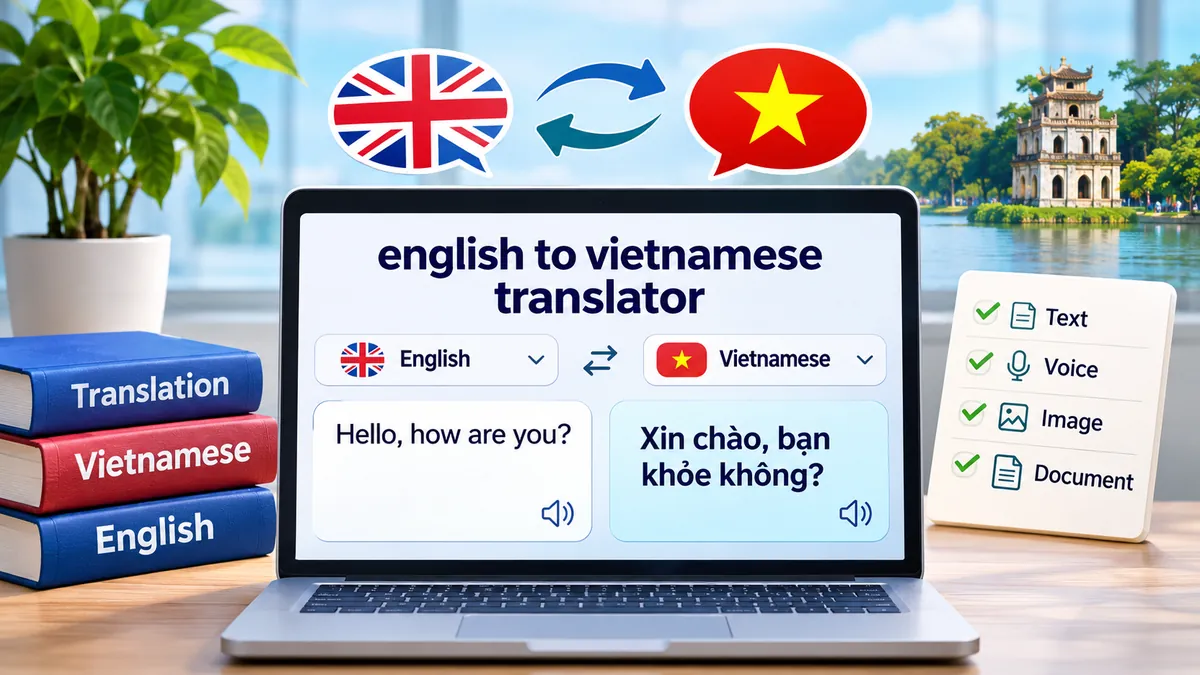
Translating English into Vietnamese involves more than replacing individual words. Vietnamese uses tones, context-dependent pronouns, and grammatical structures that differ significantly from English. Even a short sentence can change meaning when the wrong form of address or vocabulary is used.
An english to vietnamese translator is a digital tool that converts English words, sentences, or documents into Vietnamese. Popular options include Google Translate, Microsoft Translator, and DeepL. These tools use machine translation technology to interpret meaning, but accuracy depends on context, sentence structure, regional vocabulary, and the complexity of the original text.
Understanding how these tools work can help you translate everyday conversations, educational materials, travel information, and professional documents more accurately.
What Is an english to vietnamese translator?
An English-to-Vietnamese translator is a software application, website, or language service that converts English text or speech into Vietnamese while attempting to preserve its original meaning.
Most modern translation platforms use neural machine translation (NMT), which analyzes words in context rather than translating every word independently.
For example:
| English | Vietnamese |
|---|---|
| Hello | Xin chào |
| Thank you | Cảm ơn |
| Good morning | Chào buổi sáng |
| How are you? | Bạn khỏe không? |
| I love you | Tôi yêu bạn |
| What is your name? | Bạn tên là gì? |
| Where is the bathroom? | Nhà vệ sinh ở đâu? |
| How much does this cost? | Cái này giá bao nhiêu? |
These examples use generally understandable Vietnamese expressions. In actual conversations, speakers may choose different pronouns or greetings depending on age, familiarity, and social relationships.
For instance, Tôi yêu bạn is grammatically understandable, but romantic partners often use Anh yêu em or Em yêu anh, depending on how they address each other.
That distinction illustrates why translating the meaning of a sentence is often more useful than translating its individual words.
How Does an english to vietnamese translator Work?
Modern translation tools generally rely on artificial intelligence and multilingual language models trained on large collections of text.
Neural machine translation
Neural machine translation evaluates the relationships between words and phrases within a sentence.
Consider the English sentence:
“I am going to the bank.”
The word bank could refer to a financial institution or the side of a river.
Depending on context, Vietnamese translations might include:
- Ngân hàng — financial bank
- Bờ sông — riverbank
A translation system uses surrounding words to estimate which meaning is intended.
Without enough context, however, it can select the wrong interpretation.
Context and sentence structure
English generally follows a subject–verb–object sentence pattern. Vietnamese often uses the same basic order, but handles tense, plurals, pronouns, and modifiers differently.
For example:
English: “I ate breakfast yesterday.”
Vietnamese: “Hôm qua tôi ăn sáng.”
Vietnamese can express time using hôm qua (yesterday) without changing the verb ăn (eat) into a past-tense form.
Machine translation systems must recognize these grammatical differences rather than mechanically copying English sentence structures.
Speech recognition and translation
Some translation applications also support spoken language.
A typical voice translation process involves three stages:
- Speech recognition converts spoken English into text.
- Machine translation converts the recognized text into Vietnamese.
- Text-to-speech technology produces Vietnamese audio.
Accuracy depends on the quality of the speech recording, pronunciation, background noise, and the translation model.
A mistake in the initial speech recognition stage can affect the entire translated sentence.
Popular English to Vietnamese Translation Tools
Several established platforms support English-to-Vietnamese translation. Their features differ in language coverage, supported devices, document handling, and availability of offline functions.
Google Translate Gains Offline Translation in 52 Languages – MacRumors
Google Translate
Supports text translation, speech translation, and camera-based translation on supported devices. It is useful for travel, everyday communication, and understanding short passages.
Microsoft Translator icon in Windows 11 Color Style
Microsoft Translator
Provides multilingual text and speech translation features, including conversation-oriented capabilities in supported environments.
DeepL Übersetzen & Schreiben iPhone-/ iPad-App – Download – CHIP
DeepL Translator
Uses neural translation technology and offers text and document translation features. Available languages and functions can vary by platform and subscription.
Comparing translation tools
| Feature | Google Translate | Microsoft Translator | DeepL |
|---|---|---|---|
| Text translation | Yes | Yes | Yes |
| Vietnamese support | Yes | Yes | Yes |
| Voice features | Yes | Yes | Platform-dependent |
| Image translation | Supported | Platform-dependent | Platform-dependent |
| Document translation | Supported | Product-dependent | Supported |
| Offline translation | Selected mobile languages | Selected mobile languages | Not a standard offline feature |
Features and language availability can change with software updates, so users should check the current application before relying on a particular function.
No single tool guarantees perfect results for every Vietnamese sentence. Comparing outputs can help identify ambiguous wording, especially for longer or more complex material.
How to Translate English to Vietnamese Step by Step
Using an online translation tool is straightforward, but a few additional checks can make the results considerably more reliable.
Step 1: Select the correct languages
Open your preferred translator and set:
- Source language: English
- Target language: Vietnamese
Automatic language detection is convenient, but manually selecting English can prevent mistakes when translating short phrases or unfamiliar names.
Step 2: Enter complete sentences
Type or paste the English text into the translation field.
Complete sentences generally provide more context than isolated words.
For example, translating “light” alone might produce a word related to brightness or weight.
Compare these sentences:
| English sentence | Vietnamese translation |
|---|---|
| Turn on the light. | Bật đèn lên. |
| This bag is light. | Cái túi này nhẹ. |
| The room is very bright. | Căn phòng rất sáng. |
The surrounding words help determine whether the intended meaning involves illumination, weight, or brightness.
Step 3: Review the Vietnamese output
Check the translation for missing information, awkward phrasing, and incorrect pronouns.
Pay particular attention to names, addresses, measurements, dates, and numbers.
These details can be misinterpreted even when the rest of a sentence appears correct.
Step 4: Listen to the pronunciation
If the application provides audio playback, listen to the translated sentence.
Vietnamese pronunciation depends heavily on tones, so reading the written words without hearing them may not be enough for beginners.
Repeat short phrases and compare your pronunciation with the audio.
Step 5: Verify important translations
For a sentence that will be used in a formal email, educational assignment, or important conversation, compare the result with another translator or have a proficient Vietnamese speaker review it.
Back-translation—translating Vietnamese back into English—can reveal obvious mistakes, although it cannot prove that the original translation is correct.
Understanding the Vietnamese Language Before Translating
Vietnamese, known as Tiếng Việt, is the official language of Vietnam. It belongs to the Austroasiatic language family and is commonly classified within the Vietic branch.
Several characteristics distinguish Vietnamese from English.
Vietnamese uses a Latin-based writing system
Modern Vietnamese is written using chữ Quốc ngữ, a Latin-based writing system that includes additional letters and diacritical marks.
The Vietnamese alphabet contains 29 letters.
Unlike English, Vietnamese does not use the letters F, J, W, and Z as part of its standard alphabet, although they can appear in foreign names and borrowed expressions.
The writing system includes letters such as:
- Ă and Â
- Đ
- Ê
- Ô and Ơ
- Ư
These are distinct letters, not simply decorative variations.
Vietnamese is a tonal language
Standard Northern Vietnamese is commonly described as having six tones.
How tones change the meaning of a syllable
ma
LevelGhost
má
RisingMother (Southern usage)
mà
FallingBut / that
mả
DippingGrave
mã
Broken risingCode / horse (Sino-Vietnamese)
mạ
HeavyRice seedling
Illustrative meanings. Actual pronunciation and tone distinctions vary by region, and individual words can have additional meanings.
The six traditional Northern tone categories are ngang, sắc, huyền, hỏi, ngã, and nặng.
Some Southern Vietnamese varieties merge certain tone distinctions, resulting in a five-way tonal contrast in common descriptions.
Because tones can distinguish words, omitting diacritical marks may make Vietnamese text ambiguous.
Vietnamese verbs do not conjugate like English verbs
English verbs frequently change form to indicate tense:
- I eat.
- I ate.
- I will eat.
Vietnamese commonly uses time expressions and grammatical particles rather than changing the verb itself.
For example:
| English | Vietnamese |
|---|---|
| I eat rice. | Tôi ăn cơm. |
| I ate rice yesterday. | Hôm qua tôi ăn cơm. |
| I will eat rice tomorrow. | Ngày mai tôi sẽ ăn cơm. |
| I am eating rice. | Tôi đang ăn cơm. |
The verb ăn remains unchanged.
Words such as đã, đang, and sẽ can help express completed, ongoing, or future situations, but their use is not identical to English tense conjugation.
Vietnamese uses classifiers
Vietnamese frequently uses classifiers when counting nouns.
For example:
- Một con mèo — one cat
- Hai quyển sách — two books
- Ba cái bàn — three tables
Here, con, quyển, and cái function as classifiers.
English generally does not require equivalent words in these examples.
An automatic translator must account for the noun category and natural Vietnamese usage when producing these constructions.
Common English to Vietnamese Words and Phrases
Learning frequently used phrases helps readers recognize translation errors and communicate more naturally.
Greetings and polite expressions
| English | Vietnamese |
|---|---|
| Hello | Xin chào |
| Goodbye | Tạm biệt |
| Thank you | Cảm ơn |
| Thank you very much | Cảm ơn rất nhiều |
| Sorry | Xin lỗi |
| Please help me | Xin hãy giúp tôi |
| Yes | Vâng / Dạ |
| No | Không |
| See you again | Hẹn gặp lại |
| Good night | Chúc ngủ ngon |
Vâng and dạ are polite responses, while không can express negation or refusal. The appropriate response depends on the question and social context.
Travel and transportation
| English | Vietnamese |
|---|---|
| Where is the airport? | Sân bay ở đâu? |
| I need a taxi. | Tôi cần một chiếc taxi. |
| Where is the hotel? | Khách sạn ở đâu? |
| Please stop here. | Vui lòng dừng ở đây. |
| I am lost. | Tôi bị lạc đường. |
| How far is it? | Chỗ đó cách đây bao xa? |
| Where is the train station? | Ga tàu ở đâu? |
| I need help. | Tôi cần giúp đỡ. |
For travel, short and specific sentences are usually easier to translate than lengthy explanations.
For instance, “Please take me to this address” is clearer than an informal instruction containing slang or several location references.
Food and restaurants
| English | Vietnamese |
|---|---|
| I am hungry. | Tôi đói. |
| I would like water. | Tôi muốn uống nước. |
| The food is delicious. | Món ăn rất ngon. |
| I do not eat meat. | Tôi không ăn thịt. |
| I am vegetarian. | Tôi ăn chay. |
| Can I see the menu? | Cho tôi xem thực đơn được không? |
| The bill, please. | Cho tôi xin hóa đơn. |
| Is this spicy? | Món này có cay không? |
Vietnamese cuisine includes dishes whose names do not have simple English equivalents.
Examples include phở, bánh mì, bún chả, and bánh xèo.
A translation tool may preserve these names or provide a descriptive explanation. Keeping the original dish name is often more useful when ordering food.
Why English to Vietnamese Translation Can Be Difficult
Translation quality depends on more than vocabulary.
Cultural conventions, regional language differences, and context can all influence the most natural Vietnamese wording.
Personal pronouns depend on relationships
English uses a relatively small set of common personal pronouns.
Vietnamese has a much more elaborate system of personal address, frequently involving kinship terms.
Common examples include:
| Vietnamese | Typical use |
|---|---|
| Tôi | Neutral or relatively formal first person |
| Bạn | Second person in suitable peer or neutral contexts |
| Anh | Older brother; also an address term for a man |
| Chị | Older sister; also an address term for a woman |
| Em | Younger sibling or younger person |
| Cô | Aunt; also an address term for certain women |
| Chú | Uncle; also an address term for certain men |
| Ông | Grandfather; respectful address for an older man |
| Bà | Grandmother; respectful address for an older woman |
These meanings are contextual rather than fixed equivalents of English pronouns.
For example, the sentence “How are you?” may be expressed differently when addressing a friend, an older colleague, or a younger relative.
A translator that does not know the relationship between the speakers may choose a grammatically valid but socially inappropriate pronoun.
Northern, Central, and Southern Vietnamese differ
Vietnamese has regional variations in vocabulary, pronunciation, and conversational style.
Hanoi is commonly associated with Northern Vietnamese, while Ho Chi Minh City is associated with Southern Vietnamese.
Consider these examples:
| English | Northern usage | Southern usage |
|---|---|---|
| Bowl | Bát | Chén |
| Corn | Ngô | Bắp |
| Pineapple | Dứa | Thơm / Khóm |
| Pig | Lợn | Heo |
These are common regional tendencies, not absolute geographical boundaries.
A word familiar in one region may also be understood elsewhere.
Central Vietnamese includes additional regional varieties and distinctive pronunciation patterns.
Most general-purpose translators produce broadly understandable Vietnamese rather than allowing users to choose a precise regional dialect.
Idioms rarely translate word for word
English idioms can become confusing when translated literally.
Consider:
“It’s raining cats and dogs.”
A literal Vietnamese translation would not naturally communicate the intended meaning.
A better translation is:
Trời đang mưa như trút nước.
This conveys the idea of extremely heavy rain.
Similarly, “break a leg” is usually an expression of encouragement rather than a reference to physical injury.
A context-aware translation should communicate the intended meaning, not reproduce the individual words.
English words can have multiple meanings
Words such as right, run, set, charge, and fine have several meanings.
The sentence “The charge was incorrect” could refer to a financial fee, an accusation, or another specialized meaning.
Without context, translation software may select an unsuitable Vietnamese term.
Providing a complete sentence or a short explanation helps reduce ambiguity.
How Accurate Is an english to vietnamese translator?
Translation accuracy varies by the type of content, the amount of context, and the system being used.
There is no single meaningful accuracy percentage that applies to every English-to-Vietnamese translation.
A tool may translate a straightforward travel sentence well but struggle with an idiomatic expression or a specialized legal paragraph.
| Content type | Typical reliability | Main concern |
|---|---|---|
| Basic greetings | Generally high | Pronouns and politeness |
| Everyday sentences | Often good | Missing context |
| Travel instructions | Often useful | Place names and directions |
| Informal conversations | Variable | Slang and implied meaning |
| Academic writing | Variable | Specialized terminology |
| Medical information | Requires expert verification | Safety-critical meaning |
| Legal documents | Requires professional review | Legal precision |
| Literature and poetry | Often challenging | Style and cultural nuance |
These descriptions are qualitative guidance, not measured performance scores.
Common machine translation errors
One frequent problem is choosing an overly formal expression for a casual conversation.
Another is using an incorrect form of address.
Machine translation can also struggle with:
- Sarcasm and humor
- Abbreviations and internet slang
- Technical terminology
- Unclear sentence boundaries
- Cultural references
- Regional vocabulary
- Sentences with omitted subjects
- Words with multiple meanings
For example, the English phrase “I’m fine” might mean that someone feels well, is politely declining assistance, or is expressing frustration.
The best Vietnamese translation depends on which meaning is intended.
When human translation is necessary
Human review is especially valuable for contracts, official certificates, immigration documents, medical instructions, and published academic material.
A professional translator can examine the context, terminology, audience, and purpose of the document.
For documents requiring certification, a machine-generated translation alone may not satisfy the receiving organization’s requirements.
Using an English to Vietnamese Voice Translator
Voice translation is useful when people need to communicate without typing.
Many mobile applications combine speech recognition, translation, and synthesized audio.
How to translate spoken English
- Open a translation application that supports speech input.
- Choose English as the spoken language.
- Select Vietnamese as the target language.
- Tap the microphone control.
- Speak clearly at a natural pace.
- Review the recognized English text.
- Play or display the Vietnamese translation.
The recognition step deserves attention.
If the application hears “fifteen” as “fifty,” the translated sentence may be linguistically correct but factually wrong.
Tips for better voice translation
Speak in short sentences and avoid talking over other people.
Pause between ideas and minimize background noise when possible.
For important numbers, repeat the information or display it in writing.
In a restaurant, for example, showing the Vietnamese translation of an allergy-related statement may be more dependable than relying exclusively on audio. However, automated translation should not be the sole safeguard for a serious food allergy.
Can Vietnamese speech be translated back into English?
Yes. Supported translation applications can translate Vietnamese speech into English.
However, recognition accuracy may vary with regional accents, speaking speed, and recording conditions.
This is particularly relevant because Vietnamese tones carry meaning, and pronunciation varies across regions.
Translating English to Vietnamese From Images and Documents
Translation is not limited to typed text.
Modern applications can process images, photographs, and selected document formats.
Camera and image translation
Camera translation uses optical character recognition (OCR) to detect written text before translating it.
It can help readers understand:
- Restaurant menus
- Street signs
- Product labels
- Printed instructions
- Travel notices
For example, a traveler can point a smartphone camera at a Vietnamese menu and obtain an approximate English translation.
The same technology can help translate printed English material into Vietnamese.
Image quality matters. Blurry photographs, decorative fonts, poor lighting, and handwritten text can reduce recognition accuracy.
Google documents camera translation and offline image capabilities for supported downloaded languages. Google Translate Help+1
Translating PDF and Word documents
Some translation services support document uploads, including PDF and Microsoft Word formats.
The typical process involves selecting the original language, choosing Vietnamese, uploading the file, and reviewing the translated document.
However, document translation introduces additional challenges.
Tables may become misaligned, formatting may change, and scanned PDFs may require OCR.
A document containing technical terminology or complex layouts should be reviewed carefully after translation.
Protecting confidential information
Before uploading documents, consider whether they contain sensitive information.
Personal identification numbers, medical records, financial statements, and confidential business material may require special handling.
Review the provider’s privacy policy, data retention practices, and enterprise controls before submitting sensitive text.
For highly confidential documents, use an approved translation workflow rather than an unrestricted public translation website.
How to Use an english to vietnamese translator Offline
Offline translation can be helpful when traveling without reliable mobile data.
Google Translate supports downloading selected language packages for offline use. Its help documentation also explains that downloaded languages can support offline camera translation on compatible devices. Google Translate Help+1
Downloading an offline language
The general process in Google Translate is:
- Open the Google Translate mobile application.
- Connect to Wi-Fi.
- Open the language selection menu.
- Find Vietnamese.
- Download the available language package.
- Test translation with the internet connection disabled.
Offline capabilities vary by language, device, application version, and translation mode.
Text translation may work offline even when particular speech or conversation functions require an internet connection.
Limitations of offline translation
Offline models may offer fewer features or produce different results from cloud-based systems.
For best results, download the necessary languages before traveling and test the specific functions you expect to use.
Keep important addresses, emergency contacts, and essential phrases saved separately in case translation software becomes unavailable.
Improving English to Vietnamese Translation Accuracy
A few practical writing habits can significantly improve translation quality.
Use clear, direct English
Simple sentences reduce ambiguity.
Instead of:
“I was wondering if perhaps you might be able to give me a hand with this.”
Write:
“Can you help me with this?”
The shorter sentence communicates the same basic request with fewer opportunities for misinterpretation.
Avoid unnecessary slang
Expressions such as “hit me up,” “I’m down,” or “that’s sick” can have meanings unrelated to their literal wording.
Replace slang with direct language when accuracy matters.
For example, use “Contact me tomorrow” instead of “Hit me up tomorrow.”
Explain the intended audience
A message for a close friend may require different Vietnamese pronouns from a message addressed to a manager.
When using a context-aware translation system, specify the intended relationship and tone.
For example, indicate that the message is for an older colleague and should sound polite but natural.
Preserve proper nouns
Names of people, companies, products, and locations should be checked against the source.
Some geographical names have established Vietnamese forms, while others are commonly retained in their original spelling.
Avoid changing official document names or personal names without a valid reason.
Check Vietnamese diacritics
Diacritical marks are essential for distinguishing many Vietnamese words.
A missing accent mark can change the intended meaning or make a sentence harder to understand.
When copying translated text into emails or documents, verify that Unicode characters display correctly.
Compare meaning rather than identical wording
Two translators may produce different Vietnamese sentences that communicate the same idea.
This does not automatically mean that one is wrong.
Evaluate whether the translation preserves the intended message, uses appropriate vocabulary, and sounds natural to the target audience.
English to Vietnamese Translation for Students and Language Learners
Translation software can support Vietnamese learning, but it works best as a reference rather than a substitute for language study.
Learn vocabulary in context
Instead of memorizing an isolated word, study it within a sentence.
For example:
Học means “study” or “learn.”
Tôi học tiếng Việt means “I study Vietnamese.”
Seeing the word in context helps learners understand its grammatical role and common usage.
Use pronunciation alongside written text
Because Vietnamese is tonal, pronunciation practice should accompany vocabulary study.
Listen to native speech, repeat short sentences, and compare similar-sounding syllables.
Audio resources can help, but automatic pronunciation alone may not capture every regional variation.
Learn common sentence patterns
Useful patterns include:
| English pattern | Vietnamese example |
|---|---|
| I want… | Tôi muốn… |
| I need… | Tôi cần… |
| I like… | Tôi thích… |
| I don’t understand. | Tôi không hiểu. |
| Where is…? | … ở đâu? |
| What is this? | Đây là gì? |
Once learners understand these patterns, they can substitute vocabulary to create new sentences.
Understand Vietnamese word order
Vietnamese adjectives often follow the nouns they modify.
For example:
- Nhà đẹp — beautiful house
- Xe mới — new vehicle
- Sách hay — interesting or good book
This differs from common English adjective placement.
Recognizing these structures helps learners evaluate machine-generated sentences rather than accepting every output unquestioningly.
English to Vietnamese Translation for Professional Communication
Professional translation requires attention to tone, consistency, and terminology.
An English business email may contain expressions that sound unnatural when translated literally.
For example:
“Please find attached the requested document.”
A natural Vietnamese rendering could be:
Tôi xin gửi kèm tài liệu theo yêu cầu.
This communicates the intended professional message without closely reproducing the English wording.
Maintaining consistent terminology
Businesses working with Vietnamese-speaking employees, customers, or partners may use terminology lists to standardize translations.
A glossary can define preferred Vietnamese equivalents for product names, technical terms, and recurring phrases.
DeepL supports Vietnamese and offers language-related features, although availability of particular glossary and style controls depends on the language pair and product. Microsoft also lists Vietnamese among its supported Translator languages. How Can We Help You?+1
Translating technical content
Technical translation often involves specialized vocabulary in engineering, manufacturing, software development, finance, and healthcare.
A general translation model may choose a common meaning when the document requires a technical one.
For example, “current” could refer to electrical current or something happening at the present time.
The correct Vietnamese term depends on the field.
Technical content should therefore be reviewed against established terminology and relevant documentation.
Maintaining professional tone
Vietnamese business communication often uses relationship-sensitive forms of address and polite expressions.
A translation should consider the recipient’s position, familiarity, and organizational context.
For formal correspondence, human review is advisable when the relationship or wording has significant consequences.
English to Vietnamese Translation vs. Vietnamese to English Translation
Translation direction can affect the types of errors that occur.
English-to-Vietnamese translation requires the system to choose suitable Vietnamese pronouns, classifiers, and grammatical particles.
Vietnamese-to-English translation may require the system to infer information that Vietnamese leaves implicit.
For example:
Tôi ăn cơm.
Depending on context, this might mean:
- I eat rice.
- I am eating rice.
- I eat a meal.
The Vietnamese sentence does not explicitly mark tense in the same way English often does.
A translator may need surrounding sentences to choose the most appropriate English form.
| Aspect | English to Vietnamese | Vietnamese to English |
|---|---|---|
| Pronouns | Must select appropriate address terms | Must interpret contextual address terms |
| Tense | Often expressed through context or particles | May require inferred English tense |
| Classifiers | May need Vietnamese classifiers | Often omitted in English |
| Tones | Must preserve written diacritics | Must correctly interpret Vietnamese words |
| Idioms | Must adapt English expressions | Must interpret Vietnamese expressions |
Both directions benefit from complete sentences and clearly defined context.
The Future of English to Vietnamese Machine Translation
Machine translation has developed from rule-based systems and statistical approaches into neural translation and large language model-based systems.
These technologies can process broader contexts and generate more fluent sentences.
However, fluent output is not necessarily accurate output.
A translation can sound natural while omitting a qualification, changing a number, or misunderstanding a relationship between speakers.
Context-aware AI translation
AI systems can increasingly incorporate instructions about audience, formality, terminology, and writing style.
This can be particularly helpful for Vietnamese because appropriate pronouns and expressions depend on social context.
Nevertheless, users should verify that the system follows the instructions correctly.
Real-time multilingual communication
Speech recognition and speech synthesis make translated conversations more accessible.
Future improvements may reduce delays and better handle regional pronunciation, interruptions, and conversational context.
Even with these improvements, important conversations may still require professional interpretation.
Human translators remain valuable
Machine translation is useful for speed, accessibility, and understanding routine information.
Human translators contribute cultural judgment, subject-matter knowledge, and responsibility for nuanced communication.
The two approaches can complement each other, especially when machine-generated drafts undergo careful human revision.
Final Thoughts on Choosing an english to vietnamese translator
An english to vietnamese translator can help with everyday communication, travel, language learning, documents, and professional correspondence.
Google Translate, Microsoft Translator, and DeepL all support Vietnamese, but their capabilities and suitability differ depending on the task.
The most reliable approach is to provide complete English sentences, preserve context, check Vietnamese pronouns and diacritics, and review important translations before using them.
For simple conversations, automated translation is often sufficient to communicate the main idea. For legal, medical, technical, or culturally sensitive material, professional verification remains the safer choice.
Understanding the basic features of Vietnamese makes it easier to recognize translation mistakes and communicate with greater clarity.
