

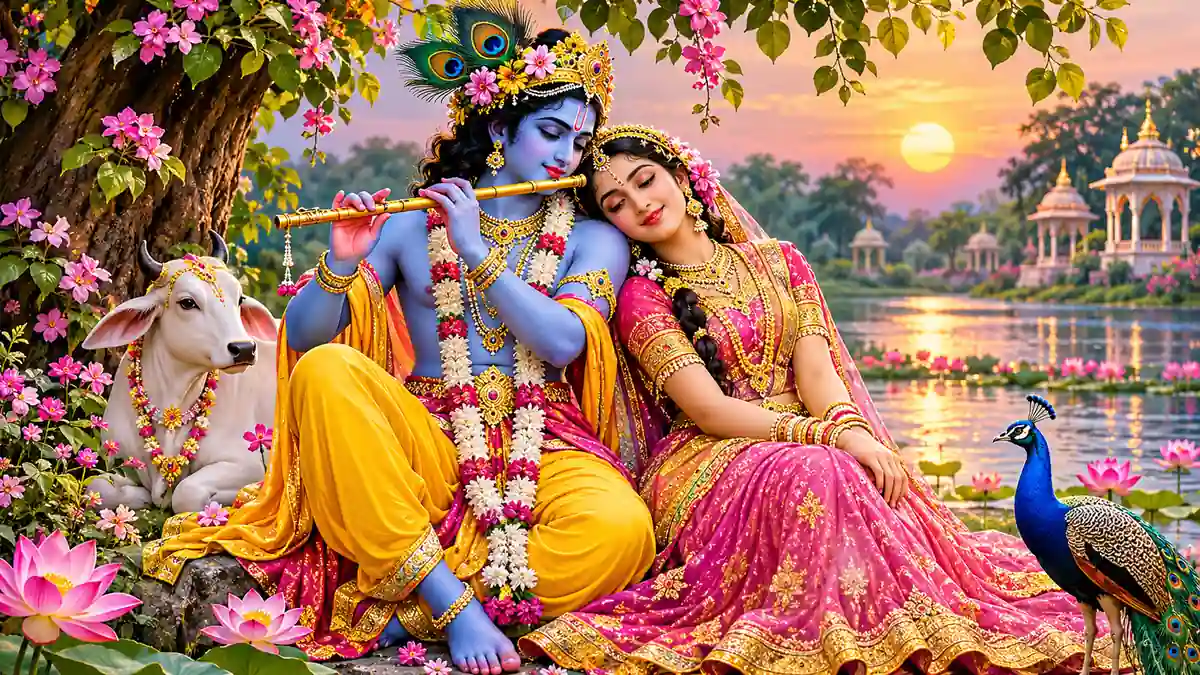
A beautiful picture of Radha and Krishna is more than a colorful piece of artwork. For millions of devotees, it represents divine love, spiritual connection, devotion, and the peaceful beauty of Vrindavan.
radha krishna images depict the sacred relationship between Radha Rani and Lord Krishna, often featuring Krishna’s flute, peacock feather, flower garlands, and enchanting natural surroundings. These devotional pictures appear in traditional Indian paintings, temple artwork, mobile wallpapers, festival greetings, and modern digital illustrations, reflecting the spiritual significance of Radha and Krishna in Hindu traditions.
From detailed paintings to simple silhouettes, each artistic style offers a different way to appreciate their symbolism. Understanding these differences helps viewers recognize the stories, cultural traditions, and devotional messages behind the images.
What Do radha krishna images Represent?
Radha and Krishna hold a special place in Hindu devotional traditions, particularly Vaishnavism and the Bhakti movement.
Krishna is worshipped as a divine manifestation of Vishnu or, in several Vaishnava traditions, as the Supreme Divine. Radha is revered as his beloved and, in many traditions, as the embodiment of devotion and divine love.
Together, they symbolize a spiritual relationship that extends beyond ordinary romantic affection.
Their imagery commonly represents:
- Divine love: A sacred relationship expressing unconditional affection.
- Bhakti: Loving devotion and surrender to the Divine.
- Spiritual harmony: The connection between the devotee and God.
- Joy and beauty: The playful, musical atmosphere associated with Krishna’s pastimes.
- Compassion and dedication: Qualities celebrated in devotional poetry and worship.
In Gaudiya Vaishnavism, Radha is especially revered as Krishna’s supreme devotee and his divine pleasure potency, often called hladini shakti.
These theological interpretations explain why Radha and Krishna are frequently depicted together rather than as separate figures.
Why Are Radha and Krishna Shown Together?
Their relationship is central to numerous devotional poems, paintings, and religious traditions.
The Gita Govinda, composed by the poet Jayadeva in the 12th century, is particularly influential in artistic representations of their relationship.
The poem explores love, separation, longing, reconciliation, and devotion through the relationship between Radha and Krishna.
Later devotional literature and painting traditions developed these themes further, inspiring generations of artists. Google Arts & Culture+1
Beautiful radha krishna images and Popular Artistic Styles
Radha Krishna artwork exists in many visual forms. Some paintings emphasize historical artistic traditions, while others use contemporary illustration techniques.
Understanding the major styles makes it easier to appreciate their distinct features.
Traditional Radha Krishna Paintings
Historical Indian paintings often portray the divine couple in gardens, forests, or beside the Yamuna River. They feature delicate brushwork, ornate clothing, expressive gestures, and natural scenery.
Radha Krishna Wallpaper Black Radha Krishna Wallpaper 4K, Digital Art,
Modern Digital Illustrations
Contemporary devotional artists use vivid colors, luminous backgrounds, soft lighting, and detailed digital effects to create expressive images suitable for screens and online sharing.
Tanjore and Decorative Artwork
Tanjore-style devotional paintings are known for rich colors, decorative surfaces, and gold embellishments. Radha Krishna compositions in this style often emphasize elaborate jewelry and sacred grandeur.
Radha Krishna Silhouette — Full Moon Vrindavan – HD Wallpaper | God Pictures | God Pictures
Minimalist and Silhouette Art
Simple outlines of Krishna’s flute, Radha’s profile, and a peacock feather can communicate the subject without elaborate decoration. These designs are popular for understated backgrounds and profile pictures.
Pahari and Kangra Miniature Paintings
Pahari painting developed across the Himalayan hill kingdoms, with Kangra becoming particularly famous for lyrical depictions of Krishna-related themes.
These paintings often feature gentle landscapes, refined facial expressions, flowering trees, and intimate scenes of Radha and Krishna.
A historical Radha-Krishna miniature from around 1800, documented by the Salar Jung Museum through Google Arts & Culture, depicts Krishna playing his flute beneath a Kadamba tree while Radha approaches him. Google Arts & Culture
Such works demonstrate how artists used natural surroundings and subtle gestures to communicate devotional emotions.
Rajasthani and Rajput Painting Traditions
Rajasthani schools, including Kishangarh and other Rajput painting traditions, also contributed distinctive depictions of Krishna and Radha.
Their artwork may include bold colors, decorative architecture, stylized eyes, elaborate textiles, and poetic landscapes.
The Rasikapriya of Keshavdas and other literary works influenced many representations of romantic and devotional emotions in Indian painting.
Pichwai-Inspired Devotional Art
Pichwai paintings are closely associated with the worship of Shrinathji, a form of Krishna, especially in the Nathdwara tradition.
Their visual language includes lotuses, cows, flowers, decorative borders, and seasonal celebrations.
Contemporary artists sometimes adapt these motifs to Radha Krishna compositions, although traditional Pichwai art is not exclusively centered on the divine couple.
Radha Krishna HD Images for Mobile and Desktop
High-definition devotional pictures are popular because they preserve the intricate details of clothing, jewelry, floral decorations, and facial expressions.
However, an image labeled HD is not necessarily suitable for every screen.
Actual resolution, aspect ratio, and image quality determine how clearly it appears.
Common Image Resolutions
| Image type | Typical resolution | Suitable use |
|---|---|---|
| HD | 1280 × 720 | Basic widescreen backgrounds |
| Full HD | 1920 × 1080 | Desktop and laptop wallpaper |
| QHD | 2560 × 1440 | High-resolution monitors |
| 4K UHD | 3840 × 2160 | Large and high-density displays |
| Portrait wallpaper | 1080 × 1920 | Many smartphone screens |
| Square image | 1080 × 1080 | Profile pictures and social posts |
These are common image dimensions, not requirements. Modern smartphones have varying screen shapes and resolutions.
How to Choose a Clear HD Image
A picture may appear sharp in a thumbnail but become blurry when enlarged.
For better results, examine the original file rather than relying on its preview.
- Check the image’s actual pixel dimensions.
- Choose an aspect ratio that matches your device.
- Inspect details such as eyes, jewelry, and fabric patterns.
- Avoid images with visible compression artifacts.
- Use the original-resolution file whenever available.
- Leave enough space around the subjects to prevent unwanted cropping.
For example, a horizontal painting may work beautifully on a laptop but crop Radha or Krishna when used as a vertical phone wallpaper.
A portrait-oriented composition is generally more suitable for a smartphone.
Radha Krishna Love Images and Their Spiritual Meaning
Radha Krishna love images are widely appreciated for their emotional warmth and religious significance.
In devotional traditions, their relationship is not understood merely as an ordinary romance. It is frequently interpreted as an expression of the highest form of divine love.
Different artistic scenes communicate different aspects of this relationship.
Radha and Krishna Standing Together
Images showing Radha beside Krishna often emphasize unity, affection, and spiritual companionship.
Their clothing may feature contrasting colors, while their expressions convey tenderness and serenity.
Some paintings include matching flower garlands or shared decorative elements to reinforce their connection.
Krishna Playing the Flute for Radha
The flute, or bansuri, is one of Krishna’s most recognizable attributes.
In devotional poetry, its music often represents the irresistible attraction of the Divine.
Paintings may show Radha listening attentively while Krishna plays beneath a flowering tree.
The scene conveys both musical beauty and the devotional longing associated with Krishna’s presence.
Radha Krishna on a Swing
Images of Radha and Krishna sitting on a decorated swing, or jhula, are associated with joyful devotional celebrations.
They are particularly relevant to Jhulan Yatra, a festival observed in several Vaishnava traditions during the monsoon season.
Artists frequently depict the swing surrounded by flowers, greenery, and festive decorations.
Moonlight and Vrindavan Scenes
Moonlit forests, riverbanks, and flowering gardens create a peaceful atmosphere in many Radha Krishna paintings.
These landscapes draw on the poetic imagery of Vrindavan, where Krishna’s youthful pastimes are traditionally situated.
They also reflect the importance of nature in devotional storytelling.
Symbols Found in radha krishna images
Many familiar details in Radha Krishna artwork carry religious or cultural meaning.
Recognizing these symbols helps viewers understand why artists repeatedly include particular objects, animals, and landscapes.
| Symbol | Common meaning or association |
|---|---|
| Flute | Divine attraction, music, and devotion |
| Peacock feather | Krishna’s identity, beauty, and grace |
| Lotus flower | Purity, spiritual beauty, and sacredness |
| Flower garlands | Worship, affection, and celebration |
| Cows | Krishna’s cowherd identity as Gopala or Govinda |
| Yamuna River | Sacred geography connected with Krishna |
| Kadamba tree | Krishna’s playful and musical pastimes |
| Vrindavan forest | Divine love and Krishna’s youthful activities |
| Swing | Seasonal celebration and devotional joy |
| Yellow garments | Krishna’s traditional visual appearance |
These interpretations are common rather than universal. Individual Vaishnava traditions and artists may emphasize different meanings.
The Peacock Feather
Krishna is frequently depicted wearing a peacock feather in his crown.
This recognizable detail appears in historical paintings, temple icons, and contemporary illustrations.
The Bhagavata Purana describes Krishna’s peacock-feather adornment in Book 10, Chapter 21.
Later devotional interpretations associate the feather with beauty, nature, humility, and Krishna’s relationship with the creatures of Vrindavan. Not every symbolic explanation comes directly from scripture. Radhakrishna
The Lotus Flower
Lotus flowers are important throughout Hindu religious imagery.
Their association with purity and spiritual beauty makes them a natural element in devotional artwork.
Radha Krishna paintings may show lotus ponds, lotus-shaped decorations, or flowers offered during worship.
Krishna’s Blue Complexion
Krishna is commonly represented with a blue or dark blue complexion.
Traditional descriptions often compare his appearance to a rain-bearing cloud.
Artists use different shades of blue, from deep indigo to bright azure, depending on the painting style.
These colors are part of established religious iconography rather than attempts to represent an ordinary human skin tone.
The Importance of Vrindavan
Vrindavan, in Uttar Pradesh, India, is a major sacred center associated with Radha and Krishna.
Its devotional landscape includes the Yamuna River, groves, temples, and places connected with Krishna’s pastimes.
For this reason, paintings often feature lush trees, peacocks, cows, flowers, and rivers.
The landscape itself becomes part of the spiritual narrative.
Radha Krishna Images for DP, Status, and Wallpapers
Digital devotional artwork appears in many everyday settings, from messaging profiles to desktop backgrounds.
Each format has different visual requirements.
Radha Krishna DP Images
A display picture, commonly called a DP, is usually shown in a small circular or square frame.
Images with close-up portraits or clear silhouettes work better than elaborate landscapes because fine background details become difficult to recognize at small sizes.
For a clear profile picture, choose a composition that keeps both faces within the central area.
Avoid placing essential details near the corners, where circular cropping may remove them.
Radha Krishna Images for WhatsApp Status
Vertical images are usually better suited to status displays.
Common themes include:
- Radha and Krishna beneath a flowering tree.
- Krishna playing his flute beside Radha.
- A peaceful Vrindavan landscape.
- Traditional devotional paintings with short quotations.
- Decorative images for Janmashtami or Radhashtami.
When adding words to an image, use readable text with sufficient contrast against the background.
Also verify the source of religious quotations before attributing them to Krishna, Radha, or a sacred text.
Radha Krishna Wallpaper for Phone
Phone wallpapers should balance visual beauty with practical readability.
A detailed painting may look attractive, but excessive decoration behind app icons can make the home screen difficult to use.
Images with a calm background, centered subjects, and moderate contrast are often easier to use.
For lock screens, avoid placing faces directly beneath the clock or notification area.
Radha Krishna Desktop Wallpaper
Landscape compositions are particularly suitable for desktop screens.
A painting showing Radha and Krishna beside the Yamuna or beneath a Kadamba tree can fill a widescreen display naturally.
Choose a sufficiently large image to avoid stretching and visible pixelation.
Radha Krishna Images in Hindu Festivals and Worship
Devotional pictures are especially meaningful during religious celebrations.
Their use may differ according to family customs, temple traditions, and regional practices.
Janmashtami
Janmashtami celebrates the birth of Lord Krishna.
Images used during the festival may depict Krishna as a child, Krishna playing the flute, or Radha and Krishna together in festive clothing.
Decorative artwork often includes flowers, lamps, garlands, and traditional ornaments.
Radhashtami
Radhashtami celebrates the appearance of Radha Rani.
Devotional artwork associated with the festival commonly emphasizes Radha’s divine qualities, her relationship with Krishna, and her importance in Vaishnava worship.
Some images show Radha and Krishna wearing elaborate ceremonial decorations.
Holi
Holi imagery frequently depicts Radha and Krishna celebrating with vibrant colors.
The association is particularly strong in the Braj region, including Vrindavan and Barsana.
These pictures emphasize joy, playful affection, and the cultural traditions surrounding the festival.
Jhulan Yatra
Jhulan Yatra celebrates Radha and Krishna through the imagery of a decorated swing.
Flowers, green landscapes, and monsoon-inspired decorations are common visual elements.
The festival has inspired both temple decorations and devotional paintings.
Images in Home Prayer Spaces
Many Hindu households display Radha Krishna pictures in a prayer room or dedicated devotional area.
Traditional practices may include keeping the space clean, arranging flowers, and using the image as a focus for prayer or meditation.
There is no single universal rule for where every Radha Krishna picture must be placed. Customs differ across communities and families.
Where to Find Authentic Radha Krishna Pictures
Not every image found online has a clear origin, reliable attribution, or permission for reuse.
Historical collections and established cultural institutions can be valuable resources for understanding traditional artwork.
Museum and Cultural Collections
Museums preserve examples of Indian miniature painting, religious iconography, and regional artistic traditions.
The Salar Jung Museum’s Radha-Krishna collection on Google Arts & Culture offers an example of historical devotional painting and its artistic context.
Such collections can help viewers distinguish traditional artwork from modern reinterpretations.
Wikimedia Commons
Wikimedia Commons contains historical photographs, paintings, sculptures, and other visual materials.
However, the availability of an image does not automatically mean it can be reused without restrictions.
Each file has its own licensing information.
Digital Art and Image Libraries
Digital art platforms and image libraries may feature contemporary illustrations, devotional backgrounds, and festival designs.
When choosing an image, look for clear attribution, suitable resolution, and licensing terms that match the intended use.
A high-resolution image is not necessarily free of copyright.
How to Choose the Right Radha Krishna Image
The most suitable picture depends on its purpose, visual composition, and devotional significance.
A traditional painting may be ideal for someone interested in Indian art history, while a minimalist design may be more practical for a phone background.
Consider the following factors before choosing.
1. Artistic Authenticity
If historical accuracy matters, look for artwork with an identified artist, period, region, or museum collection.
A modern digital illustration may be beautiful without representing a particular historical school.
2. Religious Symbolism
Examine the image’s details.
The flute, peacock feather, flower garlands, clothing, and setting can reveal which devotional themes the artist intended to emphasize.
3. Composition and Cropping
Make sure the subjects remain visible in the final display format.
A painting designed for a wide frame may lose important details when converted into a square profile picture.
4. Resolution and File Quality
Choose images with enough pixels for the intended display.
For large prints, both resolution and print dimensions matter. A commonly used target for detailed prints is 300 pixels per inch, although viewing distance and printing methods can change the requirement.
5. Copyright and Attribution
Check whether the image is public domain, licensed for reuse, or protected by copyright.
Traditional subject matter does not automatically make a modern photograph, painting, or digital illustration free to reproduce.
For Creative Commons images, follow the specific license conditions, which may include attribution or restrictions on commercial use.
Common Mistakes When Selecting Radha Krishna HD Images
A visually appealing image is not always technically suitable or culturally well documented.
Several common mistakes can reduce image quality or lead to misleading information.
Confusing image size with image quality: Enlarging a small picture does not restore details that were never captured.
Ignoring aspect ratio: Stretching an image can distort faces, figures, and decorative patterns.
Assuming every historical-looking painting is antique: Modern illustrations often imitate traditional Indian painting styles.
Using unverified religious quotations: Inspirational text shared online may be incorrectly attributed to sacred scriptures.
Overlooking licensing restrictions: An image appearing in search results does not automatically grant permission to publish it elsewhere.
Removing artist credits: When attribution is required or available, preserving it helps readers identify the artwork’s source.
Careful selection protects both the visual quality of the image and the integrity of its cultural context.
The Cultural Importance of Radha Krishna Art
Radha Krishna imagery has influenced Indian painting, literature, music, dance, and religious practice for centuries.
The themes of love, separation, devotion, and divine beauty appear in Sanskrit poetry, regional literature, temple traditions, and classical performance.
Jayadeva’s Gita Govinda became an especially important literary influence, while later devotional poets and writers developed the emotional and theological dimensions of Radha and Krishna’s relationship.
These themes appear in painting traditions associated with Rajasthan, the Himalayan hill kingdoms, and other regions of India.
They also connect with classical dance forms, including Odissi and Manipuri, in which episodes from Krishna’s life and Radha’s devotion have inspired expressive performances.
Today, the same themes continue in photography, illustration, digital painting, festival graphics, and devotional wallpapers.
The visual styles may change, but the underlying devotional subjects remain recognizable.
Conclusion
radha krishna images bring together religious devotion, artistic tradition, and the enduring symbolism of divine love. From historical Pahari miniatures to modern HD wallpapers, these pictures reflect the beauty of Radha and Krishna’s relationship and the cultural richness of Hindu devotional art.
Understanding their symbols, artistic styles, and historical background makes each picture more meaningful. Whether viewing a traditional painting, selecting a phone wallpaper, or exploring sacred imagery, appreciating the details offers a deeper connection to the stories and traditions that inspired them.
