

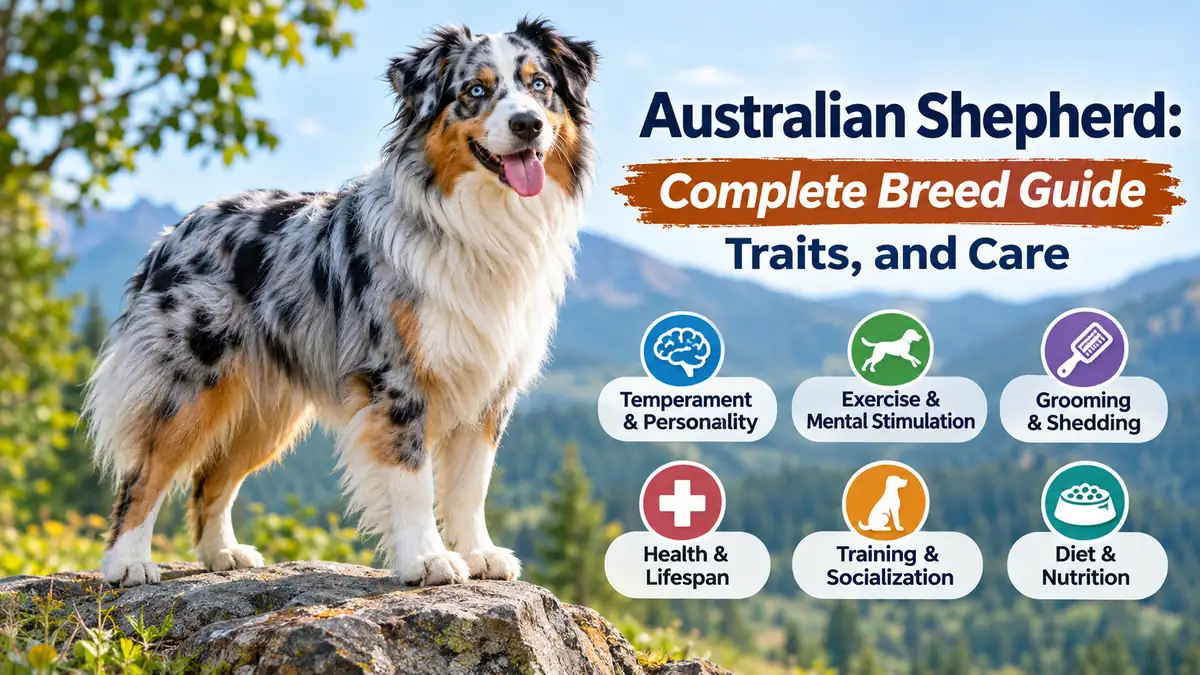
The Australian Shepherd is a striking, intelligent, and energetic dog that can become an extraordinary companion in the right home. Behind those expressive eyes and beautiful merle coats is a working breed with a powerful instinct to herd, learn, and stay busy.
Despite its name, the Australian Shepherd was developed primarily in the United States. Commonly called the Aussie, this versatile herding dog is known for its loyalty, athleticism, problem-solving ability, and close relationship with its family.
The australian shepherd is a medium-sized herding dog known for high intelligence, strong working instincts, and exceptional energy. Adults typically weigh 40–65 pounds and live around 12–15 years. Aussies need substantial daily exercise, consistent training, mental stimulation, and regular grooming. They thrive with active owners who can provide structure, companionship, and meaningful activities.
Australian Shepherd Breed Overview
Florida Australian Shepherd Association – Home
11
The Australian Shepherd belongs to the herding group and was developed to move livestock, especially sheep and cattle. Although many Aussies now live as family companions, their working heritage still influences their behavior.
| Characteristic | Australian Shepherd |
|---|---|
| Breed origin | United States |
| Breed group | Herding |
| Height | Males 20–23 inches; females 18–21 inches |
| Weight | Approximately 40–65 pounds |
| Lifespan | Commonly 12–15 years |
| Coat | Medium-length double coat |
| Colors | Blue merle, red merle, black, red |
| Temperament | Intelligent, energetic, loyal, attentive |
| Exercise needs | High |
| Shedding | Moderate to heavy |
| Trainability | Very high |
| Best suited for | Active, engaged households |
The American Kennel Club (AKC) recognizes the Australian Shepherd as a distinct breed, while the Australian Shepherd Club of America (ASCA) has played an important role in preserving its working heritage.
Although the breed is highly adaptable, adaptability should not be confused with low maintenance. An Aussie needs more than a comfortable home and occasional walks.
History and Origin of the Australian Shepherd
Why Is It Called an Australian Shepherd?
The breed’s name is misleading because the modern Australian Shepherd developed largely in the American West rather than Australia.
During the nineteenth century, sheep and experienced herders arrived in the United States through international livestock trade. Some sheep and dogs were associated with Australia, contributing to the breed’s eventual name.
The Australian Shepherd’s development involved working herding dogs selected for their ability to handle livestock across demanding ranch environments.
The precise ancestry is complex, and no single historical bloodline fully explains the modern breed.
Development in the American West
Ranchers in western states valued dogs capable of working long hours in difficult terrain.
Useful traits included:
- Intelligence and quick decision-making
- Agility and physical endurance
- Strong livestock instincts
- Responsiveness to handlers
- Adaptability to changing ranch conditions
Dogs with these qualities became increasingly associated with American ranching culture.
The breed gained additional public recognition through rodeos, horse shows, and western performances during the twentieth century.
The AKC officially recognized the Australian Shepherd in 1993.
From Ranch Dog to Family Companion
Australian Shepherds remain capable livestock workers, but their versatility has expanded their roles.
Today, they participate in obedience competitions, agility, rally, tracking, disc sports, and search-and-rescue activities.
Their popularity as companions reflects their intelligence and loyalty, although those same characteristics can make them demanding household dogs.
Australian Shepherd Appearance, Size, and Coat Colors
Portrait of an “Aussie”, Australian Shepherd Blue Merle
10 Jenis Anjing Besar Berbulu Tebal dan Lucu – Lifestyle Katadata.co.id
Australian Shepherd: Black (tri, bi, solid)
8
Australian Shepherds have an athletic, balanced appearance. They are slightly longer than tall, with enough muscle to perform demanding physical work without looking excessively heavy.
Height and Weight
Adult males typically stand 20–23 inches at the shoulder, while females generally measure 18–21 inches.
Weight varies according to sex, frame, conditioning, and individual genetics.
| Sex | Typical height | Approximate weight |
|---|---|---|
| Male | 20–23 inches | 50–65 pounds |
| Female | 18–21 inches | 40–55 pounds |
These are general ranges rather than strict weight requirements. A veterinarian can evaluate whether an individual dog has an appropriate body condition.
Australian Shepherds usually approach their adult height around their first birthday, although physical maturity and muscle development may continue afterward.
Coat Types and Texture
The Australian Shepherd has a weather-resistant double coat.
The outer coat is moderately long and may be straight or slightly wavy. Beneath it is a softer undercoat that provides insulation.
Feathering commonly appears on the backs of the legs, chest, and hindquarters.
Coat thickness can vary between individual dogs and seasonal conditions.
Recognized Coat Colors
The four principal Australian Shepherd colors are:
- Blue merle: A mottled pattern involving black and gray, sometimes with white and copper markings.
- Red merle: A mottled pattern involving shades of red and lighter cream or beige.
- Black: Solid black or black with white and copper markings.
- Red: Solid red or red with white and copper markings.
Merle is a coat pattern rather than a separate breed variety.
Eye Colors and Heterochromia
Australian Shepherds are particularly recognizable for their unusual eye colors.
Their eyes may be brown, blue, amber, or combinations of these shades.
Some Aussies have heterochromia, meaning the two eyes differ in color. Others have multiple colors within a single iris.
These variations can be normal breed characteristics.
However, coat and eye appearance should never take priority over genetic health when evaluating breeding practices.
Natural Bobtails and Tail Length
Australian Shepherds may have naturally short tails or full-length tails.
Historically, tail docking was practiced in some working populations, and certain breed standards still describe docked or naturally bobbed tails.
Tail-docking laws and animal-welfare standards vary by location.
A naturally short tail does not indicate that every Australian Shepherd should have the same tail length.
Australian Shepherd Temperament and Personality
The Australian Shepherd is generally alert, affectionate with familiar people, and deeply engaged with its surroundings.
Its personality reflects generations of selection for close cooperation with humans.
Intelligence and Trainability
Australian Shepherds are highly responsive learners.
They often understand new commands quickly and can become skilled at complex tasks through repetition, reward, and clear communication.
However, intelligence does not automatically produce good behavior.
A clever dog may also learn how to open gates, anticipate routines, or obtain attention through unwanted behaviors.
Effective training should provide appropriate challenges without relying on intimidation or harsh corrections.
Loyalty and Family Attachment
Many Aussies develop strong attachments to their households.
They often prefer being near family members and may follow their owners from room to room.
This closeness can make them excellent companions, but it also means some individuals struggle when left alone for extended periods.
Gradual independence training helps prevent excessive dependence and separation-related distress.
Are Australian Shepherds Good Family Dogs?
Australian Shepherds can be excellent family dogs when their exercise, supervision, and training needs are met.
They often enjoy interactive games and structured activities with family members.
However, their herding instincts may appear as attempts to chase or control running children.
Some dogs may nip at heels, circle people, or become overly excited during noisy play.
These behaviors require early guidance and appropriate management.
Children should learn to interact respectfully with dogs, and young children should always be supervised around them.
Behavior Around Strangers
Australian Shepherds may be reserved with unfamiliar people.
This does not necessarily indicate aggression.
Many are naturally observant and prefer to assess new situations before becoming comfortable.
Positive exposure to different people, environments, sounds, and experiences during puppyhood helps build confidence.
The goal of socialization is a calm, secure dog rather than one that must greet every stranger enthusiastically.
Do Australian Shepherds Bark a Lot?
Some Australian Shepherds are vocal, especially when excited, frustrated, or alerting their owners.
Excessive barking may develop when the dog lacks exercise, enrichment, or predictable routines.
Teaching a quiet cue, rewarding calm behavior, and addressing the underlying cause are more effective than repeatedly punishing barking.
Australian Shepherd Exercise and Mental Stimulation
Débuter le Canicross avec son Berger Australien : Le Guide Matériel
How to Production Manage without Production | Spot Creative
Australian Shepherd runs for a ball
11
Exercise is one of the most significant responsibilities of Australian Shepherd ownership.
This is a working breed developed for sustained movement and mental engagement.
How Much Exercise Does an Australian Shepherd Need?
Many healthy adult Australian Shepherds benefit from approximately 60–120 minutes of daily physical activity, although requirements vary considerably.
Working-line dogs may need more demanding activities than calmer companion-bred individuals.
A practical routine might include:
| Activity | Example duration | Main benefit |
|---|---|---|
| Brisk walking | 30 minutes | General conditioning |
| Fetch or structured play | 20 minutes | Movement and engagement |
| Training exercises | 15 minutes | Mental stimulation |
| Sniffing or exploration | 20 minutes | Enrichment and relaxation |
| Calm enrichment | 10–15 minutes | Focus and settling |
These are illustrative activities, not a mandatory exercise prescription.
Age, weather, fitness, health, and individual temperament should determine the appropriate workload.
Best Activities for Australian Shepherds
Aussies often enjoy activities that combine movement with problem-solving.
Popular options include agility, obedience training, rally, scent work, herding trials, hiking, and structured retrieval games.
Disc activities can also be rewarding, but repetitive high-impact jumping should be approached cautiously, particularly in young dogs.
Dogs do not need to participate in competitive sports to receive meaningful enrichment.
A well-designed home training routine can be equally valuable.
Mental Stimulation Matters
Physical exercise alone may not satisfy an Australian Shepherd.
Puzzle feeders, scent searches, shaping games, and short obedience sessions encourage the dog to use its brain.
For example, hiding a favorite toy in a safe room and asking the dog to find it can provide a challenging activity without requiring a large outdoor space.
Training should also include relaxation.
Constant high-intensity play can create an increasingly aroused dog that struggles to settle indoors.
What Happens When an Aussie Gets Bored?
An under-stimulated Australian Shepherd may develop unwanted behaviors, including destructive chewing, digging, excessive barking, persistent attention-seeking, or chasing moving objects.
These behaviors are not proof that the dog is stubborn or intentionally disobedient.
They may indicate unmet needs, anxiety, insufficient training, or a combination of factors.
A balanced routine should include exercise, enrichment, predictable rest, and positive human interaction.
Australian Shepherd Training and Socialization
Australian Shepherd training should begin early and continue throughout adulthood.
Because Aussies are intelligent and sensitive to their surroundings, consistent positive reinforcement is especially useful.
Basic Obedience Training
Begin with practical everyday skills:
- Teach name recognition and attention.
- Reward sitting, lying down, and coming when called.
- Introduce loose-leash walking.
- Practice waiting at doors and gates.
- Teach leaving objects alone and releasing items.
- Gradually build reliable responses around distractions.
Keep early sessions short and enjoyable.
Several brief sessions throughout the day often work better than a single exhausting training period.
Managing Herding Instincts
Herding behavior may appear as chasing bicycles, cars, children, or other animals.
These situations can become dangerous if the dog is allowed to rehearse them.
Use secure fencing, appropriate leashes, and controlled training environments.
Teach recall, impulse control, and alternative behaviors such as moving to a mat or returning to the handler.
Avoid encouraging chasing games involving moving vehicles or unwilling people.
Puppy Socialization
Puppies benefit from carefully managed exposure to unfamiliar sights, sounds, surfaces, people, and suitable dogs.
Socialization should be positive and controlled rather than overwhelming.
For example, watching bicycles from a comfortable distance can be more helpful than forcing a frightened puppy to approach them.
Discuss safe socialization opportunities and vaccination precautions with your veterinarian.
Crate Training and Independence
A crate can provide a comfortable resting space when introduced gradually and positively.
It should never be used as punishment.
Australian Shepherd puppies also benefit from learning that short periods away from their owners are safe.
Start with manageable absences and increase duration gradually.
If a dog shows persistent distress, vocalization, destruction, or panic when separated, consult a veterinarian or qualified behavior professional.
Training Mistakes to Avoid
Common mistakes include relying exclusively on physical exercise, using punishment for instinctive behavior, expecting immediate obedience in distracting environments, and neglecting rest.
Australian Shepherds need clear boundaries, but training should build confidence and cooperation rather than fear.
Australian Shepherd Grooming and Shedding
The Australian Shepherd’s double coat requires regular maintenance.
Although its fur is not as long as that of some heavily coated breeds, neglect can lead to tangles, matting, and discomfort.
How Often Should You Brush an Australian Shepherd?
Brushing two or three times per week is a reasonable starting point for many Aussies.
During heavy seasonal shedding, more frequent brushing may be necessary.
Useful grooming tools include a slicker brush, metal comb, and suitable undercoat rake.
Work gently through the coat, paying particular attention to areas behind the ears, around the legs, and beneath the collar.
Do Australian Shepherds Shed a Lot?
Yes. Australian Shepherds shed throughout the year and often experience heavier seasonal shedding.
Their undercoat helps regulate temperature, but loose hair can accumulate quickly indoors.
Regular brushing, vacuuming, and routine coat maintenance help manage shedding.
No grooming method can eliminate normal shedding completely.
Bathing and Coat Care
Most Aussies do not need frequent baths unless they become dirty or develop a veterinary skin-care requirement.
Use a dog-specific shampoo and rinse thoroughly.
Dry the coat carefully, especially in dense areas where trapped moisture may irritate the skin.
Avoid shaving the double coat for routine summer grooming. Shaving can alter coat function and does not reliably prevent overheating.
Nail, Ear, and Dental Care
Grooming should extend beyond brushing.
Check nails regularly and trim them before excessive length affects comfortable movement.
Inspect ears for redness, odor, discharge, or discomfort.
Brush teeth using dog-safe toothpaste, ideally daily, to reduce plaque accumulation.
Persistent ear problems, skin irritation, or dental discomfort require veterinary attention.
Australian Shepherd Health Problems and Lifespan
Australian Shepherds are generally robust dogs, but they have inherited risks that owners should understand.
Their average lifespan is approximately 12–15 years, although individual longevity depends on genetics, veterinary care, nutrition, lifestyle, and other factors.
Hip and Elbow Dysplasia
Hip dysplasia occurs when the hip joint develops abnormally, potentially causing instability, discomfort, and arthritis.
Elbow dysplasia affects the elbow joint and may produce similar mobility problems.
Possible warning signs include limping, stiffness after resting, reluctance to jump, and reduced willingness to exercise.
Maintaining a healthy weight, providing appropriate activity, and obtaining veterinary assessments can help manage joint health.
Responsible breeding programs use orthopedic evaluations to reduce inherited risks.
Eye Conditions
Australian Shepherds can develop several inherited eye disorders, including hereditary cataracts, progressive retinal atrophy (PRA), and collie eye anomaly (CEA).
Cataracts may impair vision by clouding the lens, while PRA involves progressive deterioration of the retina.
Some dogs also develop iris coloboma, an abnormality involving the iris.
Routine eye examinations by a veterinary ophthalmologist can help identify problems before they become severe.
MDR1 Gene Mutation and Medication Sensitivity
One of the most important breed-specific health considerations is the MDR1 mutation, associated with the ABCB1 gene.
This mutation affects the transport of certain medications and can increase the risk of serious adverse drug reactions.
Some affected dogs are particularly sensitive to certain antiparasitic drugs and other medications at specific doses.
Not every Australian Shepherd carries the mutation, and medication risk depends on the drug, dose, and individual genetic status.
DNA testing for MDR1 is strongly advisable, and results should be shared with the veterinarian before medication is prescribed.
Never assume a medication is safe or unsafe based solely on breed appearance. Australian Shepherd Health & Genetics Institute+1
Epilepsy and Seizures
Idiopathic epilepsy is another recognized health concern.
Affected dogs may experience recurrent seizures without an identifiable structural brain disorder or other underlying cause.
Signs can include involuntary movements, loss of awareness, muscle rigidity, or unusual behavior before or after an episode.
A first seizure requires veterinary evaluation. A prolonged seizure or repeated seizures without recovery is an emergency.
Treatment depends on the diagnosis and severity.
Merle Genetics and Double-Merle Risks
Merle coloring is attractive, but breeding two merle-patterned dogs together can produce puppies with two copies of the merle variant.
These double-merle dogs face an increased risk of serious eye abnormalities and hearing impairment.
The Australian Shepherd Health & Genetics Institute advises avoiding breeding combinations that produce double-merle puppies.
Coat-color DNA testing can help clarify genetic status when appearance alone is insufficient. Australian Shepherd Health & Genetics Institute+1
Other Health Concerns
Additional conditions reported in Australian Shepherds include autoimmune disorders, allergies, certain cancers, and thyroid-related problems.
These conditions do not affect every Aussie, and their likelihood varies among family lines.
Regular veterinary examinations, appropriate screening, and careful observation are more useful than assuming every dog will develop breed-associated diseases.
Recommended Health Screening
| Screening | Purpose |
|---|---|
| Hip evaluation | Assess hip joint development |
| Elbow evaluation | Identify elbow abnormalities |
| Ophthalmologist examination | Screen for inherited eye disorders |
| MDR1 DNA test | Identify medication sensitivity risk |
| Relevant inherited-disease DNA tests | Assess specific genetic risks |
| Routine veterinary examinations | Monitor general health |
The AKC identifies hip, elbow, and ophthalmologist evaluations among recommended breed health tests. American Kennel Club+1
Australian Shepherd Diet and Nutrition
Australian Shepherds need a nutritionally balanced diet that supports their age, body condition, and activity level.
An energetic working dog may require substantially more calories than a similarly sized dog with a quieter routine.
Choosing Appropriate Food
Look for a complete and balanced diet formulated for the dog’s life stage.
Important nutritional components include protein for tissue maintenance, dietary fats for energy, essential fatty acids, vitamins, and minerals.
Commercial diets should meet recognized nutritional adequacy standards, such as those established by the Association of American Feed Control Officials (AAFCO) in the United States.
Home-prepared diets require professional formulation to avoid nutritional deficiencies.
How Much Should an Australian Shepherd Eat?
There is no single correct portion for every Aussie.
Daily food requirements depend on body weight, age, neuter status, activity level, and the calorie density of the food.
Start with the manufacturer’s feeding guidance, then adjust based on veterinary advice and body-condition monitoring.
A healthy dog should generally have a visible waist when viewed from above and ribs that can be felt without excessive pressure.
Feeding Puppies
Australian Shepherd puppies need a growth-appropriate diet that supports steady development.
Young puppies usually require more frequent meals than adults.
A typical schedule may involve three or four meals daily during early puppyhood, gradually transitioning to fewer meals as the dog matures.
Avoid overfeeding to encourage rapid growth, and do not give calcium supplements unless a veterinarian recommends them.
Treats and Hydration
Training treats can be useful, but they contribute to daily calorie intake.
As a general guideline, treats should account for no more than about 10% of daily calories.
Fresh drinking water should always be available, particularly during exercise and hot weather.
Australian Shepherd Puppies: Growth and Early Care
Élevage du Berger Bleu — Chiots Berger Australien LOF | Bleu Merle, Rouge Merle, Tricolore
Puppy australian shepherd plays. Pet plays . dog in the yard on the grass
Chiots LOF Berger Australien à vendre en Bretagne
12
Australian Shepherd puppies are curious, energetic, and often eager to interact with people.
Their early months provide an opportunity to establish good habits before unwanted behaviors become established.
Puppy Growth and Development
| Age | Typical developmental focus |
|---|---|
| 8–12 weeks | Bonding, toilet training, gentle socialization |
| 3–4 months | Basic cues, leash introduction, confidence building |
| 4–6 months | Impulse control, cooperative handling, recall practice |
| 6–12 months | Adolescent behavior, consistent training, controlled activity |
| 12–18 months | Continued physical and behavioral maturity |
| 18–24 months | Further muscle development and adult behavioral settling |
Individual development varies, and some Aussies remain playful and adolescent in behavior well beyond their first birthday.
House Training
Establish a predictable toilet routine.
Take the puppy outside after sleeping, eating, drinking, and playing.
Reward successful toileting immediately and clean accidents with an appropriate enzymatic cleaner.
Punishment for accidents can create anxiety and does not teach the puppy where to eliminate.
Puppy Biting and Nipping
Puppies naturally explore with their mouths, and Australian Shepherds may also show early herding-related nipping.
Provide appropriate chew toys and redirect biting toward suitable objects.
End overly rough play calmly and reward gentle interaction.
Persistent biting should be addressed through management, rest, enrichment, and positive training rather than physical punishment.
Safe Exercise for Growing Puppies
Young dogs need movement and play, but excessive repetitive impact can place unnecessary stress on developing joints.
Avoid forced long-distance running, repetitive high jumps, and strenuous exercise that exceeds the puppy’s physical capacity.
Short walks, free movement on safe surfaces, gentle games, and age-appropriate training are better choices.
Living With an Australian Shepherd
Australian Shepherds can adapt to different homes, but successful ownership depends more on daily engagement than property size alone.
Can Australian Shepherds Live in Apartments?
Yes, some Australian Shepherds can live comfortably in apartments.
However, apartment living requires a reliable plan for exercise, enrichment, training, and noise management.
A large house does not automatically provide adequate stimulation, just as a small apartment does not automatically prevent it.
Owners must be prepared to meet the dog’s needs regardless of available indoor space.
Do Australian Shepherds Need a Large Yard?
A securely fenced yard is helpful but not essential for every Aussie.
A yard provides convenient opportunities for supervised play and training.
However, leaving a dog outside alone is not a substitute for walks, interaction, or meaningful activities.
Aussies generally benefit most from activities involving their owners.
Can Australian Shepherds Be Left Alone?
Adult Australian Shepherds can learn to tolerate reasonable periods alone, but many are not well suited to being isolated for most of the day.
Their social nature and high activity requirements can contribute to frustration when companionship and enrichment are consistently lacking.
Gradual alone-time training, safe enrichment, and appropriate exercise can help.
Puppies require more frequent attention, toilet breaks, and supervision than mature dogs.
Are Australian Shepherds Good With Cats?
Some Australian Shepherds live peacefully with cats, especially when introduced carefully.
However, their herding instincts may lead them to chase or attempt to control smaller animals.
Use barriers, supervised introductions, and reward-based training.
Cats should always have safe escape routes and access to areas the dog cannot enter.
Compatibility depends on individual temperament, prior experience, and management.
Australian Shepherds in Hot and Cold Weather
Their double coat offers some insulation, but Australian Shepherds can still experience heat-related illness.
During hot weather, provide shade, water, ventilation, and exercise during cooler hours.
Watch for excessive panting, weakness, vomiting, disorientation, or collapse.
Suspected heatstroke is a veterinary emergency.
In cold weather, healthy Aussies may enjoy outdoor activity, but exposure should still be adjusted for temperature, wind, moisture, and the individual dog’s tolerance.
Australian Shepherd vs. Similar Herding Breeds
Australian Shepherds share several characteristics with other intelligent working breeds, but important differences exist.
Australian Shepherd vs. Border Collie
Florida Australian Shepherd Association – Home
Australian Shepherd
Border Collie – Complete Breed Guide & Characteristics | PawChamp
Border Collie
Both breeds are highly intelligent and athletic.
Border Collies are especially associated with precise sheep-herding work and intense responsiveness to livestock movement.
Australian Shepherds were developed as versatile American ranch dogs and may display a more physically assertive herding style.
| Feature | Australian Shepherd | Border Collie |
|---|---|---|
| Historical development | American ranching | British border regions |
| Main working role | Versatile livestock herding | Particularly sheep herding |
| Coat | Medium-length double coat | Smooth or rough coat |
| Energy level | Very high | Very high |
| Training needs | Extensive | Extensive |
| Family suitability | Active, engaged homes | Active, engaged homes |
Neither breed is inherently easier for every owner.
Individual temperament, working lineage, and training history matter considerably.
Australian Shepherd vs. Miniature American Shepherd
Australian Shepherd
Lovely outdoor natural portrait of a miniature American Shepherd
Miniature American Shepherd
The Miniature American Shepherd developed from smaller Australian Shepherd-type dogs and is recognized as a separate breed.
It typically stands 13–18 inches tall, compared with 18–23 inches for standard Australian Shepherds.
Despite the size difference, both breeds can be intelligent, energetic, and demanding.
The Miniature American Shepherd is not simply a low-exercise version of the Aussie.
The informal term “mini Australian Shepherd” is sometimes used, but official breed recognition distinguishes the Miniature American Shepherd from the Australian Shepherd.
Australian Shepherd vs. Australian Cattle Dog
Chien Berger Australien Shining dream du Domaine D’Eily
Australian Shepherd
Australian Cattle Dog vs Blue Heeler: Is There a Difference? (With Pictures) — Dogster
Australian Cattle Dog
The Australian Cattle Dog, also called the Blue Heeler or Red Heeler, was developed in Australia to move cattle across difficult terrain.
It generally has a shorter coat and a compact, muscular build.
Both breeds require substantial exercise and structured training.
Australian Cattle Dogs are often described as particularly persistent and independent, while Australian Shepherds frequently display strong handler responsiveness.
These are broad tendencies rather than guarantees about individual dogs.
Is the Australian Shepherd Right for You?
Choosing an Australian Shepherd should involve an honest assessment of daily routines, experience, and available time.
This breed can be remarkably rewarding, but its needs are substantial.
Who Is Best Suited to an Australian Shepherd?
An Aussie may be a good fit for someone who enjoys outdoor activities, consistent training, interactive games, and spending considerable time with their dog.
Active families, experienced dog handlers, and people interested in canine sports may find the breed particularly appealing.
However, enthusiasm alone is not enough.
A sustainable routine matters more than occasional bursts of activity.
Are Australian Shepherds Good for First-Time Owners?
An Australian Shepherd can be suitable for a committed first-time owner who understands the breed’s needs and is willing to learn.
Nevertheless, it is not usually among the easiest breeds for inexperienced households.
The combination of intelligence, herding behavior, energy, and sensitivity can be challenging without consistent guidance.
Working with a qualified reward-based trainer can make the transition easier.
Advantages and Challenges
| Advantages | Challenges |
|---|---|
| Highly intelligent | Requires regular mental stimulation |
| Loyal and affectionate | May become overly dependent |
| Athletic and versatile | High daily exercise needs |
| Responsive to training | Can learn unwanted habits quickly |
| Beautiful coat variations | Significant seasonal shedding |
| Enjoys interactive activities | Herding instincts require management |
Understanding Working Lines and Companion Lines
Not every Australian Shepherd has the same temperament or activity requirements.
Dogs bred primarily for demanding livestock work may display particularly intense drive, stamina, and responsiveness.
Dogs from companion-oriented or show-focused lines may differ in energy and behavior, although they still retain many traditional breed characteristics.
Lineage alone cannot predict personality perfectly.
When evaluating a puppy or adult dog, consider the individual animal’s behavior, health, socialization, and family history.
Responsible Breeding and Adoption
Health and temperament should take priority over unusual colors or eye patterns.
Responsible breeders should be willing to discuss health screening, genetic risks, puppy socialization, and the temperament of the parents.
Organizations such as the Orthopedic Foundation for Animals (OFA) provide resources for reviewing health testing.
Breed-specific rescue organizations may also have adult Australian Shepherds available for adoption.
Adult dogs can offer a clearer picture of established energy levels and temperament than very young puppies.
Daily Australian Shepherd Care Routine
A predictable schedule can help balance an Aussie’s physical activity, training, enrichment, and rest.
The following example is intended for a healthy adult dog, not a puppy or an animal with medical limitations.
| Time | Activity |
|---|---|
| Morning | Toilet break, walk, breakfast |
| Mid-morning | Short training or enrichment session |
| Afternoon | Rest, supervised play, sniffing activities |
| Evening | Longer walk, structured game, or dog sport |
| Night | Dinner if scheduled, calm interaction, final toilet break |
Dogs need adequate sleep and quiet time between activities.
A routine that constantly increases physical intensity can create an overstimulated dog rather than a settled companion.
Weekly Care Checklist
- Brush the coat thoroughly.
- Check ears, paws, and skin.
- Inspect nails and trim when needed.
- Monitor appetite, stool, energy, and mobility.
- Refresh training exercises.
- Provide varied enrichment activities.
- Review body condition and feeding portions.
Dental care should ideally be performed daily rather than only once a week.
Common Australian Shepherd Myths
Australian Shepherds Come From Australia
Despite their name, the modern breed developed primarily in the United States.
Australia influenced the historical naming and livestock connections, but the breed’s defining development occurred in American ranching environments.
Blue Eyes Mean an Australian Shepherd Is Deaf
Blue eyes alone do not indicate deafness.
Eye-color variation is common in the breed.
Hearing impairment is a particular concern in some dogs with double-merle genetics, but normal blue-eyed Australian Shepherds are not automatically hearing impaired.
Australian Shepherds Need Constant Exercise
Aussies need substantial activity, but constant exercise is neither necessary nor desirable.
Mental enrichment, calm training, and sufficient rest are essential parts of a healthy routine.
Australian Shepherds Are Hypoallergenic
Australian Shepherds are not considered hypoallergenic.
They shed hair and produce allergens found in dander, saliva, and other biological materials.
People with dog allergies may react to individual Aussies, and no dog breed can be guaranteed allergen-free.
A Backyard Is Enough to Keep an Aussie Happy
Access to outdoor space is useful, but most Australian Shepherds need interactive activities and human companionship.
A dog can become bored in a large yard if it receives little meaningful attention.
Final Thoughts on the australian shepherd
The australian shepherd is a capable, affectionate, and exceptionally intelligent herding dog whose best qualities emerge when its needs are understood.
Its beautiful coat and expressive eyes may attract attention, but its working instincts, energy, and desire for engagement define everyday life with the breed.
For active households willing to invest in training, socialization, exercise, grooming, and preventive veterinary care, an Australian Shepherd can become a deeply rewarding companion.
The most important next step is to evaluate your lifestyle against the breed’s daily needs, rather than choosing an Aussie based on appearance alone.
