

Digital communication has never been easier to send—or easier to misunderstand. A short email can sound harsher than intended, a vague work message can trigger ten follow-up questions, and an important detail can disappear inside a crowded group chat.
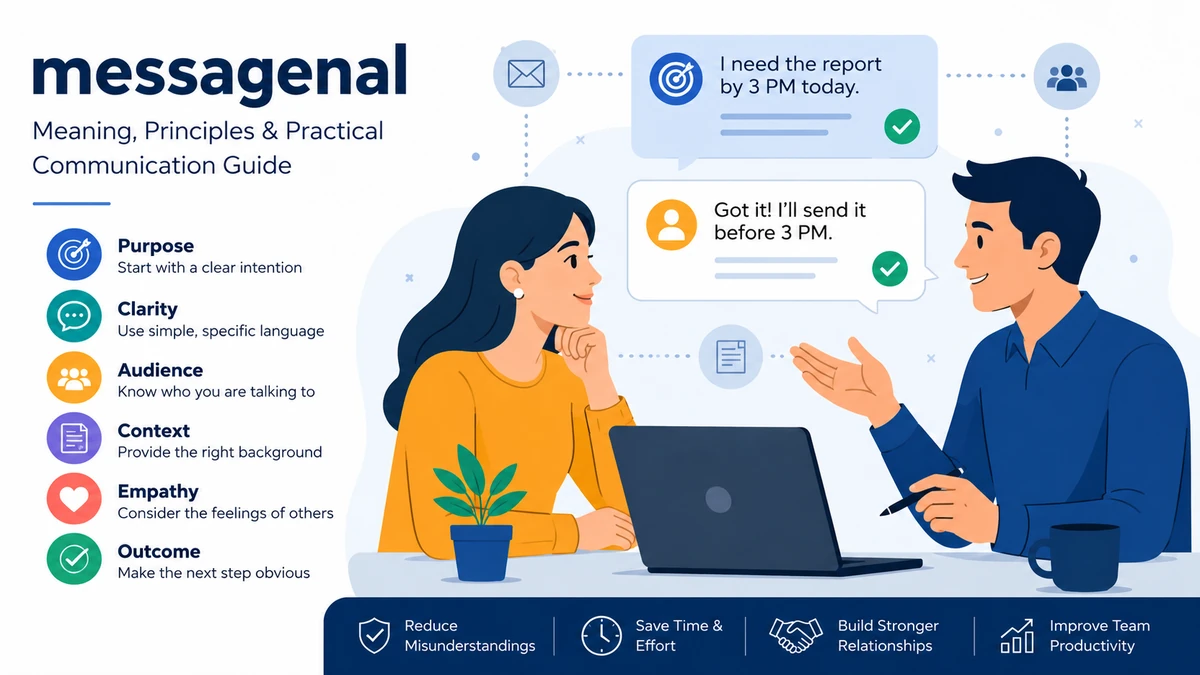
That communication problem helps explain the recent online interest in messagenal. Most current sources use the term to describe a message-first approach built around clarity, intention, context, empathy, and useful outcomes. However, the term is still emerging, and claims that it represents an established software platform or formally recognized communication framework are not well verified.
Quick answer: Messagenal is best understood as an emerging approach to digital communication that emphasizes sending purposeful, clear, context-aware messages. Instead of prioritizing speed or message volume, it focuses on helping the receiver understand the intended meaning, recognize relevant context, and know what—if anything—they should do next.
What Is messagenal?
Messagenal is a relatively new term appearing in online discussions about effective digital communication. The most consistent interpretation is not a particular messaging app, social network, or established technical standard. Rather, it describes a way of designing communication around the message and the person receiving it.
The central question is simple:
What does the receiver need to understand from this message?
That changes how a person writes.
Instead of immediately typing whatever comes to mind, the sender considers the purpose, audience, context, tone, necessary information, and expected outcome.
For example, compare these two workplace messages:
“Can you fix the report?”
and:
“Please correct the April revenue figures on page 4 and send the revised report by 3 p.m. so I can include it in today’s client review.”
Both messages request action. The second provides enough context for the recipient to act without guessing.
That is the practical idea behind messagenal communication.
Several current explainers associate the concept with purposeful messaging, audience awareness, emotional awareness, clarity, and structured communication rather than simply transmitting information as quickly as possible.
Is messagenal a real word?
This distinction matters because online descriptions can make the concept appear more established than the available evidence supports.
Messagenal does not appear to have the documented academic history normally associated with established communication concepts. One recent critical analysis argues that there is no documented origin, recognized founding author, established linguistic history, or significant earlier presence in communication literature.
Another source explicitly describes messagenal as not yet being a formal dictionary term.
Therefore, readers should treat it as an emerging internet term or informal communication concept, not as established terminology from linguistics, psychology, or communication science.
That does not make the communication practices associated with the term useless. Clarity, context, audience awareness, and purposeful writing are familiar communication principles. The distinction simply prevents a new label from being mistaken for an established academic framework.
Why messagenal Is Associated With Digital Communication
Modern communication tools have removed much of the friction involved in contacting another person.
Email, SMS, social media, direct messages, workplace chat, video platforms, and mobile notifications allow information to travel almost instantly.
Speed solved one problem while creating another: sending something quickly does not guarantee that it will be understood correctly.
Digital communication frequently removes information humans naturally use during face-to-face conversations, including facial expressions, gestures, vocal emphasis, immediate clarification, and other contextual signals.
Consider a simple message:
“Fine.”
Depending on the situation, it might mean:
- I agree.
- I understand.
- This is acceptable.
- I am annoyed.
- I want to end this conversation.
The words remain identical. Their perceived meaning changes with context and tone.
Messagenal thinking attempts to reduce this ambiguity by asking senders to consider interpretation before pressing send.
The real problem is often communication friction
Poor digital communication usually creates additional communication.
A vague request generates a question. The answer produces another question. Someone discovers missing information. A new message corrects it. Another person joins the conversation without knowing what happened earlier.
A task that could have required one clear message becomes a long thread.
This creates communication friction.
The goal of a message-first approach is therefore not necessarily to make every message extremely short. It is to provide the right amount of information the first time.
A three-line message that prevents six follow-ups can be more efficient than a five-word message.
The Core Principles Behind messagenal Communication
Different articles describe the concept somewhat differently, but several principles repeatedly appear across current explanations: purpose, clarity, audience awareness, context, emotional awareness, and meaningful outcomes.
1. Start With Purpose
Before writing, determine why the message needs to exist.
A message may be intended to:
- inform someone,
- request an action,
- answer a question,
- clarify a misunderstanding,
- provide feedback,
- document a decision,
- persuade an audience,
- provide emotional support,
- or coordinate work.
When the sender does not know the purpose, the recipient often cannot determine it either.
A useful test is:
After reading this message, what should the recipient know, feel, or do?
If there is no clear answer, the message probably needs revision.
2. Put Clarity Before Cleverness
Clear communication usually uses familiar language, logical structure, specific details, and direct sentences.
That does not mean every sentence must be short.
Consider:
“We need this soon.”
What does soon mean?
Ten minutes? Today? Friday?
Replacing it with:
“Please send the final version by 2 p.m. Thursday.”
removes unnecessary uncertainty.
Dates, deadlines, names, quantities, responsibilities, and next steps should be explicit whenever they matter.
3. Consider the Audience
The same information should not always be communicated in the same way.
A software engineer discussing a technical problem with another engineer may use specialized terminology efficiently. The same terminology could confuse a customer who simply wants to know why an application stopped working.
Audience awareness asks:
- What does this person already know?
- What information do they need?
- Which terminology will they understand?
- How much detail is appropriate?
- What might they misinterpret?
Good communication is not merely accurate from the sender’s perspective. It is understandable from the receiver’s perspective.
4. Supply Enough Context
Context turns isolated information into meaningful information.
Suppose a manager writes:
“We changed the deadline to Monday.”
The recipient may understand the words but still lack crucial information.
Which deadline? Why was it changed? Does the new deadline affect another task?
A more useful version might be:
“The website content deadline has moved from Friday to Monday because the design team needs another review cycle. Your other project deadlines remain unchanged.”
Now the recipient understands both the change and its boundaries.
5. Match Tone to the Situation
Digital text strips away many emotional cues.
A sentence intended as efficient can sound impatient. Humor can appear insulting. A short reply can seem dismissive.
Messagenal communication therefore includes emotional awareness.
Tone should reflect the relationship and circumstances. A project update, customer complaint, condolence message, performance discussion, and casual conversation should not sound identical.
6. Make the Next Step Obvious
Not every message requires action.
But when action is required, the recipient should be able to identify it immediately.
Weak:
“The presentation needs some work.”
Clearer:
“Please replace slides 5 and 6 with the updated sales figures and return the deck before tomorrow’s 10 a.m. meeting.”
The second version defines the task, scope, and deadline.
A Simple messagenal Process for Writing Better Messages
The principles become more useful when converted into a repeatable process.
Step 1: Define the outcome
Ask what you want the communication to accomplish.
Do not begin with wording. Begin with the result.
Step 2: Identify the receiver
Think about what the person already knows and what information they still need.
A first-time reader usually requires more context than someone already involved in the discussion.
Step 3: Lead With the Main Point
Do not bury important information beneath unnecessary background.
Instead of:
“Following several discussions over the last couple of weeks and after considering everyone’s schedules…”
write:
“Friday’s meeting has moved to Monday at 10 a.m.”
Then explain why if the reason matters.
Step 4: Add essential context
Provide only the information necessary to interpret or act on the message correctly.
This might include a document, deadline, reason, project name, previous decision, location, or responsible person.
Step 5: Remove ambiguity
Look for vague words such as:
- soon,
- later,
- maybe,
- some,
- stuff,
- quickly,
- probably,
- this,
- that.
These words are not inherently wrong, but they can create uncertainty when precision matters.
Step 6: Check the tone
Read the message from the recipient’s perspective.
Ask whether it could sound accusatory, impatient, dismissive, overly formal, or unnecessarily emotional.
Step 7: State the next action
If you need a response, approval, document, decision, or task completed, say exactly what is required.
Step 8: Review before sending
For important communication, spend a few seconds checking:
Purpose → Context → Clarity → Tone → Action
That small review often catches the problems responsible for long follow-up threads.
messagenal vs Traditional Reactive Messaging
The difference is easier to understand side by side.
| Reactive Messaging | Messagenal Approach |
|---|---|
| Send immediately | Identify purpose first |
| Focus on what the sender wants to say | Consider what the receiver needs |
| Assume context is understood | Supply necessary context |
| Prioritize speed | Balance speed with clarity |
| Use vague requests | Define specific actions |
| Treat tone as secondary | Consider emotional interpretation |
| Fix misunderstandings afterward | Reduce ambiguity before sending |
| More messages can feel productive | Better understanding is the goal |
The distinction is not between old and new technology.
Someone can use a modern collaboration platform and still communicate poorly. Likewise, a carefully written email can follow all of these principles.
The approach concerns how communication is constructed, not which application carries it.
Is messagenal an App or Messaging Platform?
This is one of the biggest areas of confusion surrounding the keyword.
Some online articles describe Messagenal as a unified team communication platform with real-time messaging, organized conversations, file sharing, integrations, and centralized collaboration.
Other sources describe it explicitly as a communication methodology rather than software.
More recent coverage has questioned the software interpretation because public evidence does not clearly establish a recognized application, company, founder, or major software listing matching many of the detailed product claims appearing online.
For that reason, it is safer to separate two ideas:
Messagenal as a communication concept: an emerging label for clear, purposeful, audience-aware digital messaging.
Messagenal as a specific software platform: claims about features, pricing, security, integrations, or functionality should be independently verified before being treated as factual.
A domain using the same name does not automatically prove that every online description of a similarly named product is accurate.
Why this distinction matters
New or low-volume search terms can quickly accumulate articles that repeat information from one another.
Once an unsupported claim appears in several places, repetition can create the appearance of independent confirmation.
Readers researching unfamiliar digital products should look for stronger evidence, such as an identifiable company, official documentation, verified app-store presence, credible independent coverage, clear product demonstrations, and transparent ownership information.
Where messagenal Principles Can Be Applied
The underlying communication practices are not restricted to one channel.
Workplace Communication
Teams frequently suffer from fragmented communication.
Information might be spread across email, chat, project-management systems, meeting notes, documents, and private conversations.
Clear messages help by identifying the subject, decision, responsible person, deadline, and next action.
For example:
“The homepage design is approved. Sarah will prepare the mobile version by Thursday. Please leave any final accessibility comments in the project document before Wednesday at noon.”
One message captures a decision, owner, deadline, and response window.
Remote and Hybrid Teams
Remote work makes context especially important because coworkers cannot always ask questions across a desk.
Useful asynchronous messages should often stand on their own.
A recipient reading the message several hours later should ideally understand:
- what happened,
- why it matters,
- what information is relevant,
- and what happens next.
This reduces dependence on constant real-time communication.
Email benefits greatly from message-first thinking.
A useful professional email usually has a descriptive subject, main point near the beginning, necessary context, clear request, and realistic deadline.
Long emails are not automatically bad. Unstructured emails are.
Customer Support
Customers usually want clarity more than elaborate language.
A useful support response explains what happened, what can be done, who is responsible, and when the customer should expect the next update.
Compare:
“We’re looking into your issue.”
with:
“We’ve confirmed that your payment succeeded but the order did not update correctly. Our billing team is reviewing it, and we’ll send you another update within 24 hours.”
The second message reduces uncertainty.
Leadership Communication
Leaders often communicate decisions that affect many people.
Ambiguous leadership messages can produce rumors and conflicting interpretations.
Clear communication should distinguish among confirmed decisions, proposals, uncertainties, responsibilities, and timelines.
Marketing
Marketing can also benefit from clearer messaging, although clarity should not become manipulation.
A useful marketing message tells the audience what something is, who it is relevant to, how it works, and what limitations apply.
Exaggeration may attract attention temporarily, but it damages trust when expectations do not match reality.
Personal Communication
The principles also apply outside work.
Text messages between friends, partners, and family members can be misunderstood because readers cannot always hear the intended tone.
Adding a little context can prevent unnecessary conflict.
Instead of:
“We need to talk.”
someone might write:
“Can we talk tonight about our weekend plans? Nothing bad—I just want to organize the schedule.”
The additional context completely changes how the message may be received.
Benefits of a messagenal Approach
Used sensibly, intentional communication can improve several parts of digital interaction.
Fewer misunderstandings
Specific wording leaves less room for conflicting interpretations.
Less unnecessary back-and-forth
Providing relevant details early can eliminate repetitive clarification.
Better accountability
When messages clearly identify decisions, owners, and deadlines, responsibilities become easier to track.
More useful asynchronous work
People can respond when available instead of needing an immediate conversation simply to obtain missing context.
Stronger customer experiences
Clear expectations can reduce frustration even when a business cannot immediately solve the underlying problem.
Better relationships
Empathy and emotional awareness help people communicate difficult information without creating unnecessary tension.
Lower communication noise
The objective becomes meaningful information rather than constant activity.
Quick Takeaway: Good digital communication is not measured by how quickly you send a message or how many messages you produce. A more useful measure is whether the intended person understood the message correctly and knew what to do with it.
Common Mistakes When Applying messagenal
Intentional communication can become counterproductive when taken too far.
Making every message overly formal
Not every text needs a miniature communication strategy.
“Lunch at 1?” works perfectly when the context is obvious.
Good communication should reduce friction, not turn ordinary conversation into bureaucracy.
Confusing brevity with clarity
The shortest message is not necessarily the clearest.
“Approved” may be enough in one context and dangerously vague in another.
Brevity works when removing words does not remove meaning.
Adding too much context
Overexplaining creates a different kind of communication problem.
If the recipient needs one decision, forcing them to read eight paragraphs of background may hide the answer.
Include enough context—not every available detail.
Ignoring channel choice
Some conversations should not happen through text.
Complex disagreements, sensitive feedback, emotionally charged topics, or rapidly changing situations may be better handled by voice, video, or face-to-face discussion.
Intentional communication includes choosing the right medium.
Treating a new label as established science
Perhaps the most important caution around messagenal is avoiding unsupported authority.
Current search results show substantial inconsistency in how the term is defined. Some pages call it a philosophy or framework; others describe software-like functionality; at least one recent critical analysis characterizes the term as a manufactured online buzzword.
The sensible approach is to evaluate the communication practices themselves rather than assuming the label represents a formally validated theory.
How to Write a Strong messagenal Message
A practical formula is:
Main point + relevant context + required action + timing
Imagine a team member needs revisions to a document.
Poor:
“Hey, there are problems with the document. Can you take another look?”
Better:
“I found two issues in the client proposal: the pricing table uses the old rates, and page 6 contains last month’s timeline. Please update both sections and return the revised file by 4 p.m. today.”
The improved version is not dramatically longer.
It simply answers the recipient’s likely questions before they need to ask them.
Another example: meeting change
Poor:
“Meeting changed.”
Better:
“Tomorrow’s marketing meeting has moved from 9 a.m. to 11 a.m. The Zoom link is unchanged.”
Another example: customer update
Poor:
“Your request is processing.”
Better:
“We’ve received your refund request. Our billing team is reviewing it, and you should receive an update within two business days.”
Another example: personal communication
Poor:
“Whatever.”
Better:
“I’m okay with either restaurant, so choose whichever is easier for you.”
These examples illustrate an important point: intentional communication does not require complicated language.
Often it requires the opposite.
When Should You Not Use Text Messaging?
A communication framework centered on messaging should still recognize the limitations of messaging itself.
Switch channels when:
- emotions are escalating,
- several misunderstandings have already occurred,
- the subject is highly sensitive,
- immediate collaborative problem-solving is required,
- body language would materially affect understanding,
- or a written exchange is becoming longer than a brief conversation would be.
The objective is successful communication, not forcing every interaction into text.
A five-minute conversation followed by a short written summary may sometimes be better than forty chat messages.
How Technology Fits Into messagenal Communication
Technology can support intentional messaging, but it cannot guarantee it.
Modern communication systems provide features such as threaded conversations, scheduled messages, search, shared documents, notifications, collaboration spaces, templates, and automated workflows.
These features can organize information.
They cannot automatically determine whether the sender has supplied the right context or whether the recipient understands the intended meaning.
Artificial intelligence adds another layer.
AI writing tools can help restructure long messages, summarize information, adjust tone, or identify ambiguous wording. Yet human review remains important, particularly for sensitive, legal, financial, medical, personnel, or emotionally significant communication.
A perfectly polished sentence can still communicate the wrong thing.
Does messagenal Replace Traditional Communication Skills?
No.
The useful ideas associated with messagenal largely complement familiar principles of effective communication rather than replacing them.
Active listening still matters.
So do empathy, audience awareness, concise writing, feedback, context, tone, and choosing an appropriate communication channel.
The new label is most useful when it reminds people of a modern problem: digital tools make sending communication nearly effortless, but understanding still requires thought.
That difference becomes increasingly significant as people communicate across more platforms and receive larger volumes of information.
A Practical Checklist for Everyday Use
Before sending an important message, ask:
- Purpose: Why am I sending this?
- Audience: What does the receiver already know?
- Main point: Is the most important information obvious?
- Context: Have I included what they need to understand it?
- Specificity: Are names, dates, deadlines, or quantities clear?
- Tone: Could my wording be interpreted differently from what I intend?
- Action: Does the recipient know what happens next?
- Channel: Is text actually the right way to communicate this?
- Length: Can anything unnecessary be removed?
- Accuracy: Are the important facts correct?
You do not need this checklist for every casual text.
Use it when misunderstanding would cost time, money, trust, or emotional energy.
The Future of messagenal and Intentional Digital Communication
The future of the exact term messagenal is difficult to predict because its current online usage is recent and inconsistent.
The broader problem it describes is much easier to recognize.
People increasingly communicate through multiple digital channels while dealing with notifications, remote collaboration, automated messages, AI-generated content, social platforms, email, and workplace chat.
That makes communication quality more valuable—not less.
Tools will continue becoming faster at producing and distributing language. The human challenge will increasingly involve deciding what deserves to be communicated, to whom, with what context, and toward what outcome.
That is where the strongest interpretation of messagenal has practical value.
Final Thoughts on messagenal
messagenal is best treated as an emerging label for intentional, message-centered digital communication rather than an established academic theory or a clearly verified software category. Current online sources consistently associate it with clarity, purpose, audience awareness, context, empathy, and meaningful outcomes, although definitions and product claims vary considerably.
Its practical lesson is straightforward: do not measure communication by how much you send. Measure it by how well the other person understands.
Before sending an important message, identify your purpose, state the main point clearly, provide enough context, consider the recipient’s perspective, and make the next step unmistakable. Those habits remain useful regardless of whether the term messagenal ultimately becomes widely adopted.
