

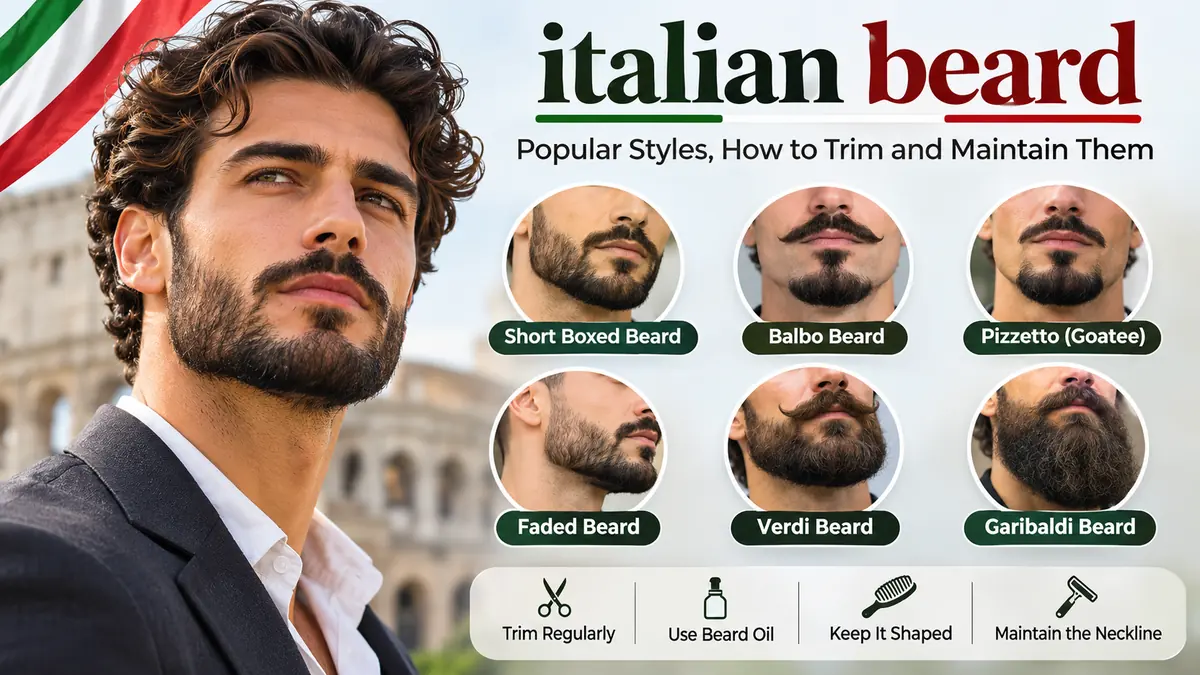
A well-shaped beard can make your jawline appear sharper, balance your facial features, and give even a simple haircut a more polished finish. The italian beard has become a recognizable grooming trend because it emphasizes precise contours, controlled length, and thoughtful proportions rather than excessive facial hair.
The italian beard is a facial-hair grooming style characterized by defined cheek lines, a clean neckline, neatly shaped moustache, and balanced volume around the jaw and chin. Modern variations often feature faded sideburns and progressively longer facial hair toward the chin, while classic interpretations include goatees, Balbo beards, and carefully shaped full beards.
The important detail is that an Italian-inspired beard is not one universally standardized shape. Different barbers may interpret the name differently, so understanding the variations makes choosing and maintaining the right style much easier.
What Is an italian beard?
The italian beard is best understood as a family of deliberately shaped facial-hair styles associated with Italian barbering aesthetics.
In June 2026, GQ Italia highlighted a contemporary version featuring tapered sideburns, increasing length toward the moustache and chin, and clearly defined cheek and neck contours. Italian barbering coverage also emphasizes natural proportions and a smooth connection between the beard, sideburns, and haircut. GQ Italia+1
Unlike a beard grown without regular shaping, this approach focuses on making facial hair complement the structure of the face.
Key characteristics of an Italian-style beard
- Defined cheek lines: The upper boundaries are tidy without necessarily being unnaturally straight.
- Clean neckline: Hair below the intended beard boundary is removed.
- Controlled sideburns: The transition from haircut to beard may be tapered or faded.
- Balanced chin volume: Slightly longer hair around the chin can create visual definition.
- Groomed moustache: The moustache is trimmed to complement the rest of the beard.
- Natural symmetry: Both sides look balanced while respecting differences in facial-hair growth.
Not every version requires shaved cheeks or a disconnected moustache. Those are features of particular styles rather than rules for every Italian-inspired beard.
Popular italian beard Styles
The best variation depends on your beard density, face shape, preferred length, and willingness to maintain precise outlines.
Short Boxed Beard: The Sharpest Beard Style for Modern Men
1. Short boxed beard
A compact full beard with neatly defined cheeks, jawline, and neckline. It provides a structured appearance without requiring significant length.
Best suited to men who want a tidy everyday beard with moderate maintenance.
Beard Styles: The Ultimate Guide for Men
2. Balbo beard
Named after Italian aviator Italo Balbo, this style combines a separate moustache with a shaped chin and lower-jaw beard. Cheeks and sideburns are generally shaved.
It can work particularly well when cheek growth is sparse. Gillette US
3. Italian goatee or pizzetto
The Italian term pizzetto commonly refers to chin-focused facial hair. It may be worn with a connected moustache, forming a circle beard, or with a more separated arrangement.
This is a practical choice for men with stronger moustache and chin growth than cheek coverage.
Book AA Tattoo Art & Barbershop | Barber in Jeffersonville
4. Modern Italian faded beard
Shorter facial hair around the sideburns gradually transitions into greater density along the jaw and chin.
This variation pairs naturally with taper fades, low fades, and other neatly blended haircuts.
Фото бороды у мужчин с усами: фото, изображения и картинки
5. Verdi beard
A fuller, rounded beard traditionally combined with a prominent styled moustache. The name is associated with Italian composer Giuseppe Verdi.
It requires more growth, regular brushing, and attention to moustache shaping.
A Volta ao Mundo em 8 Estilos de Barba: A Origem do Seu Visual — Blog Sobrebarba — Blog Sobrebarba
6. Garibaldi beard
Named after Italian historical figure Giuseppe Garibaldi, this is a longer, fuller beard with a broad, rounded lower shape.
It is better suited to dense facial-hair growth and requires patience during the growing stage.
Other related looks include the Van Dyke, anchor beard, ducktail beard, chin curtain, and designer stubble. They are not all uniquely Italian styles, but their emphasis on deliberate shape makes them useful references when discussing Italian-inspired grooming.
Italian beard styles compared
| Beard style | Typical length | Maintenance |
|---|---|---|
| Short boxed | 3–10 mm | Moderate |
| Balbo | 5–20 mm | High |
| Pizzetto / circle beard | 5–20 mm | Moderate |
| Faded beard | 3–20 mm | High |
| Verdi | 2–8 cm | High |
| Garibaldi | 10 cm or longer | Moderate to high |
| Designer stubble | 1–5 mm | Frequent trimming |
These are approximate styling ranges, not mandatory measurements. The ideal length varies with facial-hair texture, density, and the desired silhouette.
How to Choose an italian beard for Your Face Shape
Facial proportions are more useful than following one fashionable beard outline.
A beard changes how the face is visually framed. Longer hair beneath the chin can make the face appear longer, while greater fullness along the sides can make it appear wider.
Round face
A round face often benefits from controlled cheek volume and slightly more length around the chin.
Suitable options include a Balbo, extended goatee, or short ducktail. Avoid excessive width along the cheeks if the goal is a more elongated appearance.
Square face
Square faces already have noticeable jaw angles.
A short boxed beard can reinforce those lines, while a rounded beard shape can soften them. Keeping the sides relatively compact helps prevent the lower face from appearing excessively broad.
Oval face
Oval faces generally accommodate a wide variety of beard proportions.
A faded beard, short full beard, circle beard, or Balbo can all work. The main consideration is maintaining a balanced relationship between facial-hair length and the haircut.
Long or rectangular face
Longer faces often benefit from some width at the sides rather than extra length below the chin.
A short full beard or neatly rounded boxed beard may create a more balanced silhouette. Very long, pointed chin shapes can exaggerate facial length.
Diamond and heart-shaped faces
These shapes often have a relatively narrow chin or jaw compared with the upper face.
Additional fullness around the lower jaw can provide visual balance. A medium boxed beard or rounded chin-focused style may be useful.
Quick takeaway: Face-shape recommendations are visual guidelines, not strict rules. Your natural growth pattern and preferred appearance matter just as much as facial proportions.
How to Grow and Shape an italian beard at Home
Creating a well-defined beard starts with growing enough facial hair to see its natural coverage.
The most common mistake is trying to establish sharp lines before sufficient growth is available.
Step 1: Allow your facial hair to grow
For short styles, several weeks of growth may provide enough coverage to begin shaping.
Longer variations, including the Garibaldi, can require several months.
Facial-hair growth varies with genetics, age, hormones, and individual hair characteristics. A specific number of weeks cannot guarantee a particular density.
Step 2: Identify your natural cheek line
Examine where the beard naturally grows across your cheeks.
Remove isolated hairs above the desired boundary, but avoid cutting the cheek line dramatically lower than necessary.
An overly low cheek line can make the beard appear thin and reduce the natural framing around the jaw.
Step 3: Establish the neckline
A practical starting point for many short-to-medium beards is a curved boundary approximately one or two finger-widths above the Adam’s apple, adjusted to the jaw and neck.
The line should curve gently toward the area beneath each ear.
Avoid shaving directly along the underside of the jawbone. That can leave the beard looking unnaturally high when viewed from the side.
Step 4: Trim the sides
Use a guarded beard trimmer to establish an even baseline.
Start with a longer guard than you think you need. You can always remove more hair afterward.
For a modern faded look, gradually reduce length toward the sideburns while keeping greater fullness near the jaw or chin.
Step 5: Shape the moustache
Comb the moustache downward and trim hairs that extend over the upper lip.
For a Balbo or Van Dyke variation, maintain the intended separation between moustache and chin beard.
For a circle beard, preserve the connections around the mouth.
Step 6: Refine the chin and jawline
Use a comb and scissors or a trimmer to remove stray hairs.
Check the beard from the front and both side profiles.
A useful technique is to stop trimming periodically and examine the overall shape from a normal conversational distance. Small differences are often less noticeable than they appear in a magnifying mirror.
Step 7: Clean and condition
Rinse away loose hairs, gently dry the beard, and apply a small amount of suitable moisturizer, beard conditioner, or beard oil if needed.
Avoid excessive product, particularly when maintaining a short beard.
Tools Needed for Italian Beard Grooming
You do not need a large collection of grooming products to maintain a precise beard.
A few reliable tools are sufficient for most short and medium styles.
| Tool | Main purpose |
|---|---|
| Adjustable beard trimmer | Controls length and creates transitions |
| Detail trimmer | Refines cheek and moustache boundaries |
| Razor | Cleans shaved areas |
| Beard comb | Aligns hairs before trimming |
| Grooming scissors | Removes stray or longer hairs |
| Beard brush | Helps manage fuller growth |
| Beard cleanser | Removes dirt and excess oil |
| Beard oil or conditioner | Helps soften hair and reduce dryness |
| Moustache wax | Holds styled moustaches in place |
For faded styles, multiple trimmer guards make it easier to create smooth transitions.
A barber may achieve more consistent results when the fade requires very short, gradual changes in length.
How to Maintain an italian beard
The appearance of a precisely shaped beard depends on consistent maintenance.
Even a well-executed trim can lose definition when new growth extends beyond the cheek and neckline boundaries.
Daily grooming
Wash your face and gently clean the beard as needed.
Comb longer facial hair in its natural direction and use a small amount of conditioner or oil if dryness is an issue.
Avoid harsh scrubbing, which can irritate the skin beneath the beard.
Every two to four days
Inspect the cheek line, neckline, and moustache.
Short, sharply outlined styles may need touch-ups every few days, while softer and fuller styles can tolerate more regrowth.
Remove stray hairs without repeatedly changing the original shape.
Weekly maintenance
Check overall beard length and symmetry.
Trim uneven sections, clean grooming tools, and examine whether the beard still complements your haircut.
For longer styles, brushing and light trimming may be more important than frequent shaving.
When to visit a barber
A professional trim can be useful when changing styles, creating a complicated fade, or correcting uneven shaping.
Many sharply faded styles benefit from periodic barber maintenance, but there is no universal appointment interval.
Growth speed and the desired level of precision determine how often professional attention is needed.
italian beard vs Goatee, Balbo and Full Beard
These terms are sometimes used interchangeably online, but they describe different arrangements of facial hair.
| Feature | Italian-inspired beard | Goatee | Balbo | Full beard |
|---|---|---|---|---|
| Cheek coverage | Varies | Usually minimal | Shaved | Generally full |
| Moustache | Shaped, connected or separate | Optional or connected | Separate | Usually integrated |
| Chin coverage | Often emphasized | Main focus | Strongly emphasized | Full |
| Sideburns | Tapered or retained | Usually absent | Removed | Connected |
| Defining quality | Precise proportions | Chin-focused growth | Disconnected elements | Broad facial coverage |
The most important distinction is that Italian beard is a broader grooming description, whereas Balbo and goatee refer to more specific facial-hair arrangements.
A Balbo can be considered Italian-associated because of its namesake, but not every Italian-inspired beard is a Balbo.
Similarly, a full beard can incorporate Italian-style grooming through precise outlines, tapered sideburns, and controlled proportions.
Can You Grow an italian beard With Patchy Facial Hair?
Yes, depending on where your facial hair grows.
A full boxed beard generally needs reasonably consistent cheek and jaw coverage. However, a pizzetto, Balbo, or chin-focused beard may work even when the cheeks are relatively sparse.
Choose a shape that follows your growth pattern
If your moustache and chin grow densely but your cheeks remain patchy, consider a circle beard or Balbo.
If coverage is reasonably even but not particularly thick, short designer stubble may create a more consistent appearance.
Avoid attempting a long, dense beard when the necessary coverage is not present.
Does trimming make facial hair grow thicker?
No. Trimming or shaving does not change the number of hair follicles or make facial hair grow thicker.
Freshly cut hair can feel coarser because its ends are blunt, but this does not mean growth has accelerated.
Genetics, age, and hormonal factors play much larger roles in beard development.
Can beard oil fill patches?
Beard oil can condition existing facial hair and help moisturize the skin underneath.
It does not create new follicles or reliably restore growth in sparse areas.
Sudden patchy hair loss, inflamed skin, or noticeable changes in beard growth may warrant evaluation by a healthcare professional.
Common Italian Beard Trimming Mistakes
Even a simple beard style can become difficult to maintain when its original proportions are repeatedly altered.
Shaving the neckline too high
This exposes too much skin beneath the jaw and can make the beard appear disconnected from the face.
Keep the lower boundary beneath the jaw rather than directly on it.
Cutting the cheek lines too low
Removing too much upper-cheek growth can make an otherwise full beard look narrow.
Follow the natural growth boundary wherever possible.
Using a short trimmer guard immediately
Starting too short leaves little room to correct mistakes.
Begin with a longer guard and reduce the length gradually.
Ignoring sideburn transitions
A sudden difference between haircut length and beard length can look abrupt.
A gentle taper creates a more cohesive appearance, particularly with modern faded haircuts.
Overtrimming for perfect symmetry
Natural facial-hair growth is rarely identical on both sides.
Repeatedly shortening one side to match the other can result in an unnecessarily small beard.
Aim for visual balance rather than mathematical perfection.
Neglecting the skin beneath the beard
Dryness, irritation, and trapped debris can make grooming uncomfortable.
Gentle cleansing, appropriate moisturization, and clean tools support better beard maintenance.
Which Hairstyles Work With an italian beard?
The haircut and beard should complement one another rather than compete for attention.
A tapered haircut is a natural pairing because its shorter sides can transition smoothly into a faded beard.
A classic side part works well with short boxed or neatly rounded beard styles. The overall appearance is structured without requiring dramatic contrasts.
A textured crop can complement designer stubble or a compact beard, especially when the sideburns are blended carefully.
Longer hairstyles can also work with Italian-inspired facial hair. In those cases, a controlled beard outline prevents the combined look from becoming excessively bulky.
The goal is continuity between the haircut, sideburns, beard shape, and natural facial proportions.
Is the italian beard Still Popular in 2026?
Italian-inspired beard grooming remains relevant in 2026, particularly through modern fades, short sculpted beards, and carefully defined facial-hair outlines.
Contemporary Italian grooming publications have discussed the style as an approach emphasizing clean contours, tapered sideburns, and harmonious facial proportions rather than one fixed design. GQ Italia+1
Its versatility helps explain the appeal. A short boxed beard can look understated, while a Balbo creates stronger contrast and a Garibaldi provides a much fuller silhouette.
However, popularity does not mean every version suits every person. Beard density, maintenance requirements, and individual preference should guide the final choice.
Final Thoughts on the italian beard
The italian beard is less about copying one exact facial-hair pattern and more about shaping a beard with precision, balance, and attention to detail.
Short boxed beards, modern fades, pizzetto styles, and Balbo variations offer different ways to achieve that appearance. Fuller designs such as the Verdi and Garibaldi provide alternatives for men who prefer longer facial hair.
For a first attempt, choose a style that matches your natural growth, establish a comfortable length, and refine the cheek and neckline boundaries gradually. Consistent grooming and realistic expectations will do more for the finished appearance than chasing an exact measurement or trend.
