

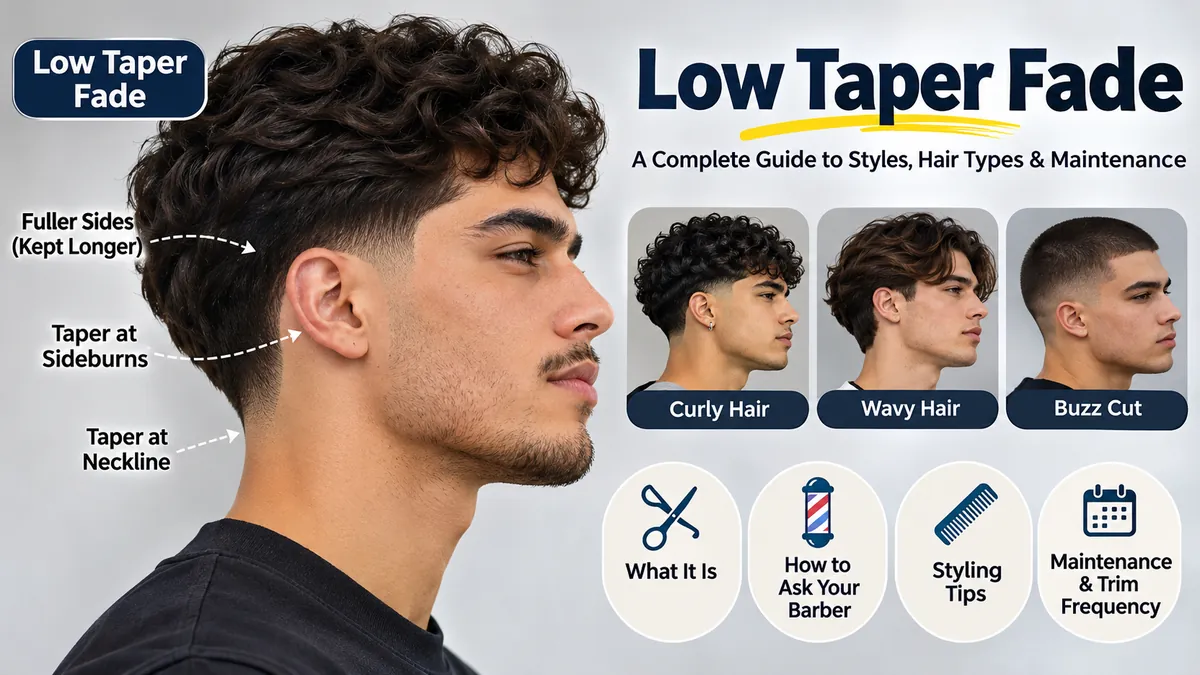
A haircut can look noticeably cleaner without removing most of the hair on your sides. That is the appeal of the low taper fade: it creates a neat, gradual transition around the edges while preserving the natural shape and volume of the hairstyle.
The low taper fade is a haircut that gradually shortens hair around the sideburns and neckline while leaving most of the sides and top longer. Unlike a traditional low fade, which extends around the lower sides and back, a low taper concentrates on smaller areas for a subtle, balanced appearance.
This haircut works with straight, wavy, curly, and coily hair. It can complement a short buzz cut, textured fringe, long curls, side part, or voluminous blowout. Understanding how the taper is positioned, how short it should go, and how it grows out helps you communicate your preferred result to a barber.
What Is a low taper fade?
A low taper fade is a gradual haircut transition positioned close to the natural hairline, primarily at the temples, sideburns, and nape of the neck.
The term combines three barbering concepts:
- Low: The shortest section remains close to the bottom of the hairline rather than extending high up the head.
- Taper: Hair gradually decreases in length toward the edges.
- Fade: Different clipper lengths are blended to create a smooth transition, sometimes ending at bare skin.
A conventional low taper typically leaves the hair above and around the ears relatively full. The barber focuses on creating a clean transition at the sideburns and neckline instead of fading a continuous strip around the entire head.
The exact finish depends on personal preference. Some people request a skin taper with nearly invisible hair at the bottom. Others prefer a number 0.5 or number 1 guard to retain a softer appearance.
Barbers sometimes use low taper and low taper fade interchangeably, so describing the desired coverage and shortest length is more reliable than using the haircut name alone. barber.style+1
Key Characteristics of a Low Taper Fade
| Feature | Description |
|---|---|
| Taper placement | Sideburns and neckline |
| Starting height | Close to the natural hairline |
| Shortest length | Skin, zero, #0.5, or #1 |
| Top length | Short, medium, or long |
| Hair compatibility | Straight, wavy, curly, and coily |
| Appearance | Clean, subtle, and blended |
| Typical touch-up | Every 2–4 weeks, depending on finish |
The most distinctive characteristic is the amount of hair preserved. A low taper provides definition without dramatically changing the overall silhouette.
Popular Low Taper Fade Haircut Styles
The low taper fade is not a complete hairstyle on its own. It describes how the hair is finished around the lower edges, allowing numerous combinations with different top lengths and textures.
1. Classic Low Taper Fade
The classic variation features a compact taper around the sideburns and neckline with naturally blended sides.
The top can be neatly combed, lightly textured, or left in its natural direction. A guarded finish generally creates a softer result than a skin-level taper.
This variation is suitable for people who prefer a conservative haircut that remains appropriate for work, school, and everyday activities.
2. Low Taper Fade With Curly Hair
Curly hair naturally creates volume and texture. A low taper fade cleans the perimeter without removing the fullness that gives curls their shape.
The barber can preserve the curl pattern on top and blend the lower edges into the surrounding hair.
For the most balanced appearance, consider the following:
- Keep enough length for curls to form naturally.
- Avoid taking the taper too high into the sides.
- Blend gradually to prevent a disconnected appearance.
- Use a lightweight curl cream or leave-in conditioner to control frizz.
A curly low taper is particularly useful when you want to preserve volume while making the hairline look more defined.
3. Low Taper Fade With Straight Hair
Straight hair makes the transition between clipper lengths especially visible.
A carefully blended taper can create a polished finish without requiring dramatic contrast.
Popular top styles include a side-swept fringe, textured crop, short quiff, and classic side part.
Because straight hair can expose uneven blending, the barber should pay attention to guard transitions and the natural direction of growth.
4. Low Taper Fade With Wavy Hair
Wavy hair provides natural movement, making it a good match for a subtle taper.
The longer top can be styled loosely, allowing the waves to create shape while the neckline and sideburns remain clean.
A small amount of sea salt spray or styling cream can enhance texture, although products that leave hair dry or stiff may reduce the natural movement.
5. Low Taper Fade With Textured Fringe
A textured fringe features layered hair styled forward over the forehead.
Combining it with a low taper creates a contrast between the fuller front and the clean edges.
The fringe can be cropped short or left longer, depending on hair density, forehead proportions, and styling preferences.
This hairstyle works particularly well when the goal is to maintain a casual appearance without leaving the sides untidy.
6. Low Taper Fade With Blowout
A blowout emphasizes height and volume on top, often using a hairdryer and a round brush or diffuser.
The low taper cleans the sideburns and neckline while preserving the fullness around the upper sides.
The result can appear more dramatic than a classic taper because of the contrast between the voluminous top and the closely finished perimeter.
However, the blowout itself usually requires more daily styling than the taper.
7. Low Taper Fade With Buzz Cut
A buzz cut keeps the hair uniformly short or nearly uniform across the top.
Adding a low taper gives the haircut more definition at the temples and neckline.
The combination is practical for people who want minimal styling and a clean outline.
A number 2, 3, or 4 guard on top can create different levels of coverage, while the perimeter can be tapered separately.
8. Low Taper Fade With Middle Part
A middle part, sometimes called a curtain hairstyle, divides longer hair toward both sides of the forehead.
A low taper helps keep the lower edges tidy without disrupting the movement of the longer sections.
This combination is especially effective with medium-length straight or wavy hair.
9. Low Taper Fade With Coily Hair or an Afro
A low taper can define the hairline while maintaining the natural shape of an Afro or other coily hairstyle.
It is commonly paired with short natural curls, sponge twists, longer coils, and shaped Afro styles.
The barber should consider shrinkage, density, and the natural hairline before establishing the final taper.
A sharp line-up can add definition, but it is not essential. Keeping the outline close to the natural hairline helps avoid an artificially pushed-back appearance.
10. Low Taper Fade With Beard
A low taper can transition smoothly into facial hair through the sideburns.
Rather than creating an abrupt division between the haircut and beard, the barber gradually adjusts the length.
A connected beard fade can make the overall style look cohesive, particularly when the beard is kept at a consistent length.
Low Taper Fade vs. Low Fade: What Is the Difference?
The difference between a low taper fade and a low fade is primarily the area of hair being shortened.
A low taper concentrates on the sideburns and neckline, while a low fade typically creates a continuous gradient around the lower sides and back.
| Feature | Low Taper Fade | Low Fade |
|---|---|---|
| Area shortened | Mainly sideburns and nape | Lower sides and back |
| Side fullness | Mostly preserved | More hair removed |
| Visible contrast | Usually subtle | Usually more noticeable |
| Back appearance | Localized neckline taper | Continuous lower fade |
| Shortest finish | Skin or guarded length | Skin or guarded length |
| Grow-out | Often softer | Wider faded area grows out |
| Overall effect | Natural and understated | More defined lower-side gradient |
Neither haircut necessarily requires bare skin. The terms describe the placement and coverage of the transition, while the guard number determines its shortest length. TaperMode+1
Low Taper vs. Mid Taper vs. High Taper
The height of the taper also changes the visual result.
Low taper: Keeps the graduated section close to the hairline and preserves the most surrounding hair.
Mid taper: Extends the transition higher toward the middle of the temple or side area, making it more noticeable.
High taper: Places the transition higher and creates a stronger contrast with the longer hair above.
The exact boundaries vary between barbers. Pointing to the preferred transition height in a reference photo is more precise than relying entirely on the terms low, mid, or high.
Is a Low Taper Fade the Same as a Skin Fade?
Not necessarily.
A skin fade describes a haircut that reaches bare or nearly bare skin at its shortest point.
A low taper fade can finish at skin level, but it can also stop at a number 0.5 or number 1 guard.
Therefore, a low skin taper is one possible version of a low taper fade rather than the only version.
How to Choose a Low Taper Fade for Your Hair Type and Face Shape
The best variation depends on hair texture, density, growth direction, head shape, and the amount of styling you prefer.
Choosing by Hair Type
| Hair type | Suggested approach | Main consideration |
|---|---|---|
| Straight | Soft low taper with textured or side-swept top | Precise blending |
| Wavy | Low taper with natural movement | Maintain wave definition |
| Curly | Compact taper with fuller curls | Preserve curl shape |
| Coily | Temple and nape taper with natural volume | Respect shrinkage and hairline |
| Fine | Guarded taper with moderate contrast | Avoid exposing too much scalp |
| Thick | Low taper with controlled side bulk | Prevent excessive width |
Hair density matters as much as texture. For example, two people with straight hair may need different taper lengths because one has fine, sparse hair and the other has thick, dense hair.
Choosing by Face Shape
Face shape can help guide the proportions of the haircut, although it should not be treated as a strict rule.
Round face: Some added height on top may create a more elongated appearance. A compact taper preserves a natural side shape.
Oval face: Many top lengths work well. The choice can focus on texture, styling effort, and personal preference.
Square face: A textured crop or short quiff can complement a defined jawline, while a low taper keeps the sides balanced.
Long or oblong face: Avoid excessive height if you do not want the face to appear longer. A fringe or medium-length top can create visual balance.
Heart-shaped face: Preserving some fullness around the sides may balance a wider forehead and narrower jaw.
These are styling principles, not requirements. Hair growth patterns and the desired overall silhouette often matter more than face shape alone.
How to Ask Your Barber for a Low Taper Fade
Clear instructions are essential because the terms taper and fade can be interpreted differently.
A useful request is:
“I’d like a low taper fade around the sideburns and neckline, down to a number 0.5. Please keep the taper low and compact, leave the sides above my ears fuller, and blend everything smoothly. I don’t want a full low fade around the head.”
This explains four important details: placement, shortest length, side fullness, and blending.
Step 1: Choose the Shortest Guard
Clipper guards determine how much hair remains at the shortest part of the taper.
| Guard | Approximate length | Appearance |
|---|---|---|
| Skin | Nearly 0 mm | Maximum scalp exposure |
| Zero | Very short stubble | Strong contrast |
| #0.5 | 1.5 mm | Short, visible shadow |
| #1 | 3 mm | Softer transition |
| #2 | 6 mm | More natural coverage |
| #3 | 10 mm | Fuller, conservative finish |
Guard lengths are approximate and may vary by clipper system.
If you have never had a fade, starting with a number 1 or 0.5 can help you understand how much contrast you prefer.
Step 2: Specify the Top Length
The taper does not determine how long the hair on top should be.
You might request a short textured top, two to three inches of length, medium curls, or a longer fringe.
Giving a measurement or showing a photograph is more helpful than saying only “leave it long.”
Step 3: Explain the Neckline
The neckline affects how the haircut looks from behind.
A natural tapered neckline gradually blends into the skin. A blocked neckline creates a more defined horizontal edge, while a rounded neckline follows a curved outline.
For a classic low taper fade, a naturally blended neckline is a common choice.
Step 4: Bring Reference Photos
Bring photographs showing the front, side, and back of the desired haircut.
A side photograph helps establish the taper height. A back photograph shows whether the neckline should remain compact or connect into a broader fade.
Reference photos are especially valuable because barber terminology is not perfectly standardized. MensFade+1
How Barbers Create a Low Taper Fade
Creating a smooth low taper requires controlled clipper work, careful blending, and an understanding of how the hair grows.
The exact process varies, but the general sequence follows several stages.
1. Assess the Hair and Establish the Shape
The barber examines the hairline, density, growth direction, and current haircut.
Cowlicks, uneven density, and natural differences between the left and right sides can influence the taper.
The longer sections are trimmed or shaped according to the requested hairstyle.
2. Establish the Lower Guideline
The barber identifies the shortest section near the sideburns and neckline.
This area may be cut using a zero setting, a guarded clipper, or a finishing trimmer, depending on the requested length.
The guideline should remain low to avoid accidentally creating a mid or full fade.
3. Blend Through Guard Lengths
The barber gradually increases the cutting length above the shortest section.
For example, a transition might involve a zero or 0.5 setting, then a number 1, followed by a number 2 or longer hair.
The clipper lever and intermediate guards help soften visible lines.
A flicking motion near the upper edge of each section can prevent harsh horizontal marks.
4. Refine the Sideburns and Neckline
The barber checks that both sideburns appear balanced and the neckline blends naturally.
A trimmer may be used to clean stray hairs, but aggressive line-up work is not always necessary.
5. Check the Finished Blend
The haircut is inspected from multiple angles under consistent lighting.
The barber looks for dark patches, uneven transitions, and areas where the fade extends higher than intended.
Although these are the general stages, creating a professional result on yourself can be difficult, particularly around the back of the head.
How to Style a Low Taper Fade at Home
The faded perimeter generally requires little daily styling. Most of the effort goes into managing the longer hair on top.
A simple routine can keep the haircut looking natural and controlled.
- Wash the hair according to your scalp condition and hair type, using a gentle shampoo when needed.
- Towel-dry carefully without aggressive rubbing, especially if the hair is curly.
- Apply a small amount of styling product suited to your texture.
- Shape the top using your fingers, a comb, brush, or diffuser.
- Check the sideburns and neckline for stray hairs without attempting to recreate the fade yourself.
Styling Products by Hair Type
| Hair type or style | Useful product | Desired effect |
|---|---|---|
| Straight textured top | Matte clay or paste | Definition and control |
| Wavy hair | Lightweight styling cream | Natural movement |
| Curly hair | Curl cream or leave-in conditioner | Curl definition |
| Coily hair | Moisturizing leave-in product | Manageability and moisture |
| Quiff or blowout | Volumizing mousse | Height and body |
| Side part | Light pomade or cream | Smooth, controlled finish |
Product quantity matters. Too much clay can make fine hair appear heavy, while excessive gel may leave curls stiff.
Start with a small amount and increase only if necessary.
For heat styling, use a suitable heat protectant and avoid unnecessarily high temperatures.
Low Taper Fade Maintenance: How Often Should You Get a Trim?
A low taper fade can grow out more subtly than a full low fade because the shortest sections occupy less of the head.
However, a freshly cut appearance still requires periodic maintenance.
A skin-level taper will show new growth relatively quickly, while a guarded taper generally remains softer as it grows.
A practical schedule is:
- Every 1–2 weeks: For people who want consistently sharp skin-level edges.
- Every 2–3 weeks: For a defined taper and tidy neckline.
- Every 3–5 weeks: For a softer, guarded taper when some regrowth is acceptable.
These are approximate preferences rather than universal rules. Hair growth, contrast, density, and the desired appearance affect how often a trim is needed. barber.style+1
How to Keep the Haircut Looking Fresh
Keep the scalp clean, use conditioner where appropriate, and avoid excessive styling-product buildup.
If you have curls or coils, maintaining moisture and reducing friction can help preserve the shape of the longer hair.
A satin pillowcase or suitable nighttime hair covering may help reduce friction for textured hairstyles.
Avoid shaving or repeatedly trimming the tapered area between appointments unless you have the necessary experience. Removing too much hair can change the fade height or create an uneven hairline.
Can a Low Taper Fade Cause Razor Bumps?
Very close cutting can contribute to irritation or ingrown hairs, particularly in people who are prone to pseudofolliculitis barbae.
A skin-level finish is not essential for this hairstyle.
If you experience razor bumps, ask the barber to leave a short guarded length rather than using a foil shaver or razor directly against the skin.
Avoid repeated close passes over irritated areas. Persistent inflammation, painful bumps, or signs of infection should be assessed by a healthcare professional.
Common Low Taper Fade Mistakes and How to Avoid Them
Even a simple-looking taper can produce disappointing results when the barber and client have different expectations.
Taking the Fade Too High
One of the most common problems is extending the transition too far above the sideburns.
This changes the silhouette and can make the haircut resemble a mid taper or conventional low fade.
To avoid it, specify that the taper should remain close to the natural hairline.
Removing Too Much Side Bulk
A low taper should usually preserve most of the hair around the sides.
Excessive clipper work can reduce the fullness needed for curly hairstyles, longer tops, or natural volume.
Ask the barber to maintain the side weight and remove only what is necessary to achieve a clean outline.
Choosing a Skin Finish Without Considering Maintenance
Skin-level tapers can look exceptionally crisp immediately after cutting, but their contrast changes as hair grows.
If frequent touch-ups are inconvenient, a number 0.5 or number 1 finish may be more practical.
Ignoring Natural Hair Growth
Hairlines are rarely perfectly symmetrical.
Forcing an artificially straight or identical outline on both sides can remove unnecessary hair.
A good taper works with the natural hairline rather than aggressively reshaping it.
Using the Wrong Product
Heavy pomade can flatten fine hair, while drying products may make textured hair appear frizzy.
Choose products according to the top hairstyle rather than the fade itself.
Expecting Every Reference Photo to Look Identical
Hair density, curl pattern, head shape, and lighting all affect how a haircut appears.
A photograph should communicate the intended shape and finish, not serve as a guarantee of an identical result.
Is a Low Taper Fade Suitable for School, Work, and Everyday Wear?
A low taper fade is adaptable because it can be kept understated or styled with more contrast.
For formal environments, a guarded taper with a neatly combed top provides a conservative appearance.
For casual styling, the same perimeter can be combined with a textured fringe, natural curls, a messy quiff, or a blowout.
For active lifestyles, a short top with a low taper can reduce the amount of daily styling required.
The hairstyle can also suit different age groups. The important considerations are the individual’s preferred appearance, hair characteristics, and any applicable school or workplace grooming rules.
Does a Low Taper Fade Work With Long Hair?
Yes. The faded section can remain very short while the top stays several inches long.
Longer hair can be worn with a middle part, loose waves, curls, or a swept-back finish.
The barber should preserve enough length around the sides to prevent the taper from creating an unwanted disconnect.
Is a Low Taper Fade Good for Thin Hair?
It can be, particularly when the taper is subtle.
A guarded finish may be preferable if a skin fade would expose too much scalp or exaggerate differences in density.
The top can be styled with lightweight products that add texture without flattening the hair.
However, a taper does not increase hair density or treat hair loss. It changes the visual distribution of the existing hair.
How Long Does a Low Taper Fade Take?
The time depends on the complexity of the full haircut.
A straightforward perimeter touch-up may be relatively quick, while a complete haircut involving scissor work, textured styling, a beard blend, and detailed line-up work will take longer.
For many conventional low taper appointments, roughly 20–40 minutes is a reasonable planning estimate, but individual barber techniques and services vary.
Final Thoughts on the low taper fade
The low taper fade offers a useful balance between a clean outline and natural hair fullness. Its defining feature is the localized transition around the sideburns and neckline rather than a continuous fade around the entire head.
It can complement straight, wavy, curly, or coily hair and works with everything from a short buzz cut to a longer textured hairstyle.
For the best result, decide how much side fullness you want to preserve, choose a comfortable shortest guard length, and show your barber a clear reference of the taper height and neckline.
A well-executed low taper fade should look intentional, blend smoothly, and suit the way you naturally wear your hair.
