

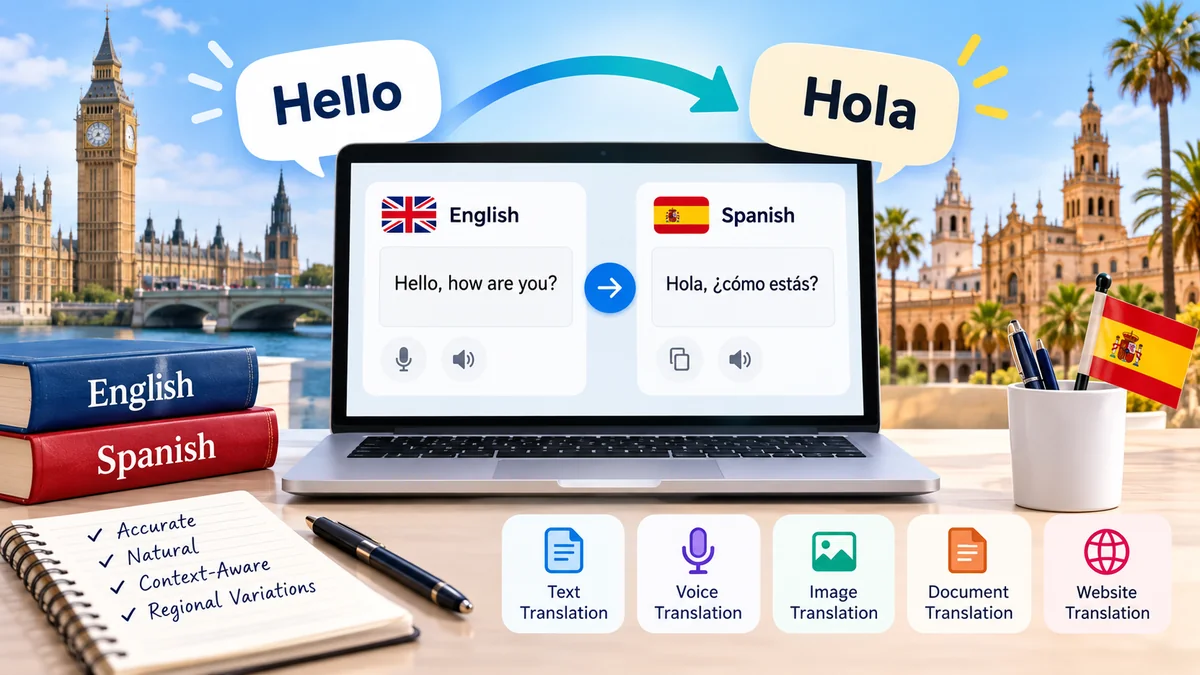
Translating English into Spanish can look simple until a short English sentence produces several equally plausible Spanish versions. Words change with context, nouns carry grammatical gender, verbs encode person and number, and the right way to say “you” can depend on formality and region.
An english to spanish translator converts English words, phrases, sentences, or longer text into Spanish. Modern translation tools can handle everyday text quickly, but accurate translation still depends on context, grammar, tone, regional vocabulary, and the intended audience. For important material, reviewing the Spanish output remains essential.
How an english to spanish translator works
Online translators no longer operate like basic dictionaries that replace each English word with a Spanish equivalent. Modern machine translation systems analyze a larger piece of text and attempt to determine meaning from context.
That distinction matters because translation is rarely one-to-one.
Consider the English word “bank.” It could mean:
- a financial institution
- the side of a river
- a collection or reserve, such as a blood bank
- a banking maneuver performed by an aircraft
A translator needs the surrounding sentence to identify the intended meaning.
Google itself advises users to put ambiguous words into a phrase or sentence so that its translation system has enough information to interpret the intended meaning. Google Help
For example:
| English | Spanish |
|---|---|
| I went to the bank to withdraw money. | Fui al banco a retirar dinero. |
| We sat on the riverbank. | Nos sentamos a la orilla del río. |
| Good morning. | Buenos días. |
| Thank you very much. | Muchas gracias. |
| Where is the hotel? | ¿Dónde está el hotel? |
This is why translating complete thoughts usually produces better results than entering isolated words one at a time.
English to Spanish translation is not word-for-word substitution
One of the most common mistakes is assuming that a grammatically correct English sentence can be translated by preserving the same word order.
English and Spanish have different grammatical systems.
A literal translation may technically communicate the idea while still sounding unnatural to a native Spanish speaker. Good translation focuses on meaning, not merely individual words.
Take a simple expression:
English: How old are you?
Spanish expresses age using the verb tener (“to have”), so the natural translation is:
Spanish: ¿Cuántos años tienes?
A literal construction based on “How old are you?” would not produce natural Spanish.
The same issue appears with idioms, phrasal verbs, slang, humor, business expressions, and culturally specific language.
Context determines the correct translation
Suppose you enter:
“I’m looking forward to seeing you.”
A translator should understand that “looking forward to” expresses anticipation. Translating “look,” “forward,” and the other words separately would miss the actual meaning.
Context becomes even more important with:
- idioms
- homonyms
- technical terminology
- slang
- professional titles
- phrasal verbs
- abbreviations
- informal messages
- regional expressions
When possible, enter the entire sentence or paragraph rather than a single ambiguous expression.
Spanish grammar changes the translation
English speakers encounter several grammatical features in Spanish that can substantially affect a translation.
Spanish nouns have grammatical gender
Spanish nouns are generally categorized as masculine or feminine, and articles and adjectives often need to agree with them.
For example:
the book → el libro
the house → la casa
SpanishDictionary notes this grammatical gender distinction when explaining English-Spanish translations. SpanishDictionary.com
This agreement can extend across an entire sentence.
For example:
The red car → El coche rojo.
The red house → La casa roja.
Notice how rojo becomes roja to agree with casa.
A reliable translator needs to manage these relationships rather than translating every word independently.
Spanish verbs contain more information
Spanish verbs change according to person, number, tense, and mood.
For example, the English verb “speak” can appear as:
- hablo — I speak
- hablas — you speak
- habla — he/she speaks or formal you speak
- hablamos — we speak
- hablan — they/you all speak
Because the verb ending often identifies the subject, Spanish frequently omits subject pronouns where English normally requires them.
That is why:
I speak Spanish.
can naturally become:
Hablo español.
The Spanish sentence does not need yo unless the speaker wants to emphasize “I.”
Formal and informal “you” can change the whole sentence
English uses “you” in an enormous range of situations. Spanish makes distinctions that English generally does not.
Two important singular forms are:
- tú — familiar or informal “you”
- usted — respectful, formal, or socially distant “you”
The choice also affects the verb.
| English | Informal Spanish | Formal Spanish |
|---|---|---|
| Do you speak English? | ¿Hablas inglés? | ¿Habla inglés? |
| Where do you live? | ¿Dónde vives? | ¿Dónde vive? |
| Can you help me? | ¿Puedes ayudarme? | ¿Puede ayudarme? |
| How are you? | ¿Cómo estás? | ¿Cómo está? |
Tú takes second-person singular verb forms, while usted uses third-person singular forms. SpanishEnglish
This is a perfect example of why an english to spanish translator needs context.
If you simply enter:
“Can you help me?”
the software may have to infer whether you are speaking to a friend, customer, professor, stranger, colleague, or official.
Tú, usted, ustedes, vosotros, and vos
The situation becomes more complex when regional Spanish is considered.
In much of Latin America, ustedes is commonly used for plural “you” in both informal and formal situations. In Spain, vosotros/vosotras normally serves as the informal plural form, while ustedes is associated with formal plural address. MySpanishLeap
Some regions also use vos instead of, or alongside, tú. Voseo is especially prominent in countries such as Argentina and Uruguay and appears in several other parts of Latin America. SpanishEnglish
For example:
Tú tienes → You have
Vos tenés → You have
Both can be correct Spanish. The appropriate choice depends on the audience.
Spanish from Spain vs Latin American Spanish
There is no single vocabulary used identically throughout every Spanish-speaking country.
Spanish is spoken across many countries and communities, producing differences in vocabulary, pronunciation, grammar, and everyday expressions.
Consider a familiar example:
| English | Spain | Common Latin American Usage |
|---|---|---|
| computer | ordenador | computadora |
| car | coche | carro/auto |
| cellphone | móvil | celular |
| you all | vosotros/ustedes | ustedes |
Even within Latin America, vocabulary varies considerably.
A word that sounds completely ordinary in Mexico may be uncommon in Argentina, Colombia, Chile, or another country. Some words can even carry different meanings across regions.
SpanishDictionary, for example, provides regional translations from Spain, Mexico, and other Spanish-speaking countries rather than treating every Spanish translation as universally interchangeable. SpanishDictionary.com
Which Spanish should you translate into?
The answer depends on the reader.
If you are writing for people in Spain, Spain-specific vocabulary and grammatical conventions may be appropriate.
If your audience is Mexican, Mexican Spanish may sound more natural.
For an international audience, neutral or broadly understood Spanish is often preferable.
Before translating important content, identify:
- who will read it,
- where they live,
- how formal the communication should be,
- whether specialized terminology is involved.
These details can dramatically improve the final result.
How to use an english to spanish translator accurately
Getting a better translation often requires better source text.
1. Write clear English first
Machine translation works best when the original sentence clearly communicates its meaning.
Avoid unnecessarily complicated sentences.
Instead of:
“Regarding the aforementioned matter, we’d appreciate it if you could possibly get back to us whenever you happen to have a moment.”
a clearer source sentence might be:
“Please reply when you have time.”
Clear input reduces ambiguity.
2. Translate complete sentences
Avoid entering individual words unless you genuinely need a dictionary definition.
For instance, translating:
“right”
provides too little context.
“Right” might refer to:
- a direction
- something correct
- a legal entitlement
- the opposite of left
- an intensifier in certain expressions
Instead, enter:
Turn right at the next street.
or:
Your answer is right.
Google Translate specifically recommends using ambiguous words in phrases or sentences to help establish their intended meaning. Google Help
3. Decide whether the tone is formal or informal
A message to your friend should not necessarily sound like a letter to a government department.
Think about:
- relationship
- age
- professional setting
- degree of familiarity
- country
- purpose
This helps determine pronouns, verb forms, vocabulary, and overall register.
4. Preserve proper nouns carefully
Names of people, businesses, brands, products, streets, organizations, and institutions may not need translation.
Automatic systems can occasionally interpret a proper noun as an ordinary word.
Check names separately before publishing the result.
5. Check numbers, dates, and measurements
Translation does not eliminate the need for proofreading.
Pay particular attention to:
- dates
- decimal separators
- currency
- addresses
- telephone numbers
- measurements
- prices
- percentages
A linguistically polished translation can still be unusable if a critical number is wrong.
6. Read the translation as a complete message
Do not review only vocabulary.
Ask:
Does this Spanish sentence communicate exactly what the English sentence intended?
Meaning should be the primary test.
Common English-to-Spanish translation mistakes
Automatic translation has improved substantially, but predictable problems remain.
Translating idioms literally
English idioms often cannot be transferred word for word.
Expressions such as:
- break the ice
- piece of cake
- hit the nail on the head
- under the weather
- spill the beans
have meanings beyond their individual words.
The correct Spanish translation should convey that intended meaning, using an equivalent expression where appropriate.
Ignoring grammatical gender
Articles and adjectives need to agree correctly with nouns.
Even if the central vocabulary is correct, incorrect agreement makes a translation sound obviously wrong.
Choosing the wrong level of formality
Translating every instance of “you” as tú can create problems in contexts where usted is expected.
The opposite can happen too. Excessively formal language can sound stiff in a casual conversation.
Regional customs matter as well; patterns of tú, usted, and vos vary across Spanish-speaking communities. Why language works
Confusing tú and tu
The accent changes the meaning.
tú = you
tu = your
For example:
Tú tienes tu teléfono.
means:
You have your phone.
The accent is not decorative; it distinguishes different grammatical functions. Why language works
Using false friends
English and Spanish share many similar-looking words, but appearances can be misleading.
These are often called false friends or false cognates.
A classic example is:
embarazada
It means pregnant, not “embarrassed.”
Likewise:
actual
usually relates to something current/present, rather than meaning “actual” in every English context.
The safest approach is to translate words within their sentence rather than guessing from spelling.
Translating phrases, conversations, and everyday Spanish
For ordinary communication, machine translation is often most useful when you need the basic meaning quickly.
Common examples include:
| English | Spanish |
|---|---|
| Hello | Hola |
| Good morning | Buenos días |
| Good afternoon | Buenas tardes |
| Good night | Buenas noches |
| Please | Por favor |
| Thank you | Gracias |
| You’re welcome | De nada |
| Excuse me | Disculpe / Perdón |
| I don’t understand | No entiendo |
| Do you speak English? | ¿Habla inglés? / ¿Hablas inglés? |
| How much does it cost? | ¿Cuánto cuesta? |
| Where is the bathroom? | ¿Dónde está el baño? |
| I need help | Necesito ayuda |
Notice again that even a simple sentence such as “Do you speak English?” has more than one valid translation because formality changes the verb.
Translating speech, images, documents, and websites
English-to-Spanish translation is no longer limited to typed text.
Current translation services may support several input formats.
For example, Google Translate supports translation involving text, handwriting, photos, and speech through its app and web services. Google states that its Translate app handles more than 200 languages overall. Google Help
Its mobile tools can also use a camera to interpret text on items such as signs or menus, and downloaded languages can enable some offline translation. Google Help
For longer material, document translation can preserve much of the workflow of uploading and processing an existing file. Google currently documents support for formats including DOCX, PDF, PPTX, and XLSX, subject to file and device limitations. Google Help
Other tools take different approaches. DeepL offers English-to-Spanish text and file translation, while SpanishDictionary.com combines machine translation with dictionary entries, examples, pronunciation, conjugation, and regional information. DeepL
The most useful tool therefore depends on whether you are translating a word, conversation, document, photograph, website, or specialized piece of writing.
Machine translation vs human translation
An online translator and a professional human translator solve overlapping but different problems.
| Need | Machine Translation | Human Translation |
|---|---|---|
| Quick everyday phrase | Very useful | Usually unnecessary |
| Understanding a message | Very useful | Sometimes |
| Travel communication | Very useful | Usually unnecessary |
| Casual email | Useful with review | Sometimes |
| Marketing copy | Requires careful review | Often preferable |
| Literary text | Limited nuance | Preferable |
| Legal document | Risky without expert review | Professional review recommended |
| Medical material | Risky without expert review | Qualified professional recommended |
| Official/certified translation | Usually insufficient | May be required |
Machine translation is particularly useful for speed and basic comprehension.
Human translators add judgment. They can interpret cultural references, resolve ambiguity, maintain a consistent voice, understand specialized terminology, and adapt language to a specific audience.
SpanishDictionary similarly distinguishes everyday translation needs from more complicated or important documents that may require a different translation approach. SpanishDictionary.com
When should you use a human translator?
Consider professional translation when an error could have serious financial, legal, medical, academic, safety, or reputational consequences.
Examples include:
- contracts
- immigration documents
- medical instructions
- court documents
- certificates
- academic records
- safety manuals
- regulated product information
- major advertising campaigns
Machine translation can still help you understand the general content, but that is different from producing an authoritative final translation.
How to check whether a Spanish translation is accurate
You do not necessarily need to be fluent to catch obvious problems.
Compare the meaning, not individual words
Read the original English sentence first.
Identify its core message.
Then check whether the Spanish version appears to preserve:
- who is doing the action,
- what action is happening,
- when it happens,
- whether the sentence is positive or negative,
- the intended tone.
A small word such as “not” being mishandled can reverse an entire sentence.
Check important terms separately
If your text contains a critical term, look it up independently in a reputable bilingual dictionary.
This is especially useful for:
- job titles
- medical terminology
- legal terms
- academic vocabulary
- technical equipment
- business terminology
Compare more than one translation when necessary
If a sentence looks suspicious, run it through another translation resource.
Different outputs reveal ambiguity.
If three translators produce substantially different Spanish sentences, the English source may be unclear or the phrase may require human interpretation.
Use examples
Dictionary examples can show how a word behaves in real sentences.
SpanishDictionary, for instance, provides translations alongside example sentences, pronunciation, conjugations, and regional information. SpanishDictionary.com
That context can be more informative than a bare translation.
How to translate longer English text into Spanish
Long passages require a slightly different process.
Start by cleaning the English source.
Fix incomplete sentences, spelling mistakes, ambiguous abbreviations, inconsistent terminology, and formatting problems before translation.
Then translate the text in meaningful sections.
Afterward, review:
- names and proper nouns,
- terminology,
- pronouns,
- verb tenses,
- gender agreement,
- formal versus informal address,
- regional vocabulary,
- punctuation,
- numbers and dates,
- consistency across sections.
For repeated terminology, consistency is particularly important.
If an English technical term has been translated one way in the first paragraph, it should not suddenly receive a different Spanish equivalent later unless the context genuinely changes.
Spanish punctuation and accents matter
Accents and punctuation can affect meaning.
Spanish uses opening and closing question marks:
¿Cómo estás?
and opening and closing exclamation marks:
¡Muchas gracias!
Accent marks also distinguish words or indicate correct stress.
Examples include:
- tú — you
- tu — your
- él — he
- el — the
- sí — yes
- si — if
Removing accents may occasionally leave a sentence understandable, but it can also alter meaning or make polished writing look incorrect.
Do not strip Spanish diacritics from a translated text simply because they are absent from English.
Can an english to spanish translator be completely accurate?
No automatic translator should be treated as infallible.
Machine translation can be remarkably effective for straightforward language, particularly when the source sentence provides enough context. Yet ambiguity, humor, idioms, cultural references, specialized terminology, regional language, and subtle tone can still produce questionable results.
Google’s own documentation explicitly notes that AI-generated translations can contain errors. Google Help
Accuracy is therefore better understood as a process:
clear English input → contextual translation → Spanish review → correction where necessary
For “Where is the train station?”, automatic translation is usually straightforward.
For a contract clause whose interpretation determines someone’s legal obligations, the standard of review should be much higher.
Practical tips for better English-to-Spanish translations
The quality of the output often improves when you give the translator better input.
Use complete sentences rather than disconnected words. Keep the original English grammatical and direct. Avoid unexplained abbreviations and clarify names that could also be ordinary words.
For longer content, maintain consistent terminology throughout the source document.
Most importantly, tell yourself what the Spanish needs to accomplish. A tourist asking for directions, a student understanding homework, a business communicating with customers, and a lawyer translating a contract have very different accuracy requirements.
A useful workflow is:
Write clearly → translate with context → check regional and formal language → verify critical terminology → proofread the final Spanish.
Final thoughts on using an english to spanish translator
An english to spanish translator is a fast and practical way to understand words, translate everyday conversations, work with documents, and communicate across languages. The best results come from translating complete ideas rather than isolated words and then checking grammar, context, formality, accents, and regional vocabulary.
For casual phrases, travel questions, and basic comprehension, modern translation tools can save considerable time. For professional, legal, medical, technical, or publication-ready material, use the machine-generated result as part of a broader review process and have high-stakes translations checked by an appropriately qualified human translator.
