

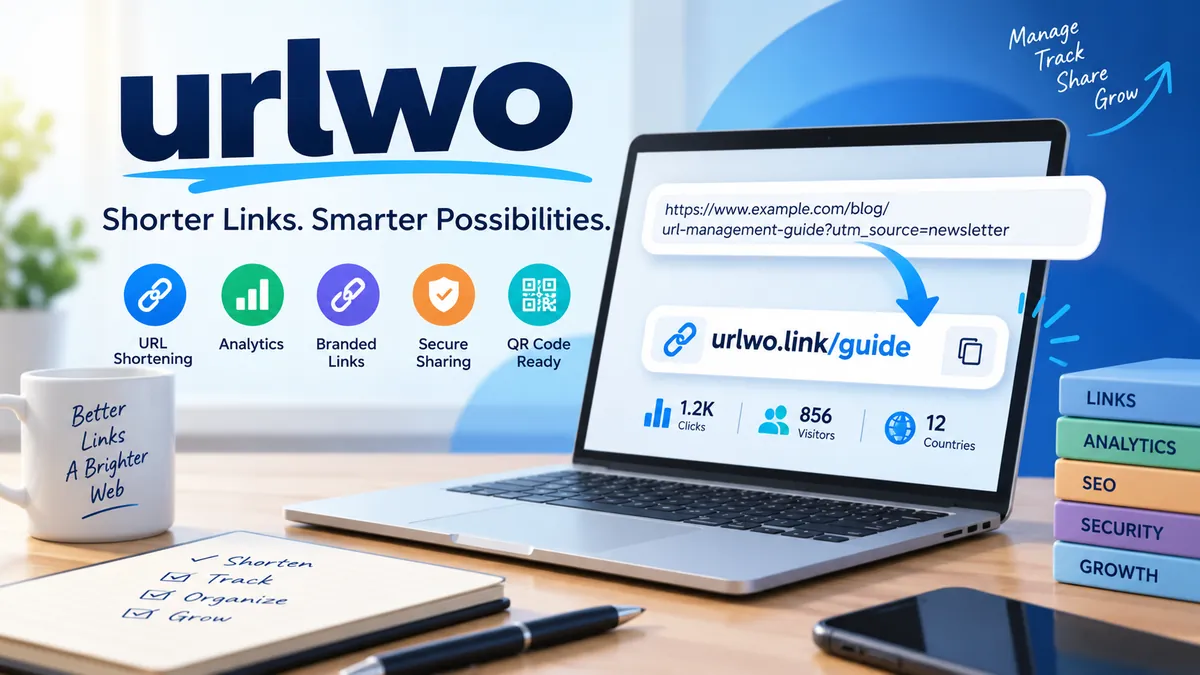
If you searched for urlwo, you probably noticed something unusual: many pages describe it confidently, but they do not all agree on exactly what it is.
Most current search results associate urlwo with URL shortening, link management, branded links, redirects, analytics, and URL optimization. However, there is an important distinction to make before treating it as an established technology or product: authoritative web standards do not define “urlwo” as a standard URL term, and competing articles give inconsistent definitions.
urlwo is best understood as an emerging or loosely defined web-related term currently used online to describe modern URL optimization and link-management ideas. Search results commonly connect it with shortening long URLs, creating readable links, tracking clicks, managing redirects, and improving link organization. It should not be confused with the standardized technical definition of a URL.
That distinction matters. Here is what the available evidence actually tells us about urlwo, what modern link-management systems really do, and which claims deserve caution.
What Is urlwo?
The dominant interpretation of urlwo in current search results is a system, concept, or approach related to managing web links.
Several pages describe it as a URL-shortening or link-management solution capable of turning complicated web addresses into cleaner links. Other sources describe it more broadly as a framework for optimizing URL readability, branding, tracking, and user experience.
There is no consistent expansion of the name, however.
For example, one source expands URLWO as “User and Structured URLs Web Links Optimization,” while another calls it “Uniform Resource Locator with Optimization.” Still other pages avoid assigning a formal expansion altogether.
That inconsistency is significant.
The safer interpretation is therefore:
urlwo is a web term currently associated with URL optimization, shortening, redirection, tracking, and link management, rather than a formally recognized internet standard.
A particularly useful current source examining the term notes that numerous articles make remarkably similar claims about urlwo but that this apparent agreement should not automatically be interpreted as proof of an established product.
For readers researching the term, that is a more reliable starting point than assuming every feature attributed to urlwo has been independently verified.
Is urlwo an Official Web Standard?
No recognized web standard identified in the research establishes urlwo as part of URL syntax or internet architecture.
The authoritative WHATWG URL Standard defines the infrastructure surrounding URLs, including domains, hosts, parsing, serialization, origins, percent encoding, URL APIs, and related concepts. Its current documentation does not define urlwo as a URL component or standard terminology.
That matters because some online explanations describe urlwo almost as though it were a new technical component of web addresses.
For example, one search result characterizes it as a conceptual marker within a web address. This interpretation should not be confused with standardized URL anatomy.
A normal web URL can contain components such as:
- Scheme or protocol
- Host or domain
- Port
- Path
- Query
- Fragment
The WHATWG URL Standard provides the modern technical foundation for how URLs are parsed and processed across the web.
So if you encounter an article claiming that “urlwo” is an official component comparable to a domain, path, query string, or fragment, treat that claim cautiously unless it provides supporting standards documentation.
Why Is urlwo Associated With Link Management?
The association makes sense when you look at how modern links are actually used.
A URL was originally concerned primarily with identifying and accessing resources. Today, links also appear in:
- Social media posts
- Email newsletters
- Advertising campaigns
- QR codes
- SMS messages
- Mobile applications
- Affiliate campaigns
- Analytics platforms
- Printed marketing material
Raw destination URLs can become lengthy once tracking parameters and other information are attached.
Imagine a fictional campaign URL such as:
A link-management service could map that destination to a shorter branded address.
When someone opens the short link, the service performs a redirect to the destination.
That general model is established technology. What remains unclear is whether every capability attributed specifically to urlwo represents a verified platform rather than authors using the term as a general label for this type of technology.
How urlwo Is Supposed to Work
Across the pages describing urlwo as a link-management solution, the basic process resembles conventional URL shortening.
1. A destination URL is provided
The original page might contain a long path, query parameters, campaign identifiers, or other data.
2. A shorter identifier is generated
The link-management system associates a shorter URL with the original destination.
3. The mapping is stored
The service needs a way to determine which destination belongs to each shortened identifier.
Conceptually, the relationship looks like this:
| Short Link ID | Destination |
|---|---|
/a7K2 | Original page A |
/guide | Original page B |
/offer | Original page C |
4. A visitor opens the short link
The request first reaches the link-management service rather than the final destination.
5. A redirect sends the visitor onward
The server returns an HTTP redirect that points the browser toward the destination URL.
6. Analytics may be recorded
Depending on the particular service and its privacy practices, a link-management platform may collect information about link activity.
Current pages discussing urlwo repeatedly associate the concept with click tracking, analytics, campaign management, and link organization.
These are common characteristics of modern link-management systems generally, but specific urlwo functionality should be verified against the actual service being used.
urlwo Features Commonly Described Online
The search results consistently associate urlwo with a handful of capabilities.
| Reported capability | What it generally means |
|---|---|
| URL shortening | Converting lengthy destinations into compact links |
| Custom links | Creating more recognizable link endings |
| Branded URLs | Using recognizable domains or branded link structures |
| Redirects | Forwarding visitors to another destination |
| Click tracking | Recording link interactions |
| Analytics | Measuring link performance |
| Campaign organization | Grouping links by marketing activity |
| QR integration | Connecting physical QR codes with web destinations |
| Link management | Maintaining links from a central interface |
| Dynamic destinations | Changing where a managed link sends visitors |
These features should be understood as the capabilities currently attributed to urlwo in search results, not a guaranteed specification.
That distinction prevents a common research mistake: several websites repeating a claim does not necessarily make the claim independently verified.
Quick Takeaway
The most credible way to understand urlwo is to separate two questions:
What does the search ecosystem currently mean by urlwo? Mostly modern link management and URL optimization.
Is urlwo itself an established technical web standard? The authoritative URL standards reviewed here do not identify it as one.
urlwo vs. a Traditional URL
Understanding ordinary URLs makes the distinction easier.
A Uniform Resource Locator (URL) identifies a resource and provides the information needed to locate or access it. The web platform has formal rules governing URL parsing and representation.
A conventional address might look like:
A link-management layer operates on top of this infrastructure.
It does not replace URLs. Instead, it may provide another address that redirects to the destination.
| Area | Standard URL | urlwo as commonly described |
|---|---|---|
| Primary role | Identify/access resources | Manage or optimize links |
| Formal web standard | Yes | Not identified as one |
| Shortening | Not inherently required | Commonly claimed |
| Redirect management | Separate HTTP behavior | Commonly associated |
| Click analytics | Not inherent to URL syntax | Commonly associated |
| Branding | Domain/path can be branded | Often emphasized |
| Campaign tracking | Usually handled separately | Often described as integrated |
This distinction clears up much of the confusion surrounding the keyword.
urlwo and URL Shorteners: Are They the Same?
Not exactly, at least according to how current articles use the term.
A basic URL shortener performs one fundamental job:
long URL → short URL → redirect → destination
The broader interpretation of urlwo adds management around that process.
That can theoretically include analytics, branded links, campaign grouping, dynamic destinations, QR codes, expiration rules, and other controls.
So a useful conceptual distinction is:
URL shortening is a function. Link management is a system.
If urlwo is being used to describe a modern link-management approach, shortening would therefore be only one part of it.
What Makes a Good Optimized URL?
Some pages discussing urlwo connect the term with SEO-friendly URL structures. This is an area where we can compare the claims against actual Google guidance.
Google recommends simple URL structures that are logical and intelligible to people. It specifically recommends readable words rather than long, incomprehensible ID numbers where possible.
A weak URL might look like:
example.com/index.php?id=48729&cat=18
A clearer structure could be:
example.com/guides/url-management
The second gives readers meaningful context.
Use descriptive words
The path should help communicate what the page contains.
A descriptive slug is generally more useful than a random collection of identifiers.
Separate words with hyphens
Google recommends hyphens rather than underscores for separating words in URLs.
For example:
/link-management-guide/
is preferable to:
/link_management_guide/
Remove unnecessary parameters
Parameters are sometimes essential for functionality, filtering, tracking, and applications.
But unnecessary parameters can create complicated URL variations. Google’s documentation recommends using as few parameters as practical.
Keep capitalization consistent
URLs can be case-sensitive. Google can consequently treat /Guide and /guide as separate URLs. Maintaining consistent casing helps avoid unnecessary variations.
These are genuine URL optimization practices regardless of whether someone labels them “urlwo.”
Does urlwo Improve SEO?
This is one of the areas where exaggerated claims require particular caution.
Using a short link does not automatically improve a page’s Google rankings.
Some search results about urlwo describe substantial SEO benefits, while others more carefully acknowledge that URL shortening itself is not a direct ranking factor.
The second interpretation is much more useful.
Good URL management can support an SEO operation indirectly by helping teams maintain understandable structures, avoid unnecessary URL variants, monitor campaigns, and manage redirects correctly.
But you should not expect this sequence:
shorten URL → ranking boost
SEO is much broader than link appearance.
What URL optimization can realistically help with
A logical URL structure can make addresses easier for people and search engines to understand. Google explicitly recommends simple, descriptive URLs.
Good URL governance can also reduce operational problems such as:
- Duplicate URL variants
- Broken internal links
- Inconsistent capitalization
- Unnecessary parameters
- Poorly implemented redirects
- Confusing site architecture
Those are legitimate reasons to take URL structure seriously.
urlwo and Branded Links
Branding is another recurring theme in pages about urlwo.
A generic shortened URL can hide meaningful information about its destination. A branded link, by contrast, can make the organization behind the link easier to recognize.
For example, compare these fictional patterns:
short.example/x82Qa
and:
links.example.com/research
The second provides more context.
But recognizable wording alone does not prove that a destination is safe. Domains can be imitated, accounts can be compromised, and redirects can lead somewhere unexpected.
Users should still inspect unfamiliar links rather than relying solely on how professional they look.
urlwo Analytics and Click Tracking
Another frequently claimed benefit is analytics.
A managed redirect creates an opportunity to record an interaction before sending the visitor to the final page.
Depending on the platform, analytics might include metrics such as:
- Total clicks
- Unique interactions
- Time and date
- Referring source
- Device category
- Approximate geographic information
- Campaign performance
This can be useful for comparing distribution channels.
Suppose the same article is promoted through an email newsletter, social profile, and QR code. Separate managed links can help identify which channel produced more visits.
However, analytics also introduces privacy considerations.
Organizations should understand what information a link service collects, how long it retains that information, where it is processed, and whether its practices comply with applicable privacy requirements.
Is urlwo Safe?
The answer depends on what exactly someone means by urlwo and which website or service is involved.
A shortened link is not inherently malicious. But shortening creates a security trade-off: the visible URL can conceal the final destination.
That makes cautious link handling important.
Before trusting an unfamiliar shortened or redirected URL:
- Check the domain carefully. Look for misspellings, misleading subdomains, or lookalike characters.
- Determine the destination when possible. Link-expansion or security tools may reveal where a redirect leads.
- Be cautious around login requests. An unexpected link that immediately asks for credentials deserves extra scrutiny.
- Avoid entering sensitive information on unfamiliar destinations.
- Check HTTPS, but don’t treat it as proof of legitimacy. HTTPS protects the connection; malicious sites can also use HTTPS.
- Verify important links independently. For banking, account recovery, payments, or other sensitive actions, visiting the organization’s known official site directly can be safer.
The WHATWG URL Standard itself includes security considerations around URLs, reinforcing the broader point that URLs and their presentation require careful handling.
A common mistake
People often assume a clean, short URL is safer than a complicated one.
That isn’t necessarily true.
A long URL may expose its real domain and destination clearly, while a short redirect can hide them. Readability and security are related to trust, but they are not the same thing.
When Link Management Is Actually Useful
Regardless of whether urlwo develops into a distinct platform, the underlying link-management practices associated with it have genuine applications.
Social media
Shorter links can reduce visual clutter and make campaign URLs easier to manage.
Email campaigns
Different links can help teams measure which newsletter placements receive interactions.
QR codes
Managed destinations can be especially useful with printed QR codes.
If a permanent QR code points to a controlled redirect, its final destination may potentially be changed without reprinting the physical code—provided the particular platform supports editable destinations.
Offline campaigns
Posters, packaging, event materials, brochures, and presentations benefit from addresses that are easy to recognize or reproduce.
Content publishing
Publishers handling hundreds or thousands of pages need consistent naming conventions and URL governance.
Internal campaign management
A central link inventory can make it easier to identify old campaigns, dead destinations, duplicate links, and ownership.
These benefits come from sound link-management architecture rather than from the word urlwo itself.
Dynamic Links and Redirect Management
A normal link often points directly to one destination.
Managed links can introduce an intermediate layer:
visitor → managed link → redirect service → destination
That layer makes additional behavior possible.
For example, a system could theoretically send visitors to different destinations according to predefined rules or allow an administrator to update the target later.
This flexibility is useful, but it introduces dependency.
If the redirect service stops working, expires the account, blocks a link, or shuts down, every link dependent on that service can become useless.
Quick Takeaway
A managed link gives you control, but it also creates dependency.
For important long-term assets, controlling the domain and maintaining a reliable redirect strategy is usually more resilient than depending entirely on an unknown third-party shortener.
Potential Advantages of the urlwo Approach
Taking urlwo in its dominant search-result sense—as a modern approach to link management—there are several reasonable benefits.
Cleaner sharing: Short links are easier to place in messages, printed material, and social posts.
Centralized organization: Campaign links can be stored and managed systematically.
Measurement: Redirect-based analytics can help identify which links generate engagement.
Brand consistency: Custom domains and descriptive paths can make links more recognizable.
Destination flexibility: Some link-management platforms let administrators change the target without replacing the public-facing link.
QR-code management: A controlled redirect can make printed campaigns easier to maintain.
None of these benefits requires urlwo to be a new web standard. They are established link-management concepts.
Limitations and Risks You Should Know
The disadvantages deserve equal attention.
Hidden destinations
Short URLs may make it difficult to see where you are going before clicking.
Third-party dependency
If the shortening provider disappears, managed links can stop functioning.
Privacy concerns
Click analytics can involve collection of visitor information.
Redirect latency
Every additional redirect introduces another request into the journey, even if the delay is normally small.
Link reputation
Some security systems treat unfamiliar short-link domains cautiously because redirect services have historically been abused for spam and phishing.
Misleading SEO expectations
Shortening an address should not be confused with optimizing the underlying website for organic search.
Unverified product claims
This is particularly relevant to urlwo. Search results currently contain numerous overlapping descriptions but inconsistent definitions and expansions of the term.
Before creating an account, installing software, paying for a service, or giving a platform access to analytics or domains, verify who operates it and what functionality actually exists.
urlwo Best Practices
If you encounter urlwo as a real link-management service—or use another platform offering the same capabilities—the underlying best practices remain straightforward.
Keep destination URLs healthy
A short link cannot rescue a broken destination.
Regularly check that target pages remain live and relevant.
Prefer descriptive links
When customization is available, use meaningful language instead of random-looking strings for links intended for humans.
Control important domains
For long-lived campaigns, a domain you control provides greater independence.
Document redirects
Maintain a record containing:
- Public link
- Destination URL
- Purpose
- Campaign
- Owner
- Creation date
- Redirect type
- Expiration date, if applicable
This becomes increasingly valuable as the number of managed links grows.
Don’t create redirect chains unnecessarily
A link that redirects through several intermediate URLs is harder to maintain and troubleshoot.
Keep the route as direct as practical.
Apply consistent URL rules
For your website’s actual URLs, follow a stable convention for lowercase characters, hyphens, folders, and parameters.
Google’s URL guidance supports logical, human-readable structures and recommends minimizing unnecessary parameters.
Protect accounts
If a link-management account controls thousands of public redirects, compromise of that account can have serious consequences.
Use strong authentication and restrict administrative access appropriately.
urlwo, URLs, and the Modern Web
The discussion surrounding urlwo points toward a genuine trend even if the term itself remains poorly standardized: links have become more than strings pasted into browsers.
Organizations now have to think about URL structure, redirect maintenance, analytics, security, campaign attribution, QR codes, mobile sharing, accessibility, and long-term link stability.
At the technical foundation, though, URLs remain governed by established web standards.
The WHATWG URL Standard defines modern URL parsing and related infrastructure, while Google publishes practical guidance for creating crawlable, understandable URL structures.
Those sources should carry more weight than unsupported claims that urlwo introduces a new technical URL standard.
How to Evaluate urlwo Information Online
Because the keyword is currently surrounded by inconsistent descriptions, readers can use a simple verification process.
First, identify the claim. Is the page calling urlwo a product, platform, framework, web-address component, or general concept?
Second, look for primary evidence. A genuine platform should normally have identifiable documentation explaining its features, ownership, privacy practices, terms, and technical operation.
Third, distinguish standards from marketing language. A phrase sounding technical does not make it part of HTML, HTTP, URL, IETF, or WHATWG standards.
Fourth, compare independent sources. Ten websites repeating nearly identical wording may ultimately reflect one unsupported claim rather than ten independent confirmations.
Fifth, verify high-impact claims separately. Claims about security, privacy, SEO rankings, data collection, or technical standards deserve particularly strong evidence.
This process is useful well beyond urlwo. Emerging technology keywords often accumulate explanations faster than authoritative documentation can establish what they actually mean.
The Bottom Line on urlwo
urlwo currently appears across search results primarily as a term for modern URL shortening, optimization, tracking, branding, redirects, and link management. Some pages present it as a platform, others as a framework or philosophy, and at least one treats it more cautiously as an emerging term whose apparent online consensus may be misleading.
What can be established more confidently is the technology surrounding it.
URLs are standardized components of the web. Modern link-management systems can shorten destinations, perform redirects, organize campaigns, and provide analytics. Descriptive URL structures also have legitimate usability and search benefits; Google recommends logical URLs with readable words, hyphens between words, and fewer unnecessary parameters.
What should not be assumed is that urlwo is itself a formally recognized web standard, a universally defined technology, or a verified product with every feature attributed to it across third-party articles.
For now, the most accurate way to understand urlwo is as an emerging, loosely defined term associated with smarter URL and link management. If you encounter a specific urlwo website or service, evaluate that service independently—especially its ownership, security, privacy policy, redirect behavior, and documentation—before relying on it for important links.
