

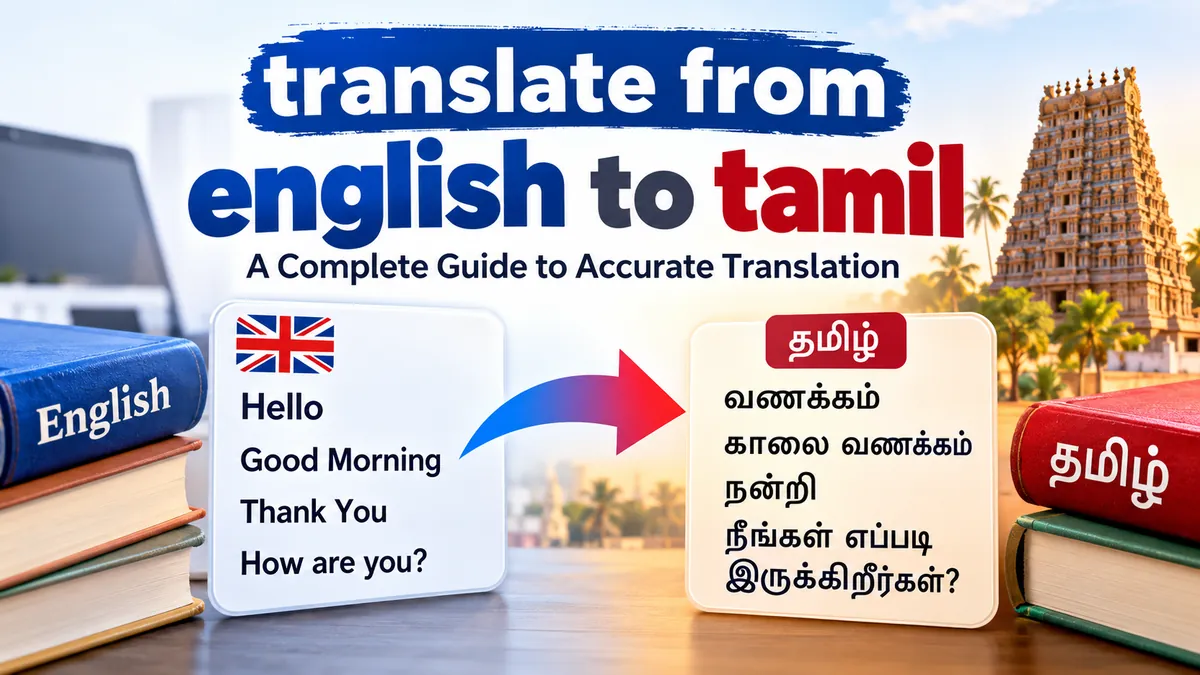
Translating English into Tamil may look as simple as replacing one word with another, but good translation requires much more. English and Tamil have different sentence structures, grammar systems, levels of formality, and ways of expressing everyday ideas.
If you want to translate from english to tamil accurately, focus on meaning and context rather than literal word replacement. Tamil generally follows subject-object-verb sentence order, uses suffixes extensively, and distinguishes between formal and informal speech. The best translation preserves the original message while making it sound natural to a Tamil reader. Translate All Words
What Does translate from english to tamil Mean?
English-to-Tamil translation means converting the meaning of English words, sentences, or longer passages into Tamil.
For example:
| English | Tamil | Transliteration |
|---|---|---|
| Hello | வணக்கம் | Vanakkam |
| Thank you | நன்றி | Nandri |
| Yes | ஆம் | Aam |
| No | இல்லை | Illai |
| Water | தண்ணீர் | Thanneer |
| Food | உணவு | Unavu |
| Book | புத்தகம் | Puthagam |
| House | வீடு | Veedu |
A dictionary can help when translating individual words. Cambridge’s English–Tamil Dictionary, for example, provides Tamil translations alongside definitions and usage examples. Cambridge Dictionary
Complete sentences require more care because the translator must understand what the speaker actually intends to communicate.
Consider the English word “bank.”
It can refer to:
- a financial institution;
- the side of a river;
- storing something for future use;
- an aircraft turning sideways.
A translator must identify the intended meaning before choosing the appropriate Tamil expression.
Why English-to-Tamil Translation Is Different From Word Replacement
English and Tamil come from different language families. English belongs to the Indo-European family, while Tamil is a Dravidian language. Their grammatical structures therefore differ substantially. Translate All Words
One of the clearest differences is basic word order.
English commonly uses SVO
English typically follows:
Subject + Verb + Object
Example:
I eat rice.
The components are:
I = subject
eat = verb
rice = object
Tamil commonly uses SOV
Tamil generally follows:
Subject + Object + Verb
The equivalent idea is:
நான் சாதம் சாப்பிடுகிறேன்.
Transliteration:
Naan saadham saappidugiren.
The structure is essentially:
I + rice + eat.
This is why mechanically translating every English word in its original order can produce unnatural Tamil. Translate All Words
How to Translate From English to Tamil Step by Step
A reliable translation process starts with understanding the English sentence before attempting to rewrite it.
1. Read the complete English sentence
Do not begin by translating individual words.
First determine:
- what the sentence means;
- who is speaking;
- who is being addressed;
- whether the tone is formal or casual;
- whether any words have multiple meanings;
- whether an idiom or figurative expression is being used.
For example:
“It’s raining cats and dogs.”
A literal translation involving cats and dogs would completely miss the meaning. The expression simply means that it is raining very heavily.
2. Identify the core message
Reduce complicated sentences to their basic meaning.
Suppose the original says:
“Could you please send me the document when you have a moment?”
The central message is:
Please send me the document when you are available.
Understanding that intent makes it easier to produce natural Tamil rather than copying English syntax.
3. Rearrange the grammar
The Tamil translation may need a different word order.
This is normal.
A translation should preserve meaning, not necessarily the exact grammatical structure of the source sentence.
4. Choose the appropriate Tamil vocabulary
Some English words have several possible Tamil equivalents.
The right choice depends on context, audience, and register.
For example, an English word used in an academic document might require a more formal Tamil equivalent than the same concept in an everyday conversation.
5. Adjust the level of respect
Tamil makes distinctions in politeness that may not be obvious in English.
The equivalent of English “you” can change according to familiarity and respect. Translation therefore needs to consider whether the reader is a friend, child, stranger, teacher, customer, elder, or official.
6. Read the Tamil sentence naturally
After translating, temporarily ignore the English source and read only the Tamil version.
Ask:
Would a Tamil speaker naturally express the idea this way?
If the sentence sounds like English grammar written with Tamil words, it probably needs revision.
English to Tamil Translation Examples
Seeing complete sentences makes the structural differences easier to understand.
| English Sentence | Tamil Translation |
|---|---|
| What is your name? | உங்கள் பெயர் என்ன? |
| My name is Ravi. | என் பெயர் ரவி. |
| How are you? | நீங்கள் எப்படி இருக்கிறீர்கள்? |
| I am fine. | நான் நலமாக இருக்கிறேன். |
| Thank you very much. | மிக்க நன்றி. |
| Where are you going? | நீங்கள் எங்கே செல்கிறீர்கள்? |
| I need some water. | எனக்கு கொஞ்சம் தண்ணீர் வேண்டும். |
| Please sit down. | தயவுசெய்து உட்காருங்கள். |
| I understand. | எனக்குப் புரிகிறது. |
| I don’t understand. | எனக்குப் புரியவில்லை. |
These examples use relatively neutral or polite Tamil. Everyday spoken Tamil may use shorter or less formal constructions.
Tamil Script and Transliteration Are Not the Same
A common source of confusion is the difference between translation and transliteration.
Translation
Translation changes the language and meaning representation.
Thank you → நன்றி
The English expression has been expressed using a Tamil equivalent.
Transliteration
Transliteration represents pronunciation using another writing system.
For example:
நன்றி → Nandri
“Nandri” is not an English translation of நன்றி. It is a Latin-script representation of how the Tamil word is pronounced.
Similarly:
வணக்கம் → Vanakkam
The Tamil script is வணக்கம், while Vanakkam helps someone who cannot read Tamil script approximate its pronunciation.
This distinction matters when searching for an English-to-Tamil converter. Some tools translate meaning, while others primarily convert Romanized Tamil into Tamil script.
Formal Tamil vs Spoken Tamil
One of the most important aspects of translation is choosing the correct register.
Tamil has notable differences between formal written language and everyday spoken language. Linguists describe this situation as diglossia, where distinct varieties are used in different contexts. translateenglishtomalayalam.com
Formal Tamil is more appropriate for contexts such as:
- educational material;
- official communication;
- government information;
- formal articles;
- professional documents;
- public notices.
Conversational Tamil is more suitable for:
- messages between friends;
- casual conversations;
- social media;
- dialogue;
- informal speech.
A grammatically correct formal sentence can therefore sound unusually stiff in a casual conversation.
Example of formality
A respectful form of “How are you?” can be written:
நீங்கள் எப்படி இருக்கிறீர்கள்?
In casual speech, speakers may use a less formal construction depending on their relationship.
Neither form is automatically better. The audience determines which one fits.
Important English and Tamil Grammar Differences
Understanding a few grammatical principles dramatically improves translation quality.
Sentence order
English primarily uses:
Subject + Verb + Object
Tamil commonly uses:
Subject + Object + Verb
The verb therefore often appears near the end of a Tamil sentence.
Articles
English relies heavily on:
a, an, the
Tamil does not use directly equivalent articles in exactly the same grammatical way. Specificity is often communicated through context or other grammatical features. Translate All Words
Trying to translate every occurrence of “the” separately is therefore unnecessary.
Prepositions and case relationships
English uses separate words such as:
- in;
- at;
- from;
- with;
- to.
Tamil frequently expresses comparable grammatical relationships through suffixes or postpositional structures rather than reproducing English prepositions one by one. Translate All Words
Verb forms
Tamil verbs can communicate information involving tense, person, number, gender, mood, and levels of respect.
Consequently, selecting the correct verb ending can be just as important as choosing the correct root word.
Agglutination
Tamil is an agglutinative language.
This means grammatical information can be attached to a root through a sequence of suffixes. An idea that requires several separate English words may sometimes be expressed through a more compact Tamil construction. ENGLISHTOMAYANMAR
This structural feature is another reason word-for-word translation performs poorly.
How Context Changes Tamil Meaning
Context is arguably the most important element of accurate translation.
Take the English word:
light
It could mean:
- illumination;
- something that is not heavy;
- a pale color;
- setting something on fire.
Likewise:
right
might refer to:
- something correct;
- the opposite of left;
- a legal entitlement.
A translator that processes an isolated word has less information for choosing the correct Tamil equivalent.
Whenever possible, translate the complete sentence rather than an isolated word.
Cambridge’s English–Tamil resources illustrate this principle by pairing translations with definitions and contextual example sentences rather than presenting vocabulary only as disconnected equivalents. Cambridge Dictionary
Common Mistakes When Translating English to Tamil
Several errors repeatedly make translations sound unnatural.
Translating word for word
This is the biggest mistake.
Because English and Tamil use different grammatical structures, preserving English word order can result in awkward Tamil even when every individual word is technically correct.
Translate the idea first.
Ignoring formality
A sentence intended for a close friend may not be suitable for a customer or elder.
When the audience is unknown, a neutral or respectful form is generally safer for public-facing text.
Translating idioms literally
Expressions such as:
“Break the ice”
“Piece of cake”
“Under the weather”
cannot reliably be translated by replacing each English word with its Tamil dictionary equivalent.
First interpret the idiom. Then communicate that meaning naturally.
Ignoring multiple meanings
Words such as “match,” “date,” “charge,” “fine,” and “right” can mean very different things depending on context.
Check the surrounding sentence before selecting a translation.
Mixing written and conversational registers
A translation can be grammatically understandable yet still sound strange if highly formal Tamil and casual spoken Tamil are mixed inconsistently.
Choose a register and maintain it.
How to Translate English Words Into Tamil
For a single English word, a bilingual dictionary is often more useful than a general sentence translator.
A good dictionary entry can provide:
- alternative meanings;
- grammatical category;
- pronunciation;
- example sentences;
- contextual usage.
For example, Cambridge’s English–Tamil Dictionary contains definitions, Tamil translations, and thousands of example sentences drawn from its corpus resources. Cambridge Dictionary
That contextual information is valuable because a single English word may have several Tamil translations.
When checking vocabulary, use this process:
- Identify the word’s meaning in the original sentence.
- Check possible Tamil equivalents.
- Examine example sentences.
- Choose the meaning matching your context.
- Put the word back into the complete sentence and check whether it still sounds natural.
How to Translate Complete English Sentences to Tamil
Sentence translation requires a slightly different approach.
Consider:
“I will call you tomorrow.”
Rather than translating four English words independently, identify:
- subject: I;
- action: call;
- recipient: you;
- time: tomorrow;
- tense: future.
Then construct a natural Tamil sentence with the appropriate grammar and respect level.
This method becomes even more important with longer sentences containing subordinate clauses, passive constructions, phrasal verbs, or idioms.
Simplify difficult English first
Machine translation can sometimes improve when unnecessarily complicated English is simplified before translation.
For example:
Complex:
“It is not uncommon for people to misunderstand this.”
Simpler:
“People often misunderstand this.”
Both communicate approximately the same central idea, but the second is easier for a translation system to interpret reliably.
Using an Online English-to-Tamil Translator
Online translation tools are useful when speed matters.
A typical process is straightforward:
- Select English as the source language.
- Select Tamil as the target language.
- Type or paste the English text.
- Generate the translation.
- Review the Tamil output.
- Correct vocabulary, grammar, tone, and names where necessary.
Cambridge, for example, provides both an English–Tamil dictionary and a text translation interface. Cambridge Dictionary
Automated translation is particularly convenient for understanding everyday text quickly, but generated output should still be reviewed when accuracy matters.
Machine Translation vs Human Translation
Neither method is automatically best for every situation.
| Feature | Machine Translation | Human Translation |
|---|---|---|
| Speed | Very fast | Slower |
| Short everyday phrases | Usually useful | Excellent |
| Context understanding | Variable | Strong |
| Idioms | Can make mistakes | Usually better |
| Formality | May be inconsistent | Can be deliberately controlled |
| Cultural nuance | Limited or variable | Strong with an experienced translator |
| Long documents | Convenient | More time-consuming |
| High-stakes material | Needs careful review | Usually preferable |
Machine translation is useful for casual messages, quick comprehension, simple phrases, and first drafts.
Human review becomes increasingly valuable for legal, medical, academic, government, marketing, and other professional material where subtle mistakes can change the intended meaning.
How to Improve Machine-Translated Tamil
Do not assume the first generated result is necessarily the final translation.
Give the translator context
Instead of entering:
“charge”
provide:
“The hotel will charge $20.”
The complete sentence reduces ambiguity.
Use clear English
Short, direct sentences are generally easier to translate than unnecessarily complicated ones.
Avoid ambiguous pronouns when possible.
Instead of:
“He told him that it was ready.”
specify the people or object if their identities matter.
Be careful with names
Names of people, companies, products, cities, and technical terminology may need transliteration rather than semantic translation.
Changing a proper noun into an unrelated Tamil word can alter the information itself.
Review numbers and dates
Always double-check:
- dates;
- prices;
- measurements;
- percentages;
- phone numbers;
- addresses.
A grammatically beautiful translation is still wrong if a number has changed.
Check the final text with a fluent speaker
For important content, native-speaker review remains one of the most reliable quality checks.
The reviewer should evaluate meaning, grammar, tone, and whether the text actually sounds natural.
Translating Documents From English to Tamil
Long documents create additional challenges because consistency becomes important.
Suppose a technical term occurs 30 times. Translating it three different ways can confuse the reader even if all three versions are individually understandable.
For documents, create a small terminology list containing:
| English Term | Preferred Tamil Term | Notes |
|---|---|---|
| Original term | Approved translation | Context |
| Technical term | Preferred equivalent | Keep consistent |
| Brand name | Transliteration if needed | Do not translate meaning |
Then use the same approved terminology throughout the document.
Formatting also deserves attention. Headings, numbered instructions, tables, captions, dates, and references should remain logically connected after translation.
Indian Tamil and Sri Lankan Tamil
Tamil is used across multiple countries and communities, including India, Sri Lanka, Singapore, and Malaysia. Vocabulary, pronunciation, conversational expressions, and stylistic preferences can differ by region. GoTranslate
For general informational material, standard written Tamil can reach a broad audience.
For highly localized content, however, identify the intended audience before translating. A phrase that sounds completely ordinary in Chennai may not be the preferred expression in Jaffna.
This distinction becomes especially important for advertising, dialogue, subtitles, customer communication, and culturally specific content.
How to Check Whether a Tamil Translation Is Accurate
A useful quality check can be performed in several stages.
First, compare meaning. Does the Tamil text communicate everything contained in the English original?
Second, check grammar. Does the sentence follow natural Tamil structure rather than copied English syntax?
Third, check tone. Is the level of politeness suitable for the intended reader?
Fourth, check terminology. Have important words been translated consistently?
Finally, read the Tamil independently. It should make sense without requiring the reader to mentally reconstruct the English sentence.
For important documents, a bilingual reviewer can compare the source and target texts line by line.
English-to-Tamil Translation for Different Purposes
The best translation style changes according to what you are translating.
Everyday conversations
Prioritize natural, conversational language.
There is little value in producing literary Tamil for a casual message between friends.
Education
Accuracy and clarity should come first. Important terminology should remain consistent so students can connect concepts across lessons.
Websites
Translate navigation, instructions, headings, error messages, and interface text according to their function rather than mechanically copying English wording.
Space also matters because translated text may be longer or shorter than the original.
Business communication
Use professional and respectful language. Company names, product names, numbers, contractual terminology, and dates deserve careful checking.
Subtitles
Subtitles must communicate meaning within limited reading time and screen space. Concise natural Tamil is often better than a rigidly literal translation.
Official or sensitive documents
Legal, medical, immigration, financial, and other high-stakes documents require much stronger quality control. Automated translation can help with initial understanding, but it should not automatically be treated as an authoritative final translation.
Translation, Localization, and Transliteration
These three terms describe different processes.
Translation communicates the meaning of one language in another.
Transliteration represents the sounds of one writing system using another.
Localization adapts content for a particular language, region, or culture.
For example, localizing an English website for Tamil readers might involve more than translating paragraphs. Dates, currency, examples, interface labels, cultural references, and terminology may also need adjustment.
Understanding these differences helps you choose the right method for the job.
Quick Checklist for Better English-to-Tamil Translation
Before accepting a translation, check whether:
- the original meaning has been preserved;
- English word order has not been copied unnecessarily;
- the Tamil grammar sounds natural;
- formal or informal language matches the audience;
- idioms have been translated by meaning;
- ambiguous English words were interpreted from context;
- names and brands were handled correctly;
- terminology remains consistent;
- numbers and dates match the source;
- the final Tamil text reads naturally on its own.
The central principle is simple: translate meaning, not isolated words.
Final Thoughts
Learning how to translate from english to tamil accurately requires more than knowing vocabulary. English and Tamil differ in word order, verb structure, grammatical relationships, levels of respect, and everyday patterns of expression.
For individual words, a reputable bilingual dictionary with contextual examples is valuable. For simple sentences, translation tools can provide a fast starting point. For longer, professional, or sensitive material, review the result carefully and use a fluent Tamil speaker or qualified translator when accuracy is critical.
When context, grammar, audience, and natural Tamil usage guide the process, the result stops sounding like a mechanical conversion and starts reading like genuine communication.
