

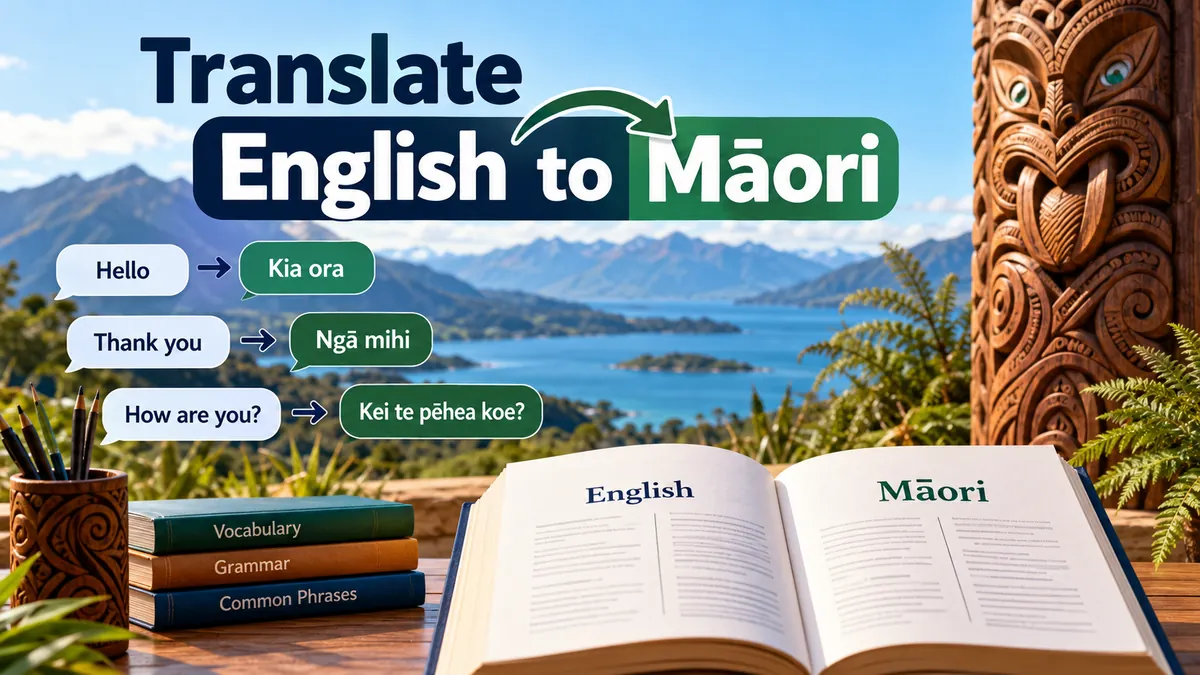
Translating English into Māori involves more than replacing words with their dictionary equivalents. The two languages have different sentence structures, cultural meanings, and ways of expressing ideas. A translation that looks correct word for word may sound unnatural or communicate something entirely different.
To translate english to maori accurately, first understand the meaning of the English sentence, identify its context, and restructure it using Māori grammar. Use reliable dictionaries, check macrons, and review the result for cultural appropriateness. For important translations, seek guidance from a fluent te reo Māori speaker.
Te reo Māori is the Indigenous language of the Māori people of Aotearoa New Zealand. It is a living language used in education, broadcasting, public services, cultural ceremonies, and everyday conversations.
This guide explains how English-to-Māori translation works, provides practical examples, and helps you avoid common mistakes.
1. How to translate english to maori accurately
The most reliable translation process begins with meaning rather than individual words.
English and Māori belong to different language families. English is a Germanic language, while te reo Māori is part of the Polynesian branch of the Austronesian language family.
Their grammatical differences affect word order, tense, possession, and sentence construction.
Step 1: Understand the English sentence
Before translating, determine what the sentence actually communicates.
For example, consider the English expression “How are you?”
It is usually a friendly greeting rather than a request for a detailed medical or emotional report.
A natural Māori equivalent is:
Kei te pēhea koe?
This means “How are you?” when addressing one person.
A translation should preserve the original intention rather than mechanically reproduce its words.
Step 2: Identify the context and audience
The appropriate Māori wording depends on who is speaking and who is being addressed.
A conversation between friends may use different expressions from a formal speech, school announcement, or cultural ceremony.
Consider whether the text is intended for:
- Everyday conversation
- Educational materials
- Workplace communication
- Government or public information
- Cultural events
- Websites and digital content
Formal documents and culturally significant messages often require additional review.
Step 3: Restructure the sentence
English generally follows subject–verb–object order.
For example:
“The child eats food.”
Māori commonly places the verbal phrase before the subject.
A possible translation is:
“Ka kai te tamaiti i te kai.”
The structure is different even though the basic meaning remains similar.
Step 4: Check spelling and macrons
Macrons are horizontal marks above vowels, such as ā, ē, ī, ō, and ū.
They indicate long vowel sounds and can distinguish words with different meanings.
For example:
- keke — cake
- kēkē — armpit
Leaving out a macron can change the meaning of a word.
Step 5: Review the completed translation
Read the translated sentence as a complete expression.
Check whether it communicates the intended meaning, uses appropriate grammar, and sounds natural.
For public-facing or sensitive content, a qualified translator or fluent speaker should review the final wording.
2. Common English to Māori words and phrases
Learning frequently used expressions is one of the easiest ways to understand how te reo Māori works.
The following examples provide useful starting points.
| English | Māori |
|---|---|
| Hello | Kia ora |
| Welcome | Nau mai |
| Goodbye (to someone leaving) | Haere rā |
| Goodbye (said by someone leaving) | E noho rā |
| Thank you | Ngā mihi |
| Thank you very much | Ngā mihi nui |
| Good morning | Mōrena |
| Good night | Pō mārie |
| Yes | Āe |
| No | Kāo |
| Please (in a request) | Tēnā |
| Water | Wai |
| Food | Kai |
| House | Whare |
| School | Kura |
| Family | Whānau |
| Love | Aroha |
| Friend | Hoa |
| Child | Tamaiti |
| Language | Reo |
Some words have several meanings depending on context. For instance, aroha can express love, compassion, or sympathy.
Useful everyday sentences
| English sentence | Māori translation |
|---|---|
| How are you? | Kei te pēhea koe? |
| I am well. | Kei te pai ahau. |
| What is your name? | Ko wai tō ingoa? |
| My name is John. | Ko John tōku ingoa. |
| Where are you going? | E haere ana koe ki hea? |
| I am going home. | Kei te haere ahau ki te kāinga. |
| I am hungry. | Kei te hiakai ahau. |
| I am thirsty. | Kei te matewai ahau. |
| See you again. | Ka kite anō. |
| Thank you for your help. | Ngā mihi mō tō āwhina. |
These examples are helpful for beginners, but they should not be treated as interchangeable templates for every situation.
How do you say hello in Māori?
The most widely recognized greeting is kia ora.
It can function as hello, a friendly acknowledgment, or an expression of goodwill.
Other greetings include:
- Tēnā koe — greeting one person
- Tēnā kōrua — greeting two people
- Tēnā koutou — greeting three or more people
These distinctions show why understanding the audience matters in translation.
3. Understanding Māori grammar before translating
Grammar is one of the biggest challenges when translating English sentences into Māori.
Although individual words may be easy to find, their placement and relationship within a sentence require careful attention.
Māori sentence structure
English often follows this pattern:
Subject + Verb + Object
For example:
“The teacher reads the book.”
A Māori translation is:
“Ka pānui te kaiako i te pukapuka.”
The verbal phrase comes first, followed by the subject and object.
Understanding this pattern helps learners create more natural sentences.
Articles: te, ngā, and he
Māori uses articles differently from English.
| Māori article | Meaning | Example |
|---|---|---|
| Te | The (singular) | Te whare — the house |
| Ngā | The (plural) | Ngā whare — the houses |
| He | A, an, or some | He whare — a house |
Most Māori nouns do not change form simply because they are plural. Instead, the article often indicates number.
For example, whare remains the same in both te whare and ngā whare.
Grammar Māori
+1
Expressing time and actions
English verbs commonly change form to express tense.
Māori uses particles and constructions that convey time, aspect, and the nature of an action.
Common examples include:
| Māori construction | Typical function | Example |
|---|---|---|
| Ka | Action or event, often future or habitual | Ka haere au — I will go |
| I | Completed past action | I haere au — I went |
| Kei te | Ongoing action | Kei te kai au — I am eating |
| Kua | Completed action with present relevance | Kua tae mai ia — They have arrived |
| E … ana | Ongoing or habitual action | E mahi ana ia — They are working |
These are useful introductory explanations rather than one-to-one equivalents of English tenses.
The appropriate construction depends on the full sentence and context.
Pronouns and number
Māori distinguishes between singular, dual, and plural pronouns.
It also distinguishes between forms of “we” that include the listener and forms that exclude the listener.
| Māori | English meaning |
|---|---|
| Au / ahau | I / me |
| Koe | You (one person) |
| Ia | He / she / they (singular) |
| Kōrua | You two |
| Koutou | You (three or more) |
| Tāua | We two, including you |
| Māua | We two, excluding you |
| Tātou | We, including you |
| Mātou | We, excluding you |
This distinction is particularly important when translating instructions, invitations, and announcements.
For example, an English sentence containing “we” may require different Māori pronouns depending on whether the audience is included.
4. Best online tools to translate english to maori
Digital translation resources can help learners understand vocabulary, compare expressions, and develop confidence.
However, no automatic translation system should be treated as a guaranteed authority for every sentence.
Google Translate
Google Translate supports translation between English and Māori.
It is useful for generating initial translations and checking basic vocabulary.
translate.google.com.pg
+1
To use it:
- Open Google Translate.
- Select English as the source language.
- Choose Māori as the target language.
- Enter the sentence or paragraph.
- Read the suggested translation.
- Verify unfamiliar words and grammatical structures using a trusted Māori resource.
For example, entering “Good morning” may provide a Māori greeting that you can compare with established usage.
Machine translation is most helpful as a starting point, especially for short and straightforward sentences.
Long passages, idioms, and culturally specific expressions require more careful checking.
Te Aka Māori Dictionary
Te Aka Māori Dictionary is an important resource for learners and translators.
Developed by Professor John C. Moorfield, the dictionary provides English-to-Māori and Māori-to-English entries, grammatical information, examples, idioms, and cultural explanations.
Its coverage extends beyond ordinary vocabulary to concepts connected with Māori history, traditions, plants, animals, and place names.
Te Aka Māori Dictionary
+1
Te Aka is particularly useful when an English word has several possible Māori equivalents.
Instead of choosing the first result, examine the definition and usage examples.
Te Whanake language resources
Te Whanake is a collection of learning resources associated with John C. Moorfield’s work in Māori language education.
Its materials help learners understand how vocabulary and grammar function within connected sentences.
This is useful because dictionary knowledge alone does not guarantee fluent sentence construction.
Te Taura Whiri i te Reo Māori
Te Taura Whiri i te Reo Māori provides language guidance and supports the revitalization and correct use of te reo Māori.
Its orthographic guidance is particularly valuable for spelling conventions, macrons, and consistent written language.
New Zealand government education guidance also recommends checking Te Aka and Māori orthographic standards when preparing written material.
Education.govt.nz
+1
Comparing translation resources
| Resource | Best use | Limitation |
|---|---|---|
| Google Translate | Quick draft translations | May miss context or nuance |
| Te Aka Māori Dictionary | Word meanings, grammar, examples | Not a complete automatic sentence translator |
| Te Whanake | Structured language learning | Requires study and practice |
| Māori Language Commission guidance | Spelling and writing conventions | Not intended for instant translation |
| Qualified human translator | Formal, cultural, or high-stakes content | Requires specialist availability |
A combination of resources generally provides better results than relying on one tool.
5. Māori pronunciation and the importance of macrons
Accurate translation includes knowing how the written language is pronounced.
Te reo Māori has five vowel letters:
A, E, I, O, and U.
Each vowel may be short or long.
Long vowels are normally represented by macrons:
Ā, Ē, Ī, Ō, and Ū.
Basic vowel pronunciation
The following English approximations can help beginners, although they do not perfectly reproduce Māori sounds.
| Vowel | Approximate sound |
|---|---|
| A | Similar to a in father |
| E | Similar to e in bed |
| I | Similar to ee in see |
| O | Similar to o in more |
| U | Similar to oo in food |
A macron indicates that the vowel sound is held longer.
Vowel length can affect meaning, so it should not be ignored.
Māori consonants
The Māori alphabet uses the consonants h, k, m, n, p, r, t, w, and the digraphs ng and wh.
The digraph ng represents a single consonant sound, similar to the final sound in the English word “sing.”
The pronunciation of wh can vary among speakers and dialects.
Māori r is typically a brief tap of the tongue, rather than the usual English r sound.
Listening to fluent speakers is more effective than relying only on English spelling approximations.
Why macrons matter in translation
Consider the difference between these words:
| Māori word | Meaning |
|---|---|
| Keke | Cake |
| Kekē | To creak |
| Kēkē | Armpit |
These distinctions are documented in Te Aka’s explanation of Māori spelling conventions.
Te Aka Māori Dictionary
The example demonstrates that vowel length is not simply decorative.
For websites, educational materials, and printed publications, correct macrons should be preserved throughout the text.
6. Cultural meaning and translation mistakes to avoid
Some English expressions have no exact Māori equivalent because language and culture organize meaning differently.
A translator must sometimes explain an idea rather than replace it with a single word.
Understanding culturally significant words
Several Māori words carry meanings that extend beyond a short English definition.
Whānau commonly refers to family, but its use can reflect extended family relationships and wider networks of belonging.
Mana can involve authority, prestige, influence, dignity, or standing, depending on the context.
Tapu refers to concepts of sacredness and restriction within Māori cultural frameworks.
Manaakitanga involves hospitality, care, generosity, and respect toward others.
Whakapapa concerns genealogy and the relationships connecting people, ancestors, and the wider world.
Kaitiakitanga is associated with guardianship and responsibilities of care, often in relation to the environment.
These words should not always be compressed into a single English equivalent. Cultural context and local usage matter.
Te Aka Māori Dictionary
+1
Translating Māori proverbs
Māori proverbs are known as whakataukī.
They often communicate cultural values through imagery, history, and traditional knowledge.
For example:
“He aha te mea nui o te ao? He tangata, he tangata, he tangata.”
A common English rendering is:
“What is the most important thing in the world? It is people, it is people, it is people.”
The meaning emphasizes the importance of people and human relationships.
A literal translation conveys the words, but additional explanation may help readers appreciate the cultural significance.
Common mistakes in English-to-Māori translation
Some translation errors occur repeatedly among beginners.
- Translating word by word: English sentence structures cannot always be transferred directly.
- Omitting macrons: This can affect pronunciation and meaning.
- Ignoring singular, dual, and plural forms: Māori distinguishes between one, two, and three or more people.
- Choosing the wrong pronoun: Inclusive and exclusive forms of “we” are not interchangeable.
- Assuming one meaning per word: Many Māori terms have several meanings.
- Using machine translation without review: Automated output can sound unnatural or misunderstand the intended message.
- Ignoring dialect variation: Vocabulary and pronunciation may differ among iwi and regions.
Te Aka documents dialect differences, including variations associated with Tūhoe, Whanganui-Taranaki, and parts of the South Island.
Te Aka Māori Dictionary
For culturally significant writing, relevant community preferences should be respected.
7. Practical examples for school, travel, and everyday communication
Understanding how translation works in real situations makes the language easier to learn.
English to Māori for school
Educational environments often introduce simple classroom expressions.
| English | Māori |
|---|---|
| Teacher | Kaiako |
| Student | Ākonga |
| Book | Pukapuka |
| School | Kura |
| Learning | Ako |
| Writing | Tuhituhi |
| Reading | Pānui |
| Question | Pātai |
| Answer | Whakautu |
| Classroom | Akomanga |
For example:
“Kei te pānui te ākonga.”
Translation: “The student is reading.”
A teacher might also say:
“Whakarongo mai.”
Meaning: “Listen.”
English to Māori for travel
Visitors to Aotearoa New Zealand may encounter Māori language in place names, signs, cultural attractions, and public announcements.
Useful expressions include:
| English | Māori |
|---|---|
| Welcome | Nau mai |
| Hello | Kia ora |
| Where is the bathroom? | Kei hea te wharepaku? |
| I need help. | Me āwhina mai ahau. |
| Thank you | Ngā mihi |
| Goodbye | Haere rā |
| See you again | Ka kite anō |
Understanding even a few expressions can make everyday interactions more meaningful.
However, travelers should avoid assuming that all Māori words on signs have simple literal translations.
Place names may preserve historical events, ancestors, or geographical descriptions.
English to Māori for websites and digital content
Bilingual websites need more than translated headings.
Navigation labels, forms, instructions, error messages, and accessibility information should communicate clearly.
For example:
| English interface term | Possible Māori equivalent |
|---|---|
| Home | Kāinga |
| Search | Rapu |
| Contact | Whakapā |
| Information | Pārongo |
| Help | Āwhina |
| News | Ngā pitopito kōrero |
These are context-dependent suggestions, not universally approved interface labels.
A website’s “Home” navigation label, for instance, may be better handled differently depending on the organization and its established terminology.
For digital publication, consider readability, consistent terminology, appropriate fonts, and proper Unicode support for macrons.
Auckland Transport’s bilingual content guidance also emphasizes correct macrons and appropriate treatment of Māori words in English-language materials.
Auckland Transport
8. How to improve English-to-Māori translation skills
Translation improves when learners develop vocabulary, grammar, listening, and cultural understanding together.
Memorizing isolated words is useful initially, but connected language practice produces more meaningful progress.
Start with short sentences
Choose everyday expressions such as:
“I am happy.”
“Where is the school?”
“The child is reading.”
Try to identify the subject, action, and intended meaning before translating.
Then compare your attempt with examples from established learning resources.
Build vocabulary by topic
Organize new words into practical groups.
For example, a family vocabulary group might include whānau, māmā, pāpā, and tamaiti.
A nature group might include moana (sea), maunga (mountain), awa (river), and whenua (land).
Learning related vocabulary makes words easier to remember and use.
Listen to fluent speakers
Pronunciation cannot be learned fully through written translations.
Listening to interviews, educational recordings, Māori-language broadcasting, and fluent speakers helps learners recognize rhythm, vowel length, and natural phrasing.
Pay particular attention to the distinction between short and long vowels.
Practice translating both directions
Translate a short English sentence into Māori, then examine its meaning in English again.
This can reveal missing information or an incorrect word choice.
However, automatically translating a sentence back into English does not prove that the Māori version is correct. Two translation errors may cancel each other out.
Use a simple daily practice routine
15-minute Māori translation practiceLearn five new words
3 minReview one grammar pattern
4 minTranslate two short sentences
4 minCheck spelling and listen to pronunciation
4 min
0 of 4 activities completed
Short, consistent practice sessions are generally easier to maintain than occasional intensive study.
The New Zealand government also provides information about Māori-language learning opportunities, including beginner and advanced courses.
New Zealand Government
9. When should you use a professional Māori translator?
Automatic tools and dictionaries are suitable for learning and low-risk everyday communication.
However, some materials require specialist expertise.
Professional translation or review is particularly valuable for legal documents, healthcare information, official announcements, educational curricula, culturally significant ceremonies, and public-facing organizational material.
A translator can assess not only grammatical accuracy but also tone, terminology, cultural meaning, and the intended audience.
For documents involving iwi-specific language or traditions, consultation with appropriate language and cultural authorities may be necessary.
Can AI translate English to Māori accurately?
AI can generate useful translation drafts, but accuracy varies with sentence complexity, context, and the quality of the system.
Short everyday expressions may be easier to translate than specialized documents or culturally nuanced passages.
AI output should therefore be checked rather than accepted automatically.
Is Māori difficult for English speakers to learn?
Māori has a relatively consistent relationship between spelling and pronunciation, which can help beginners.
However, grammatical particles, possession, pronouns, and sentence patterns differ significantly from English.
Regular practice and exposure to authentic spoken language are essential.
Is Māori the same as other Polynesian languages?
No. Māori is related to other Polynesian languages, including Hawaiian, Tahitian, and Samoan, but they are distinct languages.
They share historical linguistic connections while differing in vocabulary, grammar, and pronunciation.
Knowledge of one Polynesian language may help with learning another, but it does not make the languages interchangeable.
Conclusion
Learning to translate english to maori accurately requires an understanding of vocabulary, grammar, pronunciation, and cultural context.
Online resources such as Google Translate and Te Aka Māori Dictionary can provide a useful starting point, while structured learning materials help explain how the language works.
The most effective approach is to translate meaning rather than individual words, preserve macrons, check grammatical patterns, and seek fluent-speaker guidance when accuracy is especially important.
Begin with everyday greetings and short sentences, then gradually work toward longer conversations and more complex texts. This approach builds both translation skills and a deeper appreciation of te reo Māori as a living language.
