

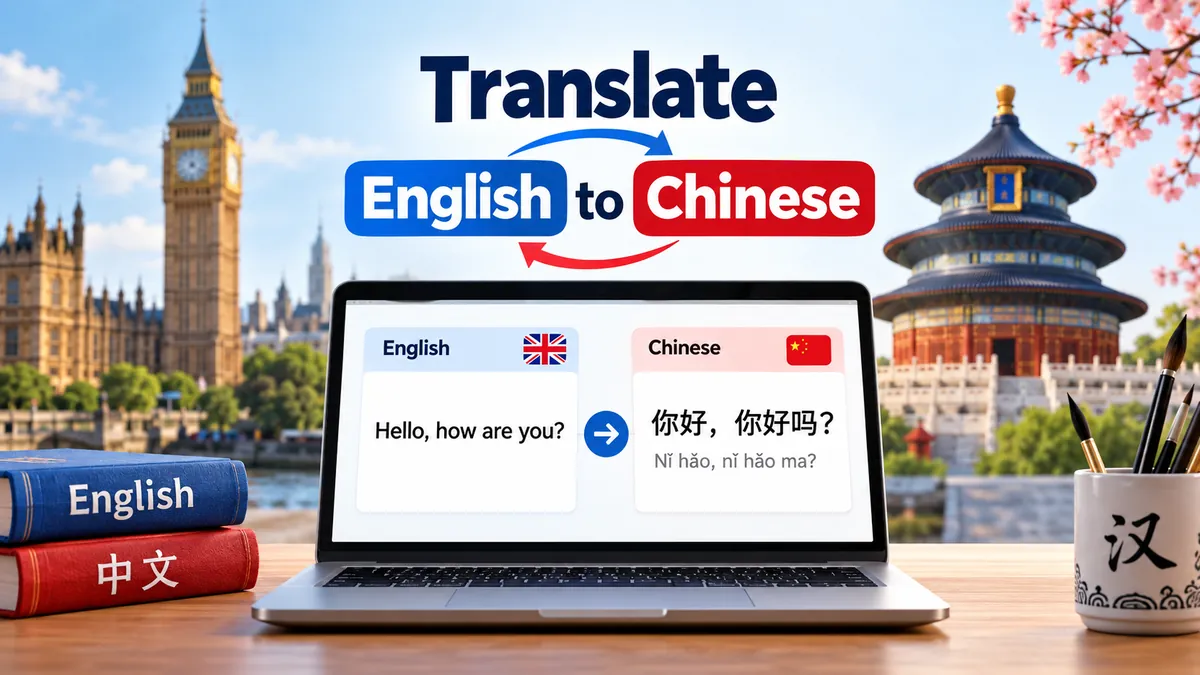
Translating English into Chinese can look simple: enter a sentence, press a button, and copy the result. The difficult part is making sure the Chinese expresses the same meaning, tone, and context as the original English.
If you need to translate english to chinese, start by deciding who will read the translation. Choose Simplified or Traditional Chinese for the target audience, translate the meaning rather than individual words, preserve names and numbers carefully, and review ambiguous phrases, idioms, technical terminology, and tone before using the result.
Modern translation tools can handle everyday sentences quickly, but English and Chinese differ substantially in writing systems, grammar, word order, pronunciation, and cultural conventions. Understanding those differences helps you produce Chinese that sounds natural rather than mechanically translated.
How to Translate English to Chinese
The basic process for translating English to Chinese is straightforward:
- Prepare the English text.
- Identify its meaning and context.
- Choose Simplified or Traditional Chinese.
- Translate the complete sentence rather than isolated words.
- Review names, dates, numbers, and terminology.
- Check whether the Chinese sounds natural.
- Verify important business, legal, medical, academic, or technical content with a qualified speaker or translator.
Many online translators follow a similar workflow: enter or paste the English text, select Chinese as the target language, generate the translation, and copy the result. Current translation pages also commonly support sentences, paragraphs, and documents rather than only individual words.
The key is not simply generating Chinese characters. A useful translation should communicate what the English speaker actually intended.
A Simple Translation Example
Consider:
English: Thank you.
Simplified Chinese: 谢谢
Pinyin: xiè xie
Now consider a longer sentence:
English: I am learning Chinese.
Simplified Chinese: 我在学中文。
The second example already requires more grammatical understanding than replacing each English word independently. This becomes increasingly important as sentences become longer or more nuanced.
Simplified vs. Traditional Chinese: Which Should You Choose?
One of the first decisions when you translate english to chinese is which Chinese writing system your audience expects.
Chinese is commonly written using Simplified Chinese or Traditional Chinese characters. The appropriate choice depends largely on the target region and audience.
| Target audience or region | Common writing system |
|---|---|
| Mainland China | Simplified Chinese |
| Singapore | Simplified Chinese |
| Taiwan | Traditional Chinese |
| Hong Kong | Traditional Chinese |
| Macau | Traditional Chinese |
Translation tools often provide separate options for the two scripts. Simplified Chinese is generally appropriate for readers in mainland China, while Traditional Chinese is commonly expected for audiences in Taiwan and Hong Kong.
This distinction matters because a translation can be linguistically understandable yet still use a script that feels inappropriate for its intended audience.
What Is Simplified Chinese?
Simplified Chinese uses character forms that were simplified from many traditional forms. It is the standard writing system in mainland China and is also widely used in Singapore.
For example:
Traditional: 學
Simplified: 学
Both relate to learning or study, but the written forms differ.
What Is Traditional Chinese?
Traditional Chinese retains older character forms and is widely used in Taiwan, Hong Kong, and Macau.
Choosing Traditional Chinese is not simply a matter of converting characters. Regional vocabulary and writing conventions can also differ, so professional localization may require more than script conversion.
Is Translating English to Chinese the Same as Translating English to Mandarin?
Not exactly.
Chinese is a broad linguistic term that includes different varieties, while Mandarin refers to a spoken variety and is the basis of Standard Chinese.
When someone asks for an English-to-Chinese text translation, they usually want written Standard Chinese in either Simplified or Traditional characters. Pinyin may also be provided to show Mandarin pronunciation. Some English-to-Chinese tools therefore display the Chinese characters alongside Pinyin.
This distinction is particularly useful for language learners.
If your goal is to send a written message to someone in mainland China, Simplified Chinese will often be the appropriate output. If your goal is to learn how to say the sentence in Mandarin, Chinese characters plus Pinyin and audio pronunciation are more useful.
Understanding Chinese Characters and Pinyin
English uses the Latin alphabet. Written Chinese primarily uses Chinese characters, often called Hanzi.
This fundamental difference is why English-to-Chinese translation cannot reliably be treated as simple letter substitution.
What Are Hanzi?
Hanzi are Chinese characters used to represent meaningful linguistic units. Characters can function independently or combine with other characters to form words.
For example:
我 — I/me
爱 — love
你 — you
Together:
我爱你 — I love you.
Written Chinese also generally does not separate every word with spaces in the same way English does.
What Is Pinyin?
Hanyu Pinyin, commonly shortened to Pinyin, is a romanization system used to represent Mandarin pronunciation with Latin letters.
For example:
你好 — nǐ hǎo — hello
Pinyin is especially valuable for beginners because seeing Chinese characters does not necessarily tell an English speaker how to pronounce them.
Mandarin pronunciation also uses lexical tones, so tone marks in Pinyin carry meaningful pronunciation information.
A translator that provides Chinese characters and Pinyin can therefore be more useful for learning and speaking than one that provides Chinese characters alone.
Why English-to-Chinese Translation Is Not Word-for-Word
English and Chinese organize information differently.
Trying to translate every English word independently often creates awkward or incorrect Chinese because meaning depends on context, sentence structure, and conventional usage.
Consider an English word such as book.
As a noun referring to something you read, it can be:
书
But the verb “book” in “book a hotel room” has a completely different meaning. Translating it with the Chinese word for a physical book would be incorrect.
This is why context-aware translation matters.
Grammar Works Differently
English frequently changes verb forms to communicate tense:
- I work.
- I worked.
- I am working.
- I will work.
Chinese generally does not use verb conjugation in the same way. Time and aspect can instead be communicated through context, time expressions, particles, or other grammatical structures. English-to-Chinese translation services consequently emphasize restructuring sentences according to Chinese grammar rather than copying English forms.
Pronouns Can Be Context-Dependent
English sentences often explicitly state subjects that Chinese may omit when the meaning is already clear from context.
A translator that mechanically preserves every English grammatical element may therefore produce Chinese that is technically understandable but unnatural.
Plurality Is Different
English regularly marks plural nouns:
book → books
Chinese generally does not add an equivalent plural ending to ordinary nouns in the same way. Quantity can instead be understood from numbers, measure words, or context.
This illustrates why good translation focuses on meaning rather than matching every source word with a target word.
Common English to Chinese Translations
Learning a few everyday expressions provides a useful introduction to how English ideas appear in Chinese.
| English | Simplified Chinese |
|---|---|
| Hello | 你好 |
| Thank you | 谢谢 |
| Good morning | 早上好 |
| Goodbye | 再见 |
| I love you | 我爱你 |
| What is your name? | 你叫什么名字? |
| How are you? | 你好吗? |
| I am learning Chinese | 我在学中文 |
| Where is the bathroom? | 洗手间在哪里? |
| Can you help me? | 你能帮我吗? |
These examples are consistent with common phrase references provided by current English-to-Chinese translation resources.
Treat phrase tables as starting points rather than universal translations. The most natural wording can change with formality, region, relationship, and context.
How to Get More Accurate English-to-Chinese Translations
Translation accuracy depends partly on the quality of the original English.
Clear source text gives both human translators and automated systems a better chance of interpreting your meaning correctly.
1. Write Complete Sentences
Avoid entering isolated words when they have several possible meanings.
Instead of:
bank
write:
I need to go to the bank to withdraw money.
The complete sentence makes it clear that “bank” refers to a financial institution rather than the side of a river.
2. Avoid Unexplained Slang
Expressions such as:
- hit the road
- break a leg
- piece of cake
- under the weather
should rarely be translated literally.
For example, “piece of cake” can mean something is very easy. A literal translation referring to cake may completely lose the intended meaning.
Good translation communicates the idea behind the idiom.
3. Provide Context
Context becomes essential for words with multiple meanings.
If you’re translating product instructions, say that the text belongs to a manual. If you’re translating an email to a business partner, the Chinese may need a more professional tone than a message to a friend.
Some newer AI translation systems explicitly use context and terminology controls to improve consistency across longer content.
4. Keep Names Consistent
Personal names, company names, product names, and places need special attention.
A proper noun might be:
- translated,
- transliterated,
- kept in English,
- or represented by an established official Chinese name.
For example, a global company may already have an official Chinese brand name. Inventing a new translation can confuse readers.
5. Check Numbers and Dates
Never assume numbers survived translation correctly.
Review:
- prices,
- percentages,
- dates,
- measurements,
- phone numbers,
- model numbers,
- addresses,
- account references.
A translation can be linguistically excellent and still become unusable because one number changed.
6. Maintain Terminology Consistency
If an English technical term appears 20 times, avoid translating it five different ways unless context genuinely changes its meaning.
A glossary can help with long documents, websites, product documentation, and recurring business content.
How Accurate Are Online English-to-Chinese Translators?
Modern machine translation can be very useful, particularly for everyday communication and understanding the general meaning of text.
Current translation platforms increasingly advertise context-aware AI rather than simple dictionary substitution, and some support complete documents, images, or terminology controls.
Accuracy, however, depends on what you are translating.
A simple sentence such as:
Where is the train station?
has relatively little ambiguity.
A marketing slogan, legal clause, joke, technical specification, or culturally specific phrase can be much harder.
Machine Translation Works Well For
Automated translation is often useful for:
- everyday messages,
- understanding foreign-language content,
- simple travel phrases,
- basic emails,
- straightforward instructions,
- preliminary document translation,
- language-learning assistance.
Human Review Matters More For
Professional review becomes more important for:
- legal contracts,
- medical information,
- government documents,
- academic publications,
- technical manuals,
- safety instructions,
- public-facing marketing,
- high-value business communication.
Even translation tools themselves commonly warn that automated output can contain errors and that important translations should be checked.
English to Chinese Translation for Documents
Translating a complete document requires more care than translating one sentence.
Documents may contain headings, tables, captions, footnotes, abbreviations, repeated terminology, names, dates, and formatting that need to remain consistent.
A practical workflow is:
- Review the document before translating.
- Identify the target region and script.
- Create a terminology list for repeated specialist terms.
- Translate by complete sentence or meaningful segment.
- Preserve document structure.
- Check names, numbers, and references separately.
- Review terminology consistency.
- Proofread the complete Chinese version in context.
Current translation platforms may accept pasted text as well as uploaded document files, although supported formats and limits vary by service.
For important documents, translation should be followed by human proofreading rather than treating the first machine-generated output as final.
Translating Business and Professional English
Business translation introduces another challenge: tone.
Compare these ideas:
Send me the report.
and:
Could you please send me the report by Friday?
They request essentially the same action, but their tone differs significantly.
A professional Chinese translation should preserve that distinction instead of converting both sentences into the same blunt command.
Technical Terminology
Industries such as manufacturing, finance, engineering, software, law, and healthcare use specialist vocabulary.
When translating professional material:
- build a glossary,
- use established Chinese terminology,
- preserve product and model names,
- check abbreviations,
- maintain consistent units,
- verify regulatory terminology,
- and have specialist content reviewed when accuracy has real consequences.
Professional translation becomes less about individual words and more about maintaining meaning consistently across an entire document.
Common Mistakes When You translate english to chinese
Some errors appear repeatedly because English speakers naturally carry English grammar and assumptions into Chinese.
Translating Every Word Literally
Literal translation is one of the biggest problems.
The Chinese sentence should express the original meaning naturally, even when that requires changing the sentence structure.
Ignoring Simplified and Traditional Chinese
Selecting “Chinese” without considering the intended audience can result in the wrong writing system.
Decide the target market before translating.
Confusing Written Chinese With Pinyin
Pinyin represents Mandarin pronunciation. It is not a substitute for Chinese characters in normal written Chinese communication.
For example:
Chinese: 谢谢
Pinyin: xiè xie
English: Thank you
Each serves a different purpose.
Ignoring Tone and Formality
A casual conversation between friends should not necessarily sound like a formal business letter.
Likewise, professional correspondence should not accidentally become overly casual.
Trusting One Translation Without Reviewing It
When a sentence is important, read the result in context. If possible, compare translations or ask a proficient Chinese speaker to review it.
Names, idioms, culturally specific phrases, and words with multiple meanings deserve particular attention.
English to Chinese Translation for Websites and Digital Content
Website translation involves more than converting visible paragraphs.
A complete localization project may include:
- navigation menus,
- buttons,
- headings,
- product descriptions,
- image text,
- form labels,
- error messages,
- metadata,
- help documentation,
- URLs,
- structured data,
- and customer-support content.
The target audience should again determine whether Simplified or Traditional Chinese is used.
Localization also considers regional terminology, cultural expectations, typography, and user experience. A sentence that is grammatically correct can still feel unnatural to the target audience if it follows English conventions too closely.
For SEO content, translating an English keyword literally may also be inadequate because Chinese users may search using a different natural phrase. Keyword research should therefore be performed in the target language rather than assuming direct equivalence.
Should You Use Chinese Characters or Pinyin?
Use Chinese characters when you need normal written communication.
Use Pinyin when pronunciation is part of the goal.
For language learners, the most helpful format can be:
English: Good morning
Chinese: 早上好
Pinyin: zǎo shang hǎo
This shows the meaning, written form, and approximate Mandarin pronunciation together.
For a business document intended for Chinese readers, however, adding Pinyin beneath every sentence would usually be unnecessary.
How to Check an English-to-Chinese Translation
A useful review process has several layers.
Meaning Check
Ask whether the Chinese communicates the same idea as the English.
Do not focus only on whether individual words match.
Fluency Check
Would a native or highly proficient Chinese speaker naturally write the sentence this way?
Awkward word order is a common sign of overly literal translation.
Terminology Check
Verify repeated technical terms, company names, product names, locations, and specialist vocabulary.
Detail Check
Compare every:
- name,
- date,
- number,
- currency,
- percentage,
- measurement,
- URL,
- email address,
- reference number.
Audience Check
Finally, confirm that the script, vocabulary, and tone suit the intended region and reader.
This final step can separate a technically understandable translation from a genuinely useful one.
Free Translation vs. Professional Translation
Free online translation is extremely convenient, but it does not solve every translation problem.
| Need | Automated translation | Professional human review |
|---|---|---|
| Casual message | Usually suitable | Usually unnecessary |
| Travel phrase | Usually suitable | Usually unnecessary |
| Understanding a webpage | Useful | Rarely necessary |
| Business email | Often useful | Helpful for important messages |
| Marketing copy | Useful as a draft | Recommended |
| Technical documentation | Useful as a draft | Often recommended |
| Legal document | Not enough by itself | Strongly recommended |
| Safety-critical material | Not enough by itself | Essential |
Machine translation is best viewed as a powerful tool rather than an automatic guarantee of correctness.
The higher the consequences of a mistranslation, the more valuable expert review becomes.
Practical Tips for Better Chinese Translation
When translating English into Chinese regularly, a few habits make a noticeable difference:
- Keep the English source concise and unambiguous.
- Decide on Simplified or Traditional Chinese before starting.
- Translate complete ideas rather than isolated words.
- Provide context for ambiguous terminology.
- Maintain a glossary for recurring terms.
- Preserve official brand and organization names.
- Check idioms instead of translating them literally.
- Review all numbers independently.
- Use Pinyin when pronunciation matters.
- Ask a proficient speaker to review high-stakes material.
The strongest translations do not look as though English words were mechanically replaced. They read as though the message was naturally written for a Chinese-speaking audience.
Final Thoughts
Learning how to translate english to chinese accurately begins with understanding that translation is about meaning, not word substitution. English and Chinese differ in writing systems, grammar, sentence structure, pronunciation, and cultural conventions, so context matters at every stage.
For everyday text, modern translation tools can provide fast and useful results. Choose Simplified Chinese or Traditional Chinese according to your audience, use Pinyin when you need pronunciation guidance, and always review ambiguous words, idioms, names, numbers, and terminology.
For professional or high-stakes material, use automated translation as a starting point and have the final Chinese checked by someone with the linguistic and subject expertise needed for the content.
