

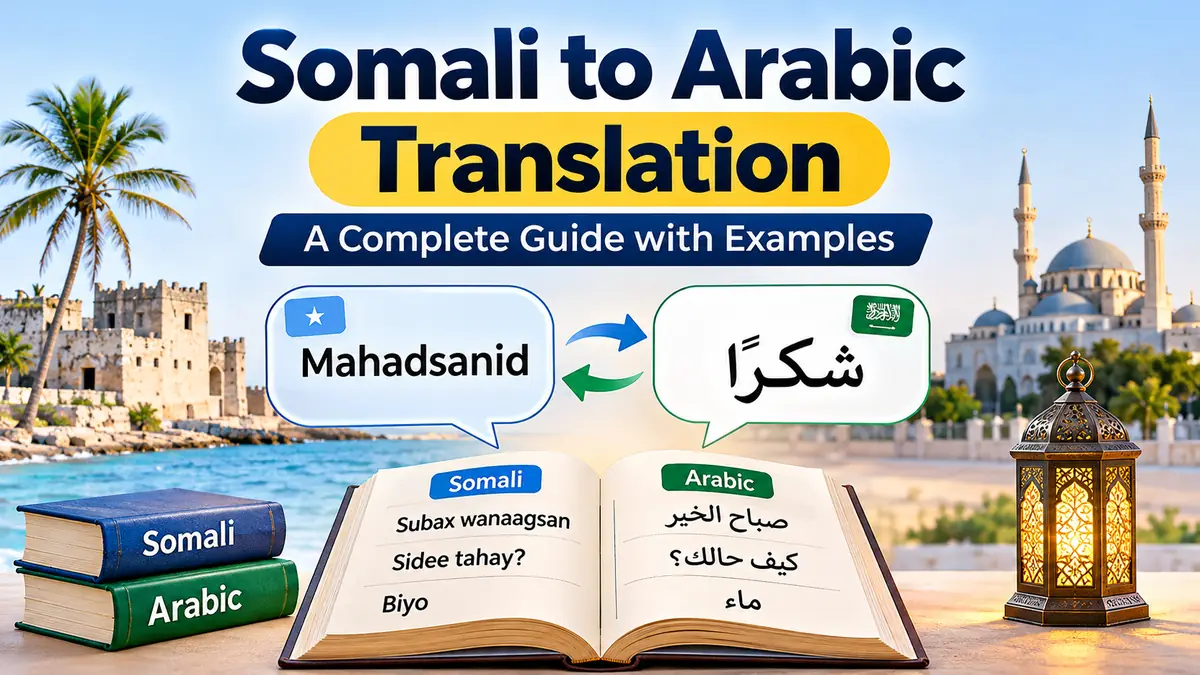
Translating Somali into Arabic can seem straightforward until a familiar word changes meaning, a sentence sounds unnatural, or an Arabic dialect introduces an unexpected expression.
Although Somali and Arabic share historical, cultural, and linguistic connections, they are distinct languages with different grammatical systems, writing conventions, and pronunciation patterns.
somali to arabic translation means converting words, sentences, conversations, or documents from the Somali language into Arabic while preserving their intended meaning. Accurate translation requires understanding Somali grammar, Arabic sentence structure, cultural expressions, and the differences between Modern Standard Arabic and regional dialects. Online translators can help with everyday communication, but context remains essential.
How Does somali to arabic Translation Work?
Somali-to-Arabic translation involves interpreting the meaning of Somali text and expressing that meaning naturally in Arabic.
The process is more complex than replacing each Somali word with its Arabic equivalent. A translator must consider grammar, context, sentence order, and the intended audience.
For example:
| Somali | Arabic | English |
|---|---|---|
| Mahadsanid | شكراً | Thank you |
| Subax wanaagsan | صباح الخير | Good morning |
| Habeen wanaagsan | ليلة سعيدة | Good night |
| Sidee tahay? | كيف حالك؟ | How are you? |
| Waan fiicanahay | أنا بخير | I am fine |
| Magacaa? | ما اسمك؟ | What is your name? |
| Nabad gelyo | مع السلامة | Goodbye |
| Haa | نعم | Yes |
| Maya | لا | No |
| Biyo | ماء | Water |
These examples use widely understood Modern Standard Arabic equivalents. Spoken Arabic expressions can differ depending on the country.
A good translation communicates the same idea in both languages, even when the individual words or sentence structures differ.
Why Somali and Arabic Translation Requires Context
Somali and Arabic belong to the Afro-Asiatic language family, but Somali belongs to the Cushitic branch while Arabic belongs to the Semitic branch.
Their shared linguistic ancestry does not mean that their grammar or vocabulary is interchangeable.
For instance, Somali commonly places the verb near the end of a sentence, while Arabic allows different sentence structures depending on emphasis and grammatical context.
Consider this example:
Somali: Waxaan rabaa biyo.
Arabic: أريد ماءً.
English: I want water.
The Arabic translation expresses the intended meaning without reproducing every grammatical feature of the Somali sentence.
This meaning-first approach is especially useful for longer sentences, educational materials, and professional documents.
Common Somali to Arabic Words and Their Meanings
Learning basic vocabulary is a practical starting point for understanding translation between the two languages.
Many frequently used Somali words have simple Arabic equivalents, although the correct choice can change depending on context.
Everyday Vocabulary
| Somali | Arabic | English |
|---|---|---|
| Guri | بيت | House |
| Dugsi | مدرسة | School |
| Buug | كتاب | Book |
| Qalin | قلم | Pen |
| Cunto | طعام | Food |
| Caano | حليب | Milk |
| Shaah | شاي | Tea |
| Hooyo | أم | Mother |
| Aabbe | أب | Father |
| Walaal | أخ / أخت | Brother / Sister |
| Saaxiib | صديق | Friend |
| Carruur | أطفال | Children |
| Maalin | يوم | Day |
| Habeen | ليل | Night |
| Magaalada | مدينة | City |
The Somali word walaal can refer to a brother or sister. Arabic generally requires a more specific word, such as أخ for brother or أخت for sister.
This illustrates why knowing the surrounding sentence matters.
Somali to Arabic Numbers
Numbers are particularly useful when discussing prices, addresses, dates, and quantities.
| Number | Somali | Arabic |
|---|---|---|
| 1 | Kow | واحد |
| 2 | Laba | اثنان |
| 3 | Saddex | ثلاثة |
| 4 | Afar | أربعة |
| 5 | Shan | خمسة |
| 6 | Lix | ستة |
| 7 | Toddoba | سبعة |
| 8 | Siddeed | ثمانية |
| 9 | Sagaal | تسعة |
| 10 | Toban | عشرة |
These Arabic forms are basic counting forms. Arabic numbers can change grammatically when used with nouns, particularly in expressions involving gender and quantity.
For example, the Arabic form used for “three books” is not constructed in exactly the same way as the form used for “three cars.”
Understanding this distinction helps prevent common translation errors.
Essential Somali to Arabic Conversation Phrases
Everyday conversations often involve greetings, introductions, requests, and questions.
The following phrases provide a foundation for communicating with Arabic speakers.
Greetings and Introductions
| Somali | Arabic | English |
|---|---|---|
| Asalaamu calaykum | السلام عليكم | Peace be upon you |
| Wa calaykum salaam | وعليكم السلام | And peace be upon you |
| Soo dhawoow | أهلاً وسهلاً | Welcome |
| Sidee tahay? | كيف حالك؟ | How are you? |
| Waan fiicanahay | أنا بخير | I am fine |
| Magacaygu waa Axmed | اسمي أحمد | My name is Ahmed |
| Aad baan ugu faraxsanahay inaan kula kulmo | سعيد بلقائك | Nice to meet you |
| Mahadsanid | شكراً | Thank you |
| Aad baad u mahadsan tahay | شكراً جزيلاً | Thank you very much |
Greetings are an area where Somali and Arabic share recognizable expressions, particularly those connected with Islamic traditions.
However, sharing a greeting does not mean that every conversational expression translates directly.
Useful Questions and Requests
| Somali | Arabic | English |
|---|---|---|
| Xaggee joogtaa? | أين أنت؟ | Where are you? |
| Maxaad rabtaa? | ماذا تريد؟ | What do you want? |
| Immisa ayay ku kacaysaa? | كم سعره؟ | How much does it cost? |
| Ma i caawin kartaa? | هل يمكنك مساعدتي؟ | Can you help me? |
| Ma fahmin | لم أفهم | I did not understand |
| Fadlan ku celi | من فضلك أعد ذلك | Please repeat that |
| Musqushu xaggee ku taal? | أين الحمام؟ | Where is the bathroom? |
| Waxaan u baahanahay caawimo | أحتاج إلى مساعدة | I need help |
Some Arabic expressions vary according to the gender of the person being addressed. For instance, the written form تريد can be interpreted differently depending on context and pronunciation.
For general learning purposes, Modern Standard Arabic provides a consistent starting point.
How to Translate Somali to Arabic Online
Online translation tools can help readers understand unfamiliar vocabulary, short messages, and longer passages.
Popular options include Google Translate and Microsoft Translator.
Microsoft’s published language-support documentation includes Somali and Arabic translation capabilities. Microsoft Learn+1
Step-by-Step Translation Process
- Open a translation platform that supports Somali and Arabic.
- Select Somali as the source language.
- Choose Arabic as the target language.
- Type or paste the Somali text.
- Generate the Arabic translation.
- Read the translated sentence carefully and check whether it preserves the intended meaning.
- Review names, numbers, technical terms, and unfamiliar expressions before sharing the result.
For example, entering:
Somali: Waxaan rabaa inaan barto luqadda Carabiga.
Produces an Arabic meaning equivalent to:
Arabic: أريد أن أتعلم اللغة العربية.
English: I want to learn the Arabic language.
For short, straightforward sentences, automated translation is often sufficient for basic understanding.
Longer passages may require additional review because words can have multiple meanings.
Can You Translate Somali to Arabic for Free?
Yes. Several online platforms provide free Somali-to-Arabic text translation.
However, their limits and features vary. Some restrict the number of characters per request, while others offer additional features such as document translation, speech playback, or browser integration.
Free translation is useful for:
- Understanding everyday messages and conversations.
- Learning new Arabic vocabulary.
- Reading basic educational materials.
- Translating informal emails.
- Preparing simple travel-related questions.
For legal agreements, medical records, immigration paperwork, and official certificates, professional verification is advisable.
Automated translation should not be assumed to satisfy an institution’s certified translation requirements.
Differences Between Somali and Arabic Languages
Understanding the linguistic differences between Somali and Arabic improves both translation accuracy and language learning.
Writing Systems and Reading Direction
Modern Somali is primarily written using the Latin alphabet, which was officially adopted for Somali in 1972.
Arabic uses the Arabic script, written from right to left.
| Feature | Somali | Arabic |
|---|---|---|
| Language family | Afro-Asiatic | Afro-Asiatic |
| Branch | Cushitic | Semitic |
| Standard writing system | Latin alphabet | Arabic script |
| Writing direction | Left to right | Right to left |
| Common sentence order | Subject–object–verb tendencies | Verb–subject–object and subject–verb–object |
| Grammatical gender | Masculine and feminine | Masculine and feminine |
| Main geographic association | Horn of Africa | Middle East and North Africa |
| Formal language standard | Standard Somali | Modern Standard Arabic |
Somali is spoken primarily in Somalia and Somali-speaking communities in Djibouti, Ethiopia, Kenya, and other countries.
Arabic is used across numerous countries and has extensive regional variation.
Both languages are important in education, religion, literature, and communication.
Differences in Grammar
Somali and Arabic both have grammatical gender, but they express it differently.
Arabic frequently uses grammatical agreement involving nouns, adjectives, verbs, and pronouns.
For example:
Arabic masculine: هو طالب.
Arabic feminine: هي طالبة.
Both mean that someone is a student, but the Arabic forms distinguish masculine and feminine references.
Somali also distinguishes gender, although its grammatical patterns do not match Arabic rules directly.
Arabic also has a complex system of word formation based on consonantal roots and morphological patterns.
The Arabic root ك-ت-ب is associated with writing and appears in words such as:
- كتاب — book
- كاتب — writer
- كتابة — writing
- مكتبة — library
Somali vocabulary does not generally follow the same Semitic root-and-pattern system.
This difference makes literal word-by-word translation unreliable for many expressions.
Pronunciation Differences
Somali contains sounds that may be unfamiliar to English speakers, including consonants represented by the letters c and x.
In standard Somali orthography, c represents a pharyngeal consonant related to Arabic ع, while x represents a sound related to Arabic ح.
Arabic also contains emphatic consonants and distinctions between short and long vowels.
Correct pronunciation is especially important for names, religious expressions, and words that differ by only one sound.
Listening to native speakers and comparing pronunciation with written examples can help learners develop more reliable speaking skills.
Why Some Somali Words Resemble Arabic
Somali contains numerous words borrowed from Arabic, reflecting centuries of contact through religion, trade, education, and cultural exchange.
Arabic influence is particularly visible in religious terminology and some areas of everyday vocabulary.
Examples of Shared or Related Vocabulary
| Somali | Arabic | English |
|---|---|---|
| Kitaab | كتاب | Book |
| Qalin | قلم | Pen |
| Salaad | صلاة | Prayer |
| Sadaqo | صدقة | Charity |
| Xadiis | حديث | Hadith |
| Xaq | حق | Right / Truth |
| Waqti | وقت | Time |
| Suuq | سوق | Market |
These similarities can make some Arabic words easier for Somali speakers to recognize.
However, borrowed words may change pronunciation, spelling, grammatical behavior, or meaning after becoming part of another language.
For instance, Somali salaad and Arabic ṣalāh are closely related in meaning, but they follow different spelling and pronunciation conventions.
Recognizing Arabic loanwords is helpful, but it cannot replace learning the grammar and vocabulary of both languages.
Religious and Cultural Expressions
Arabic plays an important role in Islamic education and religious practice in Somali-speaking communities.
Expressions such as Asalaamu calaykum, Insha Allah, and Alxamdulillaah have recognizable Arabic origins.
Their corresponding Arabic written forms include:
| Somali Usage | Arabic | Meaning |
|---|---|---|
| Insha Allah | إن شاء الله | God willing |
| Alxamdulillaah | الحمد لله | Praise be to God |
| Bismillaah | بسم الله | In the name of God |
| Subxaanallaah | سبحان الله | Glory be to God |
These expressions illustrate cultural connections between Somali and Arabic.
Their use and interpretation depend on context, so translators should avoid replacing them mechanically when translating religious or literary passages.
Common Problems in somali to arabic Translation
Even when the original Somali text appears simple, translation errors can occur.
Recognizing the most frequent problems makes it easier to review translated content.
Literal Translation and Word Order
Somali sentence structure differs from Arabic, so copying the original word order can produce awkward results.
Consider:
Somali: Waxaan akhriyay buug.
Arabic: قرأت كتاباً.
English: I read a book.
A natural Arabic translation communicates the action directly without imitating the complete Somali grammatical structure.
This is particularly relevant when translating longer paragraphs containing subordinate clauses, pronouns, or several connected ideas.
Words With Multiple Meanings
Some Somali words can have different meanings depending on context.
For example, af can refer to a mouth or a language.
A translator must distinguish between expressions such as:
Afkaaga — Your mouth.
Afka Soomaaliga — The Somali language.
In Arabic, these meanings require different vocabulary.
Translating an isolated word without its surrounding sentence can therefore produce an incorrect result.
Regional Arabic Dialects
Arabic is not spoken identically across every country.
Modern Standard Arabic is commonly used in formal writing, education, and news, while regional dialects dominate many everyday conversations.
Examples include Egyptian Arabic, Gulf Arabic, Levantine Arabic, Sudanese Arabic, and Maghrebi Arabic.
A Somali sentence translated into Modern Standard Arabic may be understood by an educated Arabic reader but sound formal in casual conversation.
For instance, “How are you?” can be expressed as:
| Arabic Variety | Expression |
|---|---|
| Modern Standard Arabic | كيف حالك؟ |
| Egyptian Arabic | إزيك؟ |
| Levantine Arabic | كيفك؟ |
| Gulf Arabic | شلونك؟ |
These examples are representative conversational forms. Pronunciation and usage vary within each region.
Choosing the appropriate variety is especially useful when translating dialogue or spoken messages.
Names and Place Names
Proper nouns require special attention because translation and transliteration are different processes.
Translation transfers meaning between languages.
Transliteration represents a word or name using another writing system.
For example, the Somali name Maxamed may be written as محمد in Arabic.
Likewise, Muqdisho is commonly written as مقديشو, the Arabic name for Mogadishu.
When translating identity documents or official records, the spelling required by the relevant authority should take priority over an automatically generated transliteration.
Translating Somali to Arabic Documents and Long Text
Document translation requires more care than translating individual words.
A long document may contain headings, specialized vocabulary, tables, dates, abbreviations, and references that must remain consistent.
Educational and Academic Materials
Students may need to translate Somali educational content into Arabic to understand lessons, assignments, or reference materials.
The most reliable approach is to translate complete sentences rather than isolated technical terms.
For example:
Somali: Waxbarashadu waa muhiim.
Arabic: التعليم مهم.
English: Education is important.
For specialized academic topics, terminology should be checked against recognized Arabic educational resources.
Scientific and technical vocabulary may have standardized equivalents that are not obvious from everyday language.
Business and Professional Communication
Professional translation often requires a more formal tone.
Consider:
Somali: Waxaan kuu soo dirayaa warbixinta.
Arabic: أرسل إليك التقرير.
English: I am sending you the report.
This sentence is appropriate for a straightforward professional message.
However, formal letters and agreements may require additional wording to convey politeness, obligations, or specific legal meanings.
Translators should also verify currency amounts, addresses, dates, and organization names.
Medical and Legal Documents
Medical and legal translation carries higher risks because small errors can change important information.
A mistaken number, omitted negation, or incorrectly translated instruction may affect the meaning of an entire document.
For these materials, use a qualified human translator familiar with the subject matter.
If certification is required, confirm the receiving organization’s rules before submitting the translation.
Machine-generated text can assist initial understanding, but it should not replace professional review when accuracy has serious consequences.
How to Improve Somali to Arabic Translation Accuracy
Accurate translation begins with clear source text and careful review.
Several practical methods can reduce errors.
Write Complete and Clear Somali Sentences
Machine translation systems generally perform better when they receive enough context to identify the intended meaning.
Avoid unnecessary abbreviations, incomplete sentences, and ambiguous wording.
For example, a complete sentence explaining who is speaking and what action is taking place gives the translation system more information than a single isolated word.
Standard spelling is also helpful, particularly when working with Somali vowel length and consonant distinctions.
Select the Correct Arabic Variety
Choose Modern Standard Arabic for general written communication, educational material, and formal documents.
For informal speech, consider whether the intended audience uses Egyptian, Gulf, Levantine, Sudanese, or another regional variety.
Do not assume that a general Arabic translation will reproduce the expressions of every local dialect.
Compare Translations Carefully
When a sentence seems unclear, comparing results from more than one translation system can help identify possible problems.
However, agreement between two automated systems does not guarantee correctness.
A useful review process involves checking whether:
- The original meaning is preserved.
- Negatives and questions remain accurate.
- Names and numbers are unchanged.
- The Arabic grammar sounds natural.
- The level of formality matches the audience.
- No information has been added or omitted.
For important documents, a bilingual reviewer remains the most reliable safeguard.
Use Back-Translation as a Basic Check
Back-translation means translating the Arabic result into Somali again.
For example:
- Translate a Somali sentence into Arabic.
- Translate the Arabic result back into Somali.
- Compare the new Somali sentence with the original.
- Investigate any meaningful differences.
This technique can reveal obvious omissions or changes in meaning.
It is not a definitive accuracy test because translation systems may repeat the same mistake in both directions.
Maintain a Consistent Vocabulary List
When translating multiple documents about the same subject, create a glossary of frequently used terms.
A glossary can include the original Somali term, its preferred Arabic equivalent, and an explanation of when that equivalent should be used.
This is particularly useful for educational, technical, administrative, and professional material.
Consistency makes translated content easier to read and reduces confusion.
Learning Arabic Through Somali Translation
Somali speakers who want to learn Arabic can use translation as a starting point for building vocabulary and understanding sentence structure.
However, effective language learning requires more than memorizing equivalent words.
Begin With Everyday Expressions
Start with common greetings, personal introductions, family terms, food vocabulary, numbers, and simple questions.
Learn each expression as part of a complete sentence.
For example:
Somali: Waxaan ahay arday.
Arabic: أنا طالب.
English: I am a student.
The Arabic example uses the masculine form طالب. A female speaker would normally use طالبة.
Studying such examples helps learners understand grammatical distinctions while expanding vocabulary.
Learn the Arabic Alphabet
The Arabic alphabet contains 28 basic letters.
Arabic letters often change shape depending on their position within a word.
Learners should practice recognizing letters, understanding their connected forms, and distinguishing similar characters.
For example:
- ب — bāʾ
- ت — tāʾ
- ث — thāʾ
- ج — jīm
- ح — ḥāʾ
- خ — khāʾ
Learning the writing system makes it easier to read translations independently rather than relying entirely on transliteration.
Practice Listening and Speaking
Written translation does not always reveal natural pronunciation.
Listening to Arabic conversations helps learners recognize rhythm, vowel length, and regional differences.
Short daily practice sessions can combine listening, reading, speaking, and writing.
For example, learners can read a Somali sentence, translate it into Arabic, listen to a native pronunciation, and repeat it aloud.
This approach connects meaning with actual language use.
Study Grammar Alongside Vocabulary
Vocabulary memorization alone is insufficient for producing accurate Arabic sentences.
Learners should gradually study personal pronouns, noun gender, definite articles, verb conjugation, plurals, and common sentence patterns.
Understanding these grammatical features improves both translation and independent communication.
Can Somali to Arabic Voice Translation Work?
Voice translation is possible through platforms that support speech recognition and translation for the required languages.
The process generally involves converting spoken Somali into text, translating that text into Arabic, and optionally generating spoken Arabic output.
However, speech features differ across services and language pairs. A platform supporting written Somali translation does not necessarily support Somali speech recognition or Arabic audio output in every mode.
Voice translation accuracy can also be affected by background noise, speaking speed, pronunciation, dialect variation, and microphone quality.
For better results, speak clearly, use shorter sentences, and review the recognized text before relying on the translation.
Voice tools can be useful for basic conversations, but they should not be treated as substitutes for professional interpreters in critical situations.
Is Somali to Arabic Translation Always Accurate?
No translation method is perfectly accurate in every situation.
Accuracy depends on the complexity of the source text, the quality of the translation system, and the linguistic context.
Simple expressions such as Mahadsanid and شكراً are relatively easy to translate because their meanings are clear.
Idioms, humor, poetry, technical terminology, and culturally specific expressions require more interpretation.
Somali poetry, for instance, can use rhythm, imagery, metaphor, and cultural references that do not transfer directly into Arabic.
A literal translation may preserve individual words while losing the intended literary meaning.
Similarly, Arabic expressions may carry religious, historical, or regional associations that require explanation when translated into Somali.
For everyday informational purposes, machine translation can provide a useful starting point. For publication-quality literary work, official documentation, or high-stakes communication, human review is essential.
Final Thoughts on somali to arabic Translation
Understanding somali to arabic translation involves more than learning vocabulary equivalents. Somali and Arabic have distinct grammatical systems, writing conventions, pronunciation patterns, and cultural expressions.
For everyday words, greetings, and simple sentences, online translation tools offer a convenient way to understand and communicate basic information.
More complex material requires attention to context, grammatical gender, regional Arabic dialects, and the intended audience.
The most effective way to improve translation skills is to combine vocabulary study, sentence-level practice, listening exercises, and careful comparison of translated examples.
Start with common expressions, develop familiarity with Modern Standard Arabic, and gradually work toward longer and more complex texts. This creates a stronger foundation for accurate communication between Somali and Arabic speakers.
