

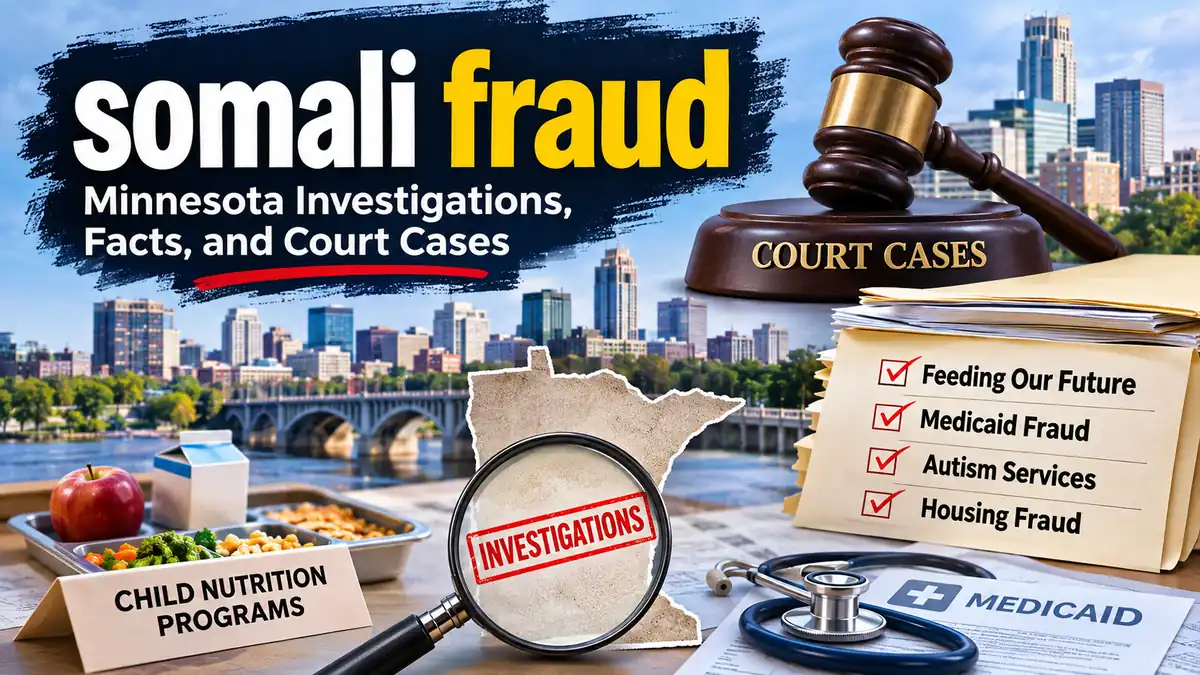
The term “somali fraud” has attracted attention in the United States, particularly following high-profile investigations into the misuse of public funds in Minnesota. Federal prosecutors have uncovered schemes involving pandemic-era food assistance, healthcare reimbursements, and other government-funded programs.
However, the term can be misleading. It is not an official legal classification, and the criminal actions of individual defendants should not be attributed to an entire ethnic community.
The phrase “somali fraud” commonly refers to allegations and criminal cases involving some Somali-American defendants, especially in Minnesota’s public-benefit fraud investigations. The most prominent example is the Feeding Our Future case, in which prosecutors alleged that approximately $250 million was fraudulently obtained from federally funded child nutrition programs.
Understanding these cases requires separating criminal allegations from established court findings, examining how public money was diverted, and identifying the oversight failures that allowed suspected misconduct to continue.
What Does somali fraud Refer To?
The phrase has been used in online discussions, news commentary, and political debates about fraud cases involving Somali-American individuals or organizations.
It most often refers to Minnesota, home to one of the largest Somali-American communities in the United States.
The phrase is not the name of a single criminal investigation. Several separate investigations have involved different defendants, government programs, and alleged methods.
These distinctions matter because a criminal indictment is an accusation, a guilty plea is an admission of criminal conduct, and a conviction represents a legal finding of guilt.
Why Minnesota Became Central to the Discussion
Minnesota has a substantial Somali-American population, particularly in Minneapolis and Saint Paul.
The state also administers federal and state assistance programs through public agencies and nonprofit organizations.
During the COVID-19 pandemic, emergency measures expanded access to certain government benefits. Some oversight requirements were relaxed to help organizations deliver assistance quickly.
Prosecutors later alleged that individuals exploited these conditions by submitting false claims, creating fabricated records, and diverting money intended for public services.
The resulting investigations attracted national attention because of the amount of taxpayer money involved and questions about government supervision.
The Feeding Our Future Fraud Scandal
The Feeding Our Future case is one of the largest pandemic-related fraud prosecutions in American history.
The organization served as a sponsor for meal distribution sites participating in federally funded child nutrition programs.
These programs were intended to provide food to children, particularly those from economically disadvantaged households.
Federal investigators discovered that participants in the scheme submitted fraudulent reimbursement claims for meals that were never served.
How the Feeding Our Future Scheme Worked
The fraud involved several interconnected activities.
- Creating or operating meal distribution sites: Participants established sites that purported to serve large numbers of children.
- Inflating meal counts: Fraudulent claims reported thousands of meals being distributed, sometimes far beyond what the sites could reasonably provide.
- Fabricating supporting documents: False attendance records, invoices, and meal-count sheets were used to support reimbursement requests.
- Obtaining government payments: Claims were submitted through the federal nutrition program’s reimbursement system.
- Diverting funds: Prosecutors established that participants used fraud proceeds for personal purchases, real estate, vehicles, and other expenses.
The scheme exploited weaknesses in the Child and Adult Care Food Program (CACFP) and Summer Food Service Program (SFSP).
Both programs were federally funded, with the Minnesota Department of Education responsible for state-level administration.
How Much Money Was Involved?
Federal prosecutors described Feeding Our Future as an approximately $250 million fraud scheme.
That figure refers to the overall scheme, not an amount personally obtained by every defendant.
| Key fact | Documented information |
|---|---|
| Estimated scheme size | Approximately $250 million |
| Primary location | Minnesota |
| Affected programs | CACFP and SFSP |
| Principal period | COVID-19 pandemic |
| March 2026 milestone | 63 convictions announced |
| Main investigating agencies | FBI, IRS Criminal Investigation, other federal authorities |
In March 2026, the Department of Justice announced that prosecutors had secured 63 convictions across the case. Additional convictions and sentences followed. United States Department of Justice+2
Who Was Convicted in the Feeding Our Future Case?
One of the central figures was Aimee Bock.
Bock, the nonprofit’s former executive director, was convicted of criminal charges related to the scheme. In 2026, she received a federal prison sentence of 500 months, equivalent to 41 years and eight months.
Her involvement demonstrates why the scandal cannot accurately be described as a criminal operation belonging exclusively to one ethnic group.
Another prominent defendant, Salim Said, operated Safari Restaurant in Minneapolis. He was sentenced to 30 years in prison in October 2026. Prosecutors attributed approximately $44 million in fraud to his conduct. AP News+2
Other defendants received different sentences according to their individual conduct, charges, plea agreements, and court findings.
For example, in September 2026, Mekfira Hussein and Abduljabar Hussein received prison sentences of 57 and 40 months, respectively, after pleading guilty to conspiracy to commit wire fraud. Prosecutors said their fraudulent claims resulted in approximately $8.8 million in program payments. United States Department of Justice
Other Minnesota Investigations Associated With somali fraud
The Feeding Our Future prosecution is not the only Minnesota fraud investigation to attract national attention.
Authorities have also investigated Medicaid-funded healthcare services, housing assistance, autism treatment, and support programs for vulnerable residents.
These are separate cases and should not automatically be treated as one coordinated criminal enterprise.
Medicaid and Healthcare Fraud
Medicaid provides healthcare coverage to eligible low-income individuals and other qualifying populations.
Minnesota’s Medicaid program, known as Medical Assistance, reimburses approved providers for covered services.
Fraud occurs when a provider knowingly submits false claims, such as billing for treatment that was never delivered.
On May 21, 2026, the Department of Justice announced charges against 15 defendants involving more than $90 million in alleged or intended losses across multiple Minnesota healthcare programs.
The announcement included allegations involving autism treatment, housing stabilization, and community-based services. These figures represented the charged schemes, not a final judicial determination that every alleged dollar had been stolen. United States Department of Justice
Autism Treatment Billing Investigations
Minnesota’s Early Intensive Developmental and Behavioral Intervention (EIDBI) program provides medically necessary treatment services for eligible children with autism spectrum disorder and related conditions.
Investigators alleged that some providers submitted improper claims and used financial incentives to attract clients.
Alleged misconduct included billing for services not provided, submitting inaccurate treatment records, and paying improper referral incentives.
According to the Department of Justice, EIDBI claims grew from more than $600,000 in 2018 to more than $400 million in 2025.
That spending growth is a significant reason the program received scrutiny. However, total program spending should not be equated with proven fraudulent payments. United States Department of Justice
Housing Stabilization Services Fraud
Minnesota’s Housing Stabilization Services program was designed to help eligible people with disabilities, mental health conditions, and other qualifying needs find and maintain housing.
The program began in July 2020.
Federal prosecutors alleged that certain providers billed Medicaid for assistance they did not deliver.
In July 2026, four defendants pleaded guilty in a scheme involving approximately $2.2 million. According to the Department of Justice, the defendants enrolled approximately 350 people and billed for services they did not provide. They also used artificial intelligence to fabricate records when questioned about their claims. United States Department of Justice
This case illustrates how falsified electronic documentation can complicate government audits.
Why Did Government Oversight Fail?
The Minnesota fraud cases raised questions beyond the defendants’ individual conduct.
They also exposed weaknesses in how government agencies reviewed applications, verified payments, and responded to warning signs.
Findings From Minnesota’s Legislative Auditor
In June 2024, Minnesota’s Office of the Legislative Auditor published a review of the Minnesota Department of Education’s oversight of Feeding Our Future.
The report concluded that inadequate oversight created opportunities for fraud.
Its findings included several serious weaknesses:
- The department approved program applications despite unresolved concerns.
- Some statements made by the organization were not adequately verified.
- A 2018 administrative review identified serious problems, but the department did not conduct an appropriate follow-up review.
- Monitoring remained limited even when pandemic-era program rules changed.
The auditor also found that warning signs existed before the COVID-19 pandemic. auditor.leg.state.mn.us+1
These findings are significant because they show that emergency pandemic policies were not the only contributing factor.
Did COVID-19 Relief Rules Make Fraud Easier?
Pandemic-related waivers changed how certain child nutrition programs operated.
The intention was to maintain food access while schools, childcare centers, and community organizations faced disruptions.
Some oversight procedures shifted toward remote monitoring and alternative documentation.
That created challenges for agencies responsible for confirming that meals had actually been served.
However, relaxed procedures did not authorize fabricated claims or the misuse of federal funds.
The distinction is straightforward: emergency policies may have increased opportunities for misconduct, but defendants remained responsible for their fraudulent actions.
How Investigators Uncovered the Fraud
Financial crime investigations often combine payment records, witness interviews, physical surveillance, and forensic accounting.
In the Minnesota cases, federal investigators examined whether the services described in reimbursement claims actually occurred.
Financial Records and Suspicious Transactions
Investigators can compare claimed reimbursement amounts against banking activity, business expenses, and supporting invoices.
Unusual transfers, unexplained payments, and large personal purchases may provide investigative leads.
A suspicious transaction alone does not establish criminal wrongdoing. Prosecutors must connect the financial activity to specific offenses and establish the required elements of the crime.
False Attendance and Service Records
In food assistance fraud, investigators may compare claimed meal counts with site capacity, food purchases, and observations of actual distribution.
In healthcare fraud, investigators can compare billing records with treatment notes, provider schedules, and information from patients or caregivers.
For example, a provider claiming hundreds of hours of services that staff could not physically deliver may warrant further investigation.
Money Laundering and Asset Recovery
Some fraud prosecutions also include money laundering charges.
Money laundering generally involves financial transactions designed to conceal or otherwise unlawfully handle proceeds of specified criminal activity.
Prosecutors may seek forfeiture of assets connected to criminal conduct, including money, vehicles, and real estate.
However, criminal forfeiture, restitution orders, and actual recovery of stolen money are different outcomes.
A court can order restitution without guaranteeing that the government will recover the full amount.
The Difference Between Allegations, Convictions, and Estimates
One of the biggest sources of confusion in discussions of somali fraud is the mixing of different legal and financial categories.
| Term | Meaning | What it establishes |
|---|---|---|
| Investigation | Authorities are examining possible misconduct | No determination of guilt |
| Criminal charge | Prosecutors formally accuse someone of an offense | An allegation requiring proof |
| Guilty plea | A defendant admits guilt to an offense | A legal basis for conviction |
| Conviction | Guilt is established through a plea or verdict | Criminal responsibility for the offense |
| Alleged loss | Amount prosecutors claim was involved | Not necessarily a final proven amount |
| Restitution | Court-ordered repayment | Not necessarily money already recovered |
These distinctions become particularly important when comparing headlines from different stages of an investigation.
A figure described as an intended loss may include money defendants tried but failed to obtain.
Likewise, a large government program budget is not evidence that the entire budget was stolen.
Why Fraud Totals Should Not Simply Be Added Together
Some public discussions combine the Feeding Our Future amount with figures from unrelated Medicaid investigations.
This can produce misleading totals.
Before adding figures, readers should determine whether they represent actual payments, attempted fraud, alleged losses, confirmed losses, or overall program spending.
They should also check whether the figures overlap.
A defensible total requires consistent definitions and reliable documentation.
How the Cases Affected Minnesota’s Somali-American Community
The Somali-American community is an established part of Minnesota’s social, cultural, and economic life.
Somali-Americans work in healthcare, education, transportation, public service, retail, and many other industries.
The involvement of Somali-American defendants in high-profile criminal cases does not establish that fraud is characteristic of Somali-Americans generally.
Criminal responsibility belongs to individuals and organizations whose conduct is established through evidence.
Why Ethnicity Became Part of the Public Debate
Several prominent defendants in Minnesota fraud prosecutions have Somali backgrounds.
As the cases received national attention, some commentators began using ethnic identity as a shorthand for the investigations.
That framing can obscure important facts.
Feeding Our Future involved defendants from different backgrounds, including the nonprofit’s former executive director, Aimee Bock.
The relevant legal questions concern fraudulent conduct, government oversight, and the misuse of public funds—not whether a defendant belongs to a particular ethnic community.
Are Somali-Americans Disproportionately Involved in Fraud?
The available case announcements do not establish a reliable population-wide fraud rate for Somali-Americans.
Answering such a question would require representative data, consistent definitions, and an appropriate comparison population.
A group of defendants from several high-profile prosecutions is not a representative sample of an entire community.
It would therefore be inaccurate to infer a general ethnic tendency toward fraud from these cases.
Political Controversy and Public Accountability
Minnesota’s fraud investigations have become part of broader debates about government spending, immigration, public assistance, and state administration.
Different political perspectives emphasize different aspects of the cases.
Critics of state government oversight point to missed warnings, inadequate monitoring, and the scale of financial losses.
Others emphasize the importance of distinguishing documented wrongdoing from claims that unfairly implicate immigrant communities.
Both accountability and factual accuracy matter.
Government agencies should be evaluated on whether they protected public funds, investigated credible warnings, and corrected known weaknesses.
Defendants should be evaluated on evidence of their individual conduct.
What Responsibility Did Minnesota Officials Have?
The Minnesota Department of Education had responsibility for administering and monitoring the federal child nutrition programs involved in Feeding Our Future.
The Legislative Auditor’s findings identified failures in that oversight.
However, administrative failure and criminal participation are not equivalent.
Evidence that an agency failed to detect fraud does not, by itself, establish that its officials knowingly participated in the scheme.
Claims of official criminal involvement require separate evidence.
What Minnesota Has Done to Prevent Further Fraud
Minnesota has introduced additional program-integrity measures in response to concerns about fraudulent billing.
According to the Minnesota Department of Human Services, actions have included identifying high-risk Medicaid services, increasing payment reviews, auditing autism service providers, and strengthening provider verification.
The department also reported discontinuing the Housing Stabilization Services program and restricting enrollment of new providers in certain high-risk programs. GovDelivery
Stronger Provider Verification
Government agencies can reduce fraud risks by confirming that providers are legitimate, properly licensed, and capable of delivering the services they bill for.
Verification may include ownership checks, site inspections, credential reviews, and examination of past compliance problems.
Better Payment Monitoring
Risk-based monitoring can identify unusual billing patterns before large amounts of money are distributed.
For example, agencies can flag claims involving unusually high service volumes, repeated documentation, or inconsistencies between provider capacity and reported activity.
Automated systems can assist with identifying anomalies, but flagged claims still require appropriate review.
Independent Audits and Whistleblower Reports
Independent audits help identify failures that internal monitoring may overlook.
Employees, beneficiaries, and members of the public may also provide information about suspected fraud.
Minnesota’s Department of Human Services provides channels for reporting suspected Medicaid fraud.
Reports should contain factual information where possible, rather than speculation based on a provider’s identity or background.
How to Verify Claims About somali fraud
Online claims about fraud investigations can spread faster than court findings.
Some posts combine accurate case details with outdated statistics, unsupported allegations, or misleading descriptions.
A practical verification process involves checking the original source and understanding what it actually establishes.
1. Start With Official Court and Justice Department Records
The U.S. Department of Justice publishes announcements about criminal charges, guilty pleas, convictions, and sentencing decisions.
Official releases usually identify the relevant charges and distinguish allegations from proven outcomes.
Court filings can provide further detail about the legal proceedings.
2. Check the Publication Date
A report published during an investigation may describe allegations that were later resolved through a plea, trial, dismissal, or sentencing.
For an ongoing case, newer court records may provide a more accurate account.
3. Confirm What Financial Figures Represent
Look for descriptions such as estimated loss, intended loss, amount billed, amount paid, or restitution ordered.
These terms are not interchangeable.
4. Compare Independent Reporting
Established news organizations can provide context about legal proceedings, government responses, and the impact on affected communities.
Independent reporting is especially valuable when official statements leave important questions unanswered.
5. Avoid Generalizing From Individual Defendants
A person’s ethnicity, religion, nationality, or immigration history is not evidence of criminal conduct.
Claims should identify specific actions, reliable records, and relevant legal findings.
Why These Fraud Cases Matter Beyond Minnesota
The Minnesota investigations illustrate challenges that affect public-benefit programs across the United States.
Government assistance systems must distribute resources efficiently while preventing false claims.
Excessively burdensome verification can delay essential services for legitimate beneficiaries.
Insufficient oversight can allow dishonest providers to obtain substantial payments.
Effective program design requires balancing both risks.
The cases also demonstrate that financial fraud can harm people beyond taxpayers.
Children who depend on nutrition programs, individuals who need housing support, and families seeking healthcare may lose access to resources when programs are exploited or subsequently restricted.
Lessons for Public Agencies
The most useful lessons concern early warning systems, independent verification, financial transparency, and consistent enforcement.
Agencies should respond to credible complaints promptly, document oversight decisions, and evaluate whether providers can substantiate their claims.
Where misconduct is confirmed, authorities should pursue appropriate legal remedies and attempt to recover misused funds.
These safeguards should apply equally to every provider, regardless of ethnicity or background.
Conclusion: Understanding somali fraud Through Verified Facts
The term “somali fraud” is most commonly associated with Minnesota’s high-profile public-benefit fraud investigations, particularly the approximately $250 million Feeding Our Future case.
Those investigations uncovered serious criminal misconduct, produced numerous convictions, and exposed weaknesses in government oversight.
Separate Medicaid investigations have raised further concerns about fraudulent billing and the protection of public funds.
The central lesson is that fraud should be investigated and prosecuted based on evidence, while government agencies should be held accountable for preventable oversight failures.
For anyone researching somali fraud, the most reliable approach is to examine individual cases, distinguish allegations from convictions, and verify financial figures using official records and credible reporting.
That provides a clearer understanding of what happened without turning the conduct of particular defendants into an unsupported judgment about an entire community.
