

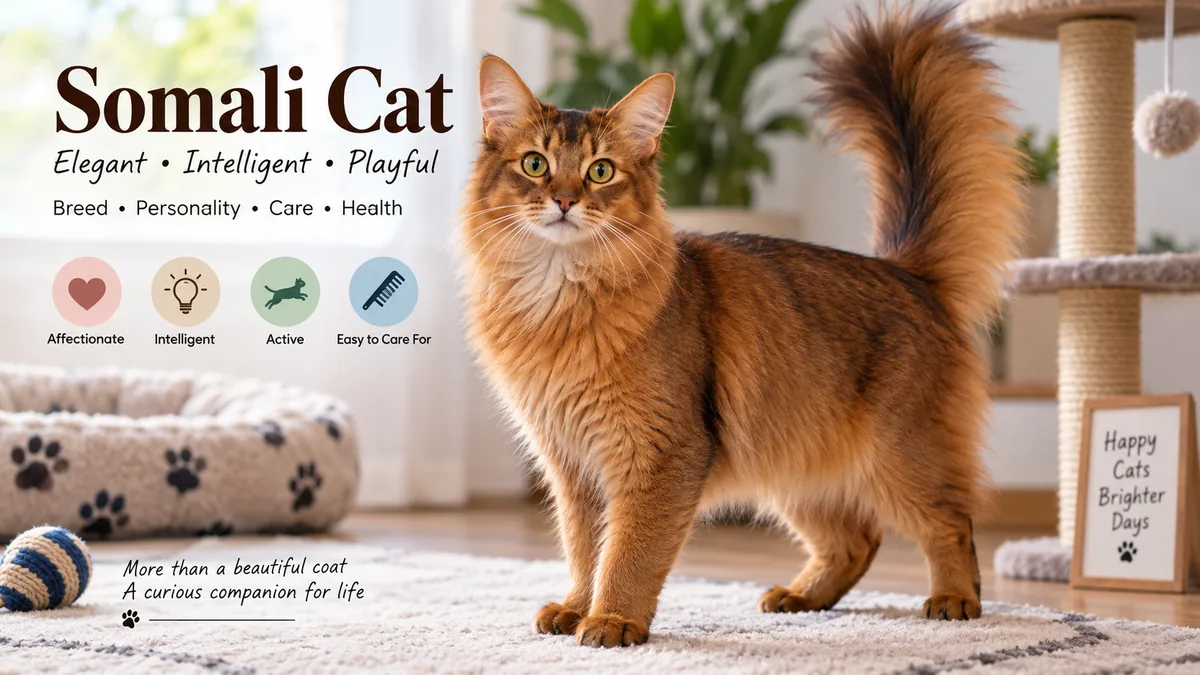
With a plumed tail, richly ticked coat, alert expression, and seemingly endless curiosity, the somali cat is easy to mistake for a tiny fox. Under that dramatic coat is an athletic, intelligent companion that tends to become deeply involved in whatever its household is doing.
The Somali is essentially the longhaired relative of the Abyssinian. It is a medium-sized, muscular, highly active cat distinguished by a silky ticked coat and bushy tail. Somalis are typically playful, affectionate, curious, and intelligent, and they thrive in homes that provide regular interaction, climbing opportunities, mental stimulation, and routine care.
What Is a somali cat?
The Somali is a pedigreed domestic cat closely related to the Abyssinian. The Cat Fanciers’ Association (CFA) describes it as the longhaired variety of the Abyssinian, while The International Cat Association (TICA) calls it the Abyssinian’s longhaired cousin.
Its most recognizable characteristics include:
- Medium-length, soft fur
- Distinctive ticking on individual hairs
- A large, bushy or “foxtail” tail
- Large, alert ears
- Almond-shaped eyes
- A muscular yet graceful body
- Ruff and fuller “breeches” in mature cats
- Energetic, inquisitive behavior
The coat is especially important to the breed’s appearance. Rather than having conventional solid-colored fur, individual hairs contain alternating bands of lighter and darker pigment. This produces the warm, shimmering effect known as ticking.
Despite the name, the modern breed was not simply developed from native cats in Somalia. Its history is tied directly to longhaired kittens appearing in Abyssinian breeding lines.
Why Is It Called a Somali?
The name reflects the breed’s connection with the Abyssinian. Abyssinia is the historical name associated with modern Ethiopia, and Somalia borders Ethiopia.
CFA credits American breeder Evelyn Mague with helping develop the longhaired Abyssinian as a distinct breed during the 1960s and choosing the name Somali. CFA began registering Somalis in 1976, and the breed reached CFA championship status in 1979.
Longhaired Abyssinians had appeared before then. Exactly how the recessive longhair trait entered Abyssinian bloodlines is less certain, so simple stories claiming one definitive origin should be treated cautiously.
somali cat Appearance, Size, and Physical Characteristics
A mature Somali should look athletic rather than heavy. The combination of a well-developed body, expressive face, large ears, long coat, and substantial tail gives the breed its distinctive wild appearance.
TICA lists females at approximately 6–8 pounds and males at around 8–10 pounds. PetMD gives a broader typical range of about 6–10 pounds and a height of roughly 7–11 inches. Individual size naturally varies according to sex, genetics, nutrition, and body condition.
Face and Eyes
The head has a modified wedge shape with gentle rather than sharply angular contours. Large ears contribute to the Somali’s permanently attentive expression.
CFA’s breed standard recognizes gold or green eyes, with richer coloration preferred in show cats. Other descriptions of pet Somalis may use terms such as amber or hazel for their eye appearance.
The Famous Foxlike Tail
The full, plumed tail is one of the easiest Somali characteristics to recognize. CFA’s standard calls for a full brush that is thick at the base and tapers slightly toward the end.
Together with the reddish shades found in many Somalis, it explains the breed’s common “fox cat” comparison.
A foxlike appearance, however, doesn’t indicate wild ancestry. The Somali is a domestic cat developed from Abyssinian lines.
Coat Texture and Ticking
The coat is medium-long, fine, soft, and double-coated. Fur tends to become fuller around the neck, abdomen, hindquarters, and tail.
Ticking means that individual hairs have contrasting bands of pigment rather than one uniform color from root to tip. CFA’s standard favors clear, even ticking and a warm, glowing overall coat.
Kittens may not immediately display the spectacular coat associated with mature adults. The ruff, breeches, tail fullness, and depth of ticking become more apparent as the animal develops.
somali cat Colors and Coat Variations
Color terminology differs between feline registries, which can make Somali color lists appear contradictory.
TICA lists ruddy, cinnamon, blue, fawn, chocolate, and lilac and notes that these colors can also occur with silver. CFA’s current standard is more restrictive in the colors it accepts for competition.
Commonly discussed Somali colors include:
| Color | General appearance |
|---|---|
| Ruddy | Warm brown or orange-brown with darker ticking |
| Cinnamon/Sorrel | Warm coppery or reddish coloration |
| Blue | Muted blue-gray ticking over a warmer base |
| Fawn | Soft beige or warm cream-toned appearance |
| Chocolate | Rich brown coloration |
| Lilac | Pale, diluted warm-gray coloration |
| Silver varieties | Pale or silvery base contrasted with colored ticking |
The exact terminology and accepted combinations depend on the registry. Someone evaluating a show cat should therefore consult the relevant organization’s current breed standard rather than assuming every recognized Somali color is accepted everywhere.
Somali Personality and Temperament
The luxurious coat gets attention first, but the personality is arguably the more important consideration for everyday life.
Somalis are generally intelligent, active, affectionate, interactive, and extremely curious. TICA describes them as interested in the people and environment around them, while CFA characterizes the breed as busy and active.
This isn’t usually a cat that wants to spend an entire day doing nothing.
A Somali may follow someone between rooms, investigate bags and boxes, climb onto high furniture, watch household chores, chase moving toys, or discover its own entertainment when none is provided.
Are Somali Cats Affectionate?
Yes, but affection doesn’t necessarily mean constant lap sitting.
Many Somalis enjoy staying close to their people without wanting to be held for long periods. Veterinarian-reviewed PetMD guidance notes that the breed is highly social but isn’t typically considered a conventional lap cat; some prefer sitting beside people or even climbing onto a person’s shoulder.
That distinction matters. Someone looking exclusively for a quiet cat that spends hours sleeping on their lap may find the Somali’s energetic style surprising.
Are Somali Cats Intelligent?
Intelligence is a defining characteristic.
Somalis tend to learn routines quickly and can respond well to positive-reinforcement and clicker training. Their intelligence also means environmental enrichment isn’t optional entertainment—it helps prevent boredom.
Useful activities include:
- Food puzzles
- Fetch
- Wand-toy sessions
- Clicker training
- Treat-searching games
- Cat trees and climbing shelves
- Scratching surfaces
- Safe window watching
- Rotating interactive toys
PetMD specifically highlights activities such as fetch, puzzle toys, vertical exploration, interactive play, birdwatching, and playing with compatible pets.
Quick takeaway: A Somali’s beautiful coat is relatively manageable; keeping its brain and body occupied can require more work than grooming it.
Exercise, Play, and the Ideal Home
A Somali needs opportunities to run, jump, climb, investigate, and interact every day.
A large house isn’t essential. A smaller home can work when its vertical space is used effectively. Tall cat trees, secure shelves, window perches, scratching posts, tunnels, and several play areas can turn limited floor space into a much richer environment.
Because these cats are skilled climbers, owners should also think vertically when cat-proofing. Fragile objects placed high on shelves aren’t necessarily out of reach.
Can a Somali Be Left Alone?
Like any cat, an adult Somali can spend reasonable periods alone, but this breed generally isn’t ideal for a household where it receives little interaction day after day.
PetMD notes that Somalis can become lonely and bored when their social and stimulation needs aren’t met and recommends interactive toys, puzzles, scratching posts, and climbing opportunities when they are alone.
Quality matters as much as quantity. Several focused interactive play sessions can be more satisfying than leaving dozens of unused toys on the floor.
Are Somali Cats Good With Children and Other Pets?
Well-socialized Somalis can fit successfully into family households.
Their playful nature may pair well with respectful children who understand that cats need boundaries. PetMD reports that properly introduced Somalis generally socialize well with people, other cats, and cat-friendly dogs.
Introductions should still be gradual. Breed tendencies never guarantee that two individual animals will immediately get along.
A successful introduction usually means giving each animal its own safe area, exchanging scents before unrestricted contact, keeping early meetings controlled, and making sure every cat has sufficient food stations, water, resting areas, scratching surfaces, and litter resources.
Young children should learn not to pull the tail, chase the cat, disturb it while eating, or force physical contact.
Somali Grooming and Coat Care
The coat looks more demanding than it usually is.
Although the Somali has longer hair, its silky coat is relatively resistant to matting. CFA recommends weekly combing to remove dead hair and help control shedding. TICA similarly describes the coat as comparatively easy to maintain.
A practical grooming routine includes:
- Comb or brush the coat about once a week.
- Pay attention to the ruff, belly, hindquarters, and tail area.
- Increase grooming when shedding becomes heavier.
- Check the skin while grooming for lumps, irritation, parasites, or unusual hair loss.
- Trim claws regularly.
- Inspect the ears for redness, odor, or abnormal debris.
- Establish dental care early.
Bathing generally isn’t required routinely. CFA notes that some cats can develop oilier coats that cause fur to clump, particularly around the back and base of the tail; those individuals may occasionally benefit from bathing.
Do Somali Cats Shed?
Yes.
The Somali isn’t a hairless or non-shedding breed. Its double coat naturally loses hair, and seasonal shedding can make loose fur more noticeable. Weekly grooming removes some of that dead hair before it reaches furniture and clothing.
Is the Somali Hypoallergenic?
No cat breed can be assumed to be allergen-free, and the Somali is not generally classified as hypoallergenic. Purina’s breed profile specifically lists the Somali as non-hypoallergenic.
People with cat allergies should spend meaningful time around the breed before making a long-term commitment rather than judging suitability from coat length alone.
Feeding and Maintaining a Healthy Weight
A highly active cat still needs controlled, nutritionally complete feeding.
TICA notes that Somali appetites vary: some individuals may overeat when food is constantly available, while very active cats can have greater calorie requirements. It recommends high-quality food and warns against unrestricted feeding for cats prone to overeating.
The right amount depends on age, weight, activity, reproductive status, health, and the calorie density of the chosen food.
Rather than feeding according to breed stereotypes, monitor body condition. You should generally be able to feel the ribs beneath a light covering of tissue without having prominent bones visible.
Fresh water should always be accessible. Some cats drink more readily from fountains, multiple bowls, or water stations positioned separately from food.
Treats are useful for training, but they shouldn’t displace balanced meals.
somali cat Health Problems to Know About
Somalis can live long, healthy lives, but their relationship with the Abyssinian means several inherited conditions deserve attention.
Two particularly important genetic concerns are progressive retinal atrophy (PRA) and pyruvate kinase deficiency (PK deficiency). TICA states that DNA testing is available for both conditions.
Progressive Retinal Atrophy
Progressive retinal atrophy refers to inherited retinal degeneration that can progressively impair vision and eventually cause blindness.
DNA screening can help responsible breeding programs identify relevant genetic risk before cats are bred.
Pyruvate Kinase Deficiency
Pyruvate kinase is an enzyme involved in red blood cell metabolism. An inherited deficiency can shorten the lifespan of red blood cells and contribute to hemolytic anemia.
Again, DNA testing is valuable because physical appearance alone cannot tell you whether a healthy-looking breeding cat carries a disease-associated variant.
Renal Amyloidosis
Renal amyloidosis has also been reported in Abyssinian/Somali lines. Unlike PRA and PK deficiency, the situation isn’t solved simply by the same routine DNA screening. CFA recommends discussing any history of renal amyloidosis in a breeder’s lines.
Dental Disease
Dental health deserves attention as well. TICA notes that some Somali lines can be prone to problems such as gingivitis and recommends establishing tooth brushing early with veterinarian-approved toothpaste.
Home dental care doesn’t replace veterinary assessment. Persistent bad breath, red or bleeding gums, drooling, difficulty eating, or pawing at the mouth warrants professional evaluation.
Quick takeaway: Genetic testing for PRA and PK deficiency is particularly relevant to Somali breeding programs, while routine veterinary examinations remain necessary because DNA tests don’t screen for every possible health problem.
How Long Do Somali Cats Live?
Published lifespan estimates vary substantially.
TICA gives a broad life expectancy of 10–19+ years with proper care, while the UK’s Governing Council of the Cat Fancy lists approximately 12–14 years. Hill’s gives another estimate of about 9–13 years.
These differences are a useful reminder that a breed lifespan isn’t an expiration date.
Genetics, body condition, nutrition, preventive veterinary care, dental health, lifestyle, accidents, infectious disease exposure, and individual medical conditions all influence longevity.
Regular veterinary checkups become particularly useful as a cat ages because subtle changes in weight, appetite, drinking, mobility, teeth, or behavior can provide early clues to illness.
Somali vs. Abyssinian: What’s the Difference?
The close relationship between the breeds makes comparison inevitable.
The easiest difference is the coat.
| Feature | Somali | Abyssinian |
|---|---|---|
| Coat | Medium-long, fuller | Short |
| Tail | Full and plumed | Short-coated |
| Ticking | Prominent | Prominent |
| General build | Athletic and muscular | Athletic and muscular |
| Activity level | High | High |
| Curiosity | High | High |
| Grooming | Weekly coat care useful | Generally less coat maintenance |
| Relationship | Longhaired relative/variety | Foundation breed |
CFA explicitly describes the Somali as the longhaired variety of the Abyssinian, while TICA describes it as the Abyssinian’s longhaired cousin.
Temperament varies between individuals, so coat length is a much more reliable distinction than claims that every Somali behaves differently from every Abyssinian.
What Daily Life With a Somali Is Really Like
The biggest mistake is choosing this breed solely because of its appearance.
A photograph shows the foxlike tail and rich coat. It doesn’t show a clever cat climbing to the highest accessible point in a room, following people around the house, investigating a cupboard that was left open, or demanding another play session.
A realistic Somali routine includes interactive play, opportunities to climb, mental challenges, social contact, controlled nutrition, fresh water, litter-box maintenance, and periodic grooming.
Rotate toys rather than presenting everything permanently. Novelty can restore interest in an old toy after it has been stored away for a while.
Training is also worth considering. Short positive-reinforcement sessions can teach useful behaviors such as entering a carrier voluntarily, tolerating grooming, targeting a hand, coming when called, or standing on a designated platform.
These aren’t just tricks. Cooperative behaviors can make routine care and veterinary visits easier.
Is a Somali the Right Cat for Your Home?
The Somali tends to suit people who enjoy an interactive companion rather than a decorative, low-engagement pet.
The breed may be a particularly good fit when you can provide daily play, climbing space, enrichment, companionship, weekly grooming, preventive healthcare, and patience for an intelligent cat that wants to investigate its surroundings.
Think carefully if you specifically want an extremely sedentary lap cat, dislike cats climbing furniture, or routinely leave pets without much stimulation.
Individual personality remains crucial. Breed descriptions explain tendencies, not guarantees.
A quiet Somali exists just as a particularly energetic individual can exceed the typical description. Age also changes behavior: kittens and adolescents are usually more demanding than mature adults.
Final Thoughts on the somali cat
The somali cat combines the athletic build and ticked coloration associated with the Abyssinian family with a silky medium-long coat and spectacular plumed tail. Its appearance may resemble a miniature fox, but its defining qualities at home are intelligence, curiosity, affection, and activity.
The essential care requirements are straightforward: provide meaningful daily play and environmental enrichment, comb the coat regularly, maintain dental and preventive veterinary care, feed according to body condition, and understand inherited concerns such as progressive retinal atrophy and pyruvate kinase deficiency.
For someone prepared to engage with an active cat rather than simply admire one, the Somali offers far more than its striking coat—it brings curiosity and interaction into almost every part of daily life.
