

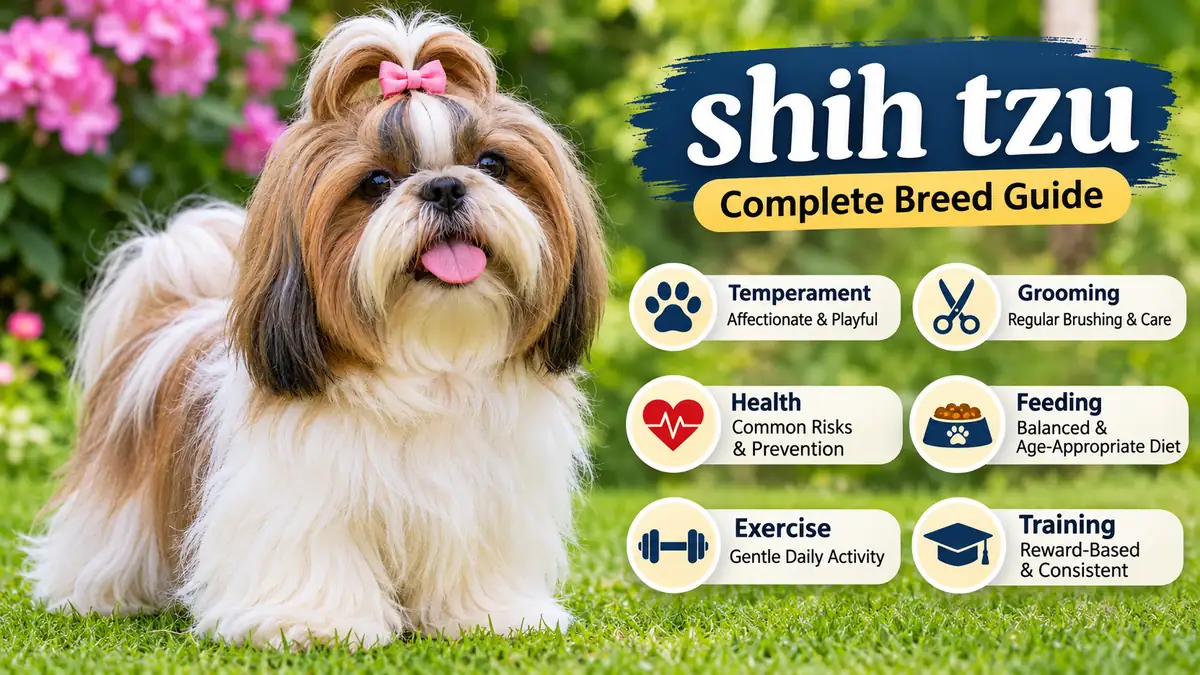
Small enough to curl up comfortably on your lap yet confident enough to act like the most important member of the household, the shih tzu has a personality that often feels much bigger than its body. Behind those expressive eyes and flowing locks is an affectionate companion with a fascinating history and some surprisingly specific care requirements.
The shih tzu is a small, long-haired companion dog known for its friendly temperament, playful personality, and distinctive flat face. Originally developed as a royal companion in China, this toy breed typically weighs 9–16 pounds and lives around 10–18 years. It adapts well to apartment living but needs consistent grooming, gentle training, and attentive healthcare.
shih tzu Breed Overview: Size, Lifespan, and Characteristics
The shih tzu belongs to the Toy Group of the American Kennel Club (AKC). Although compact, these dogs have sturdy bodies, a confident carriage, and a luxurious double coat.
| Characteristic | Breed information |
|---|---|
| Breed name | shih tzu |
| Origin | Tibetan ancestry; developed in China |
| Breed group | Toy Group (AKC) |
| Height | 9–10.5 inches |
| Weight | 9–16 pounds (4–7.3 kg) |
| Life expectancy | 10–18 years |
| Temperament | Affectionate, outgoing, playful, friendly |
| Coat | Long, dense, double-coated |
| Shedding | Relatively low |
| Grooming needs | High |
| Exercise needs | Low to moderate |
| Trainability | Moderate; responds well to rewards |
| Living environment | Apartments and houses |
| Primary purpose | Companion dog |
These measurements follow the AKC breed profile. Individual dogs can fall outside the typical ranges because of genetics, age, nutrition, and health. American Kennel Club+1
What Does shih tzu Mean?
The name shih tzu is commonly translated as “lion dog,” reflecting the breed’s traditional association with lion imagery in Chinese culture.
Its long facial hair, prominent mane-like coat, and confident posture contribute to the resemblance.
Despite the impressive name, the breed was developed primarily for companionship rather than hunting, guarding livestock, or performing demanding physical work.
History and Origin of the shih tzu
The history of this breed connects Tibetan dogs, Chinese imperial households, and centuries of selective breeding.
Tibetan Roots and Chinese Royalty
The ancestors of the modern shih tzu are associated with Tibet, where small companion dogs had longstanding cultural importance.
The breed was subsequently developed in China, where small, heavily coated dogs were valued by imperial families.
The Lhasa Apso and Pekingese are frequently mentioned in discussions of the breed’s ancestry. However, the precise historical combinations that produced the modern dog are not fully documented.
Chinese palace breeding helped establish many of the characteristics recognized today, including the compact body, abundant coat, and distinctive facial appearance.
How the Breed Became Popular Worldwide
The breed gradually became known outside China during the twentieth century.
It gained popularity in Britain and other countries before becoming firmly established in the United States.
The American Kennel Club officially recognized the shih tzu in 1969.
Today, it remains a familiar companion breed, appreciated for its affectionate personality and adaptability to indoor living. American Kennel Club+1
shih tzu Appearance, Coat Colors, and Physical Features
The shih tzu has a recognizable silhouette, but its appearance involves more than a long coat and short muzzle.
Body Structure and Facial Features
A typical adult has a compact, solid body with a broad head and a tail that curves over its back.
Common physical characteristics include:
- Large, round, expressive eyes
- A short, broad muzzle
- Drop ears covered with long hair
- A dense, flowing double coat
- A sturdy body with relatively short legs
- A high-set, plumed tail
The breed’s face is described as brachycephalic, meaning the skull has been selectively bred toward a shortened muzzle.
This appearance is closely associated with certain breathing, eye, and dental health risks.
A shorter face should never be considered more desirable at the expense of comfortable breathing.
Common Coat Colors
The AKC recognizes a wide variety of colors and combinations.
| Coat color | Typical appearance |
|---|---|
| Black | Predominantly solid black |
| Black and white | Contrasting dark and light patches |
| Gold and white | Golden coloring with white areas |
| Brindle | Mixed, striped hair coloration |
| Red and white | Reddish coat with white markings |
| Silver and white | Pale gray or silver with white |
| Liver | Brown pigmentation and coat coloration |
| Blue | Diluted dark pigmentation |
| Tricolor | Three distinct coat colors |
A puppy’s coat can change noticeably as it matures. Gold, silver, and darker markings may lighten or develop differently over time.
Coat color alone does not establish a dog’s health, quality, or temperament. American Kennel Club+1
Is There a Teacup shih tzu?
“Teacup shih tzu” is a marketing description rather than a separate AKC-recognized breed or official size classification.
Some dogs are naturally smaller than average, but intentionally breeding for extremely tiny bodies can increase the likelihood of health problems.
Potential concerns include low blood sugar in very small puppies, fragile bones, dental crowding, and difficulties maintaining a healthy body condition.
The priority should be a structurally healthy dog rather than the smallest possible adult size.
shih tzu Temperament and Personality
The breed’s affectionate nature is one of its most recognizable qualities.
Most enjoy human company, indoor activities, and opportunities to participate in household routines.
Are shih tzu Dogs Friendly?
A well-socialized shih tzu is typically outgoing, affectionate, and comfortable interacting with familiar people.
Many are playful without being excessively demanding physically.
They often enjoy following their owners from room to room, sitting nearby, or relaxing on a lap.
Individual personality still matters. Some dogs are energetic and adventurous, while others are quieter or more reserved.
Early experiences, genetics, handling, and training all influence adult behavior.
Are They Good With Children?
These dogs can make affectionate family companions when children understand how to interact gently with small animals.
Their compact size makes them vulnerable to accidental injuries from rough handling.
Young children should be taught to avoid pulling ears, grabbing fur, or disturbing a sleeping dog.
Adult supervision is essential, particularly around toddlers.
A dog should always have a quiet place where it can retreat without being followed.
Do They Get Along With Other Pets?
Many live successfully with other dogs and cats, especially when introductions are gradual.
Successful introductions depend on the personalities, socialization histories, and behavior of both animals.
Small dogs should not be expected to tolerate persistent rough play from larger pets.
Supervised interactions and separate resting areas help create a calmer environment.
Can They Be Left Alone?
Because the breed was developed for companionship, some individuals struggle with prolonged isolation.
Signs of separation-related distress can include persistent barking, pacing, destructive behavior, or inappropriate toileting when left alone.
Gradual independence training can help.
Begin with short, comfortable periods apart and increase the duration slowly, keeping departures predictable and low-key.
Severe distress warrants guidance from a veterinarian or qualified reward-based behavior professional.
The AKC describes the breed as affectionate, playful, and highly adaptable, while also emphasizing its strong attachment to people. American Kennel Club+1
shih tzu Grooming and Daily Coat Care
Grooming is one of the biggest responsibilities associated with this breed.
Its coat can grow long and dense, making regular brushing essential for preventing painful tangles and mats.
How Often Should You Brush a shih tzu?
A dog with a full-length coat generally needs daily brushing and combing.
A shorter puppy cut is easier to maintain but still requires regular attention.
Focus particularly on areas where friction encourages tangling:
- Behind the ears
- Under the collar or harness
- Around the armpits
- Along the legs and belly
- Around the tail and hindquarters
A pin brush and metal comb are useful tools. Brush gently in sections, then check that the comb passes through the hair down to the skin without snagging.
Do not pull forcefully through tight mats. Severe matting should be handled by a professional groomer.
Popular Haircuts
| Haircut | Description | Maintenance |
|---|---|---|
| Puppy cut | Short, relatively even body coat | Moderate |
| Teddy bear cut | Rounded facial styling with a shorter body | Moderate |
| Topknot style | Longer head hair secured away from the eyes | High |
| Full show coat | Long, flowing hair maintained near the ground | Very high |
| Short summer trim | Practical shorter coat for easier maintenance | Moderate |
A short haircut does not eliminate the need for brushing or protect a flat-faced dog from overheating.
Bathing and Facial Cleaning
Bathing approximately every three to four weeks is suitable for many dogs, although the schedule depends on coat condition, lifestyle, and veterinary advice.
Use a gentle dog-specific shampoo and rinse thoroughly.
Dry the coat carefully, especially around skin folds and dense areas.
The facial region deserves daily attention because tears, food particles, and moisture can collect around the eyes and muzzle.
Use a clean, damp, soft cloth to remove surface debris without touching or rubbing the eyeball.
Persistent redness, discharge, squinting, or eye discomfort requires veterinary assessment rather than additional home cleaning.
Ear, Nail, and Dental Care
Check the ears regularly for odor, redness, discomfort, or unusual discharge.
Trim nails before they become excessively long or interfere with walking.
Dental care deserves particular attention because small, short-faced breeds can experience crowded teeth and periodontal disease.
Daily toothbrushing with dog-safe toothpaste is ideal, alongside veterinary dental examinations.
Human toothpaste should not be used because some ingredients can harm dogs.
The AKC and VCA Animal Hospitals both emphasize coat maintenance, eye-area hygiene, and routine dental care. American Kennel Club+1
shih tzu Health Problems and Life Expectancy
A shih tzu can enjoy many healthy years, but understanding the breed’s medical vulnerabilities is essential.
According to the AKC, the typical life expectancy is 10–18 years. This is a broad range rather than a guarantee for an individual dog.
A UK veterinary-record study also provides evidence about the breed’s health and mortality patterns, emphasizing the importance of understanding common disorders rather than relying on appearance alone. PubMed Central (PMC)+1
Brachycephalic Obstructive Airway Syndrome
Brachycephalic obstructive airway syndrome (BOAS) affects breathing in some short-faced dogs.
Anatomical abnormalities may include narrowed nostrils, an elongated soft palate, and other restrictions in the upper airway.
Symptoms can include:
- Noisy breathing while awake
- Difficulty exercising
- Excessive panting
- Sleep disturbances
- Poor heat tolerance
- Breathing distress
Persistent snoring or noisy breathing should not automatically be dismissed as normal for the breed.
A veterinarian can assess airway function and determine whether treatment is needed.
Severe breathing difficulty, collapse, or blue-tinged gums requires immediate emergency veterinary care.
Eye Conditions
Prominent eyes and relatively shallow eye sockets can increase vulnerability to injury and disease.
Conditions seen in the breed include:
Dry eye (keratoconjunctivitis sicca): Insufficient tear production can cause irritation, discharge, and damage to the cornea.
Corneal ulcers: Damage to the clear outer surface of the eye can be painful and may threaten vision.
Cataracts: Clouding of the lens can interfere with sight.
Progressive retinal atrophy (PRA): A group of inherited retinal disorders that can cause progressive vision loss.
Retinal detachment: Separation of the retina from its supporting tissue can cause serious vision impairment.
A suddenly painful, cloudy, closed, or protruding eye is a veterinary emergency.
Dental Disease
The breed’s short jaws can contribute to crowded or misaligned teeth.
Plaque and tartar buildup may lead to gingivitis, periodontal disease, pain, and tooth loss.
Warning signs include bad breath, difficulty chewing, red gums, and reluctance to eat.
Preventive care involves regular brushing, veterinary examinations, and professional dental treatment when indicated.
Patellar Luxation
Patellar luxation occurs when the kneecap moves out of its normal position.
Affected dogs may occasionally skip on one hind leg or hold a leg up briefly while walking.
Severity varies considerably.
Some dogs require monitoring, while others benefit from surgery.
Other Potential Conditions
Additional health problems reported in the breed include hip dysplasia, intervertebral disc disease, renal dysplasia, skin-fold dermatitis, and certain hormonal disorders.
Not every dog develops these conditions, and risk varies between individuals.
Veterinary guidance from the PDSA identifies breathing problems, eye disease, dental abnormalities, and several inherited or structural conditions as important considerations. PDSA+1
How to Help a shih tzu Live Longer
Good preventive care supports health and quality of life.
- Maintain an appropriate body weight.
- Schedule routine veterinary examinations.
- Keep vaccinations and parasite prevention current.
- Provide complete, balanced nutrition.
- Brush teeth regularly.
- Maintain eye and coat hygiene.
- Prevent overheating.
- Encourage comfortable daily activity.
- Investigate changes in breathing, appetite, or behavior promptly.
- Adapt care as the dog enters its senior years.
These habits cannot guarantee a particular lifespan, but they can help prevent avoidable complications and identify problems earlier.
Feeding, Exercise, and Training a shih tzu
Good daily care involves balancing nutrition, physical activity, and mental stimulation without placing unnecessary stress on the dog’s respiratory system.
What Should a shih tzu Eat?
A complete and balanced diet formulated for the dog’s life stage is generally the best foundation.
Puppies, adults, and seniors have different nutritional needs.
Small-breed foods may offer appropriately sized kibble, but the nutritional adequacy of the diet matters more than the label’s marketing claims.
Fresh water should always be available.
Feeding Schedule by Life Stage
| Life stage | General feeding approach |
|---|---|
| Young puppy | Several small meals daily |
| Older puppy | Usually three meals, adjusted to age |
| Adult | Commonly two measured meals |
| Senior | Individualized portions and schedule |
The appropriate food quantity depends on calorie density, body condition, activity, age, and medical needs.
Very young or unusually small puppies may need more frequent meals to reduce the risk of hypoglycemia.
Ask a veterinarian to recommend an appropriate calorie intake rather than relying exclusively on a generic feeding chart.
Treats should make up only a small portion of daily calories.
Foods to Avoid
Certain human foods are dangerous to dogs, including chocolate, grapes, raisins, onions, garlic, and products containing xylitol.
Cooked bones can also cause injuries or gastrointestinal obstruction.
If a dog consumes a potentially toxic substance, contact a veterinarian promptly instead of waiting for symptoms.
How Much Exercise Does a shih tzu Need?
The breed generally needs less strenuous exercise than many working or sporting dogs.
Short walks, gentle play, and indoor activities can provide useful physical and mental stimulation.
Some welfare guidance recommends around an hour of total daily activity, while the AKC emphasizes short daily walks and indoor play. The appropriate amount should be individualized according to fitness, age, weather, and breathing ability. PDSA+1
A practical routine might include a comfortable morning walk, several brief play sessions, and another gentle walk later in the day.
Avoid strenuous exercise during hot or humid weather.
Preventing Heatstroke
Short-faced dogs can struggle to cool themselves efficiently through panting.
Protect them by providing shade, cool indoor spaces, and unrestricted drinking water.
Walk during cooler periods and avoid hot pavement.
Never leave a dog unattended in a parked vehicle.
Heavy panting, weakness, vomiting, confusion, or collapse after heat exposure may indicate heatstroke and requires immediate veterinary attention.
Begin safe cooling with cool, not ice-cold, water while arranging emergency care.
How to Train a shih tzu
These dogs can learn commands and household routines successfully, although some show an independent streak.
Reward-based training is particularly effective.
Useful early skills include:
- Responding to their name
- Coming when called
- Sitting on cue
- Walking calmly on a harness
- Settling in a designated resting area
- Tolerating gentle grooming and handling
Keep sessions short and enjoyable.
Reward desired behavior immediately with praise, play, or small treats.
Avoid punishment-based methods that can create fear or damage trust.
Potty Training
House training requires patience, particularly with young puppies that have limited bladder control.
Take the puppy to an appropriate toilet area after waking, eating, playing, and before bedtime.
Reward successful toileting promptly.
Maintain a consistent schedule and clean accidents thoroughly with an enzymatic cleaner.
Never punish a puppy for an accident discovered afterward.
Persistent house-training difficulties may indicate an unsuitable schedule, anxiety, or a medical issue requiring assessment.
Living With a shih tzu: Home, Family, and Lifestyle
A small body and moderate activity needs make the breed adaptable to several living arrangements.
However, suitability depends on more than floor space.
Are shih tzu Dogs Good for Apartments?
They can live comfortably in apartments when provided with daily exercise, enrichment, social interaction, and a predictable routine.
A large garden is not essential.
Indoor games, short walks, and puzzle feeders can help meet their activity needs.
Barking may become a concern in shared buildings, especially when a dog is bored, frightened, or distressed by separation.
Teaching calm responses to everyday noises can help.
Are They Suitable for First-Time Owners?
The affectionate temperament and manageable size can make the breed appealing to first-time dog owners.
However, prospective owners should understand its significant grooming and healthcare requirements.
| Advantages | Challenges |
|---|---|
| Affectionate companion | Requires consistent grooming |
| Adaptable to smaller homes | Vulnerable to heat |
| Generally moderate exercise needs | Potential breathing difficulties |
| Often friendly with families | Eye and dental health risks |
| Relatively low shedding | May struggle with being left alone |
| Enjoys indoor interaction | House training can require patience |
The breed may be a good match for someone who spends substantial time at home and is prepared for regular grooming and preventive veterinary care.
Are shih tzu Dogs Hypoallergenic?
No dog breed is completely hypoallergenic.
Although the shih tzu sheds relatively little, it still produces allergens found in dander, saliva, and other biological materials.
Some people with allergies may tolerate an individual dog better than others, but there is no guarantee.
Anyone with significant dog allergies should seek medical guidance and assess their reaction before committing to ownership.
Do They Bark a Lot?
Barking varies between individuals.
Some dogs bark mainly to announce visitors, while others react frequently to unfamiliar sounds or separation.
Common triggers include excitement, boredom, anxiety, and attention-seeking.
Training should focus on identifying the cause, rewarding calm behavior, and providing appropriate enrichment.
Persistent or sudden changes in vocalization may warrant veterinary assessment.
shih tzu Puppies: Growth, Socialization, and Early Care
Puppyhood is an important period for developing confidence, healthy habits, and positive associations with everyday handling.
Growth and Development
Most small-breed dogs approach their adult height within their first year, although body condition and coat development continue to change.
| Age | Typical development |
|---|---|
| 0–8 weeks | Nursing, early social interaction, rapid growth |
| 8–12 weeks | Adjustment to a new home, early training |
| 3–6 months | Teething, exploration, increasing confidence |
| 6–12 months | Adolescence and developing adult behavior |
| 12–18 months | Physical and behavioral maturation continues |
These stages are approximate. Individual development differs.
A veterinarian can monitor growth and identify unusual changes.
Socialization
Socialization involves creating positive experiences with people, everyday sounds, surfaces, environments, and appropriate animals.
Exposure should be gradual and controlled.
A puppy should never be forced into frightening situations.
Follow veterinary guidance on vaccination-related infection risks when arranging early social experiences.
Positive puppy classes can help build confidence and basic manners.
Preparing a Safe Home
Puppy-proofing is especially important for small dogs.
Secure electrical cables, medications, cleaning products, and other hazards.
Block access to unsafe stairways and high furniture if jumping could cause injury.
Provide a comfortable bed, safe toys, fresh water, and an appropriate resting area.
Begin gentle handling of paws, ears, teeth, and coat early so routine grooming becomes familiar.
Recognizing a Healthy Puppy
A puppy should be alert, responsive, and comfortable moving around.
Look for clear eyes, clean skin, a healthy body condition, and breathing that appears easy at rest.
Avoid assuming loud breathing, persistent coughing, or extreme facial flattening are harmless breed characteristics.
Health information about both parents, veterinary records, and the puppy’s living environment can provide valuable context.
shih tzu Compared With Similar Small Dog Breeds
Several companion breeds share characteristics with the shih tzu, but there are meaningful differences in appearance, grooming, activity, and health considerations.
| Breed | Typical characteristics | Key consideration |
|---|---|---|
| shih tzu | Affectionate, sturdy, long-coated companion | Grooming and flat-faced health risks |
| Lhasa Apso | Long-coated, alert, sometimes more reserved | Coat care and socialization |
| Maltese | Very small, lively, silky white coat | Grooming and delicate size |
| Pekingese | Compact, independent, heavily coated | Significant brachycephalic concerns |
| Havanese | Sociable, playful, adaptable | Coat care and activity needs |
| Toy Poodle | Intelligent, active, highly trainable | Grooming and mental stimulation |
shih tzu vs. Lhasa Apso
These breeds share Tibetan connections and long coats, but their traditional roles differ.
The Lhasa Apso historically served as an alert companion and watchdog, while the shih tzu was developed primarily for companionship.
Lhasa Apsos may be more reserved around unfamiliar people, although individual personalities vary.
shih tzu vs. Maltese
Both are small companion dogs with substantial grooming needs.
The Maltese is generally lighter and is associated with a predominantly white, silky coat.
The shih tzu has a sturdier build and a broader range of recognized colors.
shih tzu vs. Havanese
The Havanese is another affectionate companion breed, often described as lively and sociable.
Both can adapt to apartment living, but their coat textures, facial structure, and exercise preferences differ.
The Havanese generally has a less flattened facial structure, although health risks still depend on the individual dog.
Choosing between breeds should involve health, temperament, care requirements, and household compatibility rather than appearance alone.
Common Myths About the shih tzu
Several popular assumptions can lead to unrealistic expectations.
Myth: Small Dogs Do Not Need Exercise
Small dogs still need movement, exploration, and mental stimulation.
The amount and intensity should match their physical abilities, particularly when breathing difficulties are present.
Myth: Low Shedding Means No Grooming
Low shedding does not prevent tangles.
Long hair can mat close to the skin even when little loose hair appears around the home.
Myth: Noisy Breathing Is Normal
Snorting, snoring, or heavy breathing may be associated with upper airway obstruction.
Any persistent breathing noise or exercise intolerance deserves veterinary attention.
Myth: Every shih tzu Has the Same Personality
Breed tendencies provide general guidance, not a guarantee.
Training, socialization, genetics, health, and life experiences shape each dog’s behavior.
Myth: A Smaller Dog Is Always Healthier or Easier to Care For
Extreme miniaturization can introduce additional health risks.
Responsible care focuses on functional anatomy, comfortable movement, healthy breathing, and overall welfare.
Final Thoughts on the shih tzu
The shih tzu combines an affectionate personality, compact size, and centuries of companion-dog history. Its friendly disposition and adaptable lifestyle make it a rewarding household companion for many families, individuals, and apartment residents.
Its care requirements, however, should not be underestimated. Regular grooming, dental hygiene, eye protection, appropriate exercise, and monitoring for breathing problems are essential parts of responsible ownership.
Understanding these needs helps ensure that a shih tzu receives more than affection alone: it receives the daily care, attention, and veterinary support needed for a comfortable and fulfilling life.
