

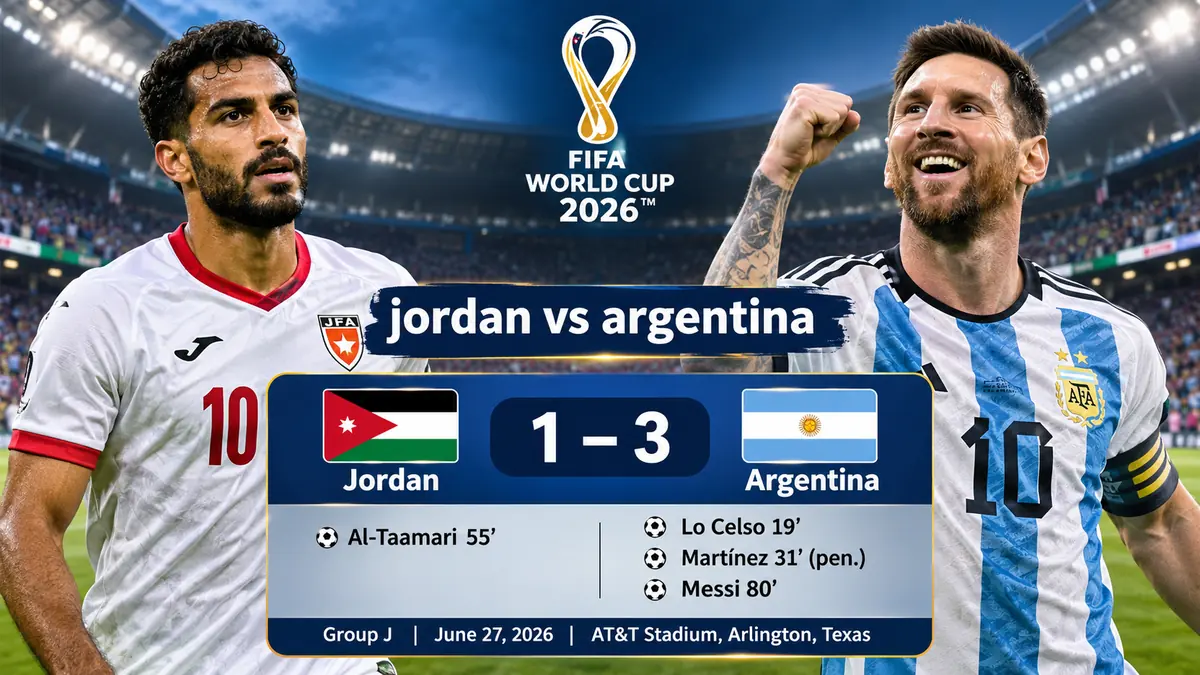
The historic jordan vs argentina encounter at the 2026 FIFA World Cup brought together two national teams with very different footballing histories. Argentina entered as the defending world champions, while Jordan was making its first appearance at football’s biggest international tournament.
Argentina defeated Jordan 3-1 on June 27, 2026, in their Group J match at AT&T Stadium in Arlington, Texas. Giovani Lo Celso, Lautaro Martínez, and Lionel Messi scored for Argentina, while Mousa Al-Taamari scored Jordan’s only goal. The result completed Argentina’s perfect group-stage record and ended Jordan’s debut World Cup campaign. Match report and highlights+1
FIFA WORLD CUP 2026 · GROUP J
Full time
Roya News | Jordan qualifies for 2026 FIFA World Cup for first time
Jordan
1 – 3
File:Flag of Argentina.svg – Wikimedia Commons
Argentina
Al-Taamari 55′
Lo Celso 19′ · Martínez 31′ (pen.) · Messi 80′
June 27, 2026 · AT&T Stadium, Arlington, Texas
jordan vs argentina Match Overview
The match was the final group-stage fixture for both teams at the 2026 FIFA World Cup, jointly hosted by the United States, Canada, and Mexico.
Argentina had already secured first place in Group J before kickoff. Jordan, meanwhile, entered the match knowing it could no longer advance to the knockout stage.
Despite the difference in experience and tournament position, Jordan produced a competitive second-half response after falling two goals behind.
Match information
| Detail | Information |
|---|---|
| Competition | FIFA World Cup 2026 |
| Stage | Group J |
| Date | June 27, 2026 |
| Venue | AT&T Stadium (Dallas Stadium) |
| Location | Arlington, Texas, USA |
| Final score | Jordan 1–3 Argentina |
| Attendance | 70,649 |
| Jordan coach | Jamal Sellami |
| Argentina coach | Lionel Scaloni |
| Referee | István Kovács |
The official match report confirms that Argentina dominated possession and controlled much of the attacking play, although Jordan briefly reduced the deficit during the second half. FBref+1
jordan vs argentina Goals and Match Highlights
Four goals defined the encounter, with Argentina establishing an early advantage before Jordan briefly threatened a comeback.
First half: Argentina establishes control
Argentina opened the scoring in the 19th minute when Giovani Lo Celso converted a free kick. His precise strike gave the South American champions an early advantage.
Twelve minutes later, Lautaro Martínez doubled Argentina’s lead from the penalty spot.
Jordan struggled to create sustained attacking pressure during the opening half. Argentina’s possession-based approach forced the Asian side to defend for long periods.
At halftime, Argentina led 2-0.
Second half: Jordan responds
Jordan made attacking changes at halftime, including the introduction of Mousa Al-Taamari.
The decision produced an immediate improvement.
In the 55th minute, Al-Taamari scored after receiving a delivery from captain Ehsan Haddad. The goal reduced the deficit to 2-1 and provided one of the most memorable moments of Jordan’s first World Cup campaign.
Argentina responded by introducing Lionel Messi in the 60th minute.
Messi eventually settled the contest with an 80th-minute free kick, restoring Argentina’s two-goal advantage.
The final whistle confirmed a 3-1 victory for Argentina. Match report and highlights+1
Goal timeline
| Minute | Scorer | Team | Score |
|---|---|---|---|
| 19′ | Giovani Lo Celso | Argentina | 0–1 |
| 31′ | Lautaro Martínez (penalty) | Argentina | 0–2 |
| 55′ | Mousa Al-Taamari | Jordan | 1–2 |
| 80′ | Lionel Messi | Argentina | 1–3 |
jordan vs argentina Match Statistics
Argentina’s superiority was reflected in the match statistics, particularly possession, passing accuracy, and total shots.
| Statistic | Jordan | Argentina |
|---|---|---|
| Ball possession | 26.7% | 73.3% |
| Total shots | 5 | 12 |
| Shots on target | 1 | 4 |
| Corner kicks | 2 | 6 |
| Accurate passes | 228 | 737 |
| Passing accuracy | 80% | 92% |
| Yellow cards | 3 | 0 |
| Red cards | 0 | 0 |
Match statistics reported by Sky Sports. Sky Sports
Match statistics comparison
Argentina controlled possession and generated more attempts.
Jordan
Argentina
0481216ShotsOn targetCorners
What the numbers reveal
Argentina enjoyed nearly three-quarters of possession, which allowed Lionel Scaloni’s team to dictate the tempo.
Its passing accuracy of 92% demonstrated an ability to retain the ball under pressure and move it efficiently between defensive and attacking areas.
Jordan’s 27% share of possession reflected its more defensive approach. However, possession alone does not determine whether a team creates meaningful opportunities.
Jordan scored from its only shot on target, showing that it could capitalize on a limited attacking opportunity.
Argentina also struck the woodwork twice, indicating that the three-goal total did not fully reflect its attacking opportunities.
Head-to-Head History: Jordan vs Argentina
The 2026 World Cup meeting was the first recorded senior international match between Jordan and Argentina.
Before the tournament, the teams had never faced one another in an official competition or international friendly, according to the Argentine Football Association.
That made the fixture historically significant regardless of the final result. AFA Official Site+1
All-time head-to-head record
| Record | Jordan | Argentina |
|---|---|---|
| Matches played | 1 | 1 |
| Wins | 0 | 1 |
| Draws | 0 | 0 |
| Losses | 1 | 0 |
| Goals scored | 1 | 3 |
| Goals conceded | 3 | 1 |
Argentina therefore holds the head-to-head advantage, with one victory from one meeting.
Unlike established international rivalries involving repeated competitive fixtures, Jordan and Argentina have only a single match from which to assess their direct history.
That distinction matters when interpreting head-to-head statistics. One result provides a historical record, but it does not establish how future encounters would unfold.
Argentina vs Jordan: Team Strengths and Playing Styles
The teams approached the 2026 World Cup with contrasting levels of international experience, tactical priorities, and competitive expectations.
Argentina: Technical quality and attacking depth
Mundial 2026: ¿contra quién preferís que juegue la Selección Argentina en 16avos de final?
Argentina entered the tournament as three-time FIFA World Cup champions, having won the competition in 1978, 1986, and 2022.
Under Lionel Scaloni, the team combined patient possession, coordinated pressing, and individual creativity.
Argentina’s attacking options included Lionel Messi, Lautaro Martínez, Julián Álvarez, and several technically gifted midfielders.
Against Jordan, Scaloni made nine changes to the starting team from Argentina’s previous match against Austria. Even with substantial rotation, Argentina maintained control of possession and created more scoring opportunities.
The ability to introduce Messi, Alexis Mac Allister, and Thiago Almada during the second half highlighted the squad’s depth.
Jordan: Defensive organization and counterattacking ability
Jordan v Argentina: Group J – FIFA World Cup 2026
Jordan, nicknamed Al-Nashama, represented the Asian Football Confederation (AFC).
The team had reached the final of the 2023 AFC Asian Cup, played in 2024, before achieving its historic World Cup qualification.
Under Moroccan coach Jamal Sellami, Jordan developed an approach emphasizing defensive discipline, collective effort, and quick attacking transitions.
Important attacking players included Mousa Al-Taamari, Yazan Al-Naimat, and Ali Olwan.
Jordan’s qualification was secured in June 2025 following a 3-0 victory over Oman and other results in its qualifying group.
Its first World Cup appearance represented a major achievement for Jordanian football, regardless of the team’s results at the tournament. FIFA+1
Tactical Analysis: Why Argentina Won
Argentina’s victory was built on territorial control, efficient attacking execution, and its ability to respond when Jordan reduced the deficit.
Argentina’s midfield dominance
Argentina’s midfielders regularly provided passing options, helping the team maintain possession and move the ball into attacking positions.
The difference in passing statistics was substantial: Argentina completed 737 accurate passes compared with Jordan’s 228.
That control limited Jordan’s opportunities to build sustained attacks.
However, Argentina’s superiority was not simply about having the ball. Its players also created space and generated shooting opportunities in dangerous areas.
Jordan’s defensive structure
Jordan used a 5-4-1 starting formation, with additional defensive coverage designed to restrict Argentina’s attacking movement.
The system provided numbers behind the ball, but it also left Jordan with limited attacking support when possession changed.
Jordan’s defensive approach meant that its forwards often needed to cover significant distances before reaching Argentina’s penalty area.
This helps explain why Jordan managed only five attempts during the match.
The impact of second-half substitutions
Jordan’s introduction of Al-Taamari at halftime gave the team a more direct attacking threat.
His goal in the 55th minute showed how quickly a well-executed attacking move could change the momentum of the match.
Argentina’s response was equally important.
Messi entered in the 60th minute and scored 20 minutes later. His free kick restored a comfortable advantage and effectively ended Jordan’s hopes of securing a draw.
The tactical lesson was clear: Jordan could threaten through isolated attacking opportunities, but Argentina possessed the technical quality and squad depth to maintain control over 90 minutes.
Key Players Who Influenced the Match
Lionel Messi: Decisive substitute
Messi did not start against Jordan, but his introduction changed the attacking dynamic.
His 80th-minute free kick was his sixth goal of the 2026 tournament and extended his scoring streak to seven consecutive World Cup matches, according to FIFA’s match report.
The goal also strengthened his position in the tournament’s Golden Boot race at that stage. Match report and highlights
Giovani Lo Celso: Early breakthrough
Lo Celso scored the opening goal with a free kick in the 19th minute.
His contribution gave Argentina an early advantage and forced Jordan to reconsider how aggressively it could defend.
He was substituted in the second half as Argentina adjusted its midfield.
Lautaro Martínez: Clinical penalty
Martínez converted a first-half penalty to make the score 2-0.
His goal provided Argentina with a cushion and reinforced the team’s control before halftime.
He was replaced by Messi in the 60th minute.
Mousa Al-Taamari: Jordan’s attacking standout
Al-Taamari scored Jordan’s only goal, converting a chance created by Ehsan Haddad.
His second-half performance demonstrated why he had become one of Jordan’s most recognizable international players.
Although Jordan lost, his goal was a significant individual moment against the defending world champions.
World Cup 2026 Group J Standings and Results
Argentina and Jordan competed in Group J alongside Austria and Algeria.
The group brought together teams from South America, Asia, Europe, and Africa, creating a diverse range of playing styles and competitive backgrounds.
Final Group J standings
| Position | Team | Played | Goal difference | Points |
|---|---|---|---|---|
| 1 | Argentina | 3 | +7 | 9 |
| 2 | Austria | 3 | 0 | 4 |
| 3 | Algeria | 3 | -2 | 4 |
| 4 | Jordan | 3 | -5 | 0 |
Final Group J standings. Group J
Argentina finished with three victories, eight goals scored, and only one conceded.
Jordan finished fourth after losing all three group matches.
Argentina’s group-stage results
| Opponent | Result |
|---|---|
| Algeria | Won 3–0 |
| Austria | Won 2–0 |
| Jordan | Won 3–1 |
Argentina collected the maximum nine points and advanced to the knockout stage as Group J winners.
Jordan’s group-stage results
| Opponent | Result |
|---|---|
| Austria | Lost 1–3 |
| Algeria | Lost 1–2 |
| Argentina | Lost 1–3 |
Jordan scored in all three matches but conceded eight goals overall.
Although it failed to secure a point, its qualification and participation marked an important milestone in the national team’s development.
Why the Match Was Historically Significant
The significance of jordan vs argentina extended beyond the final score.
For Argentina, the match represented another successful step in defending its world title. For Jordan, it was an opportunity to compete against one of international football’s most accomplished teams.
Jordan’s first World Cup campaign
Jordan had previously experienced several unsuccessful qualification attempts, including a notable campaign for the 2014 World Cup.
That qualification journey ended against Uruguay in an intercontinental playoff.
The breakthrough finally arrived in 2025, when Jordan qualified for the 2026 tournament.
Reaching the World Cup followed another major achievement: finishing as runners-up to Qatar at the AFC Asian Cup.
Together, those accomplishments demonstrated the progress Jordanian football had made at the international level.
Argentina’s World Cup pedigree
Argentina’s football history includes three World Cup titles and multiple generations of internationally renowned players.
Its 2022 victory in Qatar, led by Lionel Messi, reinforced the country’s position among football’s most successful national teams.
Argentina also entered the 2026 tournament after winning the 2024 Copa América, defeating Colombia 1-0 in the final.
That experience contrasted sharply with Jordan’s status as a World Cup debutant.
The first meeting between the nations
Before June 2026, Argentina and Jordan had no previous senior international head-to-head record.
Their first encounter therefore created a new entry in the international football history of both countries.
For Jordanian players, facing Argentina also provided experience against elite opponents in a high-profile competitive environment.
What Can Jordan Learn From the Argentina Match?
Jordan’s defeat highlighted several areas that could influence the team’s development in future international tournaments.
Maintaining possession under pressure: Jordan struggled to retain the ball for extended periods. Improving midfield passing combinations could help the team relieve defensive pressure against technically stronger opponents.
Creating more attacking opportunities: Five total shots limited Jordan’s chances of changing the result. Better support for forwards during counterattacks could increase its attacking output.
Managing defensive transitions: Argentina repeatedly moved the ball into advanced positions. Faster defensive recovery and improved positioning could help Jordan limit similar situations.
Using attacking substitutes effectively: Al-Taamari’s second-half impact demonstrated how tactical adjustments can improve a team’s performance.
These observations do not mean Jordan should abandon its defensive identity. Rather, they show the value of combining defensive organization with more reliable methods of progressing the ball.
What Did Argentina Demonstrate Against Jordan?
Argentina’s performance reinforced several characteristics associated with successful international teams.
Its ability to control possession reduced the amount of time Jordan could spend attacking.
The team also demonstrated flexibility by rotating its starting lineup without losing its overall tactical structure.
Set pieces proved particularly important. Two of Argentina’s three goals came directly from free kicks, while the other came from a penalty.
That efficiency showed the value of having players capable of converting different types of scoring opportunities.
Argentina also responded effectively after conceding. Rather than allowing Jordan’s goal to dictate the remainder of the match, the team maintained its attacking approach and eventually restored its two-goal lead.
Final Verdict: jordan vs argentina
The jordan vs argentina match ended in a deserved 3-1 victory for Argentina, which controlled possession, created more chances, and demonstrated greater attacking efficiency.
Lo Celso and Martínez established Argentina’s first-half advantage, while Al-Taamari gave Jordan a memorable moment with his second-half goal. Messi then completed the scoring with a free kick.
Argentina finished Group J with nine points and advanced as group winners. Jordan exited the tournament without a point, but its first-ever World Cup appearance represented an achievement that extended beyond the results.
The match will be remembered as the first international meeting between the two nations, a demonstration of Argentina’s quality, and an important chapter in Jordan’s football history.
