

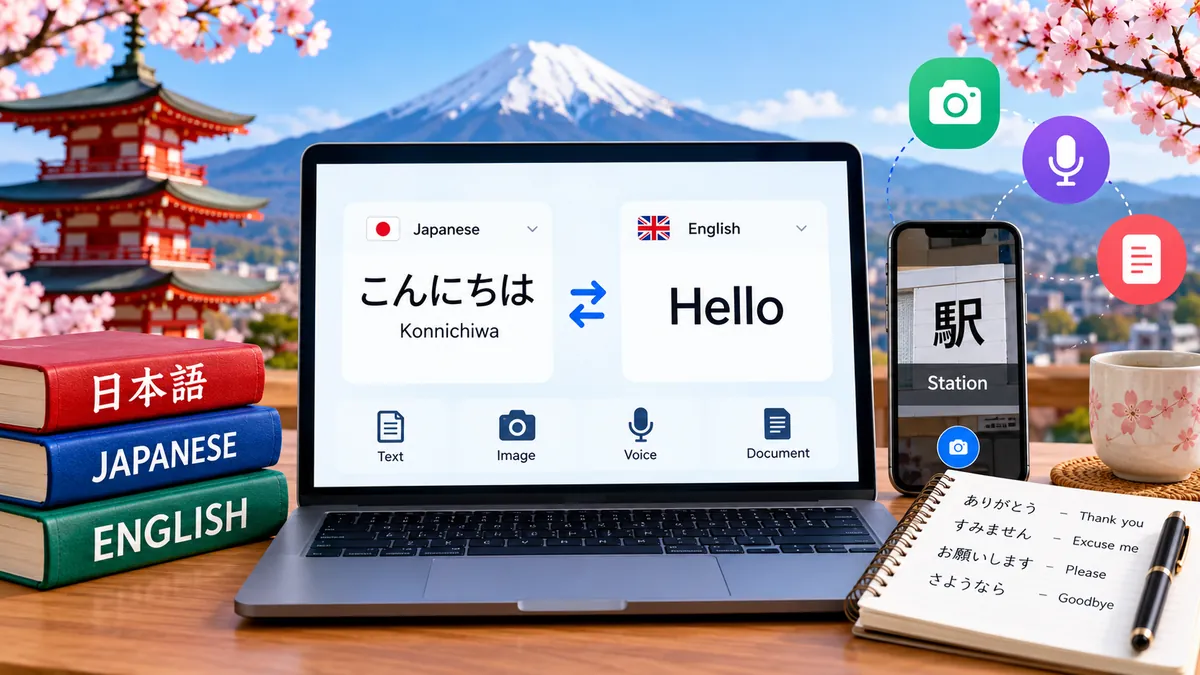
Japanese can be surprisingly difficult to translate into English. A short sentence may have several possible meanings, and even a familiar word can change depending on the speaker, situation, or level of politeness.
A japanese to english translator is a digital tool or language service that converts Japanese text, speech, or images into English. Tools such as Google Translate, DeepL, and Microsoft Translator use machine translation technology to interpret Japanese vocabulary and sentence structures. However, accurate results often require context, especially with kanji, honorifics, idioms, and informal expressions.
Understanding how these tools work makes it easier to translate everyday conversations, websites, documents, manga, and travel information without losing important meaning.
What Is a Japanese to English Translator?
A Japanese to English translator helps readers understand Japanese content by converting it into English. Depending on the tool, it may process typed text, spoken conversations, photographed signs, handwritten characters, or entire documents.
Modern translation services typically use neural machine translation (NMT), which analyzes relationships between words and phrases rather than translating every word independently.
For example:
| Japanese | Literal meaning | Natural English |
|---|---|---|
| こんにちは | This day | Hello |
| ありがとうございます | Thank you | Thank you very much |
| お元気ですか | Are you well? | How are you? |
| お疲れ様です | You must be tired | Thanks for your hard work |
| よろしくお願いします | Please treat me favorably | Nice to meet you / Thank you in advance |
| いただきます | I humbly receive | Said before eating a meal |
The last three examples show why Japanese translation is more than replacing vocabulary. The intended English expression depends on social conventions and context.
Japanese-to-English translation versus transliteration
Translation converts meaning from one language into another. Transliteration represents Japanese sounds using another writing system.
For instance:
- Japanese: ありがとう
- Romaji: Arigatou
- English translation: Thank you
Romaji is useful for pronunciation, but it does not explain the meaning of a sentence. A translator should distinguish these functions.
How Does a Japanese to English Translator Work?
Translation technology has developed from dictionary-based systems to machine-learning models capable of handling complex language patterns.
Neural machine translation
Neural machine translation uses artificial neural networks trained on multilingual and translated text.
A typical translation process involves:
- Identifying the Japanese text and its writing system.
- Analyzing words, grammar, and sentence relationships.
- Using surrounding context to estimate the intended meaning.
- Generating an English sentence.
- Selecting phrasing that sounds natural in English.
Many contemporary systems use Transformer-based architectures. These models can consider relationships across a sentence, helping them interpret expressions that would be difficult to translate word by word.
Nevertheless, even advanced systems may misunderstand ambiguous phrases or omit information.
Why Japanese translation is challenging
Japanese and English differ significantly in grammar and communication style.
English commonly follows subject–verb–object order:
I eat sushi.
Japanese typically follows subject–object–verb order:
私は寿司を食べます。
A natural English translation is “I eat sushi,” although the Japanese sentence places the verb at the end.
Japanese also frequently omits subjects when they are understood from context. A sentence such as 行きます can mean “I will go,” “He will go,” or another interpretation depending on the conversation.
A translation system may choose one interpretation even when the original sentence does not specify it.
Best Japanese to English Translator Tools
Different tools are suitable for different translation tasks. Some prioritize convenience, while others offer dictionaries, grammatical explanations, or document translation.
Google Translate
Google Translate is a widely accessible translation service supporting Japanese and English.
It can help with typed text, speech, images, and conversations, depending on the device and available features.
Common uses include reading signs, understanding short messages, translating websites, and checking everyday phrases.
Its main advantage is convenience across different input formats. However, results involving implied subjects, specialized terminology, or cultural expressions may require verification.
DeepL Translator
DeepL Translator uses neural translation technology and supports Japanese-to-English translation.
It is particularly useful when readers want to compare how a complete sentence or paragraph can be expressed naturally in English.
For example, business correspondence often requires more than literal translation. Word choice, formality, and sentence flow can affect the result.
DeepL can provide a useful alternative interpretation, but polished English does not necessarily guarantee that every detail of the original Japanese has been preserved.
Microsoft Translator
Microsoft Translator supports Japanese and English translation across Microsoft’s language services.
It can be useful for multilingual communication, travel, and productivity workflows.
Supported capabilities vary by application and platform, so users should check which text, speech, and image features are available in their version.
Jisho
Jisho is a Japanese-English dictionary rather than a full conversational translation service.
It is useful for looking up kanji, vocabulary, readings, and example sentences.
Students can use it to investigate why a machine translation selected a particular word or to explore alternative meanings.
Yomitan
Yomitan is a browser-based Japanese language-learning tool that supports dictionary lookups while reading.
It can display word meanings and related linguistic information through installed dictionaries.
This makes it useful for learners reading Japanese websites, digital books, and other selectable text.
Comparing popular tools
| Tool | Primary strength | Best suited for |
|---|---|---|
| Google Translate | Multiple translation input methods | Travel and everyday text |
| DeepL | Natural sentence translation | Paragraphs and general documents |
| Microsoft Translator | Integration with language services | Conversations and productivity |
| Jisho | Detailed vocabulary lookup | Kanji and word meanings |
| Yomitan | In-context dictionary lookup | Japanese reading practice |
No single tool is consistently the most accurate for every sentence. Comparing translations and checking important terminology is more reliable than assuming one service is always correct.
How to Translate Japanese to English Step by Step
The basic translation process is straightforward, but a few additional checks can substantially improve accuracy.
Step 1: Choose the correct translation tool
Select a service based on the material you need to translate.
For short conversations, a mobile translator with speech recognition may be convenient. For longer paragraphs, use a text translator. For unfamiliar kanji, a Japanese-English dictionary can provide more detail.
Step 2: Enter the Japanese text
Copy and paste the original Japanese characters into the translation field.
For example:
明日は東京に行きます。
A natural English translation is:
“I am going to Tokyo tomorrow.”
Whenever possible, preserve the original Japanese spelling, punctuation, and sentence boundaries.
Step 3: Set the source and target languages
Choose Japanese as the source language and English as the target language.
Automatic language detection is convenient, but manually selecting Japanese can help when translating short expressions containing only a few characters.
Step 4: Read the entire translation
Check whether the English sentence makes sense in context.
A translation may be grammatically correct while communicating the wrong intention.
For instance, 大丈夫です can mean “I’m okay,” “It’s fine,” or “No, thank you,” depending on the circumstances.
Step 5: Verify unfamiliar expressions
For ambiguous phrases, compare results from another translator or check individual words in a dictionary.
This is especially helpful when translating formal emails, technical documents, medical instructions, or culturally specific expressions.
Understanding Japanese Writing Systems
A reliable japanese to english translator must recognize three major Japanese writing systems: hiragana, katakana, and kanji.
Japanese sentences frequently combine all three.
Hiragana
Hiragana is a phonetic writing system used for grammatical elements and many native Japanese words.
Examples include:
| Hiragana | Romaji | English |
|---|---|---|
| ありがとう | Arigatou | Thank you |
| おはよう | Ohayou | Good morning |
| さようなら | Sayounara | Goodbye |
| かわいい | Kawaii | Cute |
| たべる | Taberu | To eat |
Hiragana represents sounds rather than individual meanings. The meaning of a word comes from its vocabulary and context.
Katakana
Katakana is commonly used for loanwords, foreign names, sound effects, and certain forms of emphasis.
Examples include:
| Katakana | English |
|---|---|
| コンピューター | Computer |
| テレビ | Television |
| コーヒー | Coffee |
| ホテル | Hotel |
| レストラン | Restaurant |
Some katakana expressions differ from their English origins.
For example, マンション (manshon) usually refers to an apartment or condominium building in Japanese, not a large luxury house.
Kanji
Kanji are characters of Chinese origin used to represent meaningful elements in Japanese words.
Many kanji have multiple readings.
Consider the character 生, which appears in words such as:
- 学生 (gakusei): Student
- 先生 (sensei): Teacher
- 生活 (seikatsu): Daily life
- 生きる (ikiru): To live
A translator must interpret the complete word rather than assigning one fixed English meaning to each character.
Why mixed writing matters
Consider:
私はコーヒーを飲みます。
This sentence combines kanji, hiragana, and katakana. Its natural English translation is:
“I drink coffee.”
The mixture is normal Japanese writing, not a formatting problem.
Using a Japanese to English Translator for Images and Photos
Image translation is useful when Japanese text cannot easily be copied or typed.
Common examples include restaurant menus, product labels, street signs, packaging, and printed instructions.
How camera translation works
Camera translation generally combines optical character recognition (OCR) with machine translation.
OCR identifies characters within an image. The translation engine then converts the recognized text into English.
Google Translate offers camera translation and photo translation features, although availability varies by platform and language.
Google Translate
+1
To translate a Japanese image:
- Open a translation application with camera support.
- Select Japanese and English.
- Point the camera at the text or import a photograph.
- Allow the application to recognize the characters.
- Read the translated text and verify unclear sections.
Tips for better image translation
Image quality strongly influences OCR accuracy.
Use clear lighting, avoid reflections, keep the camera steady, and capture the complete text.
Vertical Japanese writing can be more difficult for some recognition systems than standard horizontal text.
Decorative fonts, handwritten kanji, and stylized manga lettering may also cause recognition errors.
When the result looks strange, compare the detected Japanese text with the original image before blaming the translation engine. Sometimes the translation is wrong because the characters were recognized incorrectly.
Japanese to English Voice Translation
Voice translation helps people communicate when they cannot read or speak the same language fluently.
A speech translator generally performs three operations: speech recognition, language translation, and spoken output through text-to-speech technology.
Translating spoken Japanese
Suppose someone says:
駅はどこですか。
The English translation is:
“Where is the station?”
A voice translator can recognize the spoken sentence, display its meaning, and potentially read the English translation aloud.
This is useful for travel, customer service, and informal conversations.
Real-time conversation translation
Some applications provide conversation modes that alternate between two languages.
Google Translate includes conversation and speech-related features, while Microsoft lists Japanese among the languages supported by several of its translation services.
Google Translate
+1
However, real-time translation can struggle with overlapping speech, background noise, dialects, and rapid conversation.
For better results, speak in short sentences, pause between ideas, and confirm important information.
Can Japanese be translated offline?
Yes, certain applications support offline Japanese-to-English translation after the necessary language resources have been downloaded.
Google Translate offers offline language downloads, although supported functions depend on the device and application version.
Google Translate
+1
Offline translation is useful when traveling without reliable mobile data.
Before departure, download the required languages and test the feature without an internet connection. Do not assume camera, speech, and text translation will all function identically offline.
Common Japanese Phrases and Their English Meanings
Learning common expressions makes it easier to recognize whether a machine translation sounds reasonable.
| Japanese phrase | Romaji | English meaning |
|---|---|---|
| はい | Hai | Yes |
| いいえ | Iie | No |
| すみません | Sumimasen | Excuse me / Sorry |
| ありがとう | Arigatou | Thank you |
| お願いします | Onegaishimasu | Please |
| わかりません | Wakarimasen | I don’t understand |
| もう一度お願いします | Mou ichido onegaishimasu | One more time, please |
| 英語を話せますか | Eigo o hanasemasu ka | Can you speak English? |
| これは何ですか | Kore wa nan desu ka | What is this? |
| いくらですか | Ikura desu ka | How much is it? |
| トイレはどこですか | Toire wa doko desu ka | Where is the restroom? |
| 助けてください | Tasukete kudasai | Please help me |
These expressions are particularly useful for travelers and beginning Japanese learners.
Polite versus casual Japanese
Japanese uses different expressions depending on social relationships.
For example:
ありがとう is a casual way to say “Thank you.”
ありがとうございます is more polite.
Similarly, 食べる (taberu) means “to eat,” while 食べます (tabemasu) is its polite non-past form.
English translations may not always preserve these distinctions because English uses politeness differently.
A translator that produces “Thank you” for both expressions may communicate the basic meaning correctly while omitting the difference in formality.
Why Japanese to English Translations Sometimes Sound Wrong
Even sophisticated translation models can make mistakes because Japanese frequently relies on information that is not explicitly stated.
Missing subjects and pronouns
Japanese speakers often omit pronouns when the meaning is clear from context.
For example:
昨日買いました。
This could mean “I bought it yesterday” or refer to someone else who bought something yesterday.
Without surrounding sentences, a translation system cannot reliably determine the subject or object.
Words with multiple meanings
Japanese contains many homophones and context-dependent words.
The spoken word hashi can refer to:
- 橋: Bridge
- 箸: Chopsticks
- 端: Edge
Written kanji often clarify the intended meaning. In spoken translation, context becomes especially important.
Honorifics and social relationships
Japanese honorifics communicate respect, familiarity, and social relationships.
Common suffixes include -san, -sama, -kun, and -chan.
These suffixes do not have exact equivalents in English.
For instance, 田中さん may be translated as “Mr. Tanaka,” “Ms. Tanaka,” or simply “Tanaka,” depending on the context.
Automatically assigning a gendered English title can introduce information that was not present in the original.
Idioms and cultural expressions
Japanese expressions frequently carry meanings beyond their individual words.
空気を読む (kuuki o yomu) literally means “to read the air.”
Its intended meaning is to understand an unspoken social situation or recognize what others expect.
Likewise, 猫の手も借りたい (neko no te mo karitai) literally refers to wanting to borrow even a cat’s paw. It expresses being extremely busy and needing help.
A useful translator should prioritize the intended meaning rather than preserve a confusing literal expression.
Translating Japanese Manga, Anime, and Subtitles
Japanese entertainment contains distinctive vocabulary, speech patterns, and cultural references.
Manga, anime, games, and light novels can therefore be challenging for general-purpose translation tools.
Translating manga panels
Manga often combines speech bubbles, sound effects, vertical text, and handwritten lettering.
A typical workflow involves extracting the Japanese text with OCR, translating the dialogue, and checking how each sentence relates to the surrounding panels.
Context is essential because characters frequently speak in incomplete sentences.
Sound effects such as ドキドキ (dokidoki), describing a pounding heartbeat or nervous excitement, may require creative English phrasing.
Understanding anime dialogue
Anime characters may use highly informal language, regional dialects, exaggerated speech patterns, or archaic expressions.
For example, 俺 (ore) and 私 (watashi) can both mean “I,” but they convey different styles of self-reference.
A literal translation may erase those distinctions.
Subtitles also involve timing and readability constraints. Professional subtitle translators often shorten dialogue while attempting to preserve the original meaning and tone.
Translating Japanese games
Video games introduce additional challenges involving character names, interface labels, fictional terminology, and dialogue choices.
Consistency matters. A term translated one way in a menu should ideally retain that meaning throughout the game.
Fan translations and official localization may differ because localization considers cultural expectations, character voice, and gameplay context in addition to linguistic accuracy.
Translating Japanese Websites, PDFs, and Documents
Long-form content requires a different approach from translating a single sentence.
Japanese website translation
Browser translation features can help readers understand Japanese websites without copying every paragraph.
Google Translate also supports website translation through its web interface.
Google Translate
For better comprehension, pay particular attention to navigation labels, dates, disclaimers, and technical terminology.
Machine translation may change the order or wording of interface elements, which can make instructions difficult to follow.
Japanese PDF translation
PDF documents may contain selectable text or scanned images.
Selectable text is generally easier to process because the translator can access the characters directly.
Scanned PDFs require OCR before translation.
DeepL supports document translation for supported file formats, including PDFs, Word documents, and PowerPoint presentations, subject to its current feature and account limitations.
Complex tables, embedded images, unusual fonts, and vertical writing can still create formatting problems.
Business and professional documents
Business Japanese often includes honorific language called keigo.
For example:
ご確認のほどよろしくお願いいたします。
A natural English rendering might be:
“Please review this at your convenience.”
The precise translation depends on the business relationship and surrounding message.
Formal Japanese correspondence often includes expressions that should not be translated word for word.
For contracts, financial records, immigration documents, and other consequential material, qualified human review is advisable.
How to Improve Japanese to English Translation Accuracy
Better translations often come from improving the input and verification process rather than switching tools repeatedly.
Provide complete sentences
Single Japanese words may have several meanings.
A full sentence provides grammatical and situational clues that help a translation model choose the intended interpretation.
Keep surrounding context
When translating dialogue, include the preceding and following sentences where practical.
This can help clarify omitted subjects, pronouns, and references.
Check names and specialized terminology
Japanese personal names, place names, and technical expressions can have multiple readings or accepted English spellings.
Proper nouns should be checked against reliable references instead of relying solely on automatic transliteration.
Compare alternative translations
If a sentence seems unclear, compare outputs from two translation services.
Differences can reveal ambiguous vocabulary or possible omissions.
However, agreement between two tools is not proof of correctness, because translation models can make similar mistakes.
Use a dictionary for important words
Japanese dictionaries provide readings, definitions, grammatical information, and example usages.
For language learners, resources such as Jisho and dictionary-enabled reading tools can clarify how words function within a sentence.
Review numbers, dates, and measurements
Japanese documents may contain dates using Japanese era names, such as Reiwa, as well as familiar international date formats.
Large numbers also require attention. The unit 万 (man) represents ten thousand, while 億 (oku) represents one hundred million.
For example, 100万円 means one million yen, not 100,000 yen.
Mistakes involving numeric units can have serious consequences in financial or administrative documents.
Japanese to English Translation for Language Learning
Translation tools can support Japanese study when used as learning aids rather than substitutes for understanding grammar.
Learning vocabulary through examples
Instead of memorizing only isolated English meanings, study Japanese words within complete sentences.
For example:
本を読みます。
“I read a book.”
This sentence demonstrates the noun 本 (hon), the object particle を (o), and the polite verb 読みます (yomimasu).
Studying these elements together helps learners recognize recurring grammatical patterns.
Understanding particles
Japanese particles indicate grammatical relationships.
Common examples include:
| Particle | Common function |
|---|---|
| は (wa) | Marks the topic |
| が (ga) | Marks the subject or focus |
| を (o) | Marks a direct object |
| に (ni) | Indicates destinations, times, or other relationships |
| で (de) | Indicates locations of actions or means |
| の (no) | Indicates possession or noun relationships |
Particles rarely correspond to one fixed English word.
Understanding them helps learners evaluate translations more critically.
Using JLPT study materials
The Japanese-Language Proficiency Test (JLPT) measures Japanese language ability across five levels, from N5 to N1.
Translation tools can help learners investigate vocabulary and grammar encountered in JLPT preparation materials.
However, direct Japanese reading and listening practice remains essential because translating every sentence into English can slow the development of independent comprehension.
Avoiding overdependence on translation
A productive learning routine is to read the Japanese sentence first, attempt to understand it, check the translation, and then investigate unfamiliar grammar.
This encourages active learning instead of passive copying.
Machine Translation vs. Human Japanese Translation
Machine translation is fast and convenient, but human translation offers advantages when nuance and accountability matter.
| Factor | Machine translation | Human translation |
|---|---|---|
| Speed | Usually immediate | Requires additional time |
| Context | Depends on supplied information | Can interpret broader context |
| Cultural nuance | May miss subtle implications | Can adapt expressions |
| Technical terminology | May be inconsistent | Can verify specialized usage |
| Creative writing | May lose style or tone | Can preserve literary intention |
| Cost | Often free or usage-based | Usually paid |
| Quality assurance | Requires independent checking | Can include professional review |
Machine translation works well for quickly understanding general information, but its accuracy varies by content type.
Human translators are especially valuable for legal material, literature, marketing localization, sensitive communications, and documents requiring certification.
A combined approach can also be effective: machine translation produces an initial draft, while a knowledgeable reviewer checks meaning, terminology, and style.
Is an Online Japanese to English Translator Safe?
Translation services process the information users submit, so privacy deserves attention.
Avoid entering passwords, confidential customer records, private medical details, or unpublished business information into a public translation service without understanding its data-handling policies.
Organizations handling sensitive information should review provider agreements, retention practices, and security settings.
Where confidentiality is essential, use an approved translation environment or a professional translator operating under appropriate confidentiality arrangements.
Translation accuracy and information security are separate concerns. A service can produce fluent English without necessarily meeting an organization’s privacy requirements.
Choosing the Right Japanese to English Translator
The most useful translator depends on the task.
For travel, prioritize camera translation, speech input, and offline capabilities.
For reading websites and everyday messages, a general-purpose text translator is usually sufficient.
For studying Japanese, combine machine translation with dictionaries, kanji references, and grammatical explanations.
For long documents, consider tools that preserve formatting and allow terminology review.
For legal, medical, financial, or official content, treat automatic translations as preliminary references unless they have been appropriately verified.
A japanese to english translator can make Japanese text, speech, and images significantly easier to understand. The best results come from preserving context, recognizing the differences between Japanese and English, and checking important details rather than accepting every translation automatically.
Start with a complete Japanese sentence, examine the English meaning, and use a dictionary or a second translation when something is unclear. That simple process helps turn automated translation into a more accurate and dependable language-learning and communication resource.
