

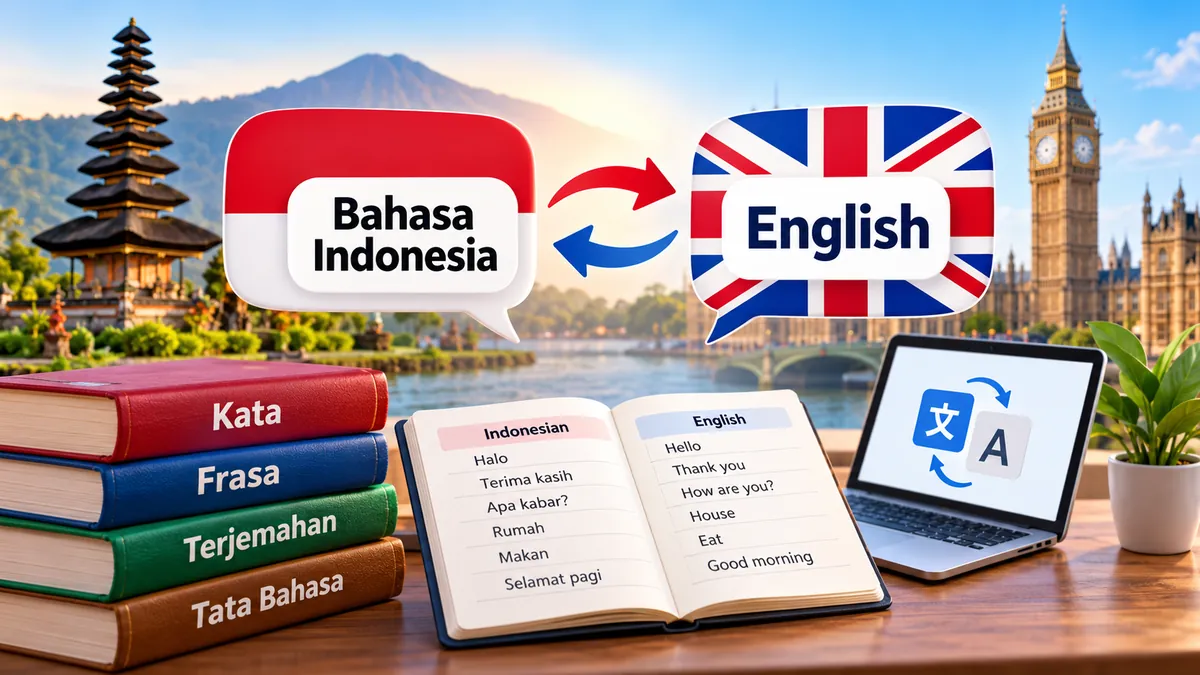
Translating Indonesian into English may seem straightforward, but even a simple sentence can change meaning depending on its context. Indonesian uses different grammar patterns, flexible word meanings, and expressions that do not always have direct English equivalents.
Indonesian to English translation involves converting words, phrases, and sentences from Bahasa Indonesia into natural, accurate English while preserving their original meaning. Good translation requires understanding Indonesian vocabulary, sentence structure, cultural expressions, and context rather than simply replacing each Indonesian word with an English equivalent.
This guide explains how Indonesian and English differ, how to translate accurately, which tools can help, and how to avoid common mistakes. It also includes everyday vocabulary, practical phrases, and examples for students, travelers, language learners, and professionals.
How Does indonesian to english Translation Work?
Indonesian, commonly called Bahasa Indonesia, is the official language of Indonesia. It belongs to the Austronesian language family and uses the Latin alphabet.
English belongs to the Indo-European language family, specifically the Germanic branch. Although the languages share some borrowed vocabulary, their grammar and word formation differ considerably.
Translation typically involves three steps:
- Understanding the source: Identify the meaning of the Indonesian words and sentence.
- Interpreting the context: Determine the intended tense, tone, and relationship between speakers.
- Expressing the meaning: Write a natural English sentence that communicates the same idea.
For example:
Indonesian: Saya sedang belajar bahasa Inggris.
English: I am learning English.
The Indonesian word sedang indicates an ongoing action. In English, that meaning is commonly expressed through the present continuous construction, “am learning.”
A literal translation that ignores these differences can sound unnatural or even change the meaning.
Common Indonesian Words and Their English Meanings
Learning frequently used vocabulary is one of the easiest ways to improve translation skills.
Basic Indonesian to English vocabulary
| Indonesian | English |
|---|---|
| Halo | Hello |
| Selamat pagi | Good morning |
| Selamat malam | Good evening / Good night |
| Terima kasih | Thank you |
| Sama-sama | You’re welcome |
| Tolong | Please / Help |
| Maaf | Sorry / Excuse me |
| Ya | Yes |
| Tidak | No |
| Saya | I / Me |
| Kamu | You |
| Dia | He / She |
| Kami | We (excluding the listener) |
| Kita | We (including the listener) |
| Mereka | They |
| Rumah | House |
| Sekolah | School |
| Buku | Book |
| Air | Water |
| Makanan | Food |
| Teman | Friend |
| Keluarga | Family |
| Hari | Day |
| Waktu | Time |
| Bagus | Good / Nice |
Some Indonesian words have several English equivalents. For instance, bagus might mean “good,” “beautiful,” “excellent,” or “nice,” depending on the situation.
Common Indonesian verbs
| Indonesian | English |
|---|---|
| Makan | Eat |
| Minum | Drink |
| Tidur | Sleep |
| Pergi | Go |
| Datang | Come |
| Belajar | Study / Learn |
| Bekerja | Work |
| Membaca | Read |
| Menulis | Write |
| Berbicara | Speak |
| Mendengar | Hear / Listen |
| Melihat | See |
| Membeli | Buy |
| Menjual | Sell |
| Membantu | Help |
Unlike English verbs, Indonesian verbs generally do not change form to indicate the person performing the action or grammatical tense.
For example, makan can correspond to “eat,” “eats,” “ate,” or “will eat,” depending on the surrounding words and context.
Everyday Indonesian to English Phrases
Translating complete phrases is often more useful than memorizing individual words because it demonstrates how vocabulary works in real conversations.
Greetings and introductions
| Indonesian phrase | English translation |
|---|---|
| Apa kabar? | How are you? |
| Kabar baik. | I’m fine. |
| Siapa nama Anda? | What is your name? |
| Nama saya Budi. | My name is Budi. |
| Senang bertemu dengan Anda. | Nice to meet you. |
| Dari mana Anda berasal? | Where are you from? |
| Saya berasal dari Indonesia. | I am from Indonesia. |
| Sampai jumpa. | See you later. |
| Selamat tinggal. | Goodbye. |
| Hati-hati. | Take care / Be careful. |
The pronoun Anda is a relatively formal way of saying “you.” In informal conversation, speakers may use kamu or other forms of address depending on their relationship.
Travel and transportation phrases
Travelers frequently encounter Indonesian on signs, tickets, menus, and transportation announcements.
| Indonesian | English |
|---|---|
| Di mana bandara? | Where is the airport? |
| Berapa harganya? | How much does it cost? |
| Saya ingin membeli tiket. | I want to buy a ticket. |
| Di mana hotel saya? | Where is my hotel? |
| Tolong bantu saya. | Please help me. |
| Saya tersesat. | I am lost. |
| Apakah ini jalan yang benar? | Is this the correct way? |
| Saya tidak mengerti. | I don’t understand. |
| Bisa bicara bahasa Inggris? | Can you speak English? |
| Di mana kamar mandi? | Where is the bathroom? |
For visitors to Jakarta, Bali, Yogyakarta, Surabaya, and other Indonesian destinations, recognizing these expressions can make everyday interactions easier.
Shopping and restaurant expressions
Indonesian food culture introduces vocabulary that does not always translate neatly into English.
- Nasi goreng — Fried rice
- Mie goreng — Fried noodles
- Ayam bakar — Grilled chicken
- Sate ayam — Chicken satay
- Air putih — Plain drinking water
- Tanpa gula — Without sugar
- Tidak pedas — Not spicy
- Saya mau pesan makanan — I would like to order food
Notice that air putih literally resembles “white water,” but its intended meaning is plain drinking water. Translating the individual words without understanding the expression would produce a misleading result.
Understanding Indonesian and English Grammar Differences
Accurate translation depends heavily on grammar. Indonesian is often considered approachable for English-speaking learners because it does not require many of the verb conjugations found in European languages.
However, its simplicity in some areas creates different challenges for translators.
1. Indonesian verbs do not conjugate for tense
English verbs change according to tense and sometimes the subject.
Compare these examples:
| Indonesian | Natural English |
|---|---|
| Saya makan nasi. | I eat rice. |
| Saya sudah makan nasi. | I have eaten rice. |
| Saya sedang makan nasi. | I am eating rice. |
| Saya akan makan nasi. | I will eat rice. |
| Saya makan nasi kemarin. | I ate rice yesterday. |
The verb makan stays the same.
Words such as sudah, sedang, and akan, along with time expressions such as kemarin (yesterday), help establish when an action occurs.
The exact English tense must still be chosen from context. For example, sudah often indicates completion, but it does not automatically require the English present perfect in every sentence.
2. Indonesian does not use grammatical gender in ordinary pronouns
The Indonesian pronoun dia can refer to a male or female person.
For example:
Dia seorang dokter.
Possible English translations include:
- He is a doctor.
- She is a doctor.
- They are a doctor.
The correct choice depends on context and the person’s pronouns. A translator should not assume gender when the Indonesian sentence does not specify it.
The possessive suffix -nya can also correspond to “his,” “her,” “their,” or “its.”
3. Adjectives usually follow nouns
English commonly places adjectives before nouns, while Indonesian typically places them afterward.
| Indonesian | English |
|---|---|
| Rumah besar | Big house |
| Mobil merah | Red car |
| Buku baru | New book |
| Anak kecil | Small child |
| Makanan enak | Delicious food |
A word-for-word translation of rumah besar as “house big” would not follow ordinary English grammar.
4. Indonesian plurals work differently
English frequently uses an -s or -es ending to mark plural nouns.
Indonesian can express plurality through context, quantity words, or reduplication.
For example:
Buku means “book” or “books,” depending on context.
Buku-buku explicitly refers to multiple books.
However, reduplication does not always mean a simple plural, and it is generally unnecessary to duplicate a noun after a number or an appropriate quantity expression.
For instance, dua buku means “two books.”
5. Indonesian articles are different
English uses articles such as “a,” “an,” and “the.”
Indonesian does not have an identical article system, so these words may need to be added during translation.
Consider:
Saya membeli buku.
A natural English translation is:
“I bought a book.”
In another context, it could mean “I buy books” or “I am buying a book.”
The surrounding information determines the most appropriate interpretation.
6. Indonesian distinguishes inclusive and exclusive “we”
One particularly useful difference is the distinction between kami and kita.
- Kami — We, excluding the person being addressed.
- Kita — We, including the person being addressed.
English usually translates both as “we,” so the distinction can disappear unless the context makes it necessary to clarify.
For example, Kita pergi sekarang can mean “Let’s go now” when the speaker is inviting the listener to join.
How to Translate Indonesian to English Step by Step
A reliable translation process combines vocabulary knowledge, grammatical analysis, and a final readability check.
Step 1: Read the complete Indonesian sentence
Avoid translating every word independently before understanding the full message.
Consider:
Saya tidak bisa datang karena sedang sakit.
A natural translation is:
“I can’t come because I’m sick.”
The sentence expresses an inability to attend or arrive due to illness.
Step 2: Identify the subject and main verb
Indonesian and English often follow a subject–verb–object structure.
For example:
Rina membaca buku.
- Subject: Rina
- Verb: membaca (reads)
- Object: buku (a book)
English: “Rina reads a book.”
However, Indonesian also permits sentence patterns that require more substantial restructuring in English.
Step 3: Determine the time reference
Look for words indicating past, present, or future events.
| Indonesian marker | Common meaning |
|---|---|
| Kemarin | Yesterday |
| Sekarang | Now |
| Besok | Tomorrow |
| Sudah | Already / Completed |
| Sedang | In progress |
| Akan | Will / Going to |
| Belum | Not yet |
| Pernah | Have ever / Once |
These markers provide clues, but they do not always correspond to a single English tense.
Step 4: Translate the intended meaning
Consider the Indonesian expression:
Buah tangan.
Its literal components are “fruit” and “hand,” but the expression often means a souvenir or gift brought back from a trip.
A natural translation might be:
“I brought you a souvenir.”
This is an example of why idiomatic expressions require interpretation rather than literal substitution.
Step 5: Review the English sentence
After translating, check whether the sentence sounds natural to an English reader.
Review verb tense, pronouns, articles, word order, punctuation, and tone.
A useful test is to read the English sentence without looking at the Indonesian original. If it sounds confusing or awkward, revise it while preserving the meaning.
Best Tools for indonesian to english Translation
Online translation tools make it easier to understand unfamiliar Indonesian words, translate longer passages, and check vocabulary.
However, different tools are useful for different tasks.
Google Translate
Google Translate supports Indonesian and English, with features for translating text, images, documents, and websites.
translate.google.co.id
+1
It is particularly helpful for everyday situations, such as reading signs, understanding short messages, and translating basic conversations.
For better results, enter complete sentences rather than isolated words. This gives the translation system more context.
DeepL Translator
DeepL Translator supports Indonesian-to-English text translation and provides options for working with documents.
DeepL
It can be useful when translating longer paragraphs or comparing alternative English wording.
Like other machine translation systems, its output should be reviewed for ambiguous language, cultural references, and specialized terminology.
Cambridge Indonesian–English Dictionary
The Cambridge Indonesian–English Dictionary provides English translations of thousands of Indonesian words.
Its dictionary-based approach makes it useful for understanding individual vocabulary items rather than relying exclusively on automatic sentence translation.
Cambridge Dictionary
Kamus Besar Bahasa Indonesia (KBBI)
The Kamus Besar Bahasa Indonesia is an official Indonesian dictionary maintained by Indonesia’s language development agency.
KBBI explains Indonesian words in Indonesian rather than serving primarily as an English translation dictionary. It is valuable for checking formal meanings, spelling, and accepted vocabulary.
KBBI VI Daring
Comparing translation resources
| Tool | Main strength | Useful for |
|---|---|---|
| Google Translate | Multiple translation formats | Everyday text, images, documents |
| DeepL | Text and document translation | Paragraphs and longer passages |
| Cambridge Dictionary | Word definitions and equivalents | Vocabulary learning |
| KBBI | Authoritative Indonesian definitions | Meaning and spelling verification |
No single tool guarantees a perfect translation. Comparing results and checking the original meaning can improve accuracy.
Common Mistakes in Indonesian to English Translation
Even experienced language learners can misunderstand Indonesian expressions when they translate too literally.
Confusing similar-looking words
Some Indonesian words resemble English words but have different meanings.
For example, aktual often means “current” or “topical,” depending on context. It does not always mean “actual” in the English sense of “real.”
Likewise, eventual and related borrowed terms should be interpreted according to their established Indonesian usage rather than their English appearance.
Translating idioms word for word
Idiomatic expressions often communicate figurative meanings.
| Indonesian expression | Literal meaning | Natural English meaning |
|---|---|---|
| Kambing hitam | Black goat | Scapegoat |
| Buah tangan | Fruit of the hand | Souvenir / Gift |
| Panjang tangan | Long hand | Having a tendency to steal |
| Besar kepala | Big head | Arrogant / Conceited |
| Angkat kaki | Lift feet | Leave / Get out |
| Cuci mata | Wash eyes | Enjoy looking around |
For instance, Dia menjadi kambing hitam means “He or she became the scapegoat,” not that someone became a black goat.
Ignoring formal and informal language
Indonesian speakers use different vocabulary depending on social relationships and situations.
Formal: Saya tidak mengetahui jawabannya.
English: “I don’t know the answer.”
Informal: Aku nggak tahu jawabannya.
English: “I don’t know the answer.”
Although the English meanings are similar, the Indonesian sentences have different levels of formality.
In professional translation, this distinction matters because the English wording should reflect the original tone.
Misinterpreting negation
Indonesian uses several negative expressions.
- Tidak commonly negates verbs and adjectives.
- Bukan commonly negates nouns and identities.
- Belum means “not yet.”
- Jangan expresses a prohibition.
Examples:
Saya tidak lapar. — “I am not hungry.”
Dia bukan guru. — “He or she is not a teacher.”
Saya belum selesai. — “I haven’t finished yet.”
Jangan pergi. — “Don’t go.”
Using the wrong negative construction can significantly change the meaning.
Indonesian Pronunciation and Its Role in Translation
Indonesian spelling is relatively consistent, but accurate listening still requires familiarity with its sounds.
Indonesian vowels
Indonesian uses five basic vowel letters: a, e, i, o, and u.
The letter e can represent different vowel sounds, which makes pronunciation less predictable than the other vowels.
| Letter | Approximate sound | Example |
|---|---|---|
| A | “ah” | Makan |
| E | “eh” or a neutral “uh” | Enak, besar |
| I | “ee” | Ini |
| O | “oh” | Obat |
| U | “oo” | Buku |
These English approximations are helpful starting points, but they do not capture every Indonesian pronunciation detail.
Important consonant combinations
Several Indonesian letter combinations have recognizable pronunciations.
- Ng represents the sound at the end of the English word “sing.”
- Ny resembles the sound in “canyon.”
- Sy generally represents an English “sh” sound.
- Kh represents a sound often found in Arabic-derived vocabulary.
Indonesian c is generally pronounced like the “ch” in “chair,” while j resembles the English “j” in “jump.”
Understanding these patterns helps with spoken Indonesian-to-English interpretation and improves recognition of unfamiliar words.
Translating Indonesian Slang and Informal Messages
Formal textbook Indonesian differs from everyday conversations, particularly in text messages and social media.
Speakers frequently use shortened words, slang, regional expressions, and borrowed English vocabulary.
Common informal Indonesian expressions
| Informal Indonesian | English meaning |
|---|---|
| Gak / Nggak | No / Not |
| Makasih | Thanks |
| Gimana? | How? |
| Kenapa? | Why? |
| Banget | Very / Really |
| Santai | Relax / Take it easy |
| Baper | Overly emotional / Taking something personally |
| Mager | Too lazy to move or do something |
| Gabut | Bored / Having nothing to do |
| Nongkrong | Hang out |
| Kuy | Let’s go |
Some slang terms carry cultural meanings that require explanation.
For example, mager comes from malas gerak, meaning a reluctance to move or do something. Depending on context, it might be translated as “I can’t be bothered” or “I’m feeling too lazy.”
Similarly, baper comes from bawa perasaan and can describe someone becoming emotionally affected or taking a comment personally.
A literal translation rarely communicates the full meaning of these expressions.
Translating Indonesian chat abbreviations
Text messages often contain shortened forms such as:
- yg — yang
- dgn — dengan
- utk — untuk
- tdk — tidak
- sy — saya
- krn — karena
- sdh — sudah
For example:
Sy sdh makan.
Standard Indonesian: Saya sudah makan.
Natural English: “I’ve already eaten.”
Expanding abbreviations before translation can make the meaning clearer and reduce errors in automatic translation.
Translating Indonesian Documents, Websites, and Audio
Different types of content require different translation methods.
Documents and academic writing
Formal documents may contain technical terms, specialized vocabulary, and institutional references.
When translating academic papers, certificates, reports, or professional documents, pay particular attention to:
- Names of institutions and organizations
- Dates, numbers, and measurements
- Academic qualifications and job titles
- Specialized terminology
- Consistency throughout the document
Indonesian educational terms do not always have exact English equivalents.
For example, Sekolah Menengah Atas (SMA) is commonly described as senior high school, but its educational context should be preserved when translating official records.
For legal, immigration, or other official submissions, check whether a certified or sworn translation is required by the receiving institution.
Websites and digital content
Website translation involves more than changing the visible text.
Navigation labels, headings, instructions, buttons, and cultural references must remain understandable to English-speaking visitors.
For example:
Hubungi Kami — “Contact Us”
Tentang Kami — “About Us”
Baca Selengkapnya — “Read More”
Daftar Sekarang — “Register Now” or “Sign Up Now”
A website translator should also check whether the English wording fits the interface and accurately reflects the intended action.
Audio and spoken conversations
Speech translation introduces additional challenges, including accents, background noise, informal grammar, and rapid conversation.
A practical workflow is to transcribe the Indonesian speech first, review uncertain words, and then translate the transcript into English.
For interviews and subtitles, timestamps, speaker identification, and natural sentence length may also matter.
Automatic transcription can misinterpret names, local expressions, or unfamiliar vocabulary, so important recordings benefit from human review.
Cultural Context in Indonesian to English Translation
Language reflects social relationships, customs, and cultural expectations.
Indonesian speakers frequently use honorifics and forms of address that do not have perfect English equivalents.
Understanding honorifics
Bapak or Pak is a respectful form of address for men and can also mean “father” in certain contexts.
Ibu or Bu is a respectful form of address for women and can mean “mother.”
Mas and Mbak are commonly used in parts of Indonesia, especially Java, as polite or familiar forms of address.
Consider:
Terima kasih, Pak.
Depending on context, a natural translation might be “Thank you, sir.”
However, automatically replacing every Pak with “sir” may sound unnatural in a longer English conversation. Sometimes retaining the person’s name or adjusting the sentence is better.
Cultural concepts without exact equivalents
Indonesian includes culturally significant words that may require explanation.
Gotong royong describes mutual cooperation and collective assistance within a community.
Mudik commonly refers to returning to one’s hometown, especially around major holidays such as Eid al-Fitr.
Silaturahmi refers to maintaining or strengthening social and family relationships through connection and visits.
These expressions can be translated descriptively, but a short explanation may communicate their meaning more effectively than a single English word.
How to Improve Indonesian to English Translation Skills
Translation ability develops through regular exposure to both languages.
Build vocabulary around everyday situations
Start with vocabulary related to family, food, transportation, education, work, and common activities.
Learning words in meaningful groups makes them easier to remember.
For example, instead of memorizing makan alone, learn it in sentences:
Saya makan pagi. — “I eat breakfast.”
Kami makan bersama. — “We eat together.”
Dia sedang makan. — “He or she is eating.”
Practice with short paragraphs
Begin with two or three Indonesian sentences.
Translate them into English without using an automatic tool, then compare your work with a reliable translation.
Pay attention to missing articles, verb tenses, pronouns, and unnatural expressions.
Read bilingual material
Bilingual stories, educational resources, and translated articles allow learners to compare sentence structures.
Rather than matching every word individually, examine how complete ideas are expressed.
Listen to Indonesian regularly
Indonesian-language podcasts, interviews, films, and news broadcasts can help learners recognize pronunciation, rhythm, and everyday expressions.
Subtitles are useful, but they should not always be treated as literal translations. Subtitle writers may shorten or adapt dialogue to improve readability.
Keep a personal translation glossary
Record difficult words, their meanings, and example sentences.
A useful glossary might include:
| Indonesian | Meaning | Example |
|---|---|---|
| Meskipun | Although / Even though | Meskipun hujan, saya pergi. |
| Karena | Because | Saya pulang karena lelah. |
| Tetapi | But | Saya ingin pergi, tetapi sibuk. |
| Sehingga | So that / As a result | Hujan deras sehingga jalan banjir. |
| Sementara | While / Meanwhile | Saya membaca sementara dia menulis. |
A glossary is particularly helpful when working repeatedly with academic, technical, or business vocabulary.
When Is Human Translation Better Than Machine Translation?
Machine translation is useful for quick comprehension, but human expertise becomes more valuable when the meaning depends on subtle context.
For casual messages, travel phrases, and general informational content, automatic translation may be sufficient after a quick review.
For legal contracts, medical documents, literary writing, advertising copy, and sensitive professional communication, errors can have more serious consequences.
A qualified translator can resolve ambiguities, maintain the intended tone, and recognize cultural references that automated systems may misunderstand.
Human review is especially useful when Indonesian sentences omit information that English grammar normally requires, such as a clear subject, time reference, or gendered pronoun.
A combined approach often works well: use translation technology to prepare an initial draft, then review it for meaning, grammar, terminology, and cultural accuracy.
Final Thoughts on indonesian to english Translation
Learning indonesian to english translation becomes easier when you focus on meaning rather than individual words.
Indonesian and English differ in verb tense, noun phrases, pronouns, plurals, and cultural expressions. Understanding these differences helps produce English sentences that are both accurate and natural.
Start with common vocabulary and everyday phrases, then practice complete sentences and longer passages. Use dictionaries and translation tools to verify unfamiliar words, but always consider context.
With consistent practice, you can develop the skills needed to understand Indonesian conversations, translate written material, and communicate more confidently in English.
