

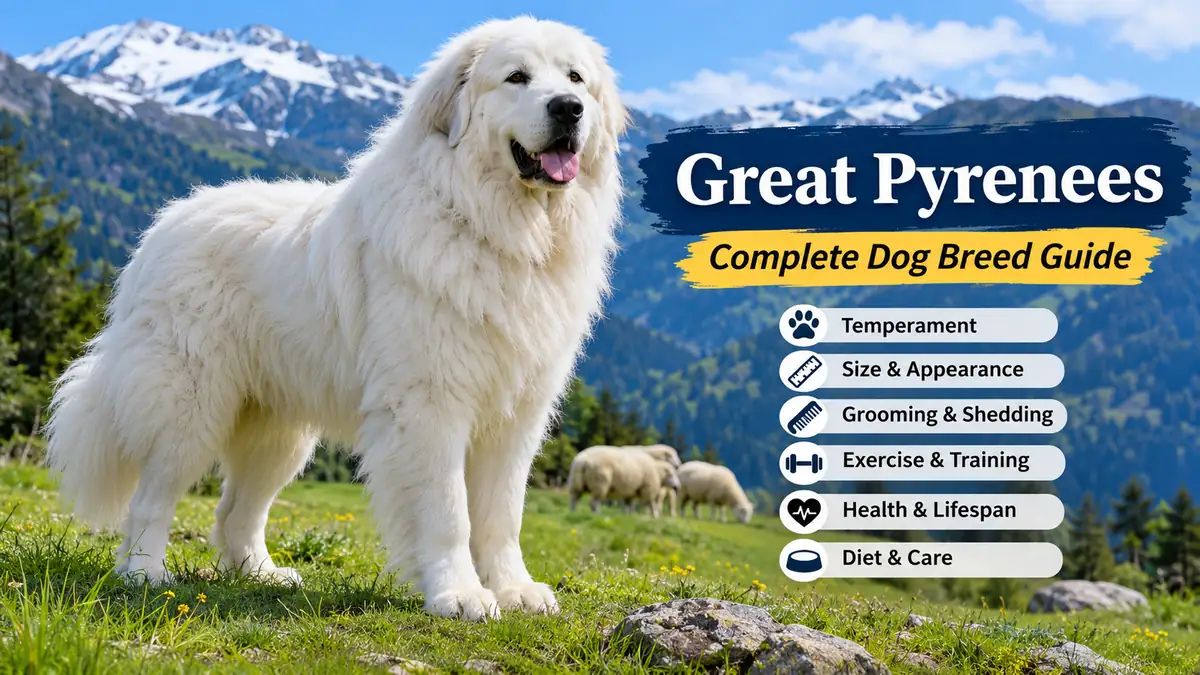
The Great Pyrenees is a magnificent, gentle giant known for its thick white coat, calm personality, and powerful protective instincts. Originally bred to guard livestock in mountainous regions, this dog combines an affectionate nature with the independence of a working guardian.
If you’re considering this breed, understanding its temperament, size, grooming requirements, and training challenges is essential. Its beautiful appearance and devotion to family are appealing, but owning one requires patience, space, and consistent care.
The great pyrenees is a large livestock guardian dog originating from the Pyrenees Mountains between France and Spain. Known for its protective instincts, gentle behavior with family members, and weather-resistant double coat, the breed typically weighs 85–100 pounds or more and lives approximately 10–12 years.
What Is a Great Pyrenees?
The Great Pyrenees is a powerful working breed developed to protect sheep and other livestock from predators. Unlike herding dogs, which move animals from one location to another, livestock guardians stay with their flock and discourage threats.
The breed is also known as the Pyrenean Mountain Dog, particularly in Europe, and as Le Chien de Montagne des Pyrénées in France.
Best Gentle Giant Dog Breeds: Dane to Newfoundland – Wooffy
Great Pyrenees Dog Breed: Temperament, Health & Training
11 Dog Breeds That Love Winter Snow and 7 That Prefer Cozy Indoor Days – Doggodigest
12
History and origin
The breed’s history is closely connected to the mountainous border region between France and Spain. For centuries, shepherds relied on these dogs to protect livestock from wolves, bears, and other predators.
Their traditional work required them to make independent decisions, sometimes far from human supervision. This background explains several characteristics that remain noticeable today:
- Strong territorial awareness and protective instincts
- Independent thinking and occasional stubbornness
- Alertness during nighttime hours
- Patience with animals they recognize as part of their group
- A calm, observant approach to unfamiliar situations
The Great Pyrenees gained recognition beyond agricultural communities through its association with French nobility. Today, the breed serves as both a livestock guardian and a family companion.
The American Kennel Club (AKC) recognizes the breed in its Working Group, while the Fédération Cynologique Internationale (FCI) classifies it among mountain-type molossoid breeds.
Great Pyrenees Size, Weight, and Appearance
A fully grown Great Pyrenees is an imposing dog with a muscular frame, broad chest, and thick coat. Despite its size, a well-conditioned dog should move smoothly and efficiently.
Average height and weight
| Characteristic | Male | Female |
|---|---|---|
| Height at shoulder | 27–32 inches | 25–29 inches |
| Typical weight | 100 pounds or more | 85 pounds or more |
| Build | Large, powerful | Large, slightly lighter |
| Coat | Thick double coat | Thick double coat |
| Lifespan | Approximately 10–12 years | Approximately 10–12 years |
These are breed-standard guidelines rather than strict limits for every individual dog. Genetics, body condition, and overall health influence adult weight.
What does a Great Pyrenees look like?
The breed has a distinctive appearance characterized by a dense white coat, dark expressive eyes, triangular ears, and a long feathered tail.
Its coat may be entirely white or feature markings in gray, badger, reddish-brown, or tan, typically around the head, ears, or body.
The thick undercoat provides insulation, while longer outer guard hairs help resist moisture and harsh weather. The breed also commonly has double dewclaws on its rear legs, a distinctive feature described in the breed standard.
When is a Great Pyrenees fully grown?
Great Pyrenees puppies grow rapidly during their first year, but their development does not stop when they reach adult height.
Many approach their adult height by 12–18 months, while filling out and developing mature musculature may continue until approximately two to three years of age.
Because giant breeds develop more slowly than smaller dogs, excessive exercise, repeated jumping, and unnecessary joint stress should be avoided during growth.
Great Pyrenees Temperament and Personality
The Great Pyrenees is generally calm, affectionate, patient, and protective. However, its personality differs considerably from breeds developed primarily for obedience or close cooperation with human handlers.
A livestock guardian was expected to observe its surroundings, evaluate possible threats, and act without waiting for instructions.
That independence remains one of the breed’s defining traits.
Are Great Pyrenees good family dogs?
Great Pyrenees can be excellent family companions when their temperament and needs fit the household.
They often form strong bonds with family members and may be especially gentle around familiar children. Their calm demeanor can make them seem surprisingly relaxed indoors.
However, several precautions matter:
- Supervise interactions between large dogs and young children.
- Teach children to respect the dog’s resting and eating spaces.
- Socialize the dog with different people and environments.
- Establish consistent household boundaries.
- Never assume protective behavior guarantees safe judgment.
Their size alone can create accidental hazards, particularly around toddlers.
Are Great Pyrenees aggressive?
The breed is not supposed to be indiscriminately aggressive. A well-socialized Great Pyrenees is typically confident, composed, and discerning.
Nevertheless, its protective instincts may lead to barking, territorial displays, or defensive reactions when it perceives a threat.
Poor socialization, fear, chronic stress, pain, and inappropriate handling can increase behavioral problems.
Owners should distinguish normal alert behavior from concerning signs such as repeated lunging, snapping, or escalating aggression. A qualified veterinary behaviorist or reward-based behavior professional can help assess these situations.
Are Great Pyrenees affectionate?
Yes. Many enjoy spending time near their families, receiving gentle attention, and resting in shared living spaces.
They may express affection through quiet companionship rather than constant play or obedience.
Some individuals are cuddly, while others prefer to maintain a little personal space.
Why are Great Pyrenees so independent?
Their independence is a direct result of their working history.
A guardian dog protecting sheep on a remote mountainside could not depend on a handler for every decision. It needed to recognize unfamiliar movement, evaluate potential danger, and respond appropriately.
Consequently, modern Great Pyrenees may understand a command but choose not to follow it immediately, particularly when distracted by something they consider important.
This is not necessarily a lack of intelligence. It reflects a different style of working behavior.
Great Pyrenees Training and Socialization
Training a Great Pyrenees requires consistency, patience, and an understanding of the breed’s independent nature.
These dogs are intelligent, but they are not always motivated by repetitive commands. They respond best when training is rewarding, predictable, and respectful.
How to train a Great Pyrenees puppy
Begin training as soon as the puppy settles into its new home.
Focus on foundational behaviors that improve everyday safety and communication.
- Name recognition: Reward the puppy for looking toward you when called.
- Basic commands: Introduce sit, stay, come, and leave it using short sessions.
- Leash manners: Teach walking without pulling before the dog becomes exceptionally strong.
- Handling exercises: Gradually familiarize the puppy with brushing, nail care, and veterinary examinations.
- Impulse control: Reward calm behavior around visitors, food, and other animals.
- Settling indoors: Teach the puppy to relax on a designated bed or mat.
Reward-based methods involving treats, praise, and positive reinforcement generally work better than intimidation or physical punishment.
The American Kennel Club emphasizes early socialization and puppy training for this independent breed. American Kennel Club+1
Why are Great Pyrenees difficult to train?
Some owners describe these dogs as stubborn because they do not respond with the immediate enthusiasm seen in certain sporting or herding breeds.
A Great Pyrenees may stop during a walk to investigate a sound or refuse to leave an area it considers important.
The practical solution is to develop reliable habits rather than demand constant obedience.
Keep sessions brief, reward desirable choices, and practice commands in different environments. Gradually increase distractions instead of expecting immediate reliability in unfamiliar situations.
Socializing a protective dog
Socialization involves teaching a puppy that unfamiliar experiences are manageable, not forcing it to greet everyone.
Introduce the dog gradually to:
- People of different ages and appearances
- Calm, vaccinated dogs
- Household noises and traffic
- Visitors entering the home
- Grooming equipment and veterinary handling
- Different walking surfaces and environments
Every introduction should be controlled and positive.
A guardian dog does not need to become overly friendly with strangers. The goal is calm, confident behavior without unnecessary fear or aggression.
Can a Great Pyrenees be trusted off-leash?
Many Great Pyrenees have strong roaming instincts and may ignore recall when something attracts their attention.
Even a well-trained individual can become distracted by wildlife, unfamiliar animals, or perceived territorial threats.
For most owners, a securely fenced area or a properly fitted leash is safer than unrestricted off-leash exercise.
Great Pyrenees Grooming and Shedding
The Great Pyrenees has a beautiful double coat that protects it from cold temperatures, moisture, and changing weather conditions.
Although the coat is naturally resistant to some dirt and tangling, regular grooming remains necessary.
Do Great Pyrenees shed a lot?
Yes. Great Pyrenees shed throughout the year, with heavier seasonal shedding when the undercoat loosens.
This seasonal process is often called blowing the coat.
During these periods, loose fur can accumulate rapidly on floors, furniture, clothing, and bedding.
A consistent brushing routine helps control shedding and prevents compacted undercoat from becoming uncomfortable.
Recommended grooming schedule
| Grooming task | Suggested frequency |
|---|---|
| Full coat brushing | At least weekly |
| Brushing during heavy shedding | Several times weekly or daily as needed |
| Bathing | When dirty or necessary |
| Nail inspection | Weekly |
| Nail trimming | As needed, often every 3–4 weeks |
| Ear inspection | Weekly |
| Tooth brushing | Ideally daily |
| Skin and paw inspection | Regularly, especially after outdoor activity |
The AKC recommends thorough brushing at least once weekly to manage loose hair. American Kennel Club+1
Best grooming techniques
Use a pin brush or slicker brush to work through the outer coat, followed by an appropriate undercoat rake or comb when necessary.
Pay particular attention to areas where friction can cause tangles:
- Behind the ears
- Around the collar
- Under the front legs
- Around the hindquarters
- Along the tail and feathering
Brush gently in sections rather than pulling through dense mats.
If matting develops close to the skin, professional grooming may be safer than attempting to cut it out with scissors.
Should you shave a Great Pyrenees in summer?
Routine shaving is generally discouraged.
The double coat provides insulation and helps protect the skin from sunlight and environmental exposure. Removing it can increase sunburn risk and may affect how the coat grows back.
However, the coat does not make a dog immune to overheating.
During hot weather, provide shade, fresh water, ventilation, and access to a cool indoor environment. Avoid strenuous activity during the hottest hours.
Veterinary-directed clipping may occasionally be appropriate for medical procedures or severe matting.
Are Great Pyrenees hypoallergenic?
No. Great Pyrenees are not considered hypoallergenic.
Their substantial shedding can distribute dander and other allergens throughout the home.
People with dog allergies may react to proteins found in canine saliva, skin secretions, and dander rather than the hair itself.
Regular cleaning may reduce allergen exposure, but no dog breed can guarantee an allergy-free environment.
Great Pyrenees Exercise and Living Requirements
Despite their imposing size, Great Pyrenees are generally moderate-energy dogs.
They were developed to patrol, observe, and conserve energy rather than run continuously.
This makes their activity requirements different from those of highly energetic breeds such as Border Collies or Australian Shepherds.
How much exercise does a Great Pyrenees need?
Healthy adults often do well with moderate daily activity, including walks, supervised outdoor exploration, and mentally engaging activities.
For many adult dogs, approximately 30–60 minutes of total walking and structured activity is a reasonable starting point, adjusted for age, conditioning, weather, and veterinary advice. It is not a universal requirement.
Activities may include:
- Relaxed neighborhood walks
- Supervised exploration in a fenced yard
- Scent-based games
- Gentle hiking on suitable terrain
- Basic obedience practice
- Livestock guardian work where appropriate
Puppies need shorter, age-appropriate activities with plenty of rest. Forced long-distance running and repetitive high-impact exercise should be avoided during skeletal development.
Can Great Pyrenees live in apartments?
Apartment living is possible for some individuals, but it presents significant challenges.
Their large size, territorial instincts, and tendency to bark can make shared buildings difficult environments.
A spacious home with secure fencing is generally more practical, although a yard does not replace exercise or human interaction.
Owners living in apartments must carefully consider noise, access to outdoor space, and the dog’s ability to settle comfortably.
Why do Great Pyrenees bark at night?
Nighttime barking is strongly connected to their livestock guardian background.
Predators historically posed threats during low-light hours, so these dogs developed a tendency to remain alert when other animals were resting.
Modern Great Pyrenees may bark at:
- Passing vehicles
- Wildlife movement
- Distant dogs
- Unfamiliar voices
- Changes in their surroundings
Training, appropriate environmental management, and reducing unnecessary visual or auditory triggers can help.
However, owners should not expect to eliminate all alert barking from a breed developed specifically to warn of potential threats.
Do Great Pyrenees need a fenced yard?
A secure fence is strongly recommended.
These dogs may patrol beyond property boundaries when allowed to roam. Their large size and protective behavior can also create safety concerns around roads, unfamiliar people, and other animals.
Check fences regularly for gaps, weak gates, and digging areas.
Electronic boundary systems are not a reliable substitute for a physical barrier when managing a determined livestock guardian.
Great Pyrenees Health Problems and Lifespan
The average Great Pyrenees lifespan is approximately 10–12 years, although individual dogs may live shorter or longer lives.
Genetics, preventive veterinary care, nutrition, body condition, and environmental conditions all influence long-term health.
Like many giant breeds, Great Pyrenees can develop orthopedic disorders and certain serious medical conditions.
Common health concerns
| Health condition | What owners should know |
|---|---|
| Hip dysplasia | Abnormal hip development can cause pain, lameness, and arthritis |
| Elbow dysplasia | Joint abnormalities may affect front-leg movement |
| Gastric dilatation-volvulus (GDV) | Potentially fatal stomach expansion and twisting |
| Patellar luxation | Displacement of the kneecap |
| Eye disorders | Some inherited conditions can affect vision |
| Osteosarcoma | Bone cancer that can affect large and giant breeds |
| Neurological disorders | Certain inherited conditions can affect coordination and movement |
| Chondrodysplasia | An inherited skeletal growth disorder |
These conditions are possible risks, not diagnoses that every Great Pyrenees will develop. PetMD+1
Hip and elbow dysplasia
Hip dysplasia occurs when the hip joint develops abnormally, potentially causing instability, inflammation, and degenerative joint disease.
Elbow dysplasia involves developmental abnormalities affecting the elbow joint.
Warning signs may include stiffness after rest, reluctance to climb stairs, difficulty rising, or changes in gait.
Maintaining a healthy body condition and avoiding excessive joint stress during growth may help reduce complications.
Veterinarians can evaluate joint problems using physical examinations and diagnostic imaging.
Bloat and gastric dilatation-volvulus
Gastric dilatation-volvulus, commonly called GDV, is one of the most urgent health risks associated with deep-chested dogs.
The stomach can fill with gas and rotate, restricting circulation and rapidly becoming life-threatening.
Emergency warning signs include:
- Repeated attempts to vomit without producing anything
- A swollen or tense abdomen
- Excessive drooling
- Restlessness or obvious abdominal discomfort
- Weakness, collapse, or pale gums
Suspected GDV requires immediate emergency veterinary treatment. Do not wait for symptoms to improve.
Veterinarians may discuss preventive gastropexy, a procedure that reduces the risk of stomach twisting, particularly for dogs considered at increased risk. PetMD
Recommended health screening
Responsible breeding programs use health evaluations to reduce the likelihood of passing on certain inherited conditions.
Relevant assessments may include hip evaluations, patellar examinations, elbow assessments, eye examinations, and selected genetic tests based on family history.
The Great Pyrenees Club of America provides breed-specific health guidance, and the Orthopedic Foundation for Animals (OFA) maintains health-testing records for participating dogs.
Health screening does not guarantee a disease-free dog, but it provides valuable information about inherited risks.
How to help a Great Pyrenees live longer
Owners can support long-term health through consistent preventive care.
- Maintain a lean, healthy body condition.
- Provide complete, balanced nutrition appropriate for life stage.
- Schedule routine veterinary examinations.
- Keep vaccinations and parasite prevention current.
- Monitor changes in mobility, appetite, and behavior.
- Maintain dental hygiene.
- Provide regular, age-appropriate exercise.
- Seek prompt veterinary attention when unusual symptoms appear.
Senior dogs may benefit from more frequent veterinary assessments, particularly when joint discomfort or other chronic conditions develop.
Great Pyrenees Diet and Nutrition
Feeding a Great Pyrenees requires attention to its large body size, growth rate, and relatively moderate activity level.
The best diet supports healthy development without encouraging excessive weight gain.
What should a Great Pyrenees eat?
A complete and balanced diet formulated for the dog’s life stage and size is generally appropriate.
Important nutritional considerations include adequate protein, appropriate fat levels, essential fatty acids, vitamins, minerals, and controlled calorie intake.
Growing puppies should receive food suitable for large- or giant-breed growth. These diets help provide appropriate calcium and phosphorus levels for skeletal development.
Adult dogs require portions based on their actual energy needs, which can differ considerably between an active livestock guardian and a mostly indoor companion.
How much food does a Great Pyrenees need?
There is no single correct feeding amount for every dog.
Daily food requirements depend on body weight, age, activity level, neuter status, health conditions, and the calorie density of the food.
A 100-pound adult Great Pyrenees may require substantially different calories from another dog of identical weight.
Start with the manufacturer’s feeding guidelines, then work with a veterinarian to adjust portions based on body condition.
You should be able to feel the ribs beneath a light layer of tissue without excessive pressure, and the dog should have a visible waist when viewed from above.
How often should you feed them?
Adult Great Pyrenees are commonly fed two measured meals daily rather than one large meal.
Puppies generally need more frequent meals, depending on their age.
Because GDV is a concern in deep-chested breeds, discuss feeding routines and individual risk factors with your veterinarian.
Avoid vigorous exercise immediately around large meals, and seek veterinary advice about other appropriate preventive measures.
Foods to avoid
Several human foods can be dangerous to dogs, including chocolate, grapes, raisins, onions, garlic, and products containing xylitol.
Cooked bones can splinter and cause injury or obstruction.
Avoid giving calcium supplements to growing giant-breed puppies unless specifically prescribed by a veterinarian, as excess minerals can disrupt normal skeletal development.
Great Pyrenees Puppies and Development
Great Pyrenees puppies are fluffy, playful, and often surprisingly calm compared with more energetic working breeds.
However, their rapid physical growth and emerging guardian instincts require careful management.
Psí plemeno Pyrenejský horský pes – VášChovatel.cz
Legend Male Great Pyrenees Puppy | Seeking Shalom Acres
Our Great Pyrenees Family – WHITE O’MORN FARM™ AKC GREAT PYRENEES
12
Great Pyrenees growth stages
| Age | Typical development |
|---|---|
| 0–8 weeks | Nursing, early social development, and rapid growth |
| 8–16 weeks | Important socialization and foundational training period |
| 4–6 months | Continued physical growth and increasing curiosity |
| 6–12 months | Adolescence, growing strength, and emerging independence |
| 12–18 months | Many approach adult height |
| 18–36 months | Continued physical filling out and behavioral maturity |
Individual development varies, and these stages should not be treated as exact deadlines.
Puppy socialization and behavior
Early experiences influence how a Great Pyrenees responds to unfamiliar situations later in life.
A puppy raised with positive exposure to people, animals, sounds, and handling is more likely to develop appropriate confidence.
Socialization should continue beyond the earliest puppy months.
Because protective behavior may become more noticeable during adolescence, owners should maintain consistent boundaries even when the puppy initially seems unusually easygoing.
Potty training a Great Pyrenees
House training follows the same general principles used with other breeds.
Take the puppy outside after waking, eating, playing, and resting.
Reward successful elimination immediately and maintain a predictable routine.
Accidents should be cleaned thoroughly without punishment. Punishing a puppy for house-training mistakes can create fear without teaching the desired behavior.
When do Great Pyrenees calm down?
Many Great Pyrenees have a relatively calm disposition even as puppies, but adolescence can bring increased independence, territorial awareness, and testing of boundaries.
Behavioral maturity may continue developing into the second or third year.
Consistent training, appropriate exercise, adequate sleep, and predictable routines help young dogs develop into stable adults.
Great Pyrenees With Children, Pets, and Livestock
The Great Pyrenees was bred to protect vulnerable animals, and this history influences how it interacts with members of its household.
However, successful relationships depend on individual temperament, socialization, supervision, and proper introductions.
Great Pyrenees with children
Many are patient and affectionate with children they know.
Their size makes supervision essential, even when the dog is gentle.
Children should learn not to climb on the dog, pull its fur, disturb it while sleeping, or approach its food.
Adults should also watch for stress signals such as stiff posture, avoidance, growling, or repeated attempts to move away.
A dog’s tolerance should never be tested deliberately.
Are Great Pyrenees good with cats?
Great Pyrenees can coexist peacefully with cats, particularly when introduced carefully and raised together.
Their guardian background may make some individuals tolerant of smaller household animals.
However, prey drive, previous experiences, and personality vary.
Introduce cats and dogs gradually using barriers, controlled interactions, and safe escape spaces for the cat.
Do not leave them unsupervised until their behavior is consistently reliable.
Do Great Pyrenees get along with other dogs?
Many live successfully with other dogs, especially when properly socialized.
Nevertheless, territorial behavior, resource guarding, and conflict between particular individuals can occur.
Initial meetings should take place in controlled, neutral environments.
Monitor interactions around food, toys, resting areas, and visitors.
Great Pyrenees as livestock guardian dogs
The breed remains valued for protecting sheep, goats, and other farm animals.
Effective livestock guarding requires more than placing a dog in a pasture.
Young dogs need appropriate introductions, supervision, suitable fencing, and guidance from experienced handlers.
A guardian must learn to behave calmly around livestock rather than chasing or roughhousing with them.
Some dogs mature into dependable guardians, while others may be better suited to companion homes.
Great Pyrenees Compared With Similar Breeds
The Great Pyrenees is sometimes confused with other large, white, fluffy dogs.
Although these breeds may look similar, their histories and behavioral tendencies can differ substantially.
Great Pyrenees vs. Maremma Sheepdog
Both breeds were developed to guard livestock, but they originated in different regions.
The Great Pyrenees comes from the Pyrenees Mountains, while the Maremma Sheepdog is associated with Italy.
Both tend to be independent and protective. Individual temperament, breeding lines, and early experiences are more useful for predicting behavior than appearance alone.
Great Pyrenees vs. Kuvasz
The Kuvasz is a Hungarian livestock guardian breed with a white coat and strong protective instincts.
Both breeds require thoughtful socialization and secure management.
The Kuvasz generally has a somewhat different coat texture and body outline, while the Great Pyrenees is recognized for its substantial feathering and characteristic rear double dewclaws.
Great Pyrenees vs. Newfoundland
The Newfoundland is another giant breed, but it was developed primarily for working around water and assisting people.
Newfoundlands are often associated with swimming and water rescue, while Great Pyrenees are associated with flock protection and territorial vigilance.
Both have substantial grooming needs, but their typical working motivations differ.
Great Pyrenees vs. Anatolian Shepherd
The Anatolian Shepherd is another livestock guardian with strong independence and protective instincts.
However, it generally has a shorter coat and a different physical appearance.
Both breeds require experienced handling and careful management around unfamiliar people and animals.
Is a Great Pyrenees the Right Dog for You?
The Great Pyrenees is best suited to a household that appreciates a calm but independent guardian.
Its affectionate personality and impressive appearance can make it an appealing companion, but potential owners should evaluate the practical demands of living with a giant working dog.
Advantages and challenges
| Advantages | Challenges |
|---|---|
| Loyal and devoted to family | Can be highly independent |
| Often gentle with familiar children | Large size requires careful supervision |
| Naturally protective | Frequent alert barking |
| Generally moderate exercise needs | Heavy seasonal shedding |
| Calm indoor temperament in suitable homes | Strong roaming instincts |
| Can coexist with other pets | Needs early socialization and consistent training |
| Adapted to cold environments | Requires careful heat management |
Are Great Pyrenees good for first-time owners?
They can be challenging for inexperienced owners.
Their size, strength, protective instincts, and independent behavior require consistent management.
Someone with previous experience handling large or guardian-type dogs may find the breed easier to understand.
First-time owners who are committed to education, professional training support, and appropriate environmental management may still succeed, but they should understand the responsibilities before bringing one home.
Can Great Pyrenees be left alone?
A mature, well-adjusted Great Pyrenees may tolerate reasonable periods alone when gradually accustomed to separation.
However, prolonged isolation without social contact, enrichment, or appropriate activity can contribute to boredom and behavioral problems.
Dogs kept outdoors should have suitable shelter, water, secure fencing, and regular human interaction.
Being a livestock guardian does not mean a dog should be neglected or left without supervision indefinitely.
What climate is best for a Great Pyrenees?
Their thick double coat makes them particularly well adapted to cold environments.
They can live in warmer climates when owners take appropriate precautions, but heat exposure must be managed carefully.
During hot weather:
- Provide constant access to drinking water.
- Offer shade and cool indoor spaces.
- Walk during cooler morning or evening hours.
- Avoid hot pavement.
- Watch for excessive panting, weakness, or signs of heat distress.
Heatstroke is a veterinary emergency. Move an affected dog to a cooler area, begin appropriate cooling with cool water, and seek emergency veterinary care immediately.
What should owners prepare before bringing one home?
A suitable living environment should include secure fencing, a large comfortable resting area, appropriate grooming equipment, and enough room for the dog to move safely.
Owners should also plan for the higher food, medication, transportation, and veterinary costs associated with giant breeds.
A strong leash, properly fitted harness, and access to a veterinarian familiar with large dogs are valuable preparations.
Final Thoughts on the Great Pyrenees
The great pyrenees is a remarkable combination of strength, gentleness, independence, and protective instinct. Its history as a livestock guardian explains why it can be affectionate with family while remaining watchful and cautious around unfamiliar situations.
The breed’s greatest strengths—loyalty, calmness, and independent judgment—can also create challenges for owners who expect constant obedience or minimal barking.
With early socialization, positive reinforcement training, regular grooming, appropriate nutrition, preventive veterinary care, and a secure living environment, a Great Pyrenees can become a deeply devoted companion.
Understanding the breed’s natural behavior before bringing one home is the most important step toward building a safe, rewarding, and lasting relationship.
