

A grammar checker can correct a sentence in seconds. The harder part is understanding why the sentence was wrong so you do not repeat the same mistake.
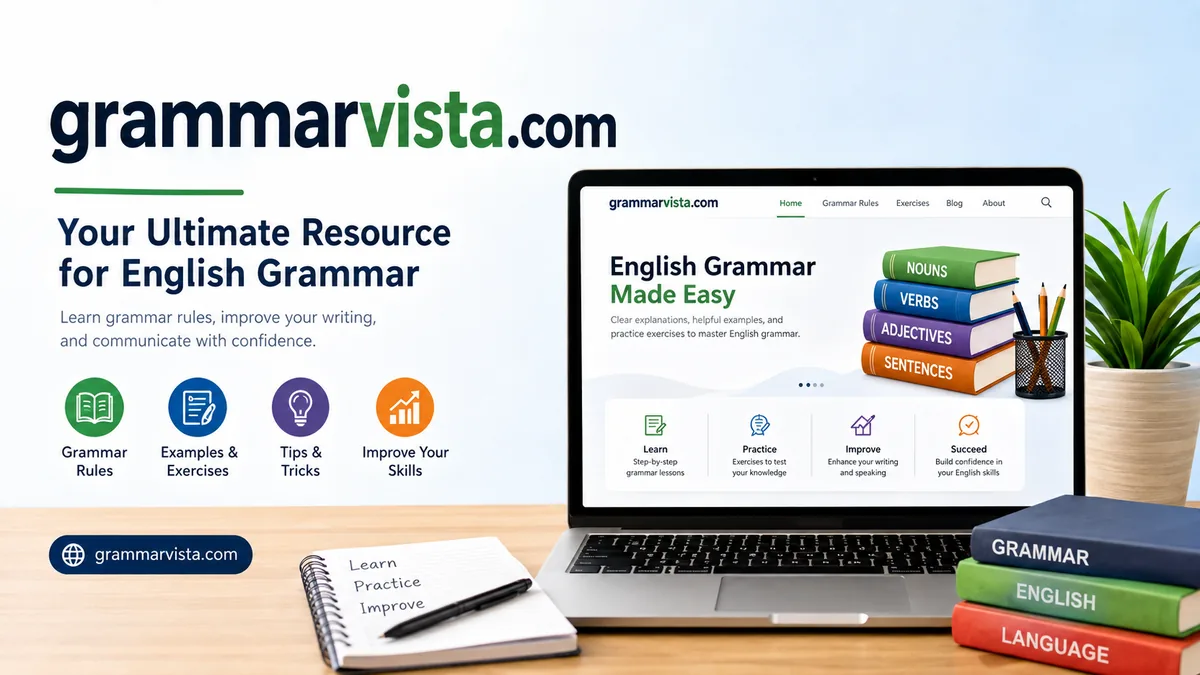
grammarvista.com is an English-language learning and writing resource built around that idea. Its current platform combines grammar checking, spelling support, vocabulary learning, writing guidance, practice exercises, and explanations designed to show the reasoning behind corrections rather than simply replacing incorrect text.
Quick answer: grammarvista.com is a free English grammar and writing resource that provides browser-based grammar and spelling checks alongside lessons, vocabulary help, writing tips, and practice exercises. The site emphasizes explanations behind corrections and states that text entered into its main checker is processed locally in the user’s browser rather than uploaded to its servers.
That combination makes the website relevant to students, English learners, professionals, writers, and anyone who occasionally stops mid-sentence wondering whether something sounds right.
What Is grammarvista.com?
grammarvista.com presents itself as an independent English-learning website focused on three closely connected skills: grammar, vocabulary, and writing.
Its basic philosophy is straightforward: correcting today’s sentence is useful, but understanding the underlying rule is more valuable. The site’s About page explains that corrections are intended to show what was written, what should replace it, possible alternatives, and the reason for the change in plain language.
The platform currently includes several types of resources:
- Grammar checking
- Spelling checking
- Clarity and word-choice suggestions
- Word counting
- Reading-time estimates
- Vocabulary resources
- English grammar lessons
- Commonly confused words
- Writing guidance
- Practice questions and exercises
- Explanations of common English mistakes
The audience is broad because grammar problems rarely belong to only one group. A student may need help with an essay, an employee may be polishing an email, while an English learner may simply be trying to understand why she goes is correct but she go is not.
grammarvista.com is more than an error detector
There is an important difference between correcting text and teaching language.
A traditional spell checker might identify a misspelled word and provide a replacement. Once you accept the suggestion, the immediate problem disappears.
Learning requires another step: understanding the pattern.
grammarvista.com attempts to connect these two processes. The correction solves the immediate problem, while its explanation is intended to help users recognize similar mistakes later.
That distinction is particularly useful for people learning English because repeated corrections without explanations can create dependence on software.
How the grammarvista.com Grammar Checker Works
The grammar checker is one of the site’s most practical features.
According to its current tools information, users can paste or type text into the checker and analyze several aspects of their writing. The website says its grammar system checks 134 grammar and usage rules, while spelling is compared against an English dictionary containing more than 276,000 words.
The process is simple:
- Enter or paste your writing.
- Run the appropriate check.
- Review detected problems.
- Examine the suggested correction.
- Read the explanation behind it.
- Compare alternatives where available.
- Apply the rule to your own sentence.
This final step matters.
Blindly clicking “accept” may produce cleaner text, but manually understanding and applying the correction builds actual language knowledge.
What does the checker look for?
The tools page describes coverage that includes areas such as:
| Writing Area | What It Can Help Identify |
|---|---|
| Grammar | Agreement, verb forms, articles and prepositions |
| Spelling | Potential misspellings |
| Word choice | Confusing or weak wording |
| Clarity | Wordy phrases and awkward constructions |
| Vocabulary | Meanings and alternative words |
| Length | Words, characters and sentences |
| Readability | General ease of reading |
| Reading time | Estimated time needed to read the text |
One useful example is subject-verb agreement.
Consider:
Incorrect: She go to school every day.
Correct: She goes to school every day.
Knowing that goes is correct solves the sentence. Understanding that a third-person singular subject in the simple present normally requires the corresponding verb form helps solve many future sentences.
That is the learning principle behind the platform.
What English Grammar Can You Learn on grammarvista.com?
Grammar can feel enormous when approached as hundreds of unrelated rules.
A more manageable way to understand it is to recognize the basic systems underneath those rules.
The site’s grammar material introduces grammar through areas such as word classes, word forms, and word order. It also covers the eight traditional parts of speech: nouns, pronouns, verbs, adjectives, adverbs, prepositions, conjunctions, and interjections.
Parts of speech
Parts of speech describe the jobs words perform.
Take this sentence:
The cheerful student answered quickly.
Here:
- student is a noun.
- cheerful is an adjective.
- answered is a verb.
- quickly is an adverb.
You do not necessarily need to name every grammatical component while writing. Still, knowing basic terminology makes explanations much easier to understand.
If a guide says that an adjective modifies a noun, for example, that advice is not useful until you can recognize both.
Subject-verb agreement
Agreement errors are extremely common because another noun can appear between the subject and verb.
Consider:
The box of old photographs is upstairs.
Some writers may instinctively choose are because photographs is plural.
But the grammatical subject is box, which is singular.
Learning to identify the true subject is more reliable than deciding which verb “sounds right.”
Verb forms and tenses
English verbs communicate both action and time.
Compare:
- I work.
- I worked.
- I am working.
- I have worked.
- I will work.
Small changes create different meanings.
Grammar resources are especially useful when the difference between two constructions seems subtle. Rather than memorizing a corrected sentence, identify what the verb form communicates about time, completion, or continuity.
Articles and prepositions
Words such as a, an, the, in, on, at, for, and to look simple but create persistent problems for English learners.
Some choices follow clear grammatical patterns. Others depend heavily on conventional usage.
That is where examples become valuable. Seeing a rule operating across several sentences usually teaches more than reading its definition once.
Vocabulary Learning on grammarvista.com
Correct grammar alone does not guarantee effective writing.
Vocabulary determines how precisely you can express an idea.
grammarvista.com therefore places vocabulary alongside grammar rather than treating it as an unrelated subject. Its resources are designed around meanings, synonyms, usage, and commonly confused words.
Meaning is only the beginning
Two words can have similar dictionary definitions without being interchangeable in every sentence.
Consider the difference between:
slim and skinny
Both can describe someone who is thin, but their connotations may differ depending on context and speaker.
Good vocabulary learning therefore involves several questions:
- What does the word mean?
- What part of speech is it?
- What words commonly appear around it?
- Is it formal or informal?
- Does it carry a positive or negative association?
- Does it sound natural in this particular sentence?
This is why vocabulary improvement cannot be reduced to memorizing long lists of synonyms.
Commonly confused words
Some of the most frustrating English mistakes involve words that sound alike or look similar.
Examples include:
- your / you’re
- their / there / they’re
- affect / effect
- accept / except
- then / than
- its / it’s
These errors may survive basic proofreading because both options are legitimate English words.
The solution is to understand the grammatical role and meaning of each form.
For example:
Your indicates possession.
Your phone is ringing.
You’re is a contraction of you are.
You’re going to enjoy this.
A useful test is to replace you’re with you are. If the sentence still makes sense, the contraction can work.
grammarvista.com Writing Tools Explained
One of the more useful aspects of grammarvista.com is that it separates different writing problems instead of treating “good writing” as one single measurement.
Its tools page currently describes four core checks: grammar, spelling, clarity/word choice, and word counting.
Grammar checker
The grammar checker looks for mechanical language problems covered by its rules.
This can provide a useful proofreading pass, especially when you already know what you want to say but are uncertain about the construction.
Spelling checker
Spelling mistakes are easy to overlook when proofreading your own work.
Your brain knows what you intended to type and sometimes reads the intended word instead of the characters actually on the screen.
A spelling check adds another layer of review.
Clarity and word choice
Grammatically correct writing can still be difficult to read.
Consider:
Due to the fact that we experienced an unexpected delay, the meeting will commence at a later point in time.
Nothing catastrophic has happened grammatically, but the sentence is unnecessarily heavy.
A clearer version is:
Because of an unexpected delay, the meeting will start later.
Clarity editing looks beyond correctness and asks whether the reader can understand the message efficiently.
Word counter and reading information
Word counts matter in essays, applications, reports, articles, assignments, and other formats with length requirements.
GrammarVista’s tool also reports characters, sentences, and estimated reading time while text is entered.
These measurements do not tell you whether the writing is good, but they provide useful context during editing.
Can grammarvista.com Help You Write More Clearly?
Yes, but a grammar checker should be only one part of the editing process.
The site’s writing guidance makes a useful distinction between correct writing and clear writing. Its clear-writing guide recommends habits such as leading with the main idea, removing unnecessary words, using active constructions when appropriate, turning heavy noun phrases back into verbs, splitting overloaded sentences, and reading work aloud.
Put the main idea early
Readers should not have to excavate the purpose of a sentence.
Instead of:
After extensive discussion and consideration of several possible alternatives, the team reached the decision to postpone the project.
Try:
The team decided to postpone the project.
The second version gives the reader the central information immediately.
Remove words that do no work
Common phrases often use several words where one will do.
For example:
| Wordy | Clearer |
|---|---|
| in order to | to |
| due to the fact that | because |
| at this point in time | now |
| has the ability to | can |
| make a decision | decide |
Concise writing is not about making everything short. It is about making every word earn its place.
Use active voice when it improves clarity
Passive voice is not grammatically wrong.
The bridge was completed in 1985 may be perfectly appropriate when the builder is irrelevant.
Problems appear when passive construction hides useful information.
The document was deleted.
Who deleted it?
If responsibility matters, naming the person creates a more informative sentence.
Read difficult sentences aloud
This simple proofreading method remains remarkably effective.
Your eyes can skim familiar text. Your voice cannot do that as easily.
If you repeatedly stumble over a sentence while reading aloud, its structure may need work.
English Grammar Practice on grammarvista.com
Reading explanations helps, but practice is where rules become familiar.
grammarvista.com currently provides interactive grammar practice questions covering recurring problems. The exercise format asks users to choose an answer and then explains why the answer is correct. The site states that practice progress is saved locally in the browser and does not require an account.
That explanation-first feedback is valuable.
Suppose you see:
There ___ three reasons for the delay.
Options:
is / are
The correct answer is are because the noun phrase three reasons is plural.
Getting the question right is useful. Being able to explain why are is required shows that you understand the pattern.
A better way to practice grammar
Do not try to fix twenty unrelated weaknesses at once.
A more effective routine is:
- Identify one mistake you make frequently.
- Learn the underlying rule.
- Study several correct and incorrect examples.
- Complete practice questions.
- Write your own examples.
- Look for the same pattern in your everyday writing.
- Repeat until the correct construction feels natural.
Then move to the next recurring problem.
Quick Takeaway: Grammar improves fastest when correction, explanation, practice, and real writing happen together. Finding your most frequent mistake and eliminating it permanently is usually more productive than trying to memorize an entire grammar book.
Is grammarvista.com Free?
According to the site’s current first-party information, its main English-learning tools are free and do not require an account or paid subscription.
The About page states that there is no account, email requirement, or paid tier for its grammar resources.
That reduces friction for someone who wants to check a sentence quickly.
There is also an educational advantage: you can move between checking a sentence, reading an explanation, and practicing grammar without creating a separate learning profile.
Features and policies on websites can change, of course, so current first-party pages should be checked whenever payment, registration, or privacy is particularly important.
Does grammarvista.com Store the Text You Check?
Privacy deserves attention whenever you paste writing into an online tool.
grammarvista.com states that its primary grammar and spelling checking happens inside the user’s browser and that the text being checked is not uploaded, stored, or logged on its server. Its privacy policy similarly says that accounts, names, email addresses, passwords, and payment information are not collected through the checker.
The site identifies one relevant distinction for its word-exploration functionality: looking up a definition may send the individual lookup word to an external dictionary service, rather than sending the complete text being checked.
Its privacy policy also notes that external resources such as Google Fonts can involve ordinary network requests containing information such as an IP address and browser details.
That distinction matters because “browser-based” does not necessarily mean a webpage makes absolutely no external requests. The relevant privacy question is what happens specifically to the writing entered into the checking interface.
For confidential legal, financial, medical, corporate, or personally identifiable information, users should still follow their organization’s data-handling rules before placing text into any third-party webpage.
Does grammarvista.com Use American or British English?
English does not have one universal spelling convention.
American and British English differ in spelling, vocabulary, punctuation conventions, and sometimes grammar.
grammarvista.com states that its checker uses American English by default while its educational approach acknowledges differences between American and British usage.
Common spelling differences include:
| American English | British English |
|---|---|
| color | colour |
| favor | favour |
| honor | honour |
| center | centre |
| defense | defence |
Neither variety is inherently better.
Consistency is what usually matters.
A US university may expect American conventions, while a UK organization may follow British spelling. Publishers, schools, and employers can also have their own style requirements.
When preparing formal work, follow the variety and style guide required by the intended reader.
Who Is Behind grammarvista.com?
Transparency becomes increasingly important when a website teaches language rules.
The site’s current About information identifies Rizwan Aslam as its editor and says he writes and reviews lessons, develops English-learning tools, and works on grammar rules, examples, and practice questions.
The website’s editorial information also states that rules are checked against established English usage and that examples are written specifically for the site rather than copied from reference books. Where American and British usage differs, the site’s stated policy is to identify those differences instead of automatically presenting one variety as universally correct.
That last point is significant because English is full of situations where context matters.
Not every disagreement is a grammatical error.
Sometimes the issue is style.
Grammar Rules vs. Writing Style: Know the Difference
One of the most useful skills a writer can develop is recognizing the difference between incorrect grammar and editorial preference.
Consider the Oxford comma.
Some style guides favor:
We bought bread, cheese, and milk.
Others permit:
We bought bread, cheese and milk.
The disagreement does not mean one writer has failed to understand English.
The choice can depend on the style system being followed.
Similar differences arise with:
- Capitalization
- Hyphenation
- Number formatting
- Quotation marks
- Date formats
- Possessive forms
- Abbreviations
- American versus British spelling
This is why automated corrections should not be accepted blindly.
Ask a simple question:
Is this actually grammatically wrong, or is the tool recommending a particular style?
That habit prevents unnecessary corrections.
How Reliable Is grammarvista.com?
No grammar checker catches every possible writing problem.
grammarvista.com itself acknowledges this limitation, stating that its checker will not detect every possible mistake and that receiving a clean result does not guarantee a passage is completely correct.
That is a realistic limitation shared by automated language tools generally.
Language depends heavily on context.
Consider:
The teacher told the student that she needed more time.
The grammar is fine.
But who needed more time—the teacher or the student?
A mechanical checker may not be able to resolve the writer’s intended meaning.
Another sentence can be grammatically correct but stylistically poor:
The implementation of the evaluation of the proposal was undertaken by the committee.
The problem is not necessarily grammar. It is readability.
This is why human review remains valuable.
When should you verify an answer elsewhere?
Cross-check a language recommendation when:
- Your grade depends on it.
- A publisher requires a particular style manual.
- Different sources give conflicting answers.
- The rule has important exceptions.
- Regional English conventions differ.
- The sentence has several possible meanings.
- You are editing high-stakes professional material.
A grammar website, dictionary, writing center, and style guide perform different jobs.
They work best together rather than as substitutes for one another.
grammarvista.com vs. Dictionaries and Style Guides
These resources can appear interchangeable when all you need is a quick answer, but their purposes differ.
| Resource | Main Purpose |
|---|---|
| Grammar learning site | Explain language rules and examples |
| Grammar checker | Detect potential errors in text |
| Dictionary | Define words and document accepted usage |
| Thesaurus | Suggest related words and alternatives |
| Style guide | Establish editorial conventions |
| Human editor | Evaluate meaning, structure, tone and context |
A dictionary is usually the better source for checking an established spelling or meaning.
A style guide is more useful when you need to know how a publication wants numbers, titles, citations, punctuation, or capitalization handled.
A grammar-learning platform becomes valuable when the real question is:
Why is this construction correct?
Understanding which resource answers which question saves time.
Common Mistakes When Using Online Grammar Checkers
Writing software becomes less useful when people outsource every language decision to it.
Several habits are worth avoiding.
Accepting every suggestion automatically
Software can misunderstand context.
Read the original sentence and the proposed revision before changing anything.
Ask whether the correction preserves your intended meaning.
Correcting without learning
If the same error appears repeatedly, accepting the same correction repeatedly is inefficient.
Stop and learn the rule.
One five-minute explanation may eliminate a mistake you have been making for years.
Assuming correct grammar means good writing
A technically correct paragraph can still be boring, confusing, repetitive, vague, or badly organized.
Grammar is one layer of editing.
Meaning comes first.
Using complicated words unnecessarily
A larger vocabulary should make your writing more precise, not more difficult.
If use communicates the idea perfectly, replacing it with utilize rarely makes the sentence more intelligent.
Choose the most accurate natural word.
Ignoring the intended audience
A sentence appropriate for an academic essay may sound ridiculous in a message to a friend.
Good writing changes with purpose, reader, and context.
How to Use grammarvista.com Effectively
The best workflow combines the site’s checking and educational functions rather than treating them separately.
1. Write naturally first
Get your meaning onto the page.
Trying to perfect every sentence while drafting can interrupt your thinking.
2. Read the text yourself
Fix obvious errors before using any software.
You may catch missing words, repeated ideas, or factual problems that a grammar tool cannot recognize.
3. Run the relevant check
Use grammar, spelling, clarity, or word-choice checking according to the problem you are trying to solve.
4. Examine each correction
Do not focus only on the replacement.
Read the explanation and understand why the original construction was flagged.
5. Investigate repeated mistakes
If the same error keeps appearing, turn it into a learning target.
Find the relevant grammar lesson and study several examples.
6. Revise for clarity
Once the mechanical mistakes are gone, examine the writing as communication.
Can anything be shorter?
Is the main point obvious?
Does each paragraph have a purpose?
7. Read the final version aloud
Listen for awkward rhythm, repetition, unnecessarily long sentences, and places where the meaning becomes difficult to follow.
8. Cross-check important language decisions
For academic, professional, or published writing, verify disputed or highly specific conventions against the dictionary or style guide appropriate to your situation.
Quick Takeaway: Do not use grammarvista.com simply to produce a “clean” result. Use corrections to identify recurring weaknesses, learn the rule behind each one, and then apply that knowledge without assistance the next time.
Can grammarvista.com Actually Improve Your English?
It can contribute to improvement, but the website cannot replace practice.
No grammar checker can.
Language develops through a cycle:
write → make mistakes → identify them → understand them → practice → write again
Tools become educational when they strengthen that cycle instead of replacing it.
For an English learner, this might mean keeping a small list of recurring mistakes.
Perhaps you repeatedly confuse your and you’re. Fix that first.
Then maybe articles—a, an, and the—cause trouble. Work on those next.
Later, move to prepositions, tense consistency, punctuation, sentence structure, and more subtle questions of vocabulary and style.
Progress becomes easier to see when you eliminate specific weaknesses one by one.
The Role of Grammar Tools in AI-Assisted Writing
Writing has changed rapidly with the growth of generative AI, automated editors, predictive keyboards, spell checkers, and browser-based writing assistants.
Yet knowing grammar still matters.
Software can produce a polished-looking sentence that is inaccurate, ambiguous, too formal, or simply inappropriate for the situation.
Someone who understands language can evaluate the output.
Someone who depends completely on software has fewer ways to recognize when the software is wrong.
That gives explanatory resources a continuing role.
The most useful question is no longer simply:
Can a tool correct this sentence?
It is:
Can I understand why the correction makes the sentence better?
That difference separates editing assistance from language learning.
Final Thoughts on grammarvista.com
grammarvista.com is best approached as a combination of an English grammar checker and a learning resource. Its current offering brings together grammar and spelling checks, clarity support, vocabulary resources, word counting, lessons, writing guidance, and interactive practice, with an emphasis on explaining the reasoning behind corrections.
Its browser-based approach to checking text and lack of a required account are notable features, while its educational material can help users move beyond simply accepting automated fixes. At the same time, the site’s own disclosures correctly recognize that no checker can catch every mistake or replace human judgment.
The most productive way to use grammarvista.com is therefore simple: check the sentence, study the explanation, understand the rule, and apply it yourself next time.
That approach does more than improve one document. It gradually builds the grammar awareness, vocabulary, sentence structure, and editing judgment needed to write clearer English without depending on a checker for every decision.
