

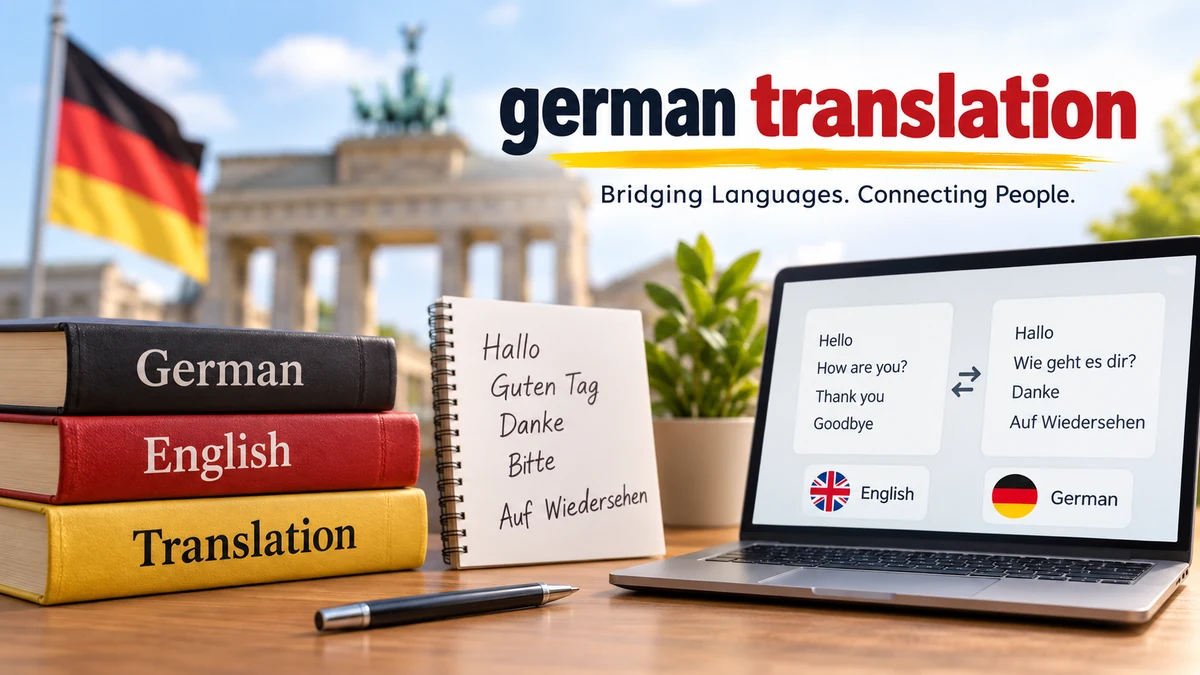
A sentence can be grammatically correct and still sound completely wrong in German. That is the central challenge of german translation: good translation is not about replacing English words with German equivalents one by one. It is about preserving meaning, tone, context, grammar, and the way German speakers naturally express an idea.
German translation converts meaning between German and another language while adapting grammar, vocabulary, word order, register, and cultural context. For English–German translation, accuracy depends especially on grammatical gender, four cases, verb placement, compound nouns, formal versus informal address, idioms, and choosing words according to context rather than literal dictionary equivalents.
This guide explains how English-to-German and German-to-English translation works, why German presents particular difficulties, how online translators and dictionaries should be used, and how to check whether a translation actually sounds natural.
What Does german translation Mean?
The German noun for “translation” is Übersetzung, while the verb “to translate” is übersetzen. A person who translates written material is an Übersetzer or Übersetzerin.
In practical terms, translation has two directions:
- English to German: translating English source material into German.
- German to English: translating German source material into English.
These directions may involve exactly the same languages, but they are not identical tasks. A translator must produce natural language for the target reader rather than simply decode the source.
Consider:
English: I am cold.
A literal word-for-word approach could tempt a learner toward:
Ich bin kalt.
But the natural expression for feeling cold is:
Mir ist kalt.
The literal version can suggest that the person themselves is cold rather than expressing the ordinary physical sensation intended by the English sentence.
This small example illustrates a much larger principle: translate the message, not the individual words.
Translation, interpreting, and localization are different
These terms are sometimes treated as interchangeable, but they describe different activities.
| Term | Main purpose | Example |
|---|---|---|
| Translation | Written language | Translating an article |
| Interpreting | Spoken or signed communication | Interpreting a meeting |
| Localization | Adapting content for a particular market | Adapting a website for Germany |
| Transcreation | Recreating persuasive meaning and effect | Advertising slogans |
| Certified translation | Translation prepared in a form required for official use | Certificates or legal documents |
Localization may require changes beyond language, including date formats, currencies, terminology, measurements, interfaces, and market conventions.
Why English-to-German Translation Is More Complicated Than Word Replacement
English and German are related Germanic languages, so learners quickly notice similarities. Words such as Haus/house, Name/name, and Hand/hand make parts of German vocabulary feel familiar.
The similarities can also create false confidence.
German grammar communicates information through articles, cases, gender, endings, and sentence structure that English often communicates differently.
German has three grammatical genders
German nouns belong to one of three grammatical genders:
- der — masculine
- die — feminine
- das — neuter
For example:
- der Tisch — the table
- die Zeitung — the newspaper
- das Buch — the book
The English article “the” therefore cannot simply be translated as one fixed German word.
The correct article depends not only on gender but also on number and grammatical case.
That makes it useful to learn a noun together with its article. Instead of memorizing Buch, learn das Buch.
German uses four grammatical cases
German has four cases: Nominativ, Genitiv, Dativ, and Akkusativ. Duden identifies these as the four cases used in German.
They help indicate the grammatical function of words.
| Case | Typical role | Example question |
|---|---|---|
| Nominative | Subject | Who or what? |
| Accusative | Direct object | Whom or what? |
| Dative | Indirect object and certain prepositional relationships | To/for whom? |
| Genitive | Possession or relationship | Whose? |
Compare:
Der Mann sieht den Hund.
The man sees the dog.
Der Hund sieht den Mann.
The dog sees the man.
English relies heavily on word order. German also uses word order, but the changing articles provide additional grammatical information.
A translation system must therefore determine what each noun is doing in the sentence before choosing the correct article and ending.
German Word Order Can Change the Entire Sentence
One of the most noticeable differences between English and German is verb placement.
A straightforward English sentence might be:
I am learning German today.
German:
Ich lerne heute Deutsch.
But German sentence structure changes when subordinate clauses, modal verbs, separable verbs, or compound verb forms appear.
Main clauses generally put the finite verb second
Consider:
Heute lerne ich Deutsch.
The sentence starts with Heute, yet lerne remains in the second structural position.
A common beginner error is to copy English structure:
Heute ich lerne Deutsch.
That is not standard German word order.
Subordinate clauses often send the finite verb to the end
English:
I know that he is learning German.
German:
Ich weiß, dass er Deutsch lernt.
The verb lernt moves toward the end of the subordinate clause introduced by dass.
Longer sentences make this distinction increasingly important. A translation can contain perfectly valid vocabulary and still feel incorrect because its syntax follows English rather than German.
Separable verbs create another challenge
German contains many verbs with separable prefixes.
For example:
anrufen — to call
Ich rufe dich morgen an.
I will call you tomorrow.
The prefix an- separates from rufe in this main clause.
Translation software and learners must recognize anrufen as a single lexical unit even though its components appear in different positions.
Literal German Translation vs Natural German
Literal translation can be useful for understanding how a sentence is constructed, but it should not automatically become the final translation.
Suppose someone says:
It’s not my cup of tea.
The sentence normally means that something does not suit someone’s taste or interests. Translating each word literally would preserve the tea but potentially lose the intended meaning.
This is why context matters.
Reverso, for example, emphasizes contextual translations and real-life examples, while Cambridge’s translator connects translations with dictionary entries. Langenscheidt’s English–German dictionary also includes British and American English as well as Austrian and Swiss German vocabulary.
One English word may have several German translations
Take the word run.
It could refer to:
- a person running
- operating a business
- running software
- a machine operating
- water flowing
- a program executing
There is no reason to expect one German verb to cover every English meaning in precisely the same way.
The correct translation emerges from the sentence.
This is one reason dictionary lookup should be treated as the beginning of translation rather than the end.
English to German Translation: A Reliable Step-by-Step Method
For short everyday material, a structured process can dramatically improve accuracy.
1. Understand the complete English sentence
Do not translate immediately.
First determine:
- Who is doing the action?
- What is happening?
- When does it happen?
- Is the sentence literal or idiomatic?
- Is the tone formal, casual, technical, humorous, or persuasive?
- Could any important word have multiple meanings?
Ambiguous source text creates ambiguous translations.
2. Identify the intended German audience
German is not completely uniform across every German-speaking community.
Standard German provides a common written foundation, but vocabulary and usage can differ between Germany, Austria, Switzerland, and other German-speaking regions.
Langenscheidt explicitly includes Austrian and Swiss German terms alongside its broader German-English dictionary coverage.
Audience therefore matters.
A translation for customers in Switzerland may need different conventions from one intended specifically for Germany.
3. Choose vocabulary from context
Check ambiguous words in a reputable bilingual dictionary.
Do not stop at the first definition. Look at:
- grammatical information
- example sentences
- collocations
- register
- subject labels
- alternative meanings
- regional usage
Contextual examples are especially helpful when several translations appear plausible.
4. Rebuild the sentence using German grammar
Now think in German structure.
Check:
- noun gender
- case
- article
- adjective endings
- pronouns
- verb conjugation
- tense
- prepositions
- word order
- separable prefixes
This is the stage where word-for-word translation becomes an actual German sentence.
5. Read the German without looking at the English
This simple test catches a surprising number of problems.
Ask:
If I had never seen the English sentence, would this German make complete sense?
If the answer is no, the source language is probably influencing the translation too strongly.
6. Compare the meaning again
Finally, return to the source.
Check that you have not accidentally:
- removed information
- introduced new information
- changed certainty
- changed tense
- changed who performed an action
- altered positive or negative meaning
- changed formal language into casual language
A natural translation must also be faithful.
German to English Translation Requires Adaptation Too
German-to-English translation presents a different set of problems.
German can construct long sentences with nested clauses and substantial information before the reader reaches the main verb. English often reads more naturally when the same information is reorganized or divided into shorter units.
German compound nouns need interpretation
German is famous for compound nouns.
Instead of treating every compound as an intimidating new word, break it into meaningful components.
For example:
Krankenhaus
- krank — sick
- Haus — house
Natural English translation:
hospital
Not “sick house.”
The same principle applies to longer compounds. Determine the concept represented by the whole word before producing English.
Capital letters provide useful grammatical clues
German nouns are capitalized.
That can help readers identify grammatical structure, particularly in long sentences where a familiar-looking form could otherwise be misread.
Capitalization is therefore not cosmetic. It carries grammatical information and should be handled carefully when translating German.
Formal and Informal German: Sie or du?
English uses you across many social situations.
German makes an important distinction between informal and formal address.
du is the informal singular form.
Sie is the formal form and is capitalized when used as the formal pronoun.
Compare:
Wie heißt du?
What is your name? — informal
Wie heißen Sie?
What is your name? — formal
This distinction affects more than one pronoun. Verb forms and related pronouns must agree with the chosen register.
A translator therefore needs to understand the relationship between speakers.
A casual message between friends should not automatically sound like government correspondence. Likewise, formal communication should not accidentally become overly familiar.
Tone should be translated, not just information
Consider the difference among:
- a text message
- an academic paper
- a customer-support response
- a legal notice
- an advertisement
- instructions for machinery
All can contain the same basic information while requiring different vocabulary and sentence structures.
Accurate german translation preserves this register.
German Vocabulary, False Friends, and Context Traps
Because English and German share linguistic roots and have borrowed words from one another, some vocabulary looks reassuringly familiar.
Sometimes that helps.
Sometimes it causes mistakes.
False friends
A false friend is a word that resembles a word in another language but differs in meaning or usage.
A classic example is:
bekommen
It means to get/receive, not “to become.”
English:
I received a letter.
German:
Ich habe einen Brief bekommen.
Confusing familiar-looking words is particularly common among learners because the incorrect translation initially feels intuitive.
Prepositions rarely map perfectly
English prepositions such as in, on, at, for, and to should not be translated mechanically.
German prepositions can also determine grammatical case.
The appropriate choice depends on meaning and established usage, not merely on the corresponding English word.
Collocations matter
Languages have preferred combinations of words.
English speakers make a decision.
Another language might naturally express the same concept using a verb that corresponds more closely to meet, take, or do.
Good translation recognizes these conventional combinations instead of forcing the source-language collocation onto German.
How Accurate Are Online German Translators?
Modern translation technology is highly useful, particularly for comprehension and routine text.
But “accurate” has several meanings.
A machine-generated sentence may:
- communicate the basic meaning correctly
- use correct grammar
- still sound slightly unnatural
- misunderstand an ambiguous word
- choose the wrong register
- mishandle specialized terminology
That is why the purpose of the translation determines how much checking is necessary.
Online translators work well for many everyday tasks
Machine translation can be particularly useful for:
- understanding messages
- reading webpages
- getting the gist of an article
- checking simple sentences
- generating an initial draft
- exploring alternative wording
A dictionary can then clarify uncertain vocabulary.
Dictionaries solve a different problem
A bilingual dictionary is particularly useful when you need to understand why a word has been translated a particular way.
Collins, Cambridge, Langenscheidt, dict.cc, and Reverso provide different combinations of definitions, grammatical information, examples, pronunciations, contextual usage, and related expressions. Collins, for example, gives Übersetzung as the standard German equivalent of “translation.”
For language learning, this detail can be more useful than receiving a finished machine-translated sentence.
Context tools help with natural usage
Contextual examples can answer questions such as:
- Which preposition normally follows this verb?
- Does this expression sound formal?
- How is this phrase used inside a complete sentence?
- Which translation fits this particular meaning?
Reverso Context, for example, provides English–German translations alongside contextual examples drawn from bilingual data.
The examples still need judgment; frequency does not automatically guarantee suitability for every situation.
Machine Translation vs Human Translation
Neither method should be treated as universally superior. They solve different problems.
| Factor | Machine translation | Human translation |
|---|---|---|
| Speed | Very fast | Slower |
| Large volumes | Strong | Resource-intensive |
| Basic comprehension | Usually useful | Excellent but often unnecessary |
| Nuance | Variable | Usually stronger |
| Ambiguity | Can struggle | Can interpret context |
| Consistent terminology | Strong with proper setup | Strong with terminology management |
| Creative language | Variable | Usually better |
| Cultural adaptation | Limited/variable | Stronger |
| Legal or high-stakes material | Requires careful verification | Specialist review is preferable |
| Cost for casual use | Often free | Usually paid |
The practical choice depends on consequences.
If you are translating a restaurant menu for personal understanding, a machine translator may be entirely adequate.
If you are translating a contract, medical information, academic publication, certificate, or safety instructions, small linguistic errors can matter considerably more.
When Professional or Certified German Translation Matters
Not every document needs a professional translator.
High-stakes documents are different.
Examples include:
- birth certificates
- marriage certificates
- diplomas and academic records
- immigration documents
- contracts
- court documents
- medical records
- technical documentation
- research publications
Professional translation also involves processes beyond knowing two languages.
ISO 17100:2015, for example, specifies requirements concerning core processes, resources, and other aspects of translation-service delivery. ISO states that the standard is intended to help translation service providers demonstrate that their processes and resources can meet applicable specifications.
A critical distinction is that an accurate translation and an officially acceptable translation are not automatically the same thing.
An authority may require certification, a particular translator qualification, specific formatting, original signatures, or other formalities. Those requirements depend on the receiving organization and jurisdiction.
For official documents, always check the receiving authority’s current requirements before arranging the translation.
How to Check German Translation Accuracy
You do not need to be a professional linguist to perform a useful first-pass quality check.
Use this sequence.
Check meaning first
Ask whether the translation communicates the same:
- people
- actions
- objects
- dates
- quantities
- conditions
- degree of certainty
- positive or negative meaning
Numbers and negation deserve particular attention because tiny errors can radically alter meaning.
Check German grammar
Review:
- noun gender
- case
- article
- adjective ending
- verb agreement
- tense
- verb position
- pronouns
- prepositions
- capitalization
Do not evaluate vocabulary while ignoring sentence structure.
Check terminology consistency
If one technical concept appears ten times, it generally should not receive several unrelated German translations without a reason.
Terminology databases and translation memories are useful in larger projects because they help maintain consistent language across documents.
Professional translation workflows often rely on terminology management for precisely this reason.
Check naturalness
Read the final German independently.
A translation can be accurate at the sentence level but awkward as a complete document.
Look for:
- repetitive wording
- unusually long constructions
- English-style syntax
- inconsistent formal/informal address
- unnatural collocations
- excessive literalness
The final text should feel as though it was written for a German-speaking reader.
Common german translation Mistakes
Several mistakes repeatedly appear in English–German work.
Translating every word individually
This ignores syntax, idioms, collocations, and context.
Better approach: understand the entire phrase before choosing German wording.
Ignoring grammatical gender
Learning Tisch without der makes future sentence construction harder.
Better approach: memorize German nouns with their articles.
Using the wrong case
The dictionary form of a noun or article does not necessarily match its role in a sentence.
Better approach: identify subject, objects, and prepositional relationships before selecting endings.
Copying English word order
English syntax can produce understandable but unnatural or incorrect German.
Better approach: identify whether you are dealing with a main clause, subordinate clause, infinitive construction, modal verb, or separable verb.
Ignoring formality
Automatically translating every English “you” without deciding between du and Sie can create an inconsistent tone.
Better approach: establish the intended relationship and register first.
Trusting the first dictionary result
The first listed translation may represent a completely different sense of the word.
Better approach: read definitions and example sentences.
Assuming fluent-looking output must be correct
Machine translation can produce smooth sentences even after misunderstanding the source.
Better approach: compare meaning separately from grammatical fluency.
German Translation for Language Learners
Translation can be an excellent learning tool when it is used actively rather than as a shortcut.
German proficiency is commonly described using the Common European Framework of Reference for Languages (CEFR), which uses six levels from A1 through C2. The Goethe-Institut groups A1–A2 as basic-user levels, B levels as independent use, and C levels as proficient use.
At A1–A2
Focus on:
- common nouns with articles
- present-tense verbs
- everyday expressions
- basic sentence order
- accusative and dative patterns
- simple questions
- common prepositions
Translation should help expose sentence patterns rather than replace learning them.
At B1–B2
Start comparing alternative translations.
Ask:
- Why did the translator choose this verb?
- Could another expression sound more natural?
- Why is the verb at the end?
- Why does this adjective have this ending?
- Is the phrase formal or informal?
This turns translation into grammar and vocabulary analysis.
At C1–C2
The challenge shifts toward nuance.
Advanced learners need to recognize:
- idiomatic expressions
- connotations
- register
- rhetorical effect
- specialized vocabulary
- stylistic differences
- implied meaning
The Goethe-Institut describes C2 competence as including the ability to understand virtually everything read or heard and to distinguish fine shades of meaning in complex situations.
At that level, translation is increasingly about style and precision rather than basic decoding.
A Better Workflow for Using German Translation Tools
Instead of relying on a single translation result, combine different resources according to what each does well.
For a single unfamiliar word
Use a bilingual dictionary.
Check:
- definition
- gender
- plural
- pronunciation
- example sentences
- register
- alternative meanings
For an expression
Use a dictionary plus contextual examples.
Idioms and multi-word expressions often cannot be understood reliably from their individual components.
For a complete sentence
Use a translator for an initial interpretation, then verify uncertain words and grammar separately.
For a paragraph
Translate the complete passage so the system has context. Then review sentence relationships, pronouns, terminology, and tone.
For an important document
Treat automated translation as assistance rather than final authority.
If errors could create legal, medical, financial, academic, safety, or administrative consequences, use an appropriately qualified human translator or reviewer.
Quick takeaway: A translator gives you an answer; a dictionary helps you investigate that answer. Using both is often more useful than repeatedly translating the same sentence through different automated systems.
German Translation Examples
The following examples show why context and grammar matter.
| English | German |
|---|---|
| Good morning. | Guten Morgen. |
| Thank you very much. | Vielen Dank. |
| I speak German. | Ich spreche Deutsch. |
| Do you speak English? | Sprechen Sie Englisch? |
| Where is the train station? | Wo ist der Bahnhof? |
| I don’t understand. | Ich verstehe nicht. |
| Can you help me? | Können Sie mir helfen? |
| What does that mean? | Was bedeutet das? |
| I am learning German. | Ich lerne Deutsch. |
| See you tomorrow. | Bis morgen. |
Notice that these are not created by mechanically matching the same number of words on each side.
For example:
Can you help me?
Können Sie mir helfen?
The German sentence uses mir, a dative pronoun. Understanding that grammatical relationship is more useful than attempting to map mir onto a single English word.
How Do You Translate a German Word When It Has Several Meanings?
Never choose the translation from the word alone if context is available.
Use the surrounding sentence to determine:
- part of speech
- grammatical role
- subject area
- literal or figurative meaning
- register
- regional usage
Then compare dictionary examples.
Suppose a German word has translations associated with business, medicine, everyday conversation, and technology. The surrounding topic immediately eliminates several possibilities.
This context-first method is one of the simplest ways to improve translation accuracy.
Is Google-Style Machine Translation Enough for Learning German?
It can support learning, but copying translated output teaches very little.
A stronger exercise is:
- Translate the sentence yourself.
- Compare it with an automated translation.
- Check differences in a dictionary.
- Identify the grammar behind those differences.
- Rewrite the sentence from memory later.
This forces you to notice structure.
The goal is not to prove that your version or the machine version is always superior. It is to understand why German expresses the idea that way.
What Makes a German Translation High Quality?
A strong translation satisfies several requirements simultaneously.
It is accurate: the original meaning survives.
It is grammatical: German morphology and syntax work correctly.
It is natural: the text does not feel mechanically converted from English.
It is consistent: terminology, names, numbers, and stylistic choices remain stable.
It is appropriate: vocabulary and tone fit the audience.
And it is fit for purpose: a casual message, university application, marketing page, medical document, and legal contract do not require the same translation process.
That final point is often overlooked. There is no universally “best” translation detached from context. The best version is the one that accurately communicates the source message to its intended reader.
Final Thoughts on german translation
Accurate german translation begins with meaning, not vocabulary. English and German share many linguistic connections, but German grammatical gender, four cases, verb placement, compound words, formal and informal address, idioms, and contextual vocabulary make literal translation unreliable.
For everyday comprehension, modern translation tools can provide a useful starting point. Dictionaries and contextual examples help explain ambiguous vocabulary and natural usage. For language learning, examining why a translation works is far more valuable than simply copying it.
For important documents, specialist terminology, or situations where a mistake has real consequences, human review becomes much more valuable.
The most useful habit is simple: understand the source, translate the idea, rebuild it naturally in the target language, and then check both meaning and grammar. That process turns translation from word substitution into genuine communication.
