

If you have ever looked at a Satta Matka result chart, you may have noticed a single digit displayed alongside open, close, jodi, and panna numbers. That digit is often called the final ank, but its meaning can vary slightly between websites.
Understanding how this number is calculated makes historical Matka charts easier to interpret and helps distinguish mathematical results from unsupported predictions.
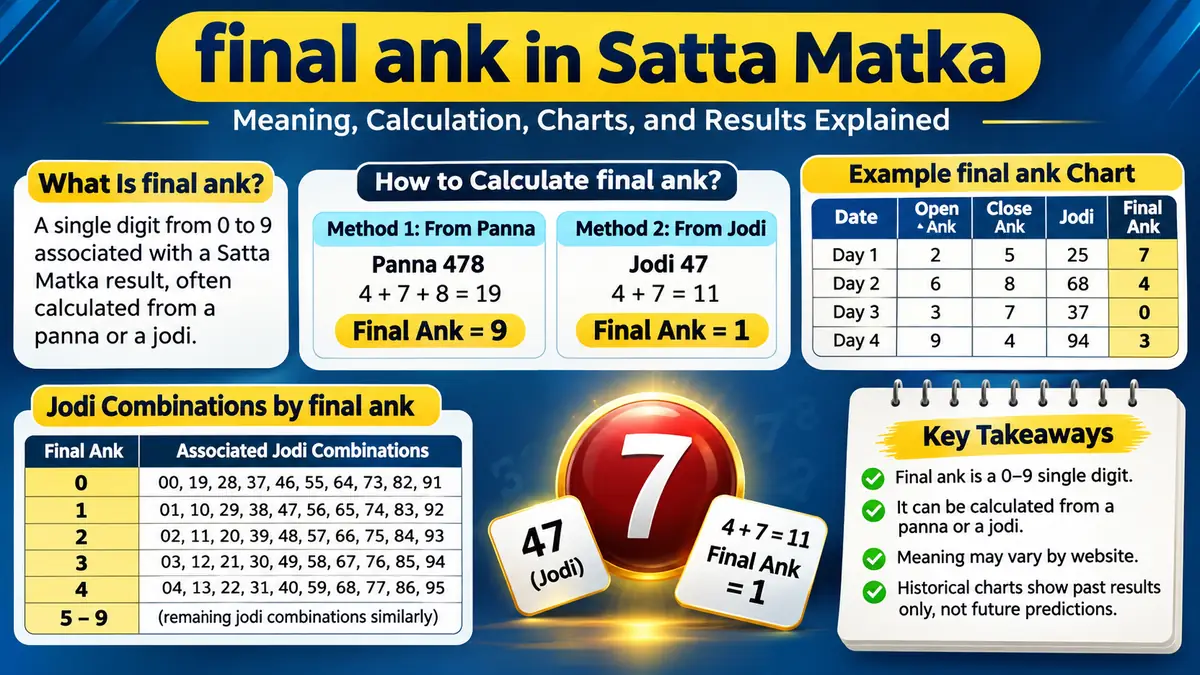
final ank is a single digit from 0 to 9 associated with a Satta Matka result. It may refer to the last digit of a three-number panna total or the last digit obtained by adding the open and close ank. Some platforms also call this combined value the jodi total. The exact meaning depends on the chart’s labeling. Satta Matka+2
What Is final ank in Satta Matka?
In Satta Matka terminology, ank means a single digit. The term final ank commonly describes a numerical value derived from a published result.
It is closely connected to several other terms:
- Open Ank: The single digit calculated from the opening panna.
- Close Ank: The single digit calculated from the closing panna.
- Jodi: A two-digit combination formed from the open and close ank.
- Panna or Patti: A three-digit number used in the result format.
- Final Ank: Depending on the website, either an individual panna’s resulting digit or the combined single-digit total of a jodi.
For example, consider a hypothetical jodi of 47. Adding its digits gives 4 + 7 = 11. Keeping the final digit produces 1.
Under the jodi-total definition, the final ank is therefore 1.
This distinction matters because some result pages use final ank to describe an open or close panna digit instead. Always check the chart’s explanation before interpreting the displayed value.
How Is final ank Calculated?
The calculation uses basic addition and the units digit of the resulting number.
Method 1: Calculating from a three-digit panna
A panna consists of three digits. Add them together and retain the last digit of the sum.
For example:
Example: Panna 478
\[ 4+7+8=19 \]
\[ 19\bmod 10=9 \]
Resulting Ank = 9
The same rule applies when the total is below 10. For panna 123, the sum is 6, so the ank is 6.
Importantly, this calculation retains the units digit rather than repeatedly adding digits until only one remains. For example, a sum of 19 gives 9, not 1.
Method 2: Calculating from a jodi
Some final ank charts define the result as the last digit of the sum of the two jodi digits.
The formula is:
\[ \text{Final Ank}=(a+b)\bmod 10 \]
Here, \(a\) represents the open ank and \(b\) represents the close ank.
| Jodi | Calculation | Final Ank |
|---|---|---|
| 12 | 1 + 2 = 3 | 3 |
| 29 | 2 + 9 = 11 | 1 |
| 47 | 4 + 7 = 11 | 1 |
| 55 | 5 + 5 = 10 | 0 |
| 68 | 6 + 8 = 14 | 4 |
| 88 | 8 + 8 = 16 | 6 |
| 99 | 9 + 9 = 18 | 8 |
These are mathematical examples, not actual market results or forecasts.
Interactive final ank calculator
Use this calculator to understand the jodi-total calculation.Open Ank (0–9)Close Ank (0–9)
Calculated final ank
1
4 + 7 = 11; units digit = 1
For educational arithmetic only. This does not calculate future results.
Understanding the final ank Chart
A final ank chart organizes previously published numerical results, often by date, market, and session.
Some charts display the open and close digits separately. Others show a single combined value derived from the jodi.
A typical historical record might contain the following information:
| Date | Open Ank | Close Ank | Jodi | Final Ank |
|---|---|---|---|---|
| Example Day 1 | 2 | 5 | 25 | 7 |
| Example Day 2 | 6 | 8 | 68 | 4 |
| Example Day 3 | 3 | 7 | 37 | 0 |
| Example Day 4 | 9 | 4 | 94 | 3 |
All entries above are fictional examples using the jodi-total definition.
How to read a final ank chart correctly
- Identify the market name, such as Kalyan, Main Bazar, or Milan Day.
- Check the date and session associated with the record.
- Locate the open ank and close ank, if available.
- Confirm whether final ank means a panna digit or the jodi total.
- Verify the displayed number using the relevant addition rule.
Historical charts may also include blank cells, pending results, or days when a market did not operate. A missing entry should not automatically be interpreted as zero. Satta Matka+1
Open Ank, Close Ank, Jodi, and final ank: Key Differences
These terms describe related but distinct parts of a result.
| Term | Format | Meaning |
|---|---|---|
| Open Panna | Three digits | Opening panel result |
| Open Ank | One digit | Units digit of open panna sum |
| Close Panna | Three digits | Closing panel result |
| Close Ank | One digit | Units digit of close panna sum |
| Jodi | Two digits | Open ank followed by close ank |
| Final Ank | One digit | Chart-dependent result, often the jodi total |
Consider the hypothetical full result:
458-74-239
The open panna is 458.
\[ 4+5+8=17\Rightarrow7 \]
The close panna is 239.
\[ 2+3+9=14\Rightarrow4 \]
The resulting jodi is 74.
Using the jodi-total convention:
\[ 7+4=11\Rightarrow1 \]
Therefore, the combined final ank is 1.
This example illustrates why the jodi and final ank are not interchangeable. The jodi retains both open and close digits, while the combined final ank reduces them to one digit.
final ank Chart for Digits 0 to 9
Under the jodi-total convention, every two-digit jodi from 00 to 99 belongs to one of ten final ank groups.
The following reference table shows how the combinations are organized.
| Final Ank | Associated Jodi Combinations |
|---|---|
| 0 | 00, 19, 28, 37, 46, 55, 64, 73, 82, 91 |
| 1 | 01, 10, 29, 38, 47, 56, 65, 74, 83, 92 |
| 2 | 02, 11, 20, 39, 48, 57, 66, 75, 84, 93 |
| 3 | 03, 12, 21, 30, 49, 58, 67, 76, 85, 94 |
| 4 | 04, 13, 22, 31, 40, 59, 68, 77, 86, 95 |
| 5 | 05, 14, 23, 32, 41, 50, 69, 78, 87, 96 |
| 6 | 06, 15, 24, 33, 42, 51, 60, 79, 88, 97 |
| 7 | 07, 16, 25, 34, 43, 52, 61, 70, 89, 98 |
| 8 | 08, 17, 26, 35, 44, 53, 62, 71, 80, 99 |
| 9 | 09, 18, 27, 36, 45, 54, 63, 72, 81, 90 |
Every group contains exactly ten combinations because each of the 100 possible jodis maps to one of ten units-digit totals. Satta Matka
This table is a mathematical classification. It does not indicate which combinations will appear in future results.
final ank Results Across Different Matka Markets
Historical Matka websites frequently organize records by market. The terminology may remain similar, but the market names, schedules, and chart formats can differ.
Kalyan final ank
Kalyan is a commonly referenced market in Matka result archives. Historical Kalyan charts may contain jodi records, panel numbers, and single-digit values.
When reviewing a Kalyan chart, confirm whether the final ank is calculated from an individual panna or the combined jodi.
Main Bazar final ank
Main Bazar records are often presented in daily or weekly tables. Some archives display complete results, while others emphasize individual digits.
The date and full result format are useful for verifying how a displayed value was obtained.
Milan Day and Milan Night
Milan Day and Milan Night are listed separately on many result platforms.
Because their records are organized under different session names, a number associated with one should not be assumed to represent the other.
Rajdhani and Time Bazar
Rajdhani and Time Bazar also appear in Matka chart archives, sometimes with additional session labels.
When comparing historical records, the market name and date are as important as the number itself. इंडियन मटका+1
Can Historical final ank Results Predict Future Numbers?
No. A historical final ank chart records previous outcomes; it does not establish what will happen in a future draw.
This is a crucial distinction between calculating a number from an existing result and attempting to predict an unknown result.
Why repeating numbers are not reliable predictions
Suppose a chart shows that the digit 4 appeared more frequently than other digits during a particular week.
That observation describes the recorded sample. It does not demonstrate that 4 is more likely to appear in the next independent draw.
Likewise, a digit that has been absent for several sessions is not necessarily due to appear.
This mistaken assumption is related to the gambler’s fallacy: the belief that past independent random outcomes must be balanced by future outcomes.
Historical frequency versus probability
If a system genuinely produces ten equally likely digits independently, each digit has a theoretical probability of:
\[ P(\text{specific digit})=\frac{1}{10}=10\% \]
However, the actual fairness and independence of a particular Matka market cannot be established simply by looking at its published chart.
A chart may show uneven frequencies because of ordinary variation, incomplete records, or differences in how results were generated.
Past frequency alone is not evidence of a dependable forecasting method.
What about fixed or guaranteed final ank numbers?
Claims involving a guaranteed final ank, fixed jodi, leaked result, or certain winning number should be treated skeptically.
No mathematical property of the jodi-total formula reveals a future draw.
A person claiming to possess guaranteed numbers may be exploiting readers who confuse historical calculations with predictions. Satta Matka+1
How to Verify Historical final ank Records
Verifying an old record is more useful than relying on an unexplained number shared through a message or social media post.
Start with the original chart and inspect the complete entry.
Check the date and market
A historical record should identify the relevant market and date.
Without those details, two identical digits may refer to entirely different sessions.
Recalculate the displayed result
If the full panna numbers are available, calculate their units-digit totals.
For example, consider:
250-78-468
Open panna:
\[ 2+5+0=7 \]
Close panna:
\[ 4+6+8=18\Rightarrow8 \]
Jodi: 78
Combined final ank:
\[ 7+8=15\Rightarrow5 \]
If a chart uses the jodi-total convention, the value should be 5.
If it displays 7 or 8 as the final ank, it may instead be referring to an individual open or close value. Read its definitions before concluding the record contains an error.
Compare multiple archives carefully
Different websites may copy information from the same original source. Agreement between several sites does not necessarily mean the underlying result was independently verified.
Look for consistent dates, market labels, complete panel values, and clearly explained calculation methods.
Understand the limits of historical charts
A result archive can help answer questions about recorded data, such as how often a particular digit appeared or whether two published entries match.
It cannot independently prove that a draw was fair, that a future result is predictable, or that a claimed winning system works.
Common Mistakes When Reading final ank Data
Several recurring misunderstandings can make these charts unnecessarily confusing.
Confusing final ank with jodi: A jodi contains two digits, while the combined final ank contains one.
Using the wrong calculation: A panna-derived ank and a jodi-total ank may produce different numbers. The chart’s definition determines which formula applies.
Ignoring leading zeros: Jodis such as 03 and 30 are different two-digit combinations, even though both produce a combined final ank of 3.
Treating blank results as zero: A blank entry may indicate a pending result or a day without a session.
Assuming historical patterns guarantee future outcomes: Frequency tables describe observations, not certainties.
Trusting unexplained predictions: Any claim about a guaranteed result requires evidence that ordinary historical charts cannot provide.
Avoiding these mistakes makes result records easier to understand without assigning them predictive powers they do not possess.
Why final ank Terminology Varies Between Websites
One reason this topic causes confusion is the lack of a single universally followed naming convention across Matka information websites.
Some platforms describe the units digit of a three-digit panna as the final ank. Others reserve that term for the combined jodi total.
Still others display a separate final ank column without clearly explaining how the number was produced.
For that reason, the most dependable approach is to identify the underlying calculation rather than rely exclusively on the heading.
The mathematical operations themselves are straightforward. It is the labeling that can differ.
A well-documented historical chart should explain its open, close, panna, jodi, and final ank fields so readers can verify the numbers independently.
Conclusion: Understanding final ank Correctly
The term final ank generally refers to a single digit associated with a Satta Matka result. Depending on the source, it may be calculated from a three-digit panna or from the sum of the two digits in a jodi.
The key is to understand which definition a chart uses, verify the arithmetic, and distinguish historical records from future predictions.
When reading final ank charts, focus on the market, date, result format, and calculation method. These details provide a clearer understanding of the recorded numbers without relying on unsupported claims about guaranteed outcomes.
Matka-related wagering may be restricted or illegal depending on local law. Historical numerical information should be treated as educational reference material, not as financial advice or a prediction system.
