

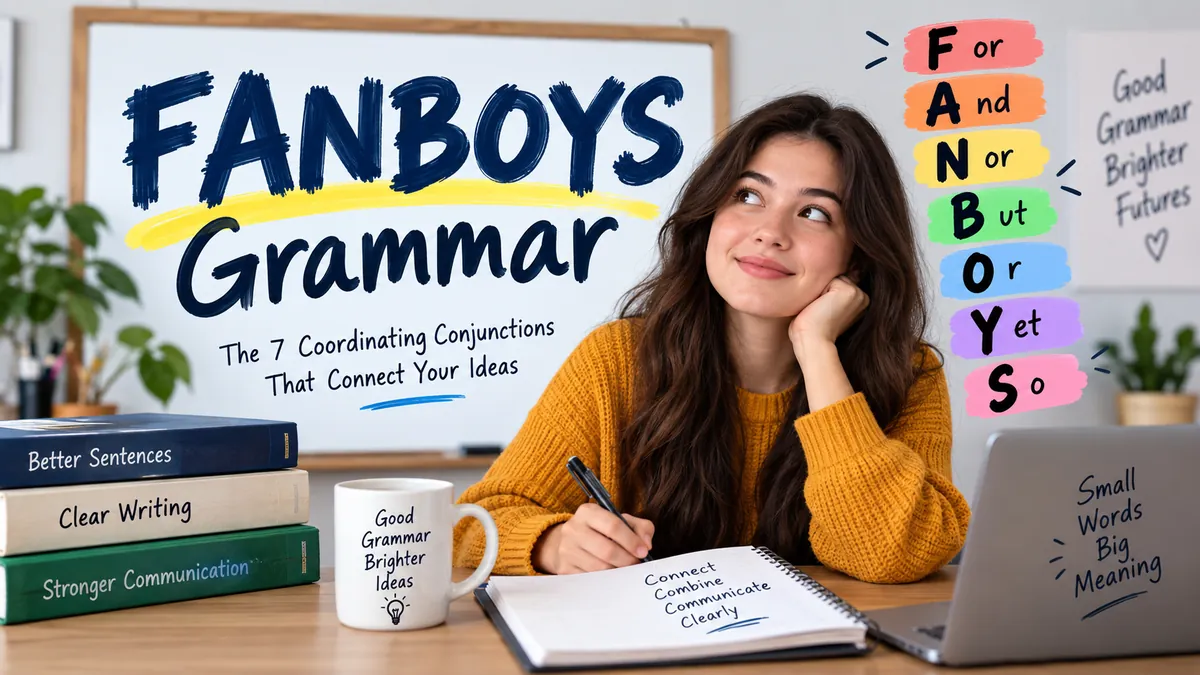
A tiny word can completely change the relationship between two ideas. That is exactly what fanboys grammar helps you understand: how words such as and, but, or, and so connect equal parts of an English sentence.
FANBOYS is a mnemonic for the seven coordinating conjunctions for, and, nor, but, or, yet, and so. These conjunctions connect grammatically equal words, phrases, or clauses. When a FANBOYS conjunction joins two independent clauses, a comma normally appears before it: I wanted to leave, but the meeting continued.
Once you understand that basic principle, FANBOYS becomes much easier than memorizing a collection of punctuation rules.
What Does FANBOYS Mean in Grammar?
In English grammar, FANBOYS is an acronym formed from the first letters of the seven coordinating conjunctions:
| Letter | Conjunction | Main Function | Simple Example |
|---|---|---|---|
| F | For | Gives a reason | We stayed inside, for it was raining. |
| A | And | Adds information | Maya cooked, and Ben cleaned. |
| N | Nor | Adds a negative idea | He didn’t call, nor did he text. |
| B | But | Shows contrast | I tried, but I failed. |
| O | Or | Presents a choice | We can drive, or we can walk. |
| Y | Yet | Shows unexpected contrast | She was tired, yet she continued. |
| S | So | Shows a result | It was late, so we left. |
The seven words are called coordinating conjunctions because they coordinate, or join, elements that have the same grammatical status. A conjunction can connect nouns with nouns, verbs with verbs, phrases with phrases, or independent clauses with independent clauses.
That idea of equal grammatical rank is central to understanding FANBOYS.
For example:
Tea and coffee
Here, and connects two nouns.
Slowly but carefully
Here, but connects two adverbs.
I wanted tea, but she ordered coffee.
Here, but connects two independent clauses.
What Is a Coordinating Conjunction?
A coordinating conjunction is a joining word that connects grammatical elements of equal or similar importance.
Compare:
Daniel bought apples and oranges.
The nouns apples and oranges perform the same grammatical function.
Now consider:
Daniel bought apples, and Maria bought oranges.
This time, and joins two complete thoughts:
- Daniel bought apples.
- Maria bought oranges.
Each could stand alone as a sentence, making each an independent clause.
Quick Takeaway: FANBOYS does more than connect sentences. Coordinating conjunctions can join individual words, phrases, verbs, and complete independent clauses.
The 7 FANBOYS Conjunctions and How to Use Them
Each FANBOYS conjunction expresses a particular relationship between ideas. Choosing the right one makes a sentence more precise.
F — For: Giving a Reason
For introduces an explanation or reason. In this role, it can have a meaning similar to because.
We decided to leave, for the weather was getting worse.
The second clause explains why the speakers decided to leave.
Another example:
Sarah took an umbrella, for dark clouds were gathering.
In everyday conversation, because is usually more natural:
Sarah took an umbrella because dark clouds were gathering.
Using for as a conjunction often sounds more formal or literary. That does not make it incorrect; it simply means that context and writing style matter.
A — And: Adding Information
And joins related or additional information.
It can connect individual words:
We bought bread and milk.
It can connect verbs:
She opened the book and started reading.
It can also connect independent clauses:
She opened the book, and I started taking notes.
And is one of the most flexible coordinating conjunctions in English. Official Canadian language guidance identifies and, but, and or as the three most commonly used coordinating conjunctions.
N — Nor: Adding Another Negative Idea
Nor connects one negative idea to another.
I don’t eat meat, nor do I eat fish.
Notice the word order after nor. English commonly uses subject-auxiliary inversion in this construction:
nor + auxiliary verb + subject
For example:
She wasn’t angry, nor was she disappointed.
He cannot swim, nor can he sail.
You may also see nor in the correlative pair neither…nor:
Neither Emma nor David attended.
However, neither…nor is a correlative conjunction pair, so it should not be confused with the FANBOYS use of nor by itself.
B — But: Showing Contrast
But connects contrasting ideas.
The room was small, but it was comfortable.
Both statements are true, but the second contrasts with what a reader might expect from the first.
But can also connect smaller grammatical elements:
small but comfortable
slowly but steadily
difficult but possible
A comma is not automatically required simply because but appears. The structure surrounding the conjunction determines the punctuation.
O — Or: Presenting Choices and Alternatives
Or introduces an alternative, possibility, or choice.
Would you like tea or coffee?
It can also connect complete clauses:
We can leave now, or we can wait until morning.
The second example contains two independent clauses:
- We can leave now.
- We can wait until morning.
That is why a comma appears before or.
Y — Yet: Expressing Unexpected Contrast
Yet functions similarly to but when used as a coordinating conjunction, although it can emphasize a stronger or more unexpected contrast.
The exam was difficult, yet everyone passed.
The result is somewhat surprising given the difficulty of the exam.
Another example:
He had very little experience, yet he performed confidently.
Compare:
The job was difficult, but she finished it.
The job was difficult, yet she finished it.
Both are grammatical. Yet places slightly more emphasis on the unexpected nature of the second idea.
S — So: Showing a Result
So connects a cause or situation with its consequence.
The road was flooded, so we turned around.
The first clause describes the situation. The second gives the result.
Another example:
I forgot to charge my phone, so the battery died.
A useful way to remember the relationship is:
cause → so → result
This distinguishes so from for:
We went home, for it was getting late.
It was getting late, so we went home.
The underlying ideas are similar, but the logical direction changes.
fanboys grammar and the Comma Rule
The most frequently tested fanboys grammar rule concerns commas.
The standard pattern is:
Independent clause + comma + FANBOYS + independent clause
For example:
The rain stopped, and we continued walking.
Ask yourself whether both sides could stand alone.
Clause 1: The rain stopped.
That is a complete sentence.
Clause 2: We continued walking.
That is also a complete sentence.
Because the conjunction joins two independent clauses, the comma belongs before and. University writing centers and grammar resources consistently teach this comma-plus-conjunction construction for joining independent clauses.
The Two-Sentence Test
When you are unsure about the comma, temporarily remove the conjunction and examine both sides.
Consider:
Maria finished the report, but she forgot to send it.
Test each side:
Maria finished the report.
She forgot to send it.
Both work as sentences.
Therefore:
Maria finished the report, but she forgot to send it.
Now consider:
Maria finished the report and sent it.
Test the second part:
Sent it.
That is not a complete sentence.
The subject Maria is shared by both verbs, so finished the report and sent it forms a compound predicate rather than two independent clauses.
No comma is normally needed.
When FANBOYS Does Not Need a Comma
A common mistake is assuming that every coordinating conjunction requires punctuation.
It does not.
When FANBOYS joins only two words, no comma is normally needed:
cats and dogs
black or white
tired but happy
When it joins two phrases, the same basic principle applies:
after lunch or before dinner
slowly but confidently
in the kitchen and beside the window
Likewise, a comma is usually unnecessary when two verbs share the same subject:
Leo opened the window and looked outside.
The sentence has one subject, Leo, followed by the compound predicate opened the window and looked outside. Grammar resources specifically distinguish this construction from two independent clauses.
Are There Exceptions to the FANBOYS Comma Rule?
You may encounter very short independent clauses joined without a comma:
I cooked and she cleaned.
Some style authorities allow the comma to be omitted when independent clauses are short, closely related, and unlikely to cause confusion. EnglishClub, for example, treats the comma as optional with short, well-balanced clauses.
For students and formal academic writing, however, the safest general rule is straightforward:
When FANBOYS joins two clear independent clauses, use a comma before the conjunction unless your required style guide gives you a reason not to.
FANBOYS and Compound Sentences
FANBOYS conjunctions are closely associated with compound sentences.
A compound sentence contains at least two independent clauses.
For example:
The library was closing, so we packed our books.
The structure is:
Independent clause: The library was closing
Coordinating conjunction: so
Independent clause: we packed our books
This is a compound sentence because both clauses can function independently.
Simple Sentence vs. Compound Sentence
Compare these two structures:
| Sentence | Structure | Type |
|---|---|---|
| Mia sang and danced. | One subject + two verbs | Simple sentence |
| Mia sang, and Noah danced. | Two independent clauses | Compound sentence |
| We ordered pizza or pasta. | Two objects | Simple sentence |
| We can order pizza, or we can cook pasta. | Two independent clauses | Compound sentence |
| He tried but failed. | One subject + compound predicate | Simple sentence |
| He tried, but he failed. | Two independent clauses | Compound sentence |
The presence of and, or, or but does not automatically create a compound sentence. You need independent clauses on both sides.
FANBOYS vs. a Comma Splice
Consider:
Incorrect: The movie ended, we went home.
Both sides are independent clauses, but a comma alone cannot normally join them. This error is called a comma splice. The Naval Postgraduate School Graduate Writing Center specifically distinguishes a correct FANBOYS construction from joining independent clauses with a comma alone.
One solution is to add a coordinating conjunction:
The movie ended, so we went home.
You could also create two sentences:
The movie ended. We went home.
Or use a semicolon when the relationship suits it:
The movie ended; we went home.
FANBOYS is therefore useful not only for creating variety but also for avoiding run-ons and comma splices.
Common fanboys grammar Mistakes
Understanding what FANBOYS stands for is easy. Applying the rules consistently is where writers tend to make mistakes.
Mistake 1: Forgetting the Comma Between Independent Clauses
Incorrect:
I wanted to attend the concert but I had to work.
Both parts are complete sentences:
I wanted to attend the concert.
I had to work.
Standard punctuation calls for:
I wanted to attend the concert, but I had to work.
Mistake 2: Adding an Unnecessary Comma
Incorrect:
We bought bread, and cheese.
The conjunction connects two nouns rather than independent clauses.
Better:
We bought bread and cheese.
The same problem occurs with compound predicates.
Incorrect:
Olivia finished her homework, and went to bed.
Better:
Olivia finished her homework and went to bed.
There is no new subject after and. Both verbs belong to Olivia.
Mistake 3: Using a Comma Without FANBOYS
Incorrect:
The restaurant was full, we ate somewhere else.
That creates a comma splice.
Correct:
The restaurant was full, so we ate somewhere else.
Mistake 4: Confusing “For” With Every Other Use of “For”
Not every occurrence of for is a coordinating conjunction.
Compare:
We left, for the storm was approaching.
Here, for introduces a clause giving the reason for leaving. It functions as a conjunction.
Now consider:
This gift is for Maria.
Here, for is a preposition.
The FANBOYS mnemonic identifies particular words, but their grammatical function still depends on how they are being used.
Mistake 5: Treating “Yet” Only as an Adverb
Yet has several grammatical uses.
In:
I haven’t finished yet.
Yet functions as an adverb.
But in:
The task was difficult, yet we completed it.
Yet is a coordinating conjunction connecting two contrasting independent clauses.
Context determines its role.
Mistake 6: Using “Nor” With Awkward Word Order
A frequent error looks like this:
She doesn’t drive, nor she owns a car.
Standard English normally requires inversion after nor in this construction:
She doesn’t drive, nor does she own a car.
This pattern is worth learning separately because nor behaves differently from the more familiar and, but, and or.
Can You Start a Sentence With FANBOYS?
Yes. A sentence can begin with a coordinating conjunction.
For example:
I knew the journey would be difficult. But I decided to go.
Or:
We could wait another hour. Or we could leave now.
You may have learned at school that starting a sentence with and or but is always incorrect. That is not an absolute rule of English grammar. Educational grammar resources acknowledge sentence-initial coordinating conjunctions, particularly when writers use them deliberately for emphasis, flow, or a natural voice.
However, frequency matters.
Starting every other sentence with And, But, or So can make formal prose feel choppy. In academic or professional writing, use sentence-initial conjunctions deliberately rather than automatically.
FANBOYS vs. Subordinating Conjunctions
Coordinating and subordinating conjunctions both connect ideas, but they create different grammatical relationships.
FANBOYS connects elements of equal grammatical rank.
I was tired, but I continued working.
Both clauses are independent.
A subordinating conjunction makes one clause dependent on another:
Although I was tired, I continued working.
Although I was tired cannot stand alone as a complete sentence in this construction. It is a dependent clause.
Compare:
| Coordinating | Subordinating |
|---|---|
| Connects grammatically equal elements | Creates a dependent relationship |
| Can join two independent clauses | Introduces a dependent/subordinate clause |
| for, and, nor, but, or, yet, so | because, although, while, if, since, when |
| I was tired, but I worked. | Although I was tired, I worked. |
This difference is useful when studying sentence structure, because coordination and subordination allow writers to express different relationships between ideas.
FANBOYS vs. Correlative Conjunctions
FANBOYS should also be distinguished from correlative conjunctions.
Correlative conjunctions work in pairs:
- either…or
- neither…nor
- both…and
- not only…but also
For example:
Either call me or send a message.
Neither Sam nor Alex was available.
Both the teacher and the students agreed.
Words such as and, or, and nor appear in both categories, but the structure is different. FANBOYS refers specifically to the seven coordinating conjunctions as individual coordinating words.
FANBOYS and Parallel Structure
One useful aspect of FANBOYS that basic explanations sometimes overlook is parallel structure.
Because coordinating conjunctions connect grammatically equal elements, the structures on either side should usually match logically and grammatically.
Awkward:
She enjoys reading novels and to write poetry.
The sentence coordinates a gerund phrase (reading novels) with an infinitive phrase (to write poetry).
More parallel:
She enjoys reading novels and writing poetry.
Or:
She likes to read novels and to write poetry.
Parallelism becomes especially important in lists.
Awkward:
The job requires patience, communicating clearly, and to solve problems.
Better:
The job requires patience, clear communication, and problem-solving skills.
FANBOYS does not merely glue ideas together. Good coordination signals that the connected elements belong at comparable grammatical and logical levels.
FANBOYS and the Oxford Comma
The Oxford comma, also called the serial comma, is related to and and or in lists but should not be confused with the independent-clause comma rule.
Consider:
We bought apples, oranges, and bananas.
The comma before and is a serial or Oxford comma.
Now compare:
We bought apples, and Sarah bought bananas.
Here, the comma exists because and joins two independent clauses.
These are two different punctuation principles.
Many styles use the Oxford comma consistently, while others omit it unless clarity requires it. Both forms can appear in accepted English:
red, white, and blue
red, white and blue
The key is to follow the style guide required by your school, publication, or organization and avoid ambiguity.
How to Identify FANBOYS in Any Sentence
Memorizing the acronym is only the first step. A reliable method is to analyze what the conjunction actually connects.
Step 1: Find the Conjunction
Look for:
for, and, nor, but, or, yet, so
Step 2: Identify What Appears on Each Side
Is the conjunction connecting:
- two words?
- two phrases?
- two verbs?
- two independent clauses?
Step 3: Test for Complete Sentences
If you suspect two clauses, ask whether each side contains a subject and predicate and expresses a complete thought.
Example:
The train arrived, but nobody got off.
Test:
The train arrived.
Complete.
Nobody got off.
Complete.
Therefore, but connects two independent clauses.
Step 4: Apply the Appropriate Punctuation
If two independent clauses are being joined, the standard construction is:
clause, FANBOYS clause
If the conjunction joins only two words, phrases, or parts of a compound predicate, normally skip the comma.
Step 5: Check the Logical Relationship
Finally, make sure you selected the right conjunction.
Ask:
- Reason? → for
- Addition? → and
- Additional negative? → nor
- Contrast? → but
- Alternative? → or
- Unexpected contrast? → yet
- Result? → so
This last check improves meaning as well as grammar.
Quick Takeaway: Don’t decide whether you need a comma by looking at the conjunction alone. Identify the grammatical structures that the conjunction connects.
FANBOYS Examples in Sentences
Seeing the seven conjunctions in similar structures makes their differences easier to remember.
Examples With “For”
I closed the window, for the room was becoming cold.
We hurried home, for a storm was approaching.
Examples With “And”
Liam prepared dinner, and Ava set the table.
The children laughed and played.
Examples With “Nor”
I haven’t visited Rome, nor have I been to Venice.
She didn’t complain, nor did she ask for help.
Examples With “But”
The instructions looked simple, but the task was difficult.
The apartment is small but comfortable.
Examples With “Or”
You can call me, or you can send an email.
Would you prefer coffee or tea?
Examples With “Yet”
The evidence was limited, yet the researchers continued.
The design is simple yet effective.
Examples With “So”
The shop was closed, so we returned tomorrow.
Traffic was heavy, so we took another route.
Notice how the punctuation changes according to sentence structure rather than according to the conjunction itself.
A Simple Way to Remember fanboys grammar
The acronym itself is the easiest memory device:
F — For
A — And
N — Nor
B — But
O — Or
Y — Yet
S — So
But memorizing seven words will not solve every punctuation question.
The more useful formula is:
Two complete sentences + FANBOYS = comma before FANBOYS
For example:
I studied all evening.
I still felt unprepared.
Both are independent clauses.
Connect them:
I studied all evening, yet I still felt unprepared.
Now compare:
I studied math and science.
Math and science are merely two objects, so there is no reason for a comma.
That distinction—independent clauses versus smaller sentence elements—solves most FANBOYS punctuation problems.
Why FANBOYS Matters in English Writing
FANBOYS may look like a basic classroom mnemonic, but the underlying concept affects writing at every level.
Coordinating conjunctions help writers show relationships between ideas:
- and builds on a thought;
- but and yet introduce contrast;
- or provides alternatives;
- for explains a reason;
- so introduces a consequence;
- nor extends a negative statement.
They also help control sentence rhythm. Instead of writing:
The deadline was approaching. We continued working.
You might emphasize cause and consequence:
The deadline was approaching, so we continued working.
Or contrast:
The deadline was approaching, yet we stopped working.
The facts may be similar, but the conjunction changes the relationship the reader perceives.
That is the real value of fanboys grammar. FANBOYS is not simply an acronym to memorize for a test. It is a practical framework for understanding coordinating conjunctions, independent clauses, compound sentences, comma usage, parallel structure, and the logical connections between ideas.
Remember the core rule: for, and, nor, but, or, yet, so coordinate equal grammatical elements. When they join two independent clauses, normally place a comma before the conjunction. When they simply connect two words, phrases, or verbs sharing a subject, a comma is usually unnecessary.
Master that distinction, and most FANBOYS questions become much easier to solve.
