

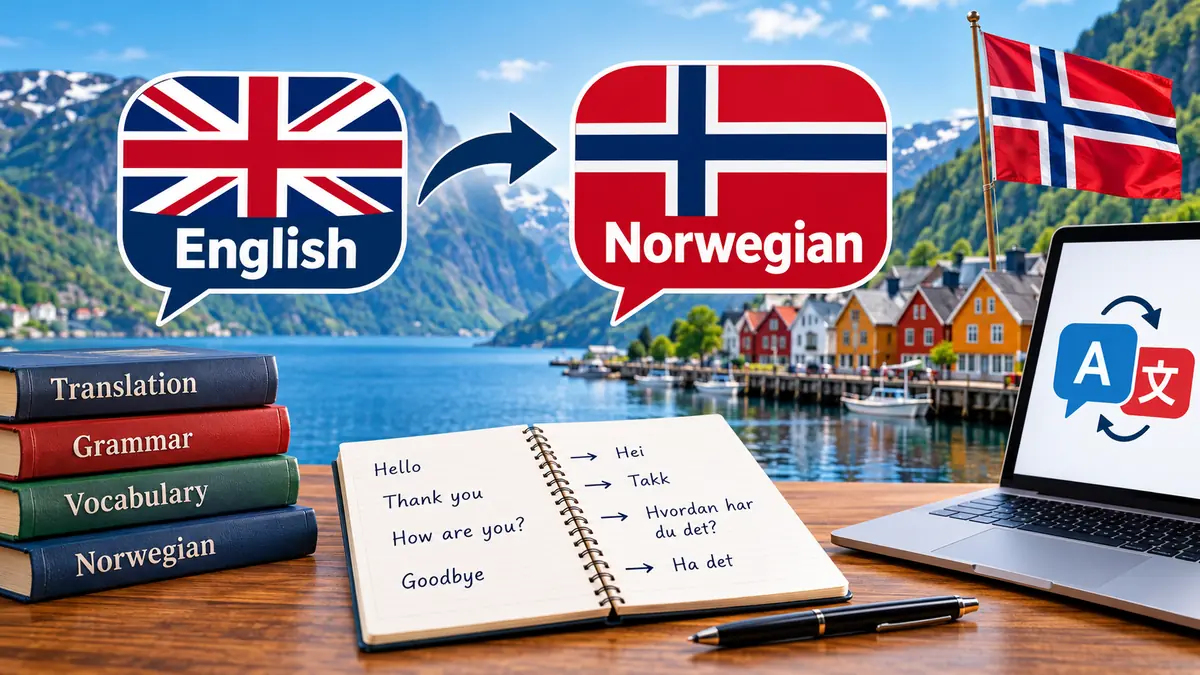
Translating English into Norwegian can look surprisingly easy at first. The languages share Germanic roots, many words feel familiar, and basic sentences often follow recognizable patterns. The trouble starts when a word-for-word translation is grammatically possible but sounds unnatural to a Norwegian reader.
For reliable english to norwegian translation, focus on meaning, context, word order, grammatical gender, definite forms, and the Norwegian written standard you need. Most general translations use Bokmål, while Nynorsk is a separate official written standard. Good translation preserves the original message rather than mechanically replacing individual English words.
How english to norwegian Translation Works
English and Norwegian are both Germanic languages, which gives them similarities in vocabulary and sentence construction. That relationship can make Norwegian more approachable for English speakers than many unrelated languages.
Still, translation is not simply a matter of finding a Norwegian equivalent for every English word.
Consider:
English: I am going to the store today.
Norwegian: Jeg går til butikken i dag.
The meaning remains straightforward, but Norwegian grammar and natural usage determine how the sentence should be expressed.
Professional-quality translation therefore involves several steps:
- Understand the complete meaning of the English sentence.
- Identify its context and intended tone.
- Choose the appropriate Norwegian vocabulary.
- Restructure the sentence when Norwegian grammar requires it.
- Check noun gender, articles, adjectives, and verb forms.
- Review the finished text for natural Norwegian usage.
Translation advice from Oslo Metropolitan University similarly emphasizes conveying meaning and considering the target audience rather than translating mechanically word by word.
Why context matters
Many English words have several meanings.
Take the word light. Depending on the sentence, it could refer to illumination, something that is not heavy, a pale color, or even the act of igniting something.
A translator must understand the intended meaning before selecting the Norwegian equivalent.
This is one reason isolated word translation can be less reliable than translating a complete sentence.
Bokmål or Nynorsk: Which Norwegian Should You Use?
One of the first decisions in English-to-Norwegian translation is choosing the written standard.
Norwegian has two official written standards:
- Bokmål
- Nynorsk
Bokmål is the more commonly used of the two, and many online English-to-Norwegian translation services default to Bokmål. For example, DeepL specifically provides English-to-Norwegian Bokmål translation.
If someone simply asks for a Norwegian translation without specifying a standard, Bokmål is therefore often the practical default. However, that does not mean Bokmål and Nynorsk should be treated as interchangeable.
Bokmål
Bokmål is widely encountered in Norwegian media, education, business communication, websites, and everyday written material.
Examples:
English: Thank you for your help.
Bokmål: Takk for hjelpen.
English: Where do you live?
Bokmål: Hvor bor du?
Nynorsk
Nynorsk has different vocabulary, spelling, and grammatical forms.
If a school, organization, government body, publication, or individual specifically requires Nynorsk, translating into Bokmål would not satisfy that requirement.
Always check the requested written standard when accuracy matters.
Common English to Norwegian Words and Phrases
Learning everyday vocabulary is a useful starting point because it shows how common ideas are expressed naturally rather than literally.
| English | Norwegian |
|---|---|
| Hello | Hei |
| Good morning | God morgen |
| Goodbye | Ha det |
| Thank you | Takk |
| Yes | Ja |
| No | Nei |
| Please | Vær så snill |
| Excuse me | Unnskyld |
| I understand | Jeg forstår |
| I don’t understand | Jeg forstår ikke |
| What is your name? | Hva heter du? |
| My name is… | Jeg heter… |
| How are you? | Hvordan har du det? |
| Where are you from? | Hvor kommer du fra? |
| I need help | Jeg trenger hjelp |
Notice that natural Norwegian phrases do not always mirror English structure exactly.
For example:
What is your name? becomes Hva heter du?
A literal word-for-word rendering would miss the normal Norwegian way of asking someone’s name.
That distinction—translating meaning rather than individual words—is central to producing natural results.
English and Norwegian Grammar Differences
Because English and Norwegian are related, beginners sometimes assume they can simply substitute Norwegian vocabulary into an English sentence structure.
That approach quickly creates mistakes.
Norwegian uses the V2 rule
One of the most important Norwegian grammar principles is the verb-second rule, usually called the V2 rule.
In a Norwegian main clause, the finite verb generally occupies the second position or constituent.
Compare:
English: Today I am going to the store.
Norwegian: I dag går jeg til butikken.
A direct structure such as I dag jeg går… does not follow normal Norwegian main-clause word order.
The V2 rule becomes particularly noticeable when a sentence starts with an adverbial expression such as:
- today
- tomorrow
- sometimes
- after work
- in Norway
- last year
A Norwegian-language teaching guide highlights V2 word order as one of the major grammatical differences English speakers need to learn.
Norwegian nouns have grammatical gender
English uses a and an without assigning ordinary nouns grammatical genders.
Norwegian is different.
In Bokmål, nouns can be:
| Gender | Article | Example |
|---|---|---|
| Masculine | en | en bil — a car |
| Feminine | ei | ei jente — a girl |
| Neuter | et | et hus — a house |
In Bokmål, many feminine nouns can also be treated using common masculine-type forms, depending on style and usage.
Learning a noun together with its article is therefore useful.
Instead of memorizing:
hus = house
learn:
et hus = a house
That makes later inflection much easier.
Definite nouns work differently
English normally places the before a noun:
the house
Norwegian commonly adds the definite ending to the noun:
huset
Similarly:
en bil — a car
bilen — the car
This feature appears constantly in Norwegian, so overlooking it can make a translation sound unnatural.
Norwegian verbs do not change by person
English verbs can change depending on the subject:
I walk
He walks
Norwegian normally keeps the same present-tense verb form:
Jeg går — I walk/go
Du går — You walk/go
Han går — He walks/goes
Vi går — We walk/go
This aspect of Norwegian grammar can actually make verb conjugation easier for English speakers.
The Norwegian Letters Æ, Ø, and Å
The Norwegian alphabet contains three letters that do not appear in the standard English alphabet:
Æ, Ø, Å
They appear after Z in Norwegian alphabetical order.
These are not decorative variations of English letters. They are independent letters and can distinguish words and pronunciations.
You should therefore preserve them when translating Norwegian text.
Avoid casually replacing:
- æ with ae
- ø with o
- å with a
Such substitutions sometimes appear when technical systems cannot display Norwegian characters, but they should not be treated as standard Norwegian spelling.
Modern websites, documents, messaging apps, and Unicode-compatible software normally support these characters without difficulty.
How to Translate English to Norwegian Step by Step
Online translators make the technical process simple, but better input generally produces better output.
1. Write clear English
Start with a sentence whose meaning is unambiguous.
Instead of:
I’ll get back to you on it.
For formal translation, something clearer might be:
I will send you an answer tomorrow.
Clear source writing reduces the chance of ambiguous interpretation.
2. Translate the complete idea
Do not translate every word independently and then assemble the results.
Words change meaning according to context.
Translate complete sentences whenever possible so the translator can identify relationships between words.
3. Confirm Bokmål or Nynorsk
For general-purpose translation, Bokmål is commonly used. If your audience requires Nynorsk, select or request Nynorsk specifically.
4. Review the output
Check:
- names
- numbers
- dates
- technical terminology
- noun gender
- word order
- punctuation
- tone
- idiomatic expressions
Machine-generated text should not automatically be assumed correct simply because it looks fluent.
5. Check important vocabulary in a dictionary
For individual words, a bilingual dictionary can provide definitions, alternatives, and example sentences.
The Cambridge English–Norwegian Dictionary, for example, contains Norwegian translations for thousands of English words along with example sentences and reports more than 60,000 short English definitions in its dictionary resources.
Dictionary checking is particularly valuable when one English word has several possible Norwegian translations.
6. Read the Norwegian sentence naturally
Ask whether the sentence sounds as though it was originally written in Norwegian.
A grammatically understandable sentence may still feel translated.
That final naturalness check often separates a usable translation from a polished one.
Using Online English to Norwegian Translators
Several established tools support English and Norwegian translation, but their features and limitations differ.
Google Translate supports text and also offers translation workflows for images, documents, and websites. DeepL supports English-to-Norwegian Bokmål text translation and document workflows. Cambridge combines a translator with dictionary resources, which can be useful when you want to investigate individual words and usage.
No translation tool should be judged only by whether the result is grammatically readable.
For important text, examine whether it correctly preserves:
Meaning: Did the translation communicate the original idea?
Tone: Is a formal English message still formal in Norwegian?
Terminology: Were specialized terms translated correctly?
Context: Did ambiguous words receive the intended interpretation?
Naturalness: Would a Norwegian speaker actually phrase the sentence this way?
These checks matter more as the consequences of an error increase.
Machine Translation vs. Human Translation
Machine translation and human translation serve different purposes.
| Situation | Machine Translation | Human Review |
|---|---|---|
| Understanding a short message | Usually useful | Usually unnecessary |
| Everyday phrases | Useful | Optional |
| Travel communication | Useful | Usually unnecessary |
| Casual conversation | Useful | Optional |
| Website content | Useful as a starting point | Recommended |
| Marketing copy | Limited without review | Strongly recommended |
| Legal documents | Risky alone | Essential |
| Medical information | Risky alone | Essential |
| Academic publication | Helpful for drafting | Recommended |
| Important business communication | Helpful | Recommended |
Machine translation is particularly convenient when speed matters and the text is low risk.
Human expertise becomes more important when wording can affect legal meaning, safety, reputation, financial decisions, or professional credibility.
Common English to Norwegian Translation Mistakes
Knowing what usually goes wrong can improve translation quality quickly.
Translating idioms literally
English contains expressions whose meanings cannot be understood from their individual words.
For example:
It’s raining cats and dogs.
The intended meaning is simply that it is raining heavily. Translating each noun literally would preserve the words while losing the message.
Idioms should be translated by meaning or replaced with a natural Norwegian equivalent.
Keeping English word order
English syntax can influence inexperienced translators.
Norwegian sentence structure sometimes looks similar, but the V2 rule and other word-order patterns mean an English structure cannot always be carried over unchanged.
Ignoring noun gender
Choosing the wrong article can affect other parts of a phrase as well.
Learn nouns with their gender rather than treating gender as information to add later.
Ignoring compound words
Norwegian frequently forms compound nouns by joining words together where English may use separate words.
This can produce translations that look unfamiliar to an English speaker but are perfectly normal in Norwegian.
Removing Norwegian characters
Replacing æ, ø, and å unnecessarily can create spelling problems.
Keep the correct Norwegian characters whenever the system supports them.
Using the wrong level of formality
Translation should preserve not just information but also the relationship between writer and reader.
A message to a friend, university, customer, government office, or employer may require different wording even when the basic meaning is identical.
English to Norwegian Translation for Travel
Travelers usually need practical communication rather than complex grammar.
Useful examples include:
Where is the train station?
Hvor er togstasjonen?
How much does this cost?
Hvor mye koster dette?
Can you help me?
Kan du hjelpe meg?
I would like a coffee.
Jeg vil gjerne ha en kaffe.
Do you speak English?
Snakker du engelsk?
Where is the bathroom?
Hvor er toalettet?
Memorizing complete expressions can be more effective than memorizing disconnected vocabulary because you learn words inside natural grammatical structures.
Translating Emails and Business Communication
Business translation requires more attention to tone.
Suppose the English sentence is:
Thank you for your message. I will review the information and reply tomorrow.
A natural Bokmål translation could be:
Takk for meldingen. Jeg skal gå gjennom informasjonen og svare i morgen.
The goal is not to reproduce every English construction. It is to produce a Norwegian message that communicates the same professional meaning.
Before sending an important translated email, check names, dates, company terminology, product names, monetary figures, deadlines, and industry-specific vocabulary separately.
Translating Documents from English to Norwegian
Long documents create additional challenges because terminology must remain consistent across many paragraphs.
Document translation may involve:
- PDF files
- Word documents
- presentations
- spreadsheets
- academic material
- reports
- manuals
- website content
Some translation platforms support direct file translation. DeepL, for instance, provides document translation options for formats including PDF, Word, and PowerPoint on its translator interface. Google Translate also provides a document translation interface supporting several common file formats.
For long documents, create a terminology list before translating.
If an English technical term appears 40 times, it should normally receive a consistent Norwegian translation unless context genuinely changes its meaning.
Formatting also deserves attention. Tables, headings, captions, hyperlinks, abbreviations, units, and references can all be affected during document translation.
How to Make Norwegian Translation Sound More Natural
Accuracy is only the first goal. Naturalness matters too.
A useful editing process is:
- Translate the meaning.
- Stop looking at the English original temporarily.
- Read the Norwegian text by itself.
- Rewrite awkward sentences.
- Compare it with the English again to ensure nothing was lost.
This helps reduce source-language interference.
Another useful technique is back translation.
Translate:
English → Norwegian
Then translate the Norwegian result back:
Norwegian → English
If the returned English expresses a substantially different idea, inspect the Norwegian translation again.
Back translation is only a checking technique; it cannot prove that a sentence is natural or fully correct.
Is Norwegian Easy for English Speakers?
Norwegian has several features that can feel approachable to English speakers.
The languages share Germanic ancestry, there are recognizable cognates, and Norwegian verbs do not normally conjugate according to grammatical person.
However, learners still need to master:
- V2 word order
- grammatical gender
- definite noun endings
- adjective agreement
- compound words
- pronunciation
- idiomatic expressions
- Bokmål and Nynorsk distinctions
Similarity can actually create a translation trap: a sentence may look plausible precisely because the languages are related.
That is why natural usage should always take priority over literal similarity.
Choosing the Right Translation Method
The best method depends on what you are translating.
For a quick everyday phrase, an online translator is usually sufficient.
For vocabulary learning, combine a translator with a reputable bilingual dictionary and example sentences.
For longer writing, translate sentence by sentence or paragraph by paragraph and review the entire text afterward for consistency.
For professional publication, legal material, sensitive information, or other high-stakes documents, use qualified human review.
The key principle behind english to norwegian translation is simple: translate the message, not just the words. Choose the correct Norwegian written standard, respect Norwegian grammar and characters, verify ambiguous terminology, and review important translations in context. Those habits produce Norwegian that is not merely understandable, but considerably more natural and reliable.
