

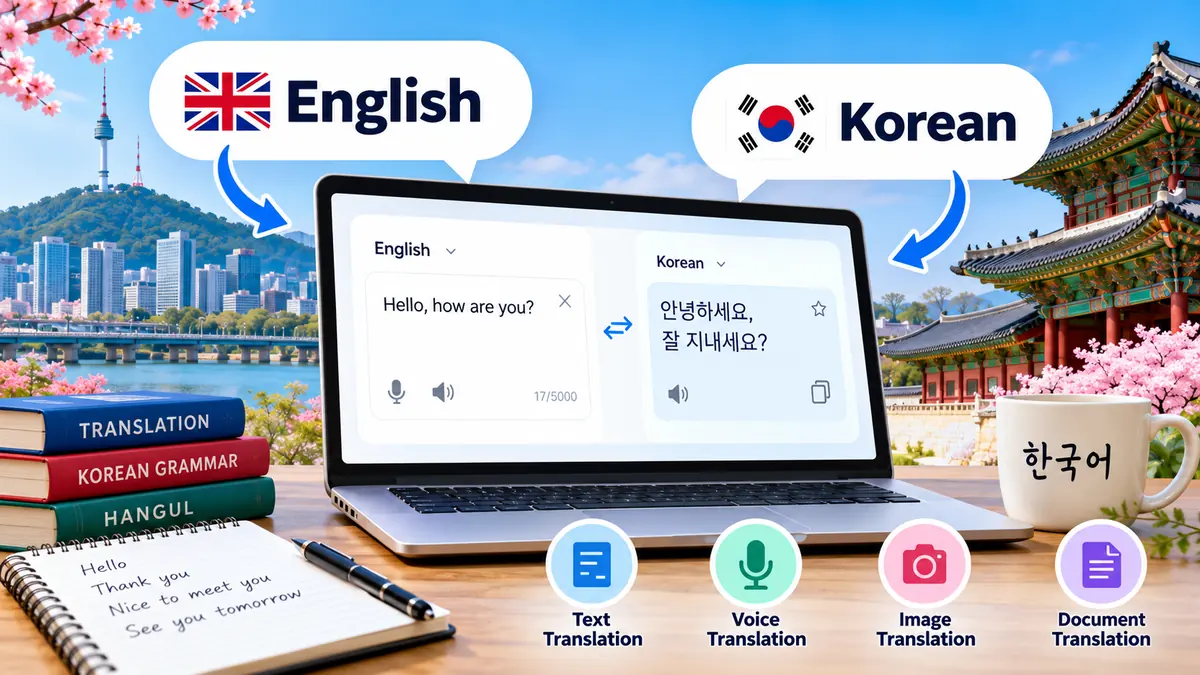
Translating English into Korean involves more than replacing words with their Korean equivalents. The two languages use different sentence structures, writing systems, politeness levels, and cultural expressions. A sentence that sounds natural in English can become awkward or even disrespectful when translated word for word into Korean.
An english to korean translator is a digital tool that converts English text, speech, or documents into Korean using machine translation technology. Tools such as Google Translate, Papago, and DeepL can help with everyday communication, but accurate results also depend on context, Korean grammar, honorifics, and appropriate word choices.
Understanding how these tools work makes it easier to translate messages, study Korean, communicate while traveling, and recognize errors before sharing translated content.
What Is an english to korean translator?
An english to korean translator is an application, website, or language-processing system that converts English-language content into Korean.
Most modern translation services use neural machine translation (NMT), a technology that analyzes words within the context of a sentence rather than translating each word independently.
Many systems also use transformer-based neural networks and multilingual language models to recognize relationships between words, sentence patterns, and meanings.
For example:
| English | Korean | Romanization |
|---|---|---|
| Hello | 안녕하세요 | Annyeonghaseyo |
| Thank you | 감사합니다 | Gamsahamnida |
| Good morning | 좋은 아침이에요 | Joeun achimieyo |
| I love you | 사랑해요 | Saranghaeyo |
| Excuse me | 실례합니다 | Sillyehamnida |
| Nice to meet you | 만나서 반갑습니다 | Mannaseo bangapseumnida |
These examples use generally polite expressions, although the most natural translation can change depending on the situation.
A translator may offer several capabilities, including text translation, speech recognition, pronunciation playback, camera translation, and document translation.
However, not every application supports all these features, and their accuracy varies depending on the content.
How to Use an english to korean translator Step by Step
Most online English-to-Korean translation tools follow a similar process.
Step 1: Choose English as the Source Language
Open a translation application or website and select English as the source language.
Some tools automatically detect the input language, but manually choosing English can prevent mistakes when translating short phrases or names.
Step 2: Select Korean as the Target Language
Choose Korean, often displayed as 한국어, as the target language.
For most translation services, this means Standard Korean written in Hangul.
The standard language used in South Korea is generally the default for mainstream translation applications.
Step 3: Enter Your English Text
Type or paste the sentence you want translated.
For example:
English: Where is the nearest subway station?
Korean: 가장 가까운 지하철역이 어디예요?
Romanization: Gajang gakkaun jihacheolyeogi eodiyeyo?
For better results, enter complete sentences rather than disconnected words.
Step 4: Review the Korean Translation
Read the generated translation and check whether it preserves the original meaning.
Pay attention to:
- Whether the sentence is a question, request, or statement.
- Whether the wording is formal or informal.
- Whether the translation uses the correct subject.
- Whether important context has been omitted.
- Whether specialized terminology is accurate.
Step 5: Listen to the Pronunciation
If the translator supports text-to-speech, use the audio playback feature to hear the Korean sentence.
Listening helps identify pronunciation patterns that are difficult to understand through romanization alone.
Step 6: Verify Important Translations
For professional, legal, medical, academic, or sensitive communication, compare the output with another reliable source or consult a qualified Korean translator.
Machine translation is useful for understanding general meaning, but it should not be treated as a substitute for professional review when accuracy has serious consequences.
Best English to Korean Translation Tools
Several translation platforms support English-to-Korean translation. Their strengths differ depending on whether you need conversational Korean, professional writing, vocabulary explanations, or image translation.

Google Translate
Supports text, speech, camera-based translation, and downloadable language packs for supported offline features. Useful for travel and everyday communication.
Website: Google Translate

Naver Papago
Developed by South Korean technology company Naver, Papago focuses on Asian languages and includes Korean honorific translation options. Particularly useful for conversations and everyday expressions.
Website: Papago

DeepL Translator
Provides Korean translation for written content, including longer passages. Its document-related capabilities make it useful for comparing formal written translations.
Website: DeepL

Microsoft Translator
Offers multilingual text and speech translation, with conversation-oriented features that can help users communicate across language barriers.
Website: Microsoft Translator
Recent comparisons highlight Papago’s Korean-specific features, Google Translate’s broad functionality, and DeepL’s usefulness for written text. No tool is guaranteed to produce the best translation in every situation.
Preply
+2
Which English to Korean Translator Is Most Accurate?
Translation accuracy depends on the original sentence, its context, and the intended audience.
For simple directions or everyday expressions, multiple tools may produce similar results. For idioms, workplace communication, and culturally sensitive language, their outputs can differ significantly.
A 2026 academic study comparing Papago, Google Translate, DeepL, and ChatGPT in English-to-Korean game translation examined issues including ambiguity, stylistic variation, specialized terminology, and context. This illustrates why translation quality must be evaluated for a specific purpose rather than judged by one universal ranking.
John Benjamins Publishing Catalog
For an important message, compare translations from two systems and ask a fluent Korean speaker to review the final wording.
Understanding Korean Grammar Before Translating English
Korean and English belong to different language families and use substantially different grammatical structures.
Understanding these differences helps explain why a literal translation frequently sounds unnatural.
English vs. Korean Sentence Structure
English commonly follows subject–verb–object (SVO) order.
Korean typically follows subject–object–verb (SOV) order.
Consider this example:
English: I eat apples.
Korean: 저는 사과를 먹어요.
The Korean sentence can be broken down as follows:
| Korean | Meaning | Function |
|---|---|---|
| 저 | I (humble) | Subject |
| 는 | Topic marker | Identifies the topic |
| 사과 | Apple | Object |
| 를 | Object marker | Marks the object |
| 먹어요 | Eat | Verb |
The verb appears at the end of the Korean sentence.
Korean also uses grammatical particles to identify the roles of nouns, and these particles often have no direct English equivalent.
Korea.net
Why Korean Particles Matter
Particles are short grammatical elements attached to Korean words.
Common examples include:
- 은/는 — topic markers.
- 이/가 — subject markers.
- 을/를 — object markers.
- 에 — frequently marks a location, destination, or time.
- 에서 — commonly marks where an action takes place.
Consider:
저는 학교에 가요.
Meaning: I go to school.
Here, 에 identifies school as the destination.
Compare that with:
저는 학교에서 공부해요.
Meaning: I study at school.
The particle 에서 indicates where the studying takes place.
A translator must recognize these relationships to generate grammatically appropriate Korean.
Korean Often Omits Subjects
English usually requires an explicit subject in a complete sentence.
Korean frequently omits subjects or objects when their meaning is understood from context.
For example:
English: I already ate.
Korean: 이미 먹었어요.
The Korean sentence does not explicitly contain the word “I.”
Depending on context, it could refer to the speaker or another understood person.
This is one reason short English sentences can produce ambiguous Korean translations.
Korean Formal and Informal Translation
One of the biggest challenges for an english to korean translator is selecting the correct level of politeness.
Korean uses speech levels and honorific expressions that communicate respect, social relationships, and formality.
A grammatically correct translation may still be socially inappropriate if it uses the wrong speech level.
Three Common Korean Speech Styles
| Style | Example: Thank you | Typical situation |
|---|---|---|
| Formal polite | 감사합니다 | Professional or respectful situations |
| Informal polite | 고마워요 | Friendly but polite conversation |
| Casual | 고마워 | Close friends or younger family members |
The appropriate style depends on factors such as age, familiarity, workplace hierarchy, and the relationship between speakers.
Formal polite endings frequently include -습니다 or -ㅂ니다, while informal polite expressions commonly end in -요.
Korea.net
What Are Korean Honorifics?
Korean honorifics are grammatical and vocabulary choices used to show respect toward another person.
For example:
| Ordinary expression | Honorific expression | Meaning |
|---|---|---|
| 이름 | 성함 | Name |
| 나이 | 연세 | Age |
| 먹다 | 드시다 | Eat |
| 자다 | 주무시다 | Sleep |
| 있다 | 계시다 | Be or stay |
| 말하다 | 말씀하시다 | Speak |
These are context-dependent forms, not interchangeable replacements in every sentence.
Korean Wiki Project
+1
For example, when asking an older person whether they have eaten, 식사하셨어요? is generally more respectful than a casual expression such as 밥 먹었어?
How to Translate English into Polite Korean
When writing to a teacher, older person, customer, or unfamiliar individual, use an appropriate polite style.
A practical approach is to:
- Identify who will receive the message.
- Determine whether the relationship is professional, formal, or personal.
- Choose polite sentence endings.
- Check whether honorific vocabulary is appropriate.
- Review the entire message for consistency.
Papago includes an honorific option for certain translation directions, including English to Korean. However, automatic politeness adjustments still require human judgment.
Kedanto
Learning Hangul and Korean Pronunciation
Hangul (한글) is the Korean writing system.
Unlike English, which uses the Latin alphabet, Korean uses Hangul characters organized into syllable blocks.
Learning the basic writing system makes it much easier to understand and verify translations.
Basic Hangul Consonants
| Hangul | Common Romanization |
|---|---|
| ㄱ | g/k |
| ㄴ | n |
| ㄷ | d/t |
| ㄹ | r/l |
| ㅁ | m |
| ㅂ | b/p |
| ㅅ | s |
| ㅇ | Silent initially; ng finally |
| ㅈ | j |
| ㅎ | h |
These romanizations are approximations. Actual pronunciation depends on a consonant’s position and neighboring sounds.
Basic Hangul Vowels
| Hangul | Romanization |
|---|---|
| ㅏ | a |
| ㅓ | eo |
| ㅗ | o |
| ㅜ | u |
| ㅡ | eu |
| ㅣ | i |
| ㅐ | ae |
| ㅔ | e |
For example, the Korean word 한글 combines two syllable blocks:
- 한 — han
- 글 — geul
Together, they form 한글 (Hangul).
Korean Romanization vs. Hangul Translation
Romanization represents Korean sounds using Latin letters. Translation conveys meaning between languages.
These are different processes.
For example:
English: Thank you.
Korean: 감사합니다.
Romanization: Gamsahamnida.
The romanized form helps beginners approximate pronunciation, but it does not fully capture Korean sound changes.
The Revised Romanization of Korean is widely used for representing Korean words in Latin characters.
For language learning, reading Hangul alongside audio pronunciation is generally more reliable than depending entirely on romanization.
Common English to Korean Translation Examples
Everyday phrases are useful for understanding how Korean expressions work in practical situations.
The following translations use polite language where appropriate.
Greetings and Basic Conversations
| English phrase | Korean translation |
|---|---|
| Hello | 안녕하세요 |
| Goodbye (to someone leaving) | 안녕히 가세요 |
| Goodbye (to someone staying) | 안녕히 계세요 |
| Thank you | 감사합니다 |
| You’re welcome | 천만에요 |
| I’m sorry | 죄송합니다 |
| Yes | 네 |
| No | 아니요 |
| How are you? | 잘 지내세요? |
| See you tomorrow | 내일 봐요 |
Some expressions have different usage patterns in Korean.
For example, 안녕히 가세요 is commonly said to someone who is leaving, while 안녕히 계세요 is used when the speaker leaves and the listener stays.
Likewise, 천만에요 is a possible translation of “you’re welcome,” but expressions such as 아니에요 or 괜찮아요 may sound more natural in everyday conversations.
Travel and Transportation Phrases
| English | Korean |
|---|---|
| Where is the bathroom? | 화장실이 어디예요? |
| How much does this cost? | 이거 얼마예요? |
| Please help me. | 도와주세요. |
| I don’t understand. | 이해가 안 돼요. |
| Do you speak English? | 영어 하세요? |
| Please take me to the airport. | 공항으로 가 주세요. |
| Where is the subway station? | 지하철역이 어디예요? |
| I need a taxi. | 택시가 필요해요. |
Travelers visiting Seoul, Busan, Incheon, or other South Korean cities may find these expressions useful when asking for directions or assistance.
Restaurant and Shopping Phrases
| English | Korean |
|---|---|
| Can I see the menu? | 메뉴 좀 볼 수 있을까요? |
| Water, please. | 물 주세요. |
| This is delicious. | 이거 맛있어요. |
| I’m vegetarian. | 저는 채식주의자예요. |
| Please make it less spicy. | 덜 맵게 해 주세요. |
| Can I pay by card? | 카드로 결제할 수 있나요? |
| Please give me a receipt. | 영수증 주세요. |
When translating food allergies or dietary restrictions, extra care is necessary.
For example, saying “I am allergic to peanuts” is more specific than simply saying “I cannot eat nuts.”
Accurate ingredient names matter because an incorrect translation could cause a serious misunderstanding.
Educational and Workplace Phrases
| English | Korean |
|---|---|
| I am a student. | 저는 학생이에요. |
| I am learning Korean. | 저는 한국어를 배우고 있어요. |
| Please explain again. | 다시 설명해 주세요. |
| I have a question. | 질문이 있습니다. |
| Thank you for your help. | 도와주셔서 감사합니다. |
| I will send the document tomorrow. | 내일 문서를 보내겠습니다. |
| Please check the email. | 이메일을 확인해 주세요. |
For business communication, formal sentence endings and appropriate titles may be preferable to casual language.
Translating English to Korean with Voice and Camera Features
Modern translation applications support more than typed text.
Speech recognition, optical character recognition (OCR), and text-to-speech technology allow users to translate spoken conversations and printed Korean.
English to Korean Voice Translation
Voice translation typically follows four stages:
- A microphone records spoken English.
- Automatic speech recognition converts the audio into text.
- A translation model generates Korean text.
- Text-to-speech technology may read the Korean translation aloud.
This can be useful when speaking with someone who does not understand English.
However, background noise, regional accents, overlapping voices, and unfamiliar names can reduce accuracy.
Speak clearly, use shorter sentences, and verify the recognized English text before relying on the translation.
Translating Korean Text from Images
Camera translation allows users to point a smartphone camera at Korean writing.
Possible applications include restaurant menus, street signs, product labels, and public transportation instructions.
The system first identifies characters within the image and then translates the recognized text.
Poor lighting, stylized fonts, handwritten notes, or partially obscured text can cause errors.
Camera translation should therefore be treated as a convenient reading aid rather than a guaranteed transcription.
Can You Translate English to Korean Offline?
Yes, some translation applications support offline English-to-Korean text translation after the necessary language resources have been downloaded.
Google Translate offers downloadable language packs for supported offline functionality. Papago also supports selected offline translation features, although capabilities differ between text, image, speech, and honorific translation.
In particular, offline text translation does not necessarily mean camera or voice translation will work without an internet connection.
iTechGuides
+1
Before traveling, download the required language resources and test the specific features you expect to use.
Common Mistakes in English to Korean Translation
Even sophisticated translation systems can produce sentences that are grammatically plausible but contextually incorrect.
Recognizing common mistakes helps users improve translation quality.
Translating English Idioms Literally
Idioms frequently have meanings that cannot be understood from their individual words.
Consider:
English: It’s raining cats and dogs.
A literal Korean translation would sound confusing.
A natural alternative is:
비가 억수같이 와요.
Meaning: It’s raining very heavily.
Another example is:
English: Break a leg!
In English, this expression can mean “good luck” before a performance.
A suitable Korean expression might be 잘하고 와!, depending on the situation.
The goal is to preserve the intended meaning rather than the original words.
Ignoring Context and Multiple Meanings
English words often have several possible meanings.
For example, “bank” could refer to a financial institution or the side of a river.
- Financial bank: 은행
- Riverbank: 강둑
A translation system needs enough context to select the correct meaning.
Instead of translating the isolated word “bank,” provide a complete sentence.
For example:
“I deposited money at the bank.”
This makes the intended meaning much clearer.
Using the Wrong Politeness Level
Translating “Sit down” as 앉아 may be acceptable with a close friend, but it can sound abrupt in a formal setting.
A more polite request is:
앉으세요.
For additional courtesy, someone might say:
앉아 주세요.
Selecting the appropriate expression depends on the relationship and situation.
Translating Names and Technical Terms Incorrectly
Personal names, company names, and specialized vocabulary require careful treatment.
For example, a company may have an established Korean brand name rather than a direct translation.
Scientific, medical, and engineering terms may also have standardized Korean equivalents.
When translating specialized content, consult a reputable dictionary, official terminology database, or domain expert.
Trusting Reverse Translation Too Much
A common technique is to translate English into Korean and then translate the result back into English.
This can reveal major errors, but it is not a definitive accuracy test.
A sentence may translate back into nearly identical English even when the Korean version uses unnatural grammar or an inappropriate tone.
Reverse translation is best used as one checking method alongside contextual review.
How to Improve English to Korean Translation Accuracy
Improving the source text often improves the resulting Korean translation.
Write Clear and Complete Sentences
Avoid ambiguous fragments whenever possible.
Instead of:
“Book it for tomorrow.”
Write:
“Please reserve a hotel room for tomorrow.”
The second sentence explains what “it” refers to.
Provide Context
If a sentence is intended for a formal email, a restaurant conversation, or a message to a friend, that context matters.
For example, “I miss you” can be translated as:
보고 싶어요.
This is a common polite expression.
A more casual version is:
보고 싶어.
Neither version is universally correct for every relationship.
Use Consistent Terminology
For longer documents, establish preferred translations for recurring terms.
A glossary can help maintain consistency for product names, academic vocabulary, company terminology, and technical concepts.
For example, the English word “application” may refer to a software application, a job application, or the act of applying something.
Each meaning may require a different Korean expression.
Compare More Than One Translation
When a sentence seems unusual, compare results from different systems.
Look for differences in word choice, verb endings, and sentence structure.
A dictionary such as the Naver Korean Dictionary or the Korean-English Learners’ Dictionary from the National Institute of Korean Language can help clarify vocabulary and usage.
Review Numbers, Dates, and Units
Numbers deserve special attention in Korean translation.
Korean uses both native Korean and Sino-Korean number systems.
For example:
| Number | Native Korean | Sino-Korean |
|---|---|---|
| 1 | 하나 | 일 |
| 2 | 둘 | 이 |
| 3 | 셋 | 삼 |
| 4 | 넷 | 사 |
| 5 | 다섯 | 오 |
Different contexts require different number systems.
Sino-Korean numbers are commonly used for dates, prices, and phone numbers, while native Korean numbers are often used with certain counters and hours.
When translating financial figures, deadlines, measurements, or quantities, verify the numbers independently.
Using English to Korean Translation for Language Learning
Translation tools can support Korean language study when used alongside grammar explanations, listening practice, and vocabulary exercises.
They are particularly useful for learners preparing for Korean conversations, reading Korean content, or studying for the Test of Proficiency in Korean (TOPIK).
Build Vocabulary with Example Sentences
Instead of memorizing isolated translations, study words in complete sentences.
For example:
학교 — School
저는 학교에 가요. — I go to school.
저는 학교에서 공부해요. — I study at school.
These examples show how the same noun can appear with different particles.
Practice Korean Pronunciation
Listen to native-speaker recordings and compare them with text-to-speech audio.
Pay attention to consonant pronunciation, vowel distinctions, syllable-final consonants (받침), and sound changes between syllables.
Romanization can help initially, but it should gradually become secondary to Hangul.
Learn Common Verb Forms
Korean verbs change according to tense, politeness, and grammatical construction.
For example, the verb 가다 means “to go.”
| Form | Korean | Meaning |
|---|---|---|
| Dictionary | 가다 | To go |
| Present polite | 가요 | Go / goes |
| Past polite | 갔어요 | Went |
| Future expression | 갈 거예요 | Will go |
| Formal polite | 갑니다 | Go / goes |
Learning these patterns helps users understand why translation software produces different endings for similar English sentences.
Use Translation as a Checking Tool
Try translating an English sentence into Korean independently before consulting an application.
Then compare your version with the machine-generated result.
Identify differences in particles, word order, verb endings, and vocabulary.
This approach turns translation software into a learning aid rather than a replacement for active language practice.
English to Korean Translation for Documents and Professional Communication
Longer documents require more attention than short everyday phrases.
Business emails, academic papers, contracts, technical manuals, and official records may contain terminology that cannot be translated reliably without specialized knowledge.
Translating Business Emails
Business Korean generally requires appropriate greetings, titles, polite requests, and closing expressions.
For example:
English: Please review the attached document.
Korean: 첨부된 문서를 검토해 주시기 바랍니다.
This expression is suitable for many formal business contexts.
However, professional Korean writing also depends on the recipient’s position and the established communication style of the organization.
Translating Academic Content
Academic translation requires consistency in terminology and accurate representation of the original argument.
Subject-specific vocabulary in science, law, economics, and medicine may not correspond directly between English and Korean.
Technical definitions should be checked against authoritative Korean-language resources.
Translating PDF and Word Documents
Some translation services support document uploads, including selected PDF and Microsoft Word formats.
Document translation may introduce problems with tables, footnotes, charts, formulas, or page layouts.
Scanned PDFs can also require OCR before their contents can be translated.
After translating a document, verify that no paragraphs, numbers, references, or important formatting elements have been lost.
Privacy Considerations
Before uploading confidential material to an online translator, review its privacy and data-processing policies.
Sensitive documents may contain personal information, financial details, business agreements, or unpublished research.
For confidential content, an approved enterprise translation environment or professional translator operating under suitable confidentiality arrangements may be more appropriate.
Machine Translation vs. Human Korean Translation
Machine translation and professional human translation serve different purposes.
| Feature | Machine translation | Human translation |
|---|---|---|
| Speed | Usually immediate | Requires additional time |
| Everyday phrases | Often useful | Accurate with context |
| Cultural nuance | Can be inconsistent | Can account for cultural context |
| Honorifics | May select incorrect forms | Can adapt to the audience |
| Technical terminology | Requires verification | Can be checked by a specialist |
| Creative writing | May lose intended style | Can preserve tone and meaning |
| Legal documents | Not reliable without review | Specialist review is appropriate |
| Cost | Often free or low-cost for basic use | Generally involves professional fees |
Machine translation works well as a starting point for routine communication, vocabulary lookup, and understanding unfamiliar text.
Human translation is particularly valuable when meaning, cultural sensitivity, legal interpretation, or professional reputation matters.
A combined workflow is often effective: generate a draft with a translation tool, then have a qualified reviewer correct it.
The Future of English to Korean Translation Technology
English-to-Korean translation has evolved from rule-based systems and statistical machine translation toward neural machine translation and more advanced AI-based language processing.
Transformer architectures, multilingual models, and large language models can use surrounding text to interpret ambiguous expressions.
Newer systems may also support multimodal translation, combining text, audio, and images.
These developments can improve convenience, but they do not eliminate fundamental language challenges.
Korean honorifics, omitted subjects, idiomatic expressions, regional dialects, and cultural expectations still require contextual understanding.
AI-generated translations can also introduce information that was not present in the original text. For this reason, translation quality should be assessed through meaning preservation, grammatical correctness, tone, and terminology accuracy rather than fluency alone.
Final Thoughts on Using an english to korean translator
An english to korean translator can make communication, travel, reading, and language learning significantly easier. Google Translate, Naver Papago, DeepL, and Microsoft Translator provide useful translation capabilities for different situations.
However, effective English-to-Korean translation requires more than converting vocabulary. Korean sentence structure, Hangul, grammatical particles, honorifics, pronunciation, and cultural context all influence how a message should be expressed.
For everyday use, begin with a reliable translation tool, provide complete sentences, and verify unfamiliar expressions. For formal or high-stakes communication, arrange qualified human review.
The most useful long-term approach is to combine translation technology with a growing understanding of Korean grammar and natural language usage.
