

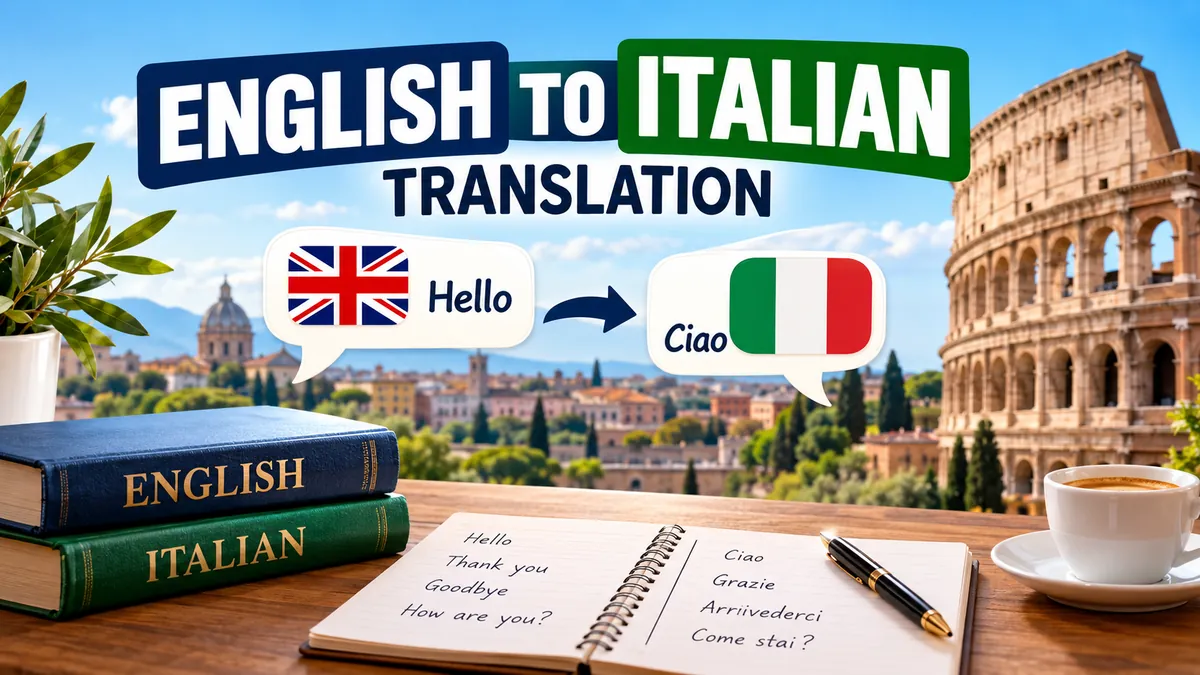
Translating English into Italian can look simple until a perfectly ordinary English sentence produces Italian that is grammatically possible but sounds unnatural. The reason is straightforward: good translation is not about replacing individual words. It is about carrying meaning, tone, context, and intent from one language into another.
english to italian translation means expressing an English message naturally and accurately in Italian while respecting Italian grammar, vocabulary, sentence structure, gender, verb forms, and levels of formality. For simple phrases, an online translator may be enough. Longer, professional, or sensitive texts usually need contextual review to avoid literal or misleading wording.
Modern translation tools make the process much faster, but understanding a few features of Italian can dramatically improve the result. Italian uses grammatical gender, extensive verb conjugation, formal and informal forms of “you,” articles that change according to the noun, and constructions that do not always have direct English equivalents.
How Does english to italian translation Work?
English and Italian communicate many of the same ideas through different grammatical systems. A translator therefore needs to understand the complete English sentence before deciding how it should be expressed in Italian.
Consider a basic example:
English: I would like a coffee.
Italian: Vorrei un caffè.
A strictly word-by-word approach is not particularly useful here. Vorrei is the conditional form of volere (“to want”), but in everyday Italian it provides the polite meaning expressed by “I would like.”
Another example is:
English: How old are you?
Italian: Quanti anni hai?
The Italian construction literally relates to how many years someone “has.” Translating each English word independently would produce an incorrect or unnatural result.
This illustrates the central principle of translation: translate the meaning of the sentence rather than the isolated words.
English and Italian: The Main Language Differences
English and Italian both use the Latin alphabet and share a considerable amount of vocabulary influenced by Latin. Their grammar, however, differs in several important ways.
Understanding these differences makes it easier to recognize why automated translations sometimes require editing.
Grammatical Gender
Italian nouns are grammatically masculine or feminine. Articles and adjectives normally need to agree with the gender and number of the noun.
For example:
| English | Italian |
|---|---|
| the book | il libro |
| the house | la casa |
| the books | i libri |
| the houses | le case |
| a beautiful book | un bel libro |
| a beautiful house | una bella casa |
English does not generally require this type of agreement.
You cannot safely determine gender from meaning alone. Although many masculine nouns end in -o and many feminine nouns end in -a, there are exceptions. A dictionary is useful when the gender is uncertain.
Articles
English mainly relies on “the,” “a,” and “an.” Italian has a wider range of definite and indefinite articles.
Common definite articles include:
- il
- lo
- la
- l’
- i
- gli
- le
The correct form depends on gender, number, and sometimes the initial sound of the following word.
For example:
il libro — the book
lo studente — the student
la casa — the house
l’amico — the friend
gli studenti — the students
This is one reason translating a noun without context can be less reliable than translating a complete phrase.
Subject Pronouns
English normally requires an explicit subject:
I speak Italian.
Italian can frequently omit it:
Parlo italiano.
The ending of parlo already tells the listener that the subject is “I.”
Writing Io parlo italiano is possible, but io may be unnecessary unless the speaker wants to emphasize or contrast the subject.
Word Order
English relies heavily on a relatively fixed subject-verb-object structure. Italian word order is more flexible because verb forms and grammatical agreement provide additional information about the sentence.
That does not mean words can be rearranged freely. Different arrangements can alter emphasis or make a sentence sound less natural.
A strong translation therefore reproduces the message rather than mechanically copying English syntax.
Formal and Informal Italian Translation
One of the most significant decisions in english to italian translation is determining how formally to address another person.
English uses “you” in both formal and informal situations. Italian distinguishes between forms such as tu and Lei.
Tu
Tu is generally associated with informal communication, including conversations with friends, relatives, children, and people with whom an informal relationship has been established.
For example:
Do you speak English?
Parli inglese?
Lei
Lei is the traditional formal singular form used when politeness or professional distance is appropriate.
For example:
Can you help me?
Può aiutarmi?
Choosing between tu and Lei can affect verbs, pronouns, possessives, and the overall tone of a translation. Current English-to-Italian resources continue to identify this formal/informal distinction as an important source of nuance.
For business correspondence, customer communication, or conversations with strangers, context should determine the appropriate register rather than a rigid rule.
Common English to Italian Words and Phrases
Everyday phrases provide a useful starting point for understanding how English ideas are naturally expressed in Italian.
| English | Italian |
|---|---|
| Hello | Ciao |
| Good morning | Buongiorno |
| Good evening | Buonasera |
| Goodbye | Arrivederci |
| Thank you | Grazie |
| Please | Per favore |
| You’re welcome | Prego |
| Yes | Sì |
| No | No |
| Excuse me | Mi scusi |
| I’m sorry | Mi dispiace |
| I don’t understand | Non capisco |
| My name is… | Mi chiamo… |
| How much does it cost? | Quanto costa? |
| Where is the bathroom? | Dov’è il bagno? |
| I need a doctor | Ho bisogno di un medico |
| The bill, please | Il conto, per favore |
| Nice to meet you | Piacere |
| Can you help me? | Può aiutarmi? |
| I would like a coffee | Vorrei un caffè |
These translations are useful models, but context still matters. Ciao, for instance, is common and informal, whereas buongiorno or another greeting may fit a more formal interaction better.
Why Word-for-Word Translation Often Fails
Literal translation is one of the most common mistakes made by language learners.
Languages divide meaning differently. An English expression may require a completely different verb, preposition, idiom, or grammatical construction in Italian.
Take:
I am hungry.
Natural Italian is:
Ho fame.
The Italian construction uses avere (“to have”), rather than the equivalent of the English verb “to be.”
Similarly:
I am 25 years old.
becomes
Ho 25 anni.
Another common issue involves English phrasal verbs. Expressions such as “give up,” “look after,” “find out,” and “get over” should be interpreted as complete units. Their Italian equivalents depend on what the expressions mean in context.
The safest question is therefore not:
“What does each word mean?”
Instead ask:
“What does this entire sentence mean, and how would an Italian speaker normally express that idea?”
Italian Verb Conjugation
Italian verbs carry more grammatical information than their English equivalents.
The infinitive parlare means “to speak.” In the present tense:
| Person | Italian |
|---|---|
| I speak | io parlo |
| you speak | tu parli |
| he/she speaks | lui/lei parla |
| we speak | noi parliamo |
| you speak | voi parlate |
| they speak | loro parlano |
Because the verb ending identifies the grammatical person, Italian commonly leaves out the subject pronoun.
Italian also has numerous tenses and moods. The correct translation can depend on whether the English sentence describes a completed action, an ongoing situation, a possibility, a command, a hypothetical event, or something expected to happen later.
This becomes particularly important with the subjunctive (congiuntivo) and conditional (condizionale).
A translator that correctly identifies vocabulary but selects the wrong tense or mood may change the intended meaning.
Adjective Agreement and Placement
Italian adjectives often change according to gender and number.
For example:
ragazzo italiano — Italian boy
ragazza italiana — Italian girl
ragazzi italiani — Italian boys
ragazze italiane — Italian girls
Adjective placement also deserves attention.
English normally places adjectives before nouns:
a beautiful house
Italian often places descriptive adjectives after nouns:
una casa bella
However, adjective position in Italian is flexible, and moving an adjective can sometimes change emphasis or nuance. This is another area where copying English word order mechanically can produce awkward Italian.
Prepositions Can Change the Meaning
English and Italian prepositions rarely match perfectly.
Italian commonly uses:
di — of/from
a — to/at
da — from/by
in — in/to
con — with
su — on/about
per — for/through
The difficulty is that a verb may require a particular preposition.
For example, the English expression “think of someone” may correspond to pensare a qualcuno in the relevant context rather than using the most obvious dictionary equivalent of “of.” Translation resources specifically highlight differences in prepositions and verb constructions as a frequent difficulty between English and Italian.
Learning complete combinations such as verbs plus their usual prepositions is therefore more effective than memorizing prepositions separately.
How to Translate English to Italian More Accurately
A reliable translation process does not need to be complicated. The following method works for everyday sentences, emails, study material, travel communication, and many other texts.
1. Understand the English Meaning First
Read the complete sentence before translating anything.
Identify:
- who is speaking;
- who is being addressed;
- what action is happening;
- when it happens;
- whether the tone is formal or informal;
- whether any words are idiomatic.
Ambiguous English creates ambiguous Italian.
2. Translate Complete Ideas
Work with sentences or meaningful phrases instead of isolated words whenever possible.
For example, translating “book” alone provides less information than translating:
I booked a hotel room.
Here, “book” is a verb rather than a noun.
Context helps both human translators and translation software select the appropriate meaning.
3. Check Gender and Number
Verify that nouns, articles, and adjectives agree.
Compare:
il nuovo ristorante
with
la nuova macchina
Small agreement errors are highly visible in Italian even when the sentence remains understandable.
4. Check the Verb
Confirm:
- grammatical person;
- singular or plural;
- tense;
- mood;
- irregular conjugation;
- auxiliary verb where required.
Verb mistakes can alter both meaning and fluency.
5. Review the Register
Ask who will read the translation.
A message sent to a friend can use vocabulary that would be inappropriate in a formal letter to a company, university, government office, or professional contact.
6. Read the Italian as Italian
Do not judge the translation only by comparing each Italian word with the English source.
Read the final sentence independently.
Does it sound like a natural Italian sentence? If the English structure is still obvious underneath the Italian words, the translation may be too literal.
Quick Takeaway
The best translation workflow is meaning → context → Italian expression → grammar check → naturalness check.
Starting with individual words and trying to reconstruct the meaning afterward is far more likely to create awkward results.
Using an Online English to Italian Translator
Online translation tools are useful for quick communication and first drafts.
A typical process is simple:
- Select English as the source language.
- Select Italian as the target language.
- Type or paste the English text.
- Generate the translation.
- Review the Italian output.
- Check uncertain vocabulary in a dictionary.
- Edit the result for tone and context.
Dictionary-based resources can be especially helpful when a word has several possible translations. Cambridge, for example, provides an English–Italian dictionary with definitions, translations, example sentences, pronunciation support, and corpus-informed language data.
The key is to treat machine translation as a tool rather than automatic proof that every sentence is correct.
Machine Translation vs. Human Translation
Both approaches have useful roles.
| Feature | Machine Translation | Human Translation |
|---|---|---|
| Speed | Very fast | Slower |
| Short everyday phrases | Usually useful | Excellent |
| Context | Improving but imperfect | Strong |
| Idioms | Can be inconsistent | Usually stronger |
| Tone and style | May require editing | Can be deliberately adapted |
| Large volumes | Efficient | More time-intensive |
| Legal or sensitive material | Requires careful review | Professional review preferred |
| Creative writing | May lose nuance | Better suited to adaptation |
Modern AI translation systems can generate remarkably fluent sentences. Fluency, however, should not automatically be treated as accuracy.
A sentence can sound natural while misunderstanding a name, technical term, ambiguous pronoun, idiom, or specialized concept.
When Should You Use a Dictionary?
An English–Italian dictionary remains valuable even when you have access to AI translators.
Use one when:
- a word has several meanings;
- you need to confirm grammatical gender;
- you are unsure about a preposition;
- you need example sentences;
- you want to verify usage;
- you need pronunciation guidance;
- a machine translation looks suspicious.
A dictionary entry can reveal distinctions that disappear when you simply paste a sentence into a translator.
Cambridge’s English–Italian resources, for example, provide learner-oriented definitions and real usage examples rather than only single-word equivalents.
English to Italian Translation for Travel
Travel is one of the situations where quick translations are especially practical.
Useful phrases include:
Where is the train station?
Dov’è la stazione ferroviaria?
How much does this cost?
Quanto costa?
A table for two, please.
Un tavolo per due, per favore.
I don’t understand.
Non capisco.
Do you speak English?
Parla inglese?
Where is my hotel?
Dov’è il mio hotel?
I need help.
Ho bisogno di aiuto.
For travel, perfect literary translation is rarely necessary. Clarity, politeness, pronunciation, and the ability to communicate the essential meaning matter more.
Pronouncing Italian Translations Correctly
A correct written translation is only part of spoken communication.
Italian spelling is relatively systematic, but several sounds deserve attention.
C and G
The pronunciation of c and g changes depending on the following vowel.
For example:
casa begins with a hard c sound.
cena begins with a sound similar to the English “ch.”
Likewise, g changes in words such as gatto and gelato.
Double Consonants
Double consonants matter in Italian pronunciation and can distinguish words.
They should not simply be treated as decorative spelling. Current translation guides emphasize that consonant length is a meaningful feature of spoken Italian.
Written Accents
Accents can also matter:
si and sì are not identical.
Sì means “yes.”
Preserving accents is therefore part of accurate written translation.
Common Mistakes in English to Italian Translation
Several mistakes repeatedly make otherwise understandable Italian sound unnatural.
Translating Idioms Literally
English idioms often need an equivalent Italian expression rather than direct substitution.
Determine the intended meaning first.
Ignoring Formality
Using an informal construction in a formal situation can create the wrong tone. Decide who is speaking to whom before translating.
Forgetting Gender Agreement
Articles and adjectives need to match their nouns.
Copying English Word Order
A grammatically correct Italian sentence does not necessarily follow English syntax.
Choosing the First Dictionary Meaning
Many English words have multiple meanings.
“Light,” for example, can refer to illumination, weight, color, or something being not severe. The appropriate Italian word changes with the meaning.
Ignoring Contractions
Italian regularly combines prepositions and articles.
Examples include:
di + il = del
a + il = al
in + il = nel
su + il = sul
Recognizing these forms is essential for natural reading and writing.
Trusting Machine Translation Without Review
Machine translation is excellent for speed, but high-stakes text should still be checked for terminology, context, names, numbers, tone, and unintended ambiguity.
Can AI Translate English to Italian Accurately?
For many everyday sentences, modern AI and machine translation systems can provide useful Italian quickly. Their strongest results tend to come from clear source sentences with sufficient context.
Accuracy becomes harder when the source contains:
- idioms;
- jokes;
- slang;
- ambiguous pronouns;
- regional expressions;
- specialized terminology;
- creative language;
- culturally specific references;
- unusual formatting.
The source text itself matters too.
Instead of writing:
“Send it over when you’re done with that.”
provide the missing context when possible:
“Send the completed report to me when you finish editing it.”
Clearer English gives a translation system more information to work with.
Translation for Documents and Professional Content
The required level of review should increase with the consequences of an error.
An informal travel message and a legal agreement should not use the same translation workflow.
Professional review is particularly valuable for:
- contracts;
- certificates;
- immigration documents;
- medical information;
- academic records;
- financial material;
- technical manuals;
- public-facing marketing copy;
- official correspondence.
In these situations, terminology and legal or professional conventions may matter as much as basic grammar.
For certified or officially submitted documents, check the requirements of the institution receiving the translation. A grammatically accurate translation is not automatically an officially acceptable or certified translation.
How to Check an Italian Translation
After translating, use a structured review.
First, compare the Italian version with the original English sentence. Make sure no information has disappeared or been added.
Then check:
Meaning: Does the Italian communicate the same idea?
Grammar: Are verbs, articles, nouns, and adjectives correct?
Register: Is the level of formality appropriate?
Terminology: Are specialized terms translated consistently?
Names and numbers: Have dates, measurements, names, prices, and figures remained accurate?
Naturalness: Would the sentence make sense without seeing the English original?
For important material, having a proficient Italian speaker or professional translator review the final text remains one of the strongest quality checks.
Learning Italian Through Translation
Translation is also a useful language-learning exercise.
Instead of only reading Italian, try translating short English sentences yourself and then comparing your version with a reliable model.
This forces you to recall vocabulary, verb endings, articles, prepositions, and sentence structures. Translation practice resources use this active-production approach precisely because producing a sentence demands more grammatical knowledge than simply recognizing it while reading.
A practical routine is:
- Write one short English sentence.
- Translate it without assistance.
- Check unfamiliar vocabulary.
- Compare your version with a reliable translation.
- Identify the grammatical differences.
- Rewrite the correct Italian sentence from memory.
- Say it aloud.
Over time, focus less on translating individual words and more on remembering complete Italian patterns.
Final Thoughts on english to italian translation
Accurate english to italian translation requires more than exchanging English vocabulary for Italian vocabulary. Good translation preserves meaning while adapting grammar, gender, verb conjugation, articles, prepositions, formality, word order, idioms, and tone to the way Italian is actually used.
For everyday phrases and straightforward text, modern translation tools can provide a useful starting point. Dictionaries help resolve vocabulary and usage questions, while human review becomes increasingly valuable as the text becomes more technical, creative, sensitive, or consequential.
The most effective habit is simple: understand the complete English message first, translate the idea rather than each individual word, and then review the Italian as an independent sentence. That approach produces translations that are not merely understandable, but much more natural and reliable.
