

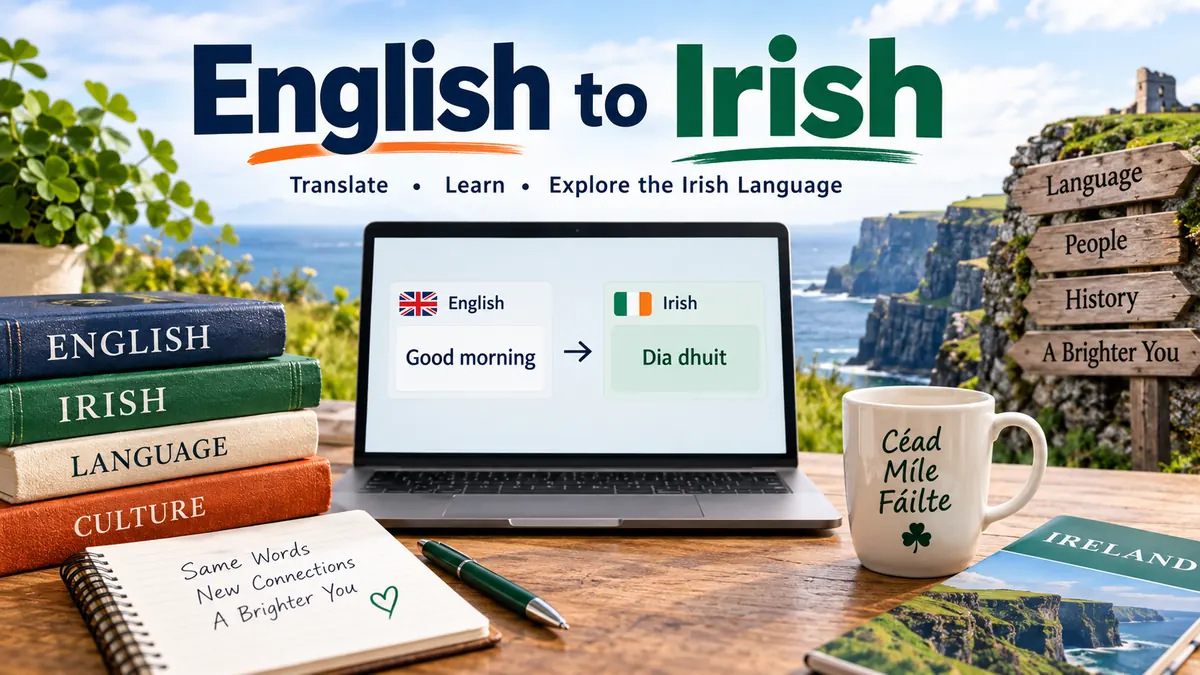
Turning an English sentence into natural Irish is rarely as simple as replacing each English word with an Irish equivalent. Irish—Gaeilge—has its own sentence structure, grammar, initial mutations, verb system, pronunciation, and idiomatic expressions. A translation can therefore be understandable yet still sound unnatural to a fluent speaker.
english to irish translation means converting English words, phrases, or complete texts into Gaeilge while preserving their intended meaning rather than simply translating word for word. Accurate translation requires attention to context, Irish grammar, vocabulary, word order, pronunciation, and sometimes regional dialect. Reliable dictionaries are especially useful when an English word has several possible meanings.
Irish is a Celtic language and is one of Ireland’s official languages. It is also one of the European Union’s 24 official languages; Irish reached equal working status with the EU’s other official languages on 1 January 2022 after the end of a long-standing derogation.
This guide explains how English-to-Irish translation works, where literal translation fails, which resources can help, and how to handle everyday phrases accurately.
What Does english to irish Translation Actually Mean?
When people search for english to irish, they usually want one of several things: the Irish equivalent of an English word, a translation of a sentence, common conversational phrases, help understanding Gaeilge, or a reliable English-Irish dictionary.
One important distinction comes first.
Irish and Irish English are not the same language.
Irish is Gaeilge, a Celtic language. Irish English, sometimes discussed under the broader term Hiberno-English, is the variety of English spoken in Ireland.
For example:
| English | Irish |
|---|---|
| Ireland | Éire |
| Irish language | Gaeilge |
| Welcome | Fáilte |
| Thank you | Go raibh maith agat |
| Good morning | Maidin mhaith |
| Good night | Oíche mhaith |
| Please | Le do thoil |
| Goodbye | Slán |
| School | Scoil |
| House | Teach |
These examples look straightforward, but longer sentences quickly demonstrate why context matters.
An English word may have several senses, and each sense can require a different Irish translation. A good English-Irish dictionary therefore provides meanings, examples, grammatical information, and usage notes instead of giving users a single supposedly universal equivalent.
Foras na Gaeilge’s current dictionary website does exactly this, offering the New English-Irish Dictionary alongside the newer monolingual Irish dictionary, plus grammar information, pronunciation recordings, and usage notes.
Quick Takeaway
Treat an English-to-Irish dictionary entry as a set of possible translations, not an automatic substitution. First determine what the English word means in your particular sentence, then select the Irish expression that communicates that meaning.
Is Irish the Same as Gaelic?
This is one of the most common sources of confusion.
The language is called Irish in English and Gaeilge in Irish. “Irish Gaelic” is sometimes used internationally to distinguish it from Scottish Gaelic, but simply saying Irish is normal and unambiguous in most contexts.
Irish belongs to the Celtic language family. Scottish Gaelic and Manx are closely related Goidelic languages, but they are separate languages.
That distinction matters when choosing translation tools. Selecting Scottish Gaelic when you need Irish can produce entirely different vocabulary, spelling, and grammar.
You may see language selectors use:
- Irish
- Gaeilge
- Irish Gaelic
- Language code ga
If your goal is English-to-Irish translation, Gaeilge is the target language.
How english to irish Translation Works
Good translation starts with meaning.
Imagine translating the English word “bank.” It might refer to a financial institution, a riverbank, or the act of tilting an aircraft. Selecting an Irish word before identifying the intended sense risks producing the wrong translation.
The same principle applies to hundreds of everyday English words.
A practical translation process looks like this:
- Read the complete English sentence.
- Identify the intended meaning of ambiguous words.
- Determine the sentence’s subject, verb, tense, and objects.
- Find context-appropriate Irish vocabulary.
- Reconstruct the sentence according to Irish grammar.
- Apply required grammatical changes and initial mutations.
- Check spelling and terminology.
- Read the finished Irish as an independent sentence.
- Check pronunciation if the translation will be spoken.
- Have important material reviewed by a competent Irish speaker or translator.
This meaning-first approach is more dependable than translating each word independently.
Why dictionaries show several translations
Consider an English dictionary entry containing several numbered meanings. Those divisions matter.
If a word functions as a noun in one sentence and a verb in another, the appropriate Gaeilge translation may change completely.
The New English-Irish Dictionary makes these distinctions explicit. For example, its entry for “standard” separates meanings involving quality, a norm, music, measurement, economics, military usage, and several adjectival meanings.
That is why context is the first question to ask whenever a dictionary returns several possibilities.
English and Irish Grammar Are Different
English speakers often make translation mistakes because they try to preserve English sentence structure.
Irish grammar operates differently.
Irish commonly uses verb-first word order
Modern English normally follows:
Subject + Verb + Object
Irish commonly uses:
Verb + Subject + Object
This is known as VSO word order.
That structural difference alone means that translating English one word at a time frequently produces awkward or incorrect Gaeilge.
Irish nouns have grammatical gender
Irish nouns are grammatically masculine or feminine. Gender can affect other words around the noun, including articles and adjectives.
A learner therefore needs more than the English meaning of a noun. Knowing its grammatical information is part of knowing how to use it correctly.
Adjectives often follow nouns
English normally puts an adjective before its noun:
big house
Irish frequently places the adjective after the noun.
This pattern illustrates why English syntax cannot simply be carried across unchanged.
Irish uses inflected verbs
Verbs can change according to tense, mood, person, and other grammatical factors.
Regular patterns become easier with practice, but Irish also contains important irregular verbs. Learner dictionaries commonly provide verb tables for precisely this reason; Collins, for example, includes tables for common regular and irregular Irish verbs in its learner dictionaries.
The definite article works differently
English uses “the” with relatively little grammatical variation.
Irish article usage interacts with grammatical gender, number, case, and the beginning of the following word. Translators need to consider the entire noun phrase rather than translating “the” independently.
Initial Mutations: A Major Difference from English
One feature learners quickly encounter is the initial mutation.
Under particular grammatical conditions, the beginning of an Irish word changes. Two especially important processes are lenition and eclipsis.
Lenition
Lenition can alter the beginning of a consonant, commonly represented in modern spelling by inserting an h after the initial consonant where applicable.
It is not an optional spelling decoration. The grammatical environment determines when lenition is required.
Eclipsis
Eclipsis places another consonant before the original initial consonant in particular contexts.
Again, this follows grammatical rules.
Initial mutations can be triggered by possessives, prepositions, numbers, grammatical constructions, and other environments.
This creates a common machine-translation problem: a tool may identify the correct base word but fail to produce the appropriate form for its position in the sentence.
Quick Takeaway: When checking an Irish translation, do not only ask whether each vocabulary item is correct. Check whether articles, noun forms, verb forms, adjective agreement, and initial mutations fit the sentence.
Common English to Irish Words and Phrases
Everyday phrases provide a useful starting point for learners because they show vocabulary inside real expressions.
| English phrase | Irish |
|---|---|
| Hello | Dia duit |
| Welcome | Fáilte |
| Thank you | Go raibh maith agat |
| Please | Le do thoil |
| Goodbye | Slán |
| Good morning | Maidin mhaith |
| Good night | Oíche mhaith |
| How are you? | Conas atá tú? |
| I am well | Tá mé go maith |
| Yes | Sea* |
| No | Ní hea* |
| Ireland | Éire |
| Irish | Gaeilge |
| Friend | Cara |
| House | Teach |
| School | Scoil |
| Water | Uisce |
| Food | Bia |
*Irish responses to questions are more complicated than simply substituting universal words for English “yes” and “no.” In many constructions, speakers answer by repeating the relevant positive or negative form of the verb.
That last point is a useful warning against phrase-table learning.
How do you say hello in Irish?
A widely taught greeting is:
Dia duit
It is commonly used as the Irish equivalent of “hello.”
Learners may encounter slightly different forms depending on dialect, speaker, and conversational context. That is normal rather than evidence that one dictionary must be wrong.
How do you say thank you in Irish?
A standard expression is:
Go raibh maith agat
This is one of the most useful phrases for new learners to recognize.
How do you say welcome in Irish?
Fáilte means “welcome.”
It appears frequently on signs, in greetings, and in expressions associated with hospitality.
How do you say goodbye?
Slán is commonly used when saying goodbye.
As with English, however, real conversations contain multiple farewell expressions depending on who is leaving, context, and level of formality.
Why Word-for-Word Translation Often Fails
Suppose an English sentence contains an idiom such as:
“It’s raining cats and dogs.”
A literal translation of every noun and verb would preserve the vocabulary but lose the actual message.
The intended meaning is simply that it is raining heavily.
Translation therefore works at several levels:
| Translation level | What must be preserved |
|---|---|
| Word | Basic lexical meaning |
| Phrase | Meaning of the complete expression |
| Sentence | Grammar and intended message |
| Paragraph | Context and logical relationships |
| Document | Tone, terminology and consistency |
The longer the material becomes, the less useful isolated word substitution is.
This is particularly relevant for emails, educational material, websites, official notices, legal information, subtitles, and public-facing content.
Context Is More Important Than the First Dictionary Result
A reliable dictionary is not merely a bilingual word list.
For example, searching “chair” can refer to furniture, the person leading a meeting, or a university position. A guide to Foclóir.ie demonstrates this problem directly: users are advised to pay attention to definitions and subject labels so they choose the translation matching the intended sense.
When translating a word, ask three questions:
What does it mean here?
Identify the specific sense.
What grammatical role does it play?
Determine whether it is a noun, adjective, verb, or another part of speech.
How would the complete idea normally be expressed in Irish?
This prevents English syntax from controlling the final sentence.
This process takes slightly longer than copying the first search result, but it prevents many obvious mistakes.
The Best Resources for english to irish Translation
Different resources solve different problems.
Foclóir.ie for modern English-to-Irish vocabulary
Foclóir.ie is one of the most useful starting points for English-to-Irish lookup.
It is operated within the dictionary work of Foras na Gaeilge. The New English-Irish Dictionary originally went online beginning in 2013, while its concise print edition appeared in 2020. The online resources include grammatical information, sound files, examples, and usage notes.
Rather than searching an entire paragraph, try looking up the key English words individually and examining their different senses and examples.
Teanglann.ie for dictionaries, grammar, and pronunciation
Teanglann.ie is another major Irish-language resource.
Foras na Gaeilge describes it as its Dictionary and Language Library. It provides digital access to major dictionaries including de Bhaldraithe’s English-Irish Dictionary (1959), Ó Dónaill’s Foclóir Gaeilge-Béarla (1977) and An Foclóir Beag (1991). It also includes grammar and pronunciation resources.
It is particularly useful when you want to investigate an Irish word after finding a translation.
Téarma.ie for terminology
Specialized terminology creates different challenges from everyday vocabulary.
Technical, scientific, administrative, professional, and modern concepts may require an established term rather than an improvised translation.
Foras na Gaeilge’s Terminology Committee develops and approves standardized Irish terminology, and its terminology work supports modern use of the language.
This matters when translating specialized documents where consistent terminology is essential.
Collins for learners
Collins publishes Irish-English and English-Irish learner dictionaries containing everyday vocabulary, grammar guidance, pronunciation information, examples, and verb tables. Its compact Gem dictionary lists 28,000 headwords and 46,000 translations.
A learner dictionary can sometimes be easier for beginners than a highly detailed reference work.
Foclóir.ie vs Teanglann.ie: Which Should You Use?
These resources complement rather than replace each other.
| Need | Useful starting point |
|---|---|
| English word → modern Irish | Foclóir.ie |
| Example sentences | Foclóir.ie |
| Usage information | Foclóir.ie |
| Irish word → English | Teanglann.ie |
| Older major dictionaries | Teanglann.ie |
| Grammar information | Both |
| Pronunciation | Both/resources provided through them |
| Specialist terminology | Téarma.ie |
| Beginner-friendly print dictionary | Collins |
A productive workflow is to find a modern translation through Foclóir.ie, investigate the resulting Gaeilge vocabulary and grammar where necessary, and consult terminology resources for specialist concepts.
Irish Pronunciation Matters as Much as Spelling
A written translation is only half the job if you intend to speak it.
Irish spelling follows systematic patterns, but those patterns are different from English. An English speaker who pronounces Irish words according to English spelling conventions can end up surprisingly far from their normal pronunciation.
This is where audio recordings become valuable.
Foclóir.ie includes sound files and grammatical information, while Foras na Gaeilge’s language resources also provide pronunciation support.
Broad and slender consonants
One fundamental concept in Irish pronunciation is the distinction between broad and slender consonants.
The surrounding vowels provide important information about consonant quality. Irish spelling is therefore doing more work than an English-speaking learner may initially realize.
Rather than trying to invent an English phonetic spelling, listen to a reliable recording and imitate it.
Do all Irish speakers pronounce words identically?
No.
Irish has important regional dialect traditions, particularly associated with the Gaeltacht areas of Connacht, Munster, and Ulster. Vocabulary, pronunciation, and some grammatical forms can vary.
Consequently, two authentic recordings do not necessarily have to sound identical.
This is another reason audio from reliable Irish-language dictionaries is so useful: it exposes learners to actual pronunciation rather than an English approximation.
Standard Irish and Regional Dialects
Learners will often encounter the term An Caighdeán Oifigiúil, or the Official Standard.
The standard helps provide consistency in written Irish, particularly where multiple dialectal forms exist. It should not be interpreted as meaning that legitimate regional forms are “wrong.”
The history of the standard explicitly recognizes the living speech of the Gaeltacht and the existence of valid variants. Its purpose is largely to provide consistent conventions for written usage.
This distinction matters in translation.
For a school assignment, government document, website interface, or broadly distributed written material, standardized forms can provide consistency. In conversation, literature, local communication, or dialect-focused learning, regional forms may be entirely appropriate.
Which Irish dialect should beginners learn?
There is no universal answer that makes the other dialects unnecessary.
If your purpose is general written communication, learning standard written Irish provides a useful foundation. If you have family, educational, cultural, or geographic connections with a particular Gaeltacht region, focusing on that region’s speech can make practical sense.
The key is consistency.
Do not assume every difference between resources is an error; sometimes you are simply seeing legitimate linguistic variation.
How to Get More Accurate English to Irish Translations
Translation quality improves dramatically when the English source text is clear.
1. Write plain English first
Complex English creates complex translation problems.
Instead of:
“We’d really appreciate it if you could possibly get back to us whenever you have a chance.”
A clearer source might be:
“Please reply when you have time.”
You are not removing meaning. You are reducing ambiguity.
2. Translate meaning, not isolated words
Read the complete sentence before choosing vocabulary.
A dictionary cannot determine your intended meaning if you give it insufficient context.
3. Check multiple senses
Never assume the first dictionary definition is automatically correct.
Look at definitions, subject labels, grammatical categories, and examples.
4. Check the Irish grammar
After choosing vocabulary, examine:
- verb form;
- tense;
- word order;
- noun gender;
- article usage;
- adjective agreement;
- prepositions;
- lenition;
- eclipsis;
- spelling.
This is where many translations that initially “look right” break down.
5. Listen to pronunciation
If you will say the phrase aloud, use native or authoritative dictionary audio rather than guessing from spelling.
6. Read the translation independently
Forget the original English for a moment.
Ask whether the Irish sentence stands naturally on its own. This helps expose structures that are grammatically modeled too closely on English.
7. Use human review when accuracy matters
Machine translation is convenient for understanding the general meaning of informal material. It should not automatically be treated as publication-ready Irish.
For contracts, public signage, government communications, healthcare information, advertising, educational materials, or other consequential content, professional review is sensible.
Can Google Translate and AI Translate English to Irish Accurately?
Automated translation can be useful, particularly for quick comprehension and straightforward sentences. Its biggest advantages are speed and accessibility.
But speed is not the same thing as guaranteed linguistic accuracy.
Machine systems may struggle with:
- ambiguous English words;
- idioms;
- unusual sentence structures;
- initial mutations;
- specialist terminology;
- regional expressions;
- tone;
- names and proper nouns;
- context spread across several sentences.
The risk rises when the text becomes specialized or consequential.
A practical approach is to use automated translation for a first pass, then verify important vocabulary against authoritative dictionaries and check grammar independently.
For learning, this checking process is particularly valuable because it explains why the Irish sentence takes its particular form.
Why Back-Translation Helps—but Cannot Prove Accuracy
One popular checking technique is back-translation.
Suppose you translate:
English → Irish
Then take the result and translate:
Irish → English
If the second English sentence is completely different from the original meaning, you have found an obvious warning sign.
But if it comes back perfectly, that still does not prove the Irish is correct.
Two automated systems can normalize an unnatural expression into the same intended English meaning. Back-translation can therefore detect some failures, but it cannot reliably verify grammar, idiom, register, or naturalness.
Use it as a diagnostic check, not certification.
Common Mistakes When Translating English to Irish
Several mistakes appear repeatedly among beginners.
Translating every word independently
This preserves English structure rather than producing natural Gaeilge.
Better approach: translate complete ideas and phrases.
Choosing the first dictionary entry
The first result may represent the wrong meaning.
Better approach: compare definitions and usage examples.
Ignoring initial mutations
The base dictionary form is not necessarily the form required in a sentence.
Better approach: check the grammatical environment.
Treating English “yes” and “no” as universal equivalents
Irish commonly forms positive and negative answers around the verb used in the question.
Better approach: learn question-and-answer patterns rather than memorizing two isolated words.
Assuming spelling tells you the English-style pronunciation
Irish has its own sound system and orthographic conventions.
Better approach: use audio.
Mixing Irish and Scottish Gaelic
They are related but distinct languages.
Better approach: verify that the target language is Irish/Gaeilge or code ga.
Ignoring dialect differences
A legitimate regional form may differ from a standardized written form.
Better approach: decide whether you need standard written Irish or a particular dialect.
Translating Names, Places, and Proper Nouns
Proper nouns require special attention because not every name should be translated.
Some Irish places have established names in both languages. Dublin, for example, is Baile Átha Cliath in Irish, while Ireland is Éire.
Other personal or brand names may remain unchanged.
The correct approach depends on whether an established Irish form exists and on the context in which the translation will appear.
Do not invent an Irish version simply because the rest of a sentence is being translated.
For addresses, legal names, product names, URLs, company names, and technical identifiers, preservation may be particularly important.
English to Irish Translation for School and Learning
For students, a translator works best as a learning aid rather than a shortcut.
If you paste an entire assignment into an automated tool, you may receive a sentence without understanding any of its grammar. That makes it difficult to identify mistakes and does little to develop your Gaeilge.
A stronger learning method is:
- Write a short English sentence.
- Identify its verb, subject, and key vocabulary.
- Look up unfamiliar vocabulary.
- Build the Irish sentence yourself.
- Check the relevant grammar.
- Compare your version with trustworthy examples.
- Listen to important words.
- Record corrections and the reason for each correction.
Over time, recurring structures become recognizable.
Learners also benefit from dictionaries that provide examples rather than isolated definitions. Collins’ learner dictionary, for instance, emphasizes real examples, everyday expressions, grammar support, and guidance for spoken and written Irish.
Translation for Official and Professional Content
The standards become higher when translated material is intended for the public.
Irish has significant institutional status. Ireland’s public-service framework includes obligations concerning services and communications through Irish under the Official Languages Act 2003, as amended in 2021.
Irish is also an official and working language of the European Union. The derogation that had limited the volume of EU material translated into Irish ended on 1 January 2022, placing Irish on the same operational footing as the EU’s other official languages.
Professional translation may therefore involve much more than vocabulary. Translators must maintain:
- terminological consistency;
- grammatical accuracy;
- appropriate register;
- legal or technical meaning;
- formatting;
- names and references;
- consistency across related documents.
Translation memories and language corpora can also help professional translators maintain consistency across large projects. Foras na Gaeilge’s lexicographic infrastructure includes a Corpus of Irish for Lexicography, while earlier dictionary-development work drew on large Irish and English corpora.
Dictionary, Translator, or Human Translator?
Each option serves a different purpose.
| Method | Best suited to | Main limitation |
|---|---|---|
| Bilingual dictionary | Words and short expressions | User must choose correct sense |
| Grammar resource | Understanding forms and structures | Does not translate whole texts |
| Machine translator | Fast drafts and basic comprehension | Can miss context and nuance |
| Terminology database | Technical vocabulary | Narrower than a general dictionary |
| Audio dictionary | Pronunciation practice | Does not solve sentence grammar |
| Human translator | Important or publication-ready material | Requires more time and resources |
For everyday learning, combining several resources often produces the strongest result.
A dictionary helps identify vocabulary. Grammar resources explain how that vocabulary changes. Audio teaches pronunciation. Examples reveal natural usage.
A Better Workflow for Longer English-to-Irish Text
Long passages should not be treated as one enormous sentence.
First, read the entire source so you understand its subject and tone. Then create a small terminology list for recurring words, names, and specialized concepts.
Translate one meaningful section at a time.
Maintain consistent terminology throughout the document. If an English technical term appears twelve times, casually switching between several Irish equivalents may confuse readers even when each term could theoretically work.
After translating, perform separate reviews:
Meaning review: Did anything disappear or change meaning?
Grammar review: Are the Irish structures correct?
Terminology review: Are recurring terms consistent?
Style review: Does it read like natural Gaeilge rather than translated English?
Proofreading review: Are spelling, punctuation, capitalization, numbers, names, and formatting correct?
Separating these checks catches more errors than trying to notice everything during a single reread.
How to Learn English-to-Irish Vocabulary Faster
Memorizing disconnected word pairs has limited value.
Learn vocabulary inside short phrases instead.
Instead of memorizing only:
uisce = water
learn it within useful expressions and sentences. Context reinforces both meaning and grammar.
A simple study routine can include:
- five new words;
- one example sentence for each;
- audio pronunciation;
- the relevant grammatical information;
- one review session the following day;
- another review several days later.
Pay particular attention to common verbs, prepositions, question structures, pronouns, numbers, time expressions, greetings, and everyday nouns.
These high-frequency patterns make new sentences easier to understand.
What Makes an English-to-Irish Translation Sound Natural?
Natural translation is not necessarily the version that resembles the English most closely.
It is the version an Irish speaker could reasonably produce to communicate the same idea.
That may require changing:
- word order;
- sentence length;
- idiom;
- grammatical construction;
- punctuation;
- pronoun use;
- level of formality.
This is the difference between lexical equivalence and effective translation.
If you are unsure about a phrase, search reliable Irish corpora or dictionaries for examples of the proposed structure. Real usage is often more informative than trying to construct a sentence from separate dictionary entries.
Final Thoughts on english to irish Translation
Accurate english to irish translation begins with understanding meaning and ends with checking whether the result works naturally in Gaeilge. Vocabulary is only one part of that process. Word order, verb forms, grammatical gender, initial mutations, idiom, dialect, pronunciation, and context can all affect the final translation.
For everyday vocabulary, start with authoritative resources such as Foclóir.ie and Teanglann.ie. Use pronunciation recordings when speaking Irish, terminology resources for specialized vocabulary, and grammar information whenever a word changes form. For important public, legal, educational, or professional material, add competent human review.
Most importantly, do not ask, “What is the Irish word for each English word?” Ask, “How is this idea naturally expressed in Irish?” That small change in approach leads to much clearer and more reliable Gaeilge.
