

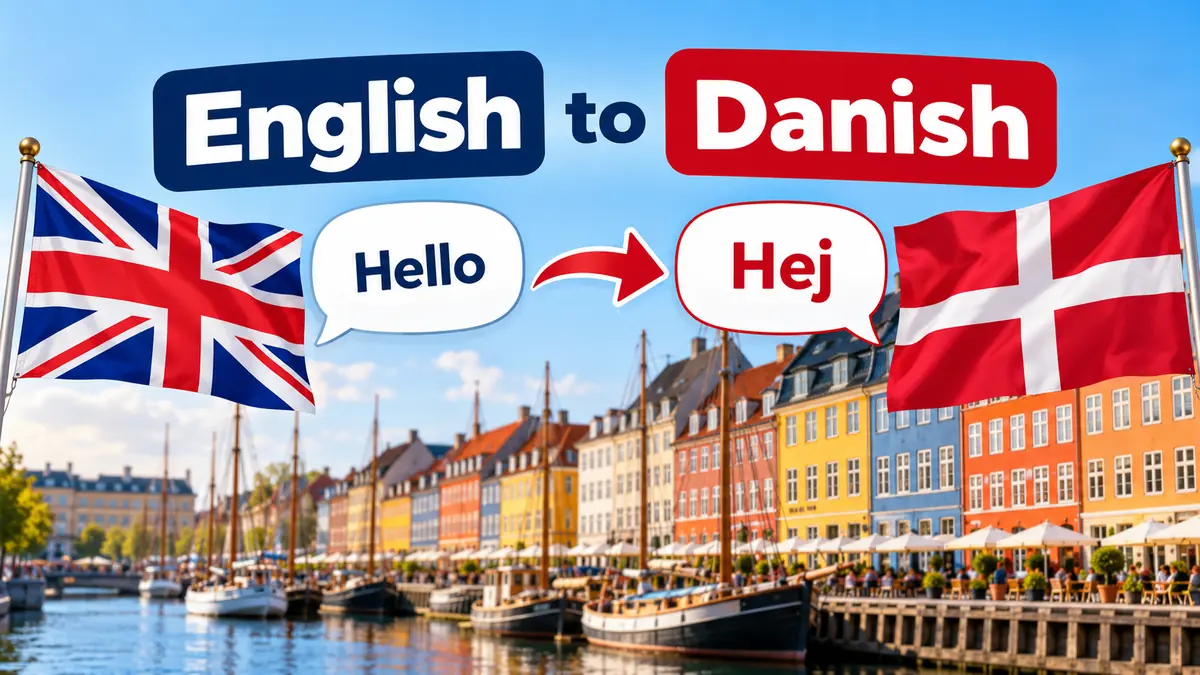
Translating English into Danish can seem straightforward until you encounter unfamiliar letters, unusual word order, or expressions that do not translate literally. A sentence that sounds natural in English may need a different structure to make sense to a Danish speaker.
english to danish translation involves converting English words, sentences, and meanings into Danish while preserving the original message, context, and tone. Accurate translation requires more than replacing individual words. Understanding Danish grammar, pronunciation, vocabulary, and cultural conventions helps produce natural and understandable results.
Danish is the official language of Denmark and belongs to the North Germanic branch of the Indo-European language family. It shares historical and linguistic connections with Swedish, Norwegian, German, and English.
This guide explains how English-to-Danish translation works, introduces everyday vocabulary, compares important grammar rules, and shows how to avoid common translation mistakes.
How Does english to danish Translation Work?
English-to-Danish translation involves interpreting the meaning of English text and expressing that meaning using Danish vocabulary and sentence structure.
The process typically involves three elements:
- Vocabulary: Identifying Danish equivalents for English words.
- Grammar: Adjusting word order, articles, verb forms, and sentence construction.
- Context: Choosing expressions that sound natural to Danish speakers.
Consider this example:
| English | Danish |
|---|---|
| Good morning | Godmorgen |
| Thank you | Tak |
| How are you? | Hvordan har du det? |
| I love Denmark | Jeg elsker Danmark |
| Where is the station? | Hvor er stationen? |
| I don’t understand | Jeg forstår ikke |
These examples demonstrate that some expressions translate directly, while others require changes in sentence structure.
For instance, the English phrase “How are you?” becomes “Hvordan har du det?” in Danish. Translating each word separately would not produce the same natural expression.
Literal Translation vs. Natural Translation
Literal translation follows the original words as closely as possible. Natural translation prioritizes the intended meaning.
The English expression “It’s raining cats and dogs” should not be translated by replacing every word with its Danish equivalent.
A natural Danish expression would be:
Det øsregner.
This means that it is raining very heavily.
Understanding the difference between literal and natural translation is especially useful when translating conversations, idioms, advertisements, and creative writing.
Common English Words and Their Danish Translations
Learning frequently used vocabulary provides a foundation for understanding Danish sentences.
Basic Everyday Vocabulary
| English | Danish |
|---|---|
| Hello | Hej |
| Goodbye | Farvel |
| Yes | Ja |
| No | Nej |
| Please | Vær venlig |
| Thank you | Tak |
| You’re welcome | Selv tak |
| Sorry | Undskyld |
| Good | God |
| Bad | Dårlig |
| Water | Vand |
| Food | Mad |
| House | Hus |
| School | Skole |
| Book | Bog |
| Friend | Ven |
| Family | Familie |
| Work | Arbejde |
| Today | I dag |
| Tomorrow | I morgen |
Some Danish words resemble their English equivalents because both languages belong to the Germanic language family.
For example, the Danish words hus, skole, and familie are recognizable to many English speakers.
However, similar-looking words do not always have identical meanings.
Essential Danish Greetings
Greetings are among the most useful expressions for travelers and language learners.
| English Expression | Danish Translation |
|---|---|
| Hello | Hej |
| Good morning | Godmorgen |
| Good afternoon | God eftermiddag |
| Good evening | Godaften |
| Good night | Godnat |
| See you later | Vi ses senere |
| Have a nice day | Hav en god dag |
| Nice to meet you | Rart at møde dig |
| Welcome | Velkommen |
| How are you? | Hvordan har du det? |
Danish speakers commonly use hej in both informal and everyday professional settings.
The phrase vi ses is another frequently used expression. It literally suggests seeing someone again and functions similarly to “See you” in English.
Useful Danish Travel Phrases
Travelers visiting Copenhagen, Aarhus, Odense, or other Danish destinations can benefit from learning basic expressions.
| English | Danish |
|---|---|
| Do you speak English? | Taler du engelsk? |
| I speak a little Danish | Jeg taler lidt dansk |
| Where is the bathroom? | Hvor er toilettet? |
| How much does it cost? | Hvad koster det? |
| I need help | Jeg har brug for hjælp |
| Where is the hotel? | Hvor er hotellet? |
| Can you help me? | Kan du hjælpe mig? |
| I would like some water | Jeg vil gerne have noget vand |
| I am lost | Jeg er faret vild |
| Thank you very much | Mange tak |
These phrases are particularly helpful when asking for directions, ordering food, shopping, or communicating with local residents.
Understanding Danish Grammar for Accurate Translation
English and Danish share several grammatical features, but important differences affect how sentences should be translated.
Danish Nouns and Grammatical Gender
Danish nouns generally belong to two grammatical genders:
- Common gender, using the indefinite article en.
- Neuter gender, using the indefinite article et.
Examples include:
| English | Danish |
|---|---|
| A book | En bog |
| A house | Et hus |
| A car | En bil |
| A child | Et barn |
| A dog | En hund |
| An apple | Et æble |
Unlike English, Danish often attaches the definite article to the end of a noun.
For example:
| English | Danish |
|---|---|
| A book | En bog |
| The book | Bogen |
| A house | Et hus |
| The house | Huset |
| A car | En bil |
| The car | Bilen |
This suffix system is a major difference between Danish and English grammar.
When an adjective appears before a definite noun, Danish normally uses a separate definite article instead.
For example, “the big house” becomes det store hus.
Danish Sentence Structure and Word Order
Both English and Danish commonly use subject-verb-object order in simple statements.
English: “I read a book.”
Danish: Jeg læser en bog.
However, Danish follows the verb-second rule in main clauses. The finite verb normally appears in the second grammatical position, even when the sentence begins with an adverb or another phrase.
Compare these examples:
| English | Danish |
|---|---|
| I am going home today | Jeg tager hjem i dag |
| Today I am going home | I dag tager jeg hjem |
| She speaks Danish | Hun taler dansk |
| Tomorrow we will travel | I morgen rejser vi |
In the second example, i dag appears first, followed by the verb tager, and then the subject jeg.
This differs from ordinary English word order and is a common source of translation mistakes.
Danish Verb Conjugation
Danish verbs are generally simpler than English verbs in one important respect: they do not change according to the grammatical person.
Consider the present tense of at tale, meaning “to speak.”
| English | Danish |
|---|---|
| I speak | Jeg taler |
| You speak | Du taler |
| He speaks | Han taler |
| She speaks | Hun taler |
| We speak | Vi taler |
| They speak | De taler |
The Danish verb taler remains unchanged across these subjects.
English, by contrast, changes “speak” to “speaks” with third-person singular subjects.
Danish also uses auxiliary verbs to express certain tenses and meanings.
For example:
- I have eaten — Jeg har spist.
- I can swim — Jeg kan svømme.
- I will call tomorrow — Jeg vil ringe i morgen.
The auxiliary vil can express intention or willingness, so the best translation of English “will” depends on context.
Adjective Agreement in Danish
Danish adjectives may change according to gender, number, and definiteness.
For example:
| English | Danish |
|---|---|
| A big car | En stor bil |
| A big house | Et stort hus |
| Big houses | Store huse |
| The big house | Det store hus |
The adjective stor changes to stort with a neuter singular noun and store in plural or definite constructions.
Ignoring adjective agreement can make an otherwise understandable translation grammatically incorrect.
Danish Pronunciation and Alphabet Differences
One of the biggest challenges in learning Danish is pronunciation. Although Danish uses the Latin alphabet, its spoken sounds can differ considerably from their written forms.
The Danish alphabet contains 29 letters, including three additional vowels:
- Æ
- Ø
- Å
These letters are separate characters, not decorative variations of English letters.
Understanding Æ, Ø, and Å
| Danish Letter | Example | Meaning |
|---|---|---|
| Æ | Æble | Apple |
| Ø | Øl | Beer |
| Å | År | Year |
The letter æ often represents a vowel similar to the English vowel in “bed,” although its exact pronunciation varies.
The letter ø represents a rounded front vowel without a direct English equivalent. The letter å can represent sounds resembling the vowel in some pronunciations of “thought.”
Danish has a rich vowel system, and pronunciation can change depending on neighboring sounds, stress, and speaking style.
Ordnet
+1
Why Is Danish Pronunciation Difficult?
Danish pronunciation presents several challenges for English speakers.
First, written letters do not always correspond directly to their expected sounds. Some consonants are softened or reduced in everyday speech.
Second, Danish uses a pronunciation feature called stød, a type of laryngealization that can help distinguish certain words.
Third, unstressed syllables are frequently reduced, making spoken Danish sound different from carefully pronounced written examples.
For example, the Danish word mad, meaning “food,” contains a final consonant that does not sound like an ordinary English “d.”
Listening to native recordings is more effective than trying to pronounce Danish words entirely from their spelling.
Best Methods for english to danish Translation
There are several ways to translate English into Danish. The most appropriate method depends on the complexity of the text and the accuracy required.
Using Online Translation Tools
Online translation services can quickly translate individual words, complete sentences, and longer passages.
Common resources include:
| Translation Resource | Main Use |
|---|---|
| Google Translate | General text, images, documents, and website translation |
| DeepL Translator | Context-based text and document translation |
| Cambridge Dictionary | Checking vocabulary and word meanings |
| Den Danske Ordbog | Understanding Danish definitions, usage, and pronunciation |
Google Translate provides English-to-Danish translation alongside document, image, and website translation features.
translate.google.dk
+1
The Cambridge English–Danish Translator also supports translation and access to dictionary entries for individual words.
Cambridge
Machine translation is useful for understanding everyday content, but it should not automatically be treated as error-free.
Step-by-Step Translation Process
A reliable translation workflow includes five steps.
- Read the entire English sentence. Identify the intended meaning before translating individual words.
- Translate the text into Danish. Use your language knowledge, a dictionary, or an appropriate translation tool.
- Check the grammar. Review noun gender, adjective endings, verb forms, and word order.
- Review the context. Confirm that idioms, technical terminology, and tone are appropriate.
- Read the Danish result naturally. Look for awkward wording, missing information, or expressions that sound overly literal.
For example, consider the English sentence:
“I am looking forward to meeting you.”
A natural Danish translation is:
Jeg glæder mig til at møde dig.
The Danish construction glæder mig til expresses anticipation. It should be understood as a complete expression rather than translated word by word.
Translating Long Documents
Longer documents require additional attention because meaning often depends on information introduced earlier.
A pronoun in one paragraph may refer to a person or organization mentioned several sentences before. A translation tool processing isolated sentences might lose that relationship.
When translating reports, articles, or instructions, maintain consistent terminology throughout the document.
Preserve headings, numbers, names, dates, and formatting where appropriate. Review the final translation as a complete document rather than as unrelated sentences.
For legal, medical, or official material, a qualified human translator may be necessary because small wording differences can have significant consequences.
Common Mistakes When Translating English into Danish
Several translation errors occur repeatedly among beginners and automated systems.
Confusing Similar-Looking Words
English and Danish share linguistic roots, but not every similar-looking word has the same meaning.
Consider the Danish word eventuelt.
It usually means “possibly,” “if applicable,” or “alternatively,” depending on context. It does not normally mean the English word “eventually.”
The English sentence “Eventually, we found the answer” could be translated as:
Til sidst fandt vi svaret.
Choosing eventuelt simply because it resembles “eventually” would change the meaning.
Translating English Idioms Literally
Idiomatic expressions often require a different Danish phrase.
| English Expression | Natural Danish Equivalent |
|---|---|
| It’s raining cats and dogs | Det øsregner |
| Better late than never | Bedre sent end aldrig |
| Practice makes perfect | Øvelse gør mester |
| To break the ice | At bryde isen |
| Time flies | Tiden flyver |
Some idioms have close equivalents, while others require a completely different expression.
The safest approach is to identify the meaning of the original idiom before searching for a Danish equivalent.
Using the Wrong Word for “You”
English uses “you” for both singular and plural audiences.
Danish distinguishes between:
- Du — singular informal “you.”
- I — plural “you.”
- De — formal “you,” now uncommon in ordinary conversation.
For example:
“Are you ready?” addressed to one person becomes:
Er du klar?
Addressed to several people, it becomes:
Er I klar?
Failing to identify the audience can result in an incorrect pronoun.
Misplacing Danish Negation
The Danish word ikke commonly means “not.”
Compare:
English: “I understand.”
Danish: Jeg forstår.
English: “I do not understand.”
Danish: Jeg forstår ikke.
In main clauses, ikke generally appears after the finite verb. In subordinate clauses, its placement is different.
For example:
“I know that he does not understand.”
Jeg ved, at han ikke forstår.
Recognizing this difference helps prevent unnatural sentence construction.
Ignoring Context and Tone
An English word may have several Danish translations.
The word “right,” for example, can mean:
- Højre — the direction right.
- Rigtig — correct or right.
- Ret — a right or entitlement in certain contexts.
The correct translation depends on the sentence.
A dictionary may list all these meanings, but the translator must determine which one fits.
english to danish Translation for Different Situations
Translation requirements vary depending on whether the text is a casual message, educational material, professional communication, or technical documentation.
Everyday Conversations
Conversational Danish often uses shorter, more natural expressions than formal written language.
For example:
English: “I would like a cup of coffee.”
Danish: Jeg vil gerne have en kop kaffe.
English: “What are you doing?”
Danish: Hvad laver du?
English: “See you tomorrow.”
Danish: Vi ses i morgen.
These expressions are useful because they reflect ordinary communication rather than rigid word-for-word translation.
Academic and Educational Translation
Students translating educational material must preserve terminology and logical relationships.
For example:
English: “The experiment demonstrates the relationship between temperature and pressure.”
Danish: Forsøget viser sammenhængen mellem temperatur og tryk.
The Danish word sammenhæng communicates the idea of a relationship or connection.
Academic translations should prioritize clarity, consistency, and accurate technical vocabulary.
Professional and Business Communication
Business translation requires attention to politeness, tone, and cultural expectations.
Consider this English email opening:
“Dear Mr. Jensen, thank you for your message.”
A suitable Danish version is:
Kære hr. Jensen, tak for din besked.
Danish professional communication often uses direct, relatively informal language, but the appropriate tone depends on the relationship and organization.
Translating an English business message too literally may produce wording that sounds unnecessarily stiff.
Website and Digital Content Translation
Website translation involves more than converting visible text.
Headings, navigation menus, product descriptions, instructions, and interface labels should be understandable to Danish users.
For example:
| English Interface Text | Danish |
|---|---|
| Home | Forside |
| Contact us | Kontakt os |
| Read more | Læs mere |
| Search | Søg |
| Settings | Indstillinger |
| Privacy policy | Privatlivspolitik |
| Terms and conditions | Vilkår og betingelser |
Website localization may also require adjusting dates, currencies, measurements, and regional terminology.
For Danish audiences, dates are commonly written in day-month-year order, and decimal numbers generally use a comma rather than a period.
A price written as “1,299.50” in English-language formatting may appear as “1.299,50” in Danish formatting.
These details affect readability and should be checked separately from the language itself.
How to Improve Your Danish Translation Skills
Becoming better at translating English into Danish requires practice with real language rather than memorizing isolated vocabulary.
Build Vocabulary Around Common Topics
Start with subjects that appear frequently in everyday life, such as family, food, travel, education, work, and transportation.
Learning related words together makes them easier to remember.
For example, a transportation vocabulary group might include:
| English | Danish |
|---|---|
| Train | Tog |
| Bus | Bus |
| Bicycle | Cykel |
| Ticket | Billet |
| Airport | Lufthavn |
| Station | Station |
| Road | Vej |
| Journey | Rejse |
Use each new word in a complete sentence to understand how it functions grammatically.
Practice Translation in Both Directions
Translating English into Danish develops writing and sentence-construction skills.
Translating Danish back into English helps test comprehension.
For example:
English: “The children are playing in the garden.”
Danish: Børnene leger i haven.
Translate the Danish sentence back into English without looking at the original.
This exercise helps reveal missing details and grammatical misunderstandings.
However, a successful back-translation does not guarantee that the original Danish sentence is natural. It is only one useful checking technique.
Listen to Spoken Danish
Written Danish and spoken Danish can differ significantly.
Listening to Danish news, podcasts, interviews, and educational recordings helps learners recognize reduced sounds and common speech patterns.
Pay particular attention to frequently used expressions such as jeg ved ikke (“I don’t know”) and det er godt (“that’s good”).
Repeated exposure makes it easier to connect written words with their spoken forms.
Learn Grammar Through Complete Sentences
Instead of memorizing rules in isolation, study how those rules appear in real sentences.
For example, compare:
Jeg spiser morgenmad. — I eat breakfast.
I dag spiser jeg morgenmad hjemme. — Today I eat breakfast at home.
Jeg spiser ikke morgenmad. — I do not eat breakfast.
These sentences demonstrate ordinary word order, verb-second structure, and negation.
Practicing variations of the same sentence is an effective way to recognize recurring grammatical patterns.
Check Words in a Reliable Dictionary
When a translation seems uncertain, consult a dictionary that provides definitions, examples, and grammatical information.
Bilingual dictionaries are helpful for finding possible equivalents. Monolingual Danish dictionaries are useful for understanding how Danish words are actually used.
Pay attention to whether a word is formal, informal, technical, outdated, or restricted to a particular context.
English vs. Danish: Important Language Differences
Understanding the broader differences between English and Danish makes translation easier.
| Feature | English | Danish |
|---|---|---|
| Language family | West Germanic | North Germanic |
| Alphabet | 26 letters | 29 letters |
| Grammatical gender | Limited in nouns | Common and neuter |
| Definite articles | Usually separate words | Often noun suffixes |
| Verb conjugation | Changes with some subjects | Generally unchanged by person |
| Main-clause word order | Usually subject-verb-object | Verb-second |
| Additional letters | None | Æ, Ø, Å |
| Pronunciation | Varies by dialect | Extensive vowel variation and sound reduction |
Despite these differences, English speakers may recognize many Danish words because the languages share Germanic origins and have influenced one another historically.
Danish also has similarities with Norwegian and Swedish, although pronunciation and vocabulary differences can affect mutual understanding.
How Accurate Are Automatic English-to-Danish Translators?
Automatic translation tools can produce useful results for everyday sentences and straightforward informational content.
However, accuracy depends on the complexity and context of the material.
Simple sentences with clear meanings are generally easier to translate than idioms, humor, specialized terminology, or ambiguous passages.
For example:
“The bank is closed.”
Without additional context, the English word “bank” could refer to a financial institution or the side of a river.
A translation system needs surrounding information to choose the correct Danish term.
When Machine Translation Is Usually Helpful
Machine translation can be useful for understanding everyday messages, finding the general meaning of webpages, reviewing unfamiliar vocabulary, and preparing informal communication.
It is also valuable as an initial draft that can be checked and improved.
When Human Review Is Necessary
Human review becomes more important when the text contains legal obligations, medical information, contractual terms, culturally sensitive expressions, or specialized technical language.
A translation may be grammatically correct while still communicating the wrong meaning.
For important material, accuracy should be evaluated by someone who understands both the subject matter and the Danish language.
Conclusion
Learning english to danish translation becomes easier when you focus on meaning, grammar, pronunciation, and context rather than replacing words individually.
Danish shares useful similarities with English, but features such as grammatical gender, verb-second word order, definite noun endings, and the letters Æ, Ø, and Å require special attention.
Online translators and bilingual dictionaries can help with vocabulary and initial translations. For natural, reliable results, review complete sentences, check unfamiliar expressions, and practice with authentic Danish.
Start with common phrases, gradually introduce more complex sentences, and use listening and reading practice to strengthen your understanding of how Danish is actually spoken and written.
