

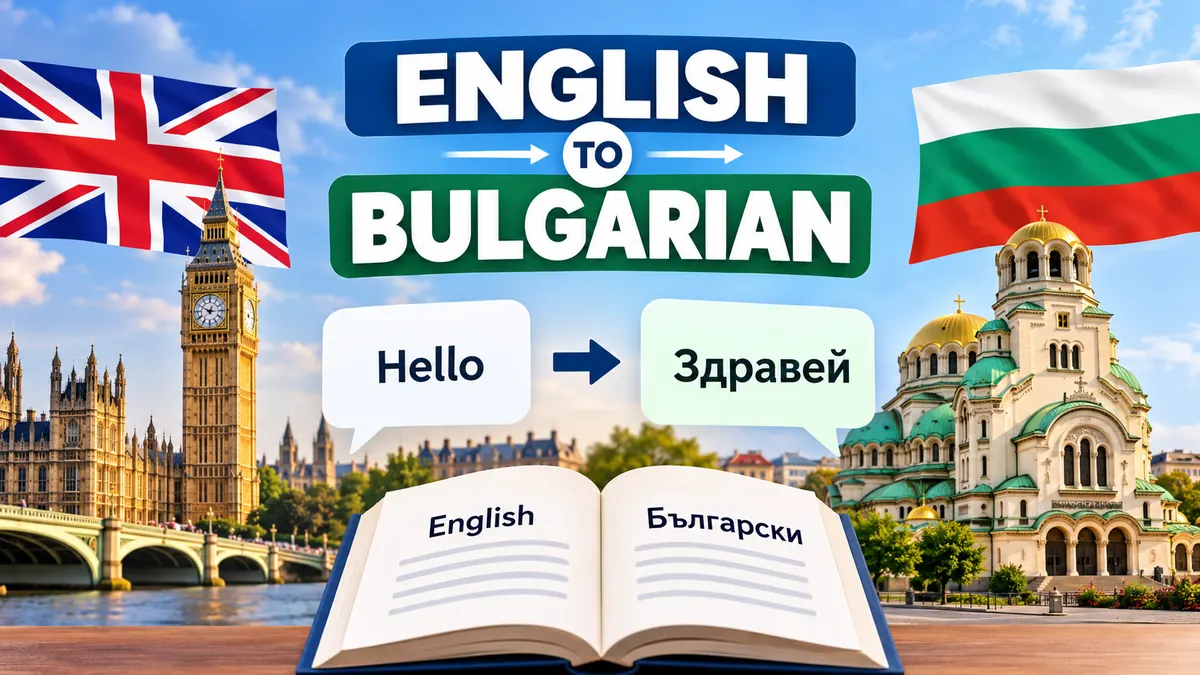
Translating English into Bulgarian involves more than replacing one word with another. Bulgarian uses the Cyrillic alphabet and has its own grammar, pronunciation, verb forms, and ways of expressing politeness and context.
If you need english to bulgarian translation for travel, study, everyday conversation, work, or understanding Bulgarian text, learning a few basic patterns can make translations much easier to understand and check.
English to Bulgarian translation converts English words, sentences, or documents into Bulgarian, a South Slavic language written in Cyrillic. Accurate translation depends on context because grammar, word order, gender, verb aspect, definite articles, and formal or informal speech can change the correct Bulgarian wording.
English to Bulgarian Translation Basics
Bulgarian is the official language of Bulgaria and belongs to the South Slavic branch of the Indo-European language family. Modern Bulgarian is written using a Cyrillic alphabet containing 30 letters.
That immediately creates an important difference for English speakers. English uses the Latin alphabet, while Bulgarian uses Cyrillic.
For example:
| English | Bulgarian | Transliteration |
|---|---|---|
| Hello | Здравей | Zdravey |
| Good morning | Добро утро | Dobro utro |
| Thank you | Благодаря | Blagodarya |
| Please | Моля | Molya |
| Yes | Да | Da |
| No | Не | Ne |
| Goodbye | Довиждане | Dovizhdane |
These everyday translations illustrate why transliteration can be useful when you are first learning Bulgarian. It represents Cyrillic words with Latin letters so an English speaker can get an approximate idea of how to read them.
Transliteration, however, is not translation. Writing Благодаря as Blagodarya represents the Bulgarian word in Latin characters; translating it as Thank you gives its English meaning.
How to Translate English to Bulgarian Accurately
For a short word or simple sentence, translation may seem straightforward. Longer sentences require more attention to context.
A practical process is:
- Read the complete English sentence before translating individual words.
- Identify its intended meaning and tone.
- Determine whether the Bulgarian should be formal or informal.
- Translate the meaning rather than mechanically copying English structure.
- Check noun gender, articles, pronouns, and verb forms.
- Review the Bulgarian sentence for natural word order.
- Verify important terminology using a dictionary or contextual examples.
- Have high-stakes translations reviewed by a qualified human translator.
Context is particularly important with words that have several meanings.
Consider the English word bank. Depending on the sentence, it could refer to a financial institution or the side of a river. A translator needs the surrounding sentence to determine which meaning is intended.
This is one reason dictionary resources that provide definitions and example sentences can be more informative than a simple word-for-word result. Glosbe, for example, provides contextual examples and information from translation-memory resources for English-Bulgarian searches.
Understanding the Bulgarian Cyrillic Alphabet
One of the first things English speakers notice about Bulgarian is its writing system.
The modern Bulgarian alphabet has 30 letters:
А Б В Г Д Е Ж З И Й К Л М Н О П Р С Т У Ф Х Ц Ч Ш Щ Ъ Ь Ю Я
Bulgarian Cyrillic contains several letters that resemble Latin characters but do not necessarily represent the sound an English reader might expect.
For example:
| Bulgarian Letter | Approximate Sound |
|---|---|
| А | a |
| Б | b |
| В | v |
| Г | g |
| Д | d |
| Е | e |
| Ж | zh |
| З | z |
| И | i |
| Й | y |
| К | k |
| Л | l |
| М | m |
| Н | n |
| О | o |
| П | p |
| Р | r |
| С | s |
| Т | t |
| У | u |
| Ф | f |
| Х | h/kh |
| Ц | ts |
| Ч | ch |
| Ш | sh |
| Ю | yu |
| Я | ya |
The pronunciation descriptions above are approximations. Actual Bulgarian pronunciation cannot always be represented perfectly with English spelling.
Cyrillic Letters That Can Confuse English Speakers
Some Cyrillic characters look familiar but represent different sounds.
В resembles English B but represents a v sound.
Н resembles English H but generally represents n.
Р resembles English P but represents a rolled or tapped r sound.
С resembles English C but represents s.
Recognizing these differences makes Bulgarian names, road signs, menus, and everyday vocabulary considerably easier to read.
Common English to Bulgarian Words
Learning frequently used vocabulary is useful even when you normally rely on a translator.
| English | Bulgarian |
|---|---|
| Hello | Здравей |
| Thanks | Благодаря |
| Please | Моля |
| Sorry | Съжалявам |
| Yes | Да |
| No | Не |
| Water | Вода |
| Food | Храна |
| House | Къща |
| Hotel | Хотел |
| Restaurant | Ресторант |
| Help | Помощ |
| Today | Днес |
| Tomorrow | Утре |
| Good | Добър |
| English | Английски |
| Bulgarian | Български |
Some Bulgarian words change form depending on gender, number, grammatical function, or surrounding words. A vocabulary table is therefore a starting point rather than a substitute for understanding sentences in context.
Useful English to Bulgarian Phrases
For travel and everyday communication, complete phrases are often more valuable than isolated vocabulary.
Greetings and Polite Expressions
| English | Bulgarian |
|---|---|
| Hello | Здравей |
| Good morning | Добро утро |
| Good evening | Добър вечер |
| Good night | Лека нощ |
| Thank you | Благодаря |
| Please | Моля |
| Goodbye | Довиждане |
| Sorry | Съжалявам |
Common phrase resources consistently use forms such as Добро утро, Благодаря, Моля, and Довиждане for everyday communication.
Questions and Communication
| English | Bulgarian |
|---|---|
| How are you? | Как си? |
| What is your name? | Как се казваш? |
| I understand | Разбирам |
| I don’t understand | Не разбирам |
| Can you help me? | Можеш ли да ми помогнеш? |
| What time is it? | Колко е часът? |
| Where is the restroom? | Къде е тоалетната? |
| How much is this? | Колко струва това? |
These examples also reveal an important feature of Bulgarian: the exact wording can change according to formality, number, gender, and the relationship between speakers.
English and Bulgarian Grammar Differences
Good english to bulgarian translation requires understanding that the two languages organize information differently.
Bulgarian Uses Grammatical Gender
Bulgarian nouns have grammatical gender: masculine, feminine, or neuter.
This can affect adjectives and other words associated with the noun.
English does not normally require this kind of agreement, so translating an adjective without knowing the noun it describes may produce the wrong form.
Bulgarian Uses Definite Articles Differently
English places the definite article the before a noun:
the book
Bulgarian typically expresses definiteness with an ending attached to the noun or noun phrase rather than a separate word before it. Bulgarian’s postposed definite article is one of its distinctive grammatical features.
That means an English sentence should not simply be reconstructed word by word in Bulgarian.
Bulgarian Has Largely Lost the Noun Case System
Many Slavic languages make extensive use of grammatical cases. Modern Bulgarian is unusual within the Slavic family because it has largely lost the elaborate noun-declension case system found in languages such as Russian. Instead, relationships are commonly expressed through prepositions and sentence structure.
This can make certain parts of Bulgarian grammar more approachable for English speakers, although other areas remain complex.
Verbs Carry Important Information
Bulgarian verbs communicate information about tense, person, number, and aspect.
Verb aspect is especially significant. Perfective and imperfective forms can describe an action differently depending on whether it is viewed as completed, ongoing, repeated, or considered in another temporal way.
A literal English translation may fail when it ignores these distinctions.
Formal vs Informal Bulgarian
One common translation mistake is choosing a grammatically possible phrase that is socially inappropriate.
English you can refer to one person or several people and can be used in both formal and informal situations.
Bulgarian distinguishes between forms such as:
ти — informal singular “you”
вие — plural “you” and also a polite/formal form of address
This distinction affects verbs and other parts of the sentence.
For example, a phrase intended for a friend may differ from one used when addressing a stranger, customer, official, or older person.
When translating professional correspondence, customer messages, official communication, or polite requests, tone should therefore be checked alongside literal meaning.
Why Word-for-Word Translation Can Fail
Literal translation is tempting because it appears predictable. Languages, however, do not always divide meaning in the same way.
Idioms provide an obvious example. Translating each word separately may produce a Bulgarian sentence that is technically understandable but unnatural—or one that communicates something completely different.
The same problem occurs with:
- phrasal verbs;
- idiomatic expressions;
- humor and sarcasm;
- slang;
- professional terminology;
- cultural references;
- ambiguous pronouns;
- words with several meanings.
A better question is not simply, “What does each English word mean in Bulgarian?”
Ask: “How would a Bulgarian speaker naturally express this idea?”
That shift usually produces a much better translation.
English to Bulgarian Pronunciation
Reading Bulgarian and pronouncing Bulgarian are related skills, but they are not identical.
A transliteration such as:
Благодаря → Blagodarya
can help an English speaker approach the word, but Latin letters cannot perfectly represent every Bulgarian sound or stress pattern.
Bulgarian pronunciation also includes sounds and combinations that may initially be unfamiliar to English speakers.
For language learning, combine three forms whenever possible:
Cyrillic: Благодаря
Transliteration: Blagodarya
Meaning: Thank you
Then listen to native or reliable audio pronunciation rather than depending indefinitely on transliteration.
Resources offering pronunciation alongside contextual translations can be particularly useful because learners can connect spelling, sound, and meaning.
Can You Translate English to Bulgarian Online?
Yes. Online translation tools can quickly convert English words, sentences, and larger pieces of text into Bulgarian.
Google Translate supports text translation as well as document, image, and website translation interfaces.
DeepL Translator provides text and file translation services.
Glosbe English-Bulgarian Dictionary is useful for checking translations in context, including example sentences and dictionary information.
Machine translation is especially convenient for understanding everyday text, getting the general meaning of a message, or producing a first draft.
It should not automatically be treated as a final translation for every purpose.
How Reliable Is Automatic English to Bulgarian Translation?
Machine translation has improved considerably, but accuracy depends on what you translate.
Simple sentences with clear context are generally easier than:
- idioms;
- creative writing;
- legal documents;
- medical information;
- technical terminology;
- marketing copy;
- ambiguous sentences;
- jokes and wordplay;
- highly formal correspondence.
Even a grammatically correct result can miss the intended tone.
For casual communication, an automatic translation may be sufficient. For legal, medical, immigration, contractual, academic, or other high-stakes material, professional review is much safer.
A Practical Accuracy Check
After translating an important sentence:
- Check unfamiliar Bulgarian words in a dictionary.
- Look at example sentences rather than definitions alone.
- Verify names, numbers, dates, and technical terminology separately.
- Check whether the tone should be formal or informal.
- Read the complete translated paragraph rather than reviewing words individually.
- Ask a proficient Bulgarian speaker or professional translator to review important material.
Back-translation—translating the Bulgarian result back into English—can sometimes expose obvious problems, but it does not prove that the Bulgarian is natural or fully accurate.
English to Bulgarian for Travel
A small amount of Bulgarian can be useful when visiting Bulgaria, especially for greetings, directions, restaurants, shopping, transportation, and everyday courtesy.
Useful travel expressions include:
| Situation | English | Bulgarian |
|---|---|---|
| Greeting | Hello | Здравей |
| Courtesy | Thank you | Благодаря |
| Request | Please | Моля |
| Understanding | I don’t understand | Не разбирам |
| Help | Can you help me? | Можеш ли да ми помогнеш? |
| Shopping | How much is this? | Колко струва това? |
| Direction | Where is the restroom? | Къде е тоалетната? |
| Leaving | Goodbye | Довиждане |
Learning Cyrillic can also make signs, place names, transportation information, and menus easier to recognize.
A practical Bulgarian phrasebook may go beyond basic greetings to cover transportation, banking, healthcare, restaurants, accommodation, emergencies, numbers, dates, and official situations.
English to Bulgarian for Documents
Document translation requires more care than translating a casual message.
Before translating a document, identify:
- its intended audience;
- whether terminology must remain consistent;
- whether names should be translated or transliterated;
- whether formatting matters;
- whether an official or certified translation is required;
- whether the document contains sensitive information.
Some online tools support uploaded documents directly. Google Translate currently presents document translation for formats including DOCX, PDF, PPTX, and XLSX, while DeepL also provides document translation functionality.
For official purposes, however, always check the requirements of the organization receiving the document. An automated translation may not satisfy requirements for certified or professionally prepared translations.
Translation vs Transliteration
These two concepts are easy to confuse.
Translation changes meaning from one language to another.
English:
Thank you
Bulgarian translation:
Благодаря
Transliteration changes the writing system while attempting to represent the same Bulgarian word:
Благодаря → Blagodarya
Transliteration is useful for pronunciation assistance, maps, names, addresses, and learners who have not yet mastered Cyrillic.
It should not replace the original Bulgarian spelling when accurate written Bulgarian is required.
Common English to Bulgarian Translation Mistakes
Several mistakes appear repeatedly when English speakers work with Bulgarian.
Translating every word independently. Context determines meaning, so individual dictionary entries are not always enough.
Ignoring formal and informal speech. Choosing the wrong form of “you” can change the tone of a sentence.
Relying completely on transliteration. Transliteration helps beginners read words, but learning Cyrillic provides a more reliable foundation.
Ignoring grammatical gender. Adjectives and related forms may need to agree with nouns.
Copying English word order mechanically. A sentence can be understandable yet still sound unnatural.
Using the first dictionary meaning. Words with multiple senses require contextual checking.
Trusting machine translation for high-stakes material without review. Legal, medical, academic, and official documents deserve additional verification.
How to Improve Your Bulgarian Translations
Accuracy improves quickly when you combine translation tools with basic language knowledge.
Start by learning the Bulgarian Cyrillic alphabet rather than depending permanently on Latin transliteration. The alphabet has only 30 letters, making it a manageable first step for beginners.
Next, learn phrases rather than isolated vocabulary. A phrase teaches you vocabulary, grammar, and natural word combinations at the same time.
Compare contextual examples when a word has multiple meanings. Translation-memory and dictionary resources can show how the same term behaves in different sentences.
Finally, separate casual translation from important translation. A quick automatic result can be perfectly useful for understanding an ordinary message, while a contract or official document requires a much higher level of checking.
Final Thoughts on english to bulgarian
Successful english to bulgarian translation is about communicating meaning naturally rather than replacing English words one by one. Bulgarian uses Cyrillic, grammatical gender, postposed definite articles, formal and informal forms of address, and verb distinctions that do not always map neatly onto English.
For everyday words and travel phrases, online translators and English-Bulgarian dictionaries can provide fast assistance. For learning, combine Cyrillic spelling, pronunciation, contextual examples, and complete phrases. For professional or high-stakes documents, use automatic translation as a starting point and have the final Bulgarian reviewed by someone with appropriate language expertise.
