

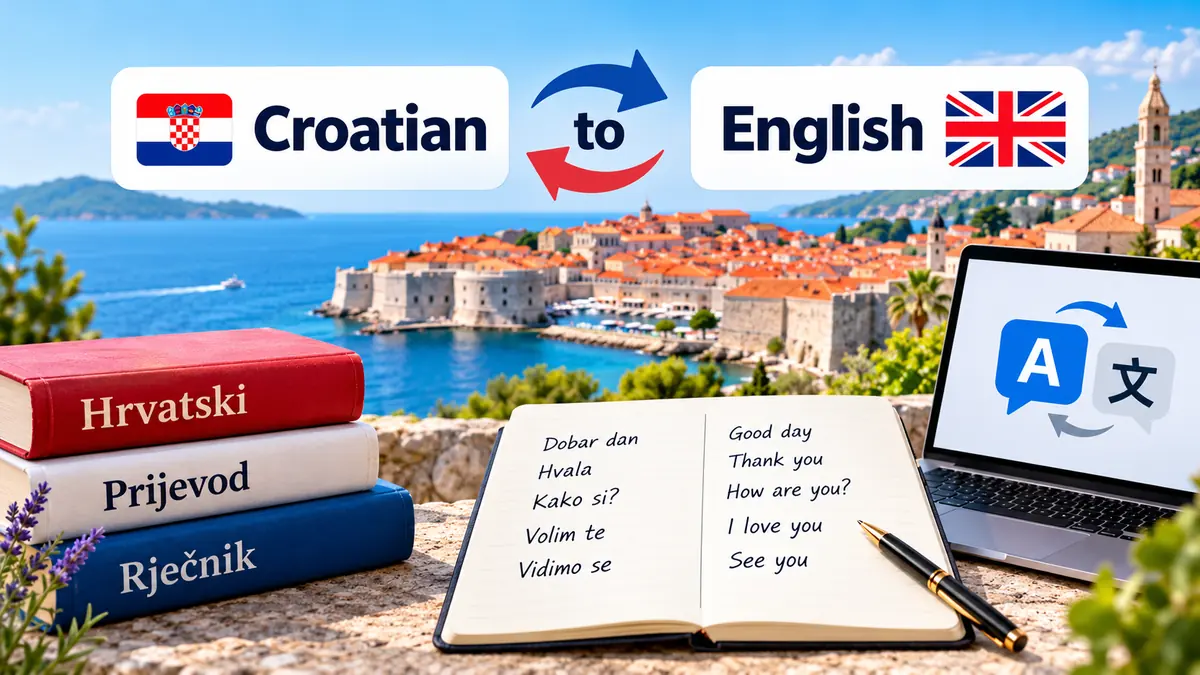
Translating Croatian into English involves more than replacing words with their dictionary equivalents. Croatian uses grammatical cases, flexible word order, and verb forms that can change the meaning of a sentence. Even a short phrase may need restructuring to sound natural in English.
Croatian to English translation is the process of converting written or spoken Croatian into accurate, understandable English while preserving the original meaning, tone, and context. Good translation considers Croatian grammar, vocabulary, pronunciation, regional expressions, and cultural differences rather than relying exclusively on literal word-for-word substitutions.
This guide explains how Croatian translation works, introduces essential vocabulary, compares the two languages, and demonstrates practical ways to translate sentences accurately.
How croatian to english Translation Works
Croatian (hrvatski) is a South Slavic language and the official language of Croatia. It is also one of the official languages of the European Union.
English belongs to the Germanic branch of the Indo-European language family, while Croatian belongs to the Slavic branch. Although they share distant linguistic ancestry, their grammatical systems differ considerably.
A Croatian sentence can communicate information through word endings that English typically expresses using word order, prepositions, and auxiliary verbs.
For example:
| Croatian | English |
|---|---|
| Dobar dan | Good afternoon / Good day |
| Kako si? | How are you? |
| Hvala | Thank you |
| Molim | Please / You’re welcome |
| Dobro jutro | Good morning |
| Laku noć | Good night |
| Vidimo se | See you |
| Volim te | I love you |
Notice that molim has more than one possible translation. Its meaning depends on the conversation.
This illustrates a central principle: accurate translation requires context.
Why literal translation can be misleading
Consider the Croatian expression Nema problema.
A literal translation is “There is no problem,” but natural English might be “No problem” or “Don’t worry about it.”
Similarly, Kako se zoveš? literally relates to how someone is called, but its natural English equivalent is “What’s your name?”
A reliable translator focuses on what the speaker intends to communicate.
Croatian Alphabet and Pronunciation
Croatian uses the Latin alphabet, but its spelling system differs from English.
The standard Croatian alphabet contains 30 letters, including three digraphs treated as individual alphabet letters: dž, lj, and nj.
Croatian spelling is relatively phonetic. Letters generally have consistent pronunciations, making written Croatian more predictable than English spelling.
Croatian letters that English speakers should recognize
| Letter | Approximate English sound | Croatian example |
|---|---|---|
| Č | ch in “church” | čaj (tea) |
| Ć | Softer ch-like sound | kuća (house) |
| Š | sh in “shoe” | škola (school) |
| Ž | s in “measure” | žena (woman) |
| Đ | Soft j-like sound | đak (pupil) |
| Dž | j in “jump” | džep (pocket) |
| Lj | Palatalized l sound | ljubav (love) |
| Nj | ny in “canyon” | njega (him) |
| C | ts in “cats” | cesta (road) |
| J | y in “yes” | jedan (one) |
These English comparisons are approximations, not exact phonetic equivalents.
The letters č and ć represent different sounds, as do dž and đ. Their distinction matters in correct Croatian spelling.
Why Croatian diacritics matter
Diacritics are marks that modify letters. In Croatian, removing them can change a word or make its meaning ambiguous.
For example, šišati means “to cut hair,” while writing the word without its diacritics makes it harder to recognize accurately.
For reliable Croatian-to-English translation, preserve letters such as č, ć, š, ž, and đ whenever possible.
Common Croatian Words and Their English Meanings
Building basic vocabulary makes translation easier, particularly when reading messages, menus, travel information, and everyday conversations.
Essential everyday vocabulary
| Croatian | English |
|---|---|
| Da | Yes |
| Ne | No |
| Hvala | Thank you |
| Molim | Please / You’re welcome |
| Oprostite | Excuse me / Sorry |
| Dobro | Good / Well |
| Loše | Bad / Poorly |
| Dan | Day |
| Noć | Night |
| Voda | Water |
| Hrana | Food |
| Kruh | Bread |
| Mlijeko | Milk |
| Kava | Coffee |
| Kuća | House |
| Grad | City |
| Ulica | Street |
| Vrijeme | Time / Weather |
| Novac | Money |
| Prijatelj | Friend |
Some Croatian words have multiple meanings. Vrijeme, for instance, can refer to time or weather.
The correct English word depends on the sentence.
Croatian greetings and polite expressions
Greetings are among the most useful phrases for visitors and language learners.
| Croatian phrase | English meaning |
|---|---|
| Bok! | Hi! / Bye! |
| Dobar dan! | Good day! / Hello! |
| Dobro jutro! | Good morning! |
| Dobra večer! | Good evening! |
| Laku noć! | Good night! |
| Kako ste? | How are you? (formal/plural) |
| Drago mi je. | Nice to meet you. |
| Hvala lijepa. | Thank you very much. |
| Nema na čemu. | You’re welcome. |
| Doviđenja! | Goodbye! |
Croatian distinguishes between informal and formal forms of address.
Kako si? is generally appropriate for someone you know well, while Kako ste? is used for formal situations or when addressing multiple people.
English normally uses “you” for both.
Understanding Croatian Grammar When Translating Into English
Grammar is one of the biggest challenges in croatian to english translation.
Croatian is a highly inflected language. Nouns, adjectives, pronouns, and verbs change their forms according to grammatical function.
English depends more heavily on fixed sentence structure and supporting words.
The seven Croatian grammatical cases
Croatian has seven grammatical cases:
| Case | Main function |
|---|---|
| Nominative | Subject of a sentence |
| Genitive | Possession, quantity, and certain relationships |
| Dative | Indirect object or recipient |
| Accusative | Direct object and certain movement expressions |
| Vocative | Direct address |
| Locative | Location or topic, used with prepositions |
| Instrumental | Means, accompaniment, or instrument |
Consider the noun knjiga, meaning “book.”
- Knjiga je nova. — The book is new.
- Čitam knjigu. — I am reading a book.
- Nema knjige. — There is no book.
The noun changes from knjiga to knjigu or knjige, depending on its grammatical role.
English generally keeps the word “book” unchanged.
A translator must recognize these endings to identify who is doing an action and what is being affected.
Croatian word order versus English word order
English usually follows subject–verb–object order.
For example:
Ana čita knjigu. — Ana is reading a book.
Croatian can also use:
Knjigu čita Ana.
The basic meaning remains that Ana reads the book, although the emphasis changes.
English cannot freely rearrange these words without changing the structure or requiring a special construction.
When translating Croatian, identify grammatical roles before deciding on the most natural English word order.
Grammatical gender
Croatian nouns belong to three grammatical genders:
- Masculine
- Feminine
- Neuter
Adjectives and certain other words change to agree with the nouns they describe.
For example:
| Croatian | English |
|---|---|
| Dobar čovjek | A good man |
| Dobra žena | A good woman |
| Dobro dijete | A good child |
The Croatian adjective changes among dobar, dobra, and dobro.
English uses “good” in all three examples.
Verb conjugation and omitted pronouns
Croatian verb endings often identify the subject, allowing speakers to omit personal pronouns.
For example:
Govorim engleski.
The natural English translation is “I speak English.”
There is no separate Croatian word for “I” in that sentence, but the verb ending provides the information.
Other examples include:
| Croatian | English |
|---|---|
| Govorim | I speak / I am speaking |
| Govoriš | You speak / You are speaking |
| Govori | He/she speaks / is speaking |
| Govorimo | We speak / We are speaking |
| Govorite | You speak / You are speaking |
| Govore | They speak / They are speaking |
The English subject and tense must be selected according to context.
Perfective and imperfective verbs
Croatian frequently distinguishes between completed actions and actions viewed as ongoing, repeated, or not necessarily completed.
For example:
Pisati means “to write,” while napisati often emphasizes completing the writing.
Compare:
Pisao sam pismo. — I was writing a letter / I wrote a letter.
Napisao sam pismo. — I wrote a letter, with the action presented as completed.
English does not have a directly equivalent grammatical aspect system, so translators may need to use tense, context, or additional wording to express the distinction.
How to Translate Croatian to English Step by Step
A consistent translation process improves accuracy, even when using automatic translation software.
Step 1: Identify the original meaning
Read the complete Croatian sentence before translating individual words.
For example:
Idem u školu.
This means “I am going to school” or “I go to school,” depending on context.
The verb idem already identifies the first-person subject.
Step 2: Recognize grammatical forms
Look for noun endings, verb conjugations, prepositions, and pronouns.
Consider:
Dajem knjigu prijatelju.
The natural translation is “I am giving a book to a friend.”
Here, knjigu is the direct object, while prijatelju identifies the recipient.
Step 3: Choose natural English wording
Translate the meaning rather than preserving every Croatian word in its original position.
For example:
Imam dvadeset godina.
A literal rendering is “I have twenty years.”
Natural English says “I am twenty years old.”
Step 4: Check the context
Determine whether the text is formal, informal, technical, or conversational.
Croatian expressions can have different meanings depending on their setting.
Izvolite might mean “Here you go,” “Please, go ahead,” or “How can I help you?”
Step 5: Review the final translation
Read the English version independently.
Check whether it sounds natural, communicates the intended message, and preserves important information.
For longer documents, compare the final English text against the Croatian original to identify omissions or altered meanings.
Best Tools for Croatian to English Translation
Several online services support Croatian and English. Each has different strengths, particularly when translating sentences, documents, and specialized terminology.
Google Translate
Google Translate supports Croatian-to-English translation and offers options for translating text, images, and documents.
Its interface also includes language detection, pronunciation-related features, and support for several document formats.
translate.google.com
+1
Google Translate is useful for understanding everyday messages, short paragraphs, travel information, and general content.
However, automatic results can misinterpret idioms, specialized terminology, or sentences without sufficient context.
DeepL Translator
DeepL Translator is another machine translation service that supports Croatian and English.
It can help produce natural-sounding translations of longer sentences and connected paragraphs.
For important content, compare the output with the original rather than assuming that fluent English necessarily means accurate translation.
Microsoft Translator
Microsoft Translator provides multilingual translation capabilities through Microsoft’s language technology ecosystem.
It can be useful for everyday communication and translation workflows involving Microsoft applications.
Features and supported formats can vary by application and platform.
Comparing translation methods
| Method | Main advantage | Main limitation |
|---|---|---|
| Google Translate | Convenient for everyday translation | May miss context |
| DeepL | Useful for natural sentence phrasing | Requires verification |
| Microsoft Translator | Integration with Microsoft tools | Features vary by platform |
| Bilingual dictionary | Explains individual word meanings | Limited sentence context |
| Human translator | Can interpret nuance and specialized language | Requires time and expertise |
For routine reading, machine translation is often sufficient to understand the general meaning.
Legal, medical, financial, and other high-stakes documents benefit from review by a qualified human translator.
Useful Croatian to English Sentences for Everyday Situations
Practical examples help connect vocabulary with real communication.
Travel and directions
| Croatian | English |
|---|---|
| Gdje je hotel? | Where is the hotel? |
| Gdje je autobusna stanica? | Where is the bus station? |
| Koliko košta karta? | How much does the ticket cost? |
| Trebam pomoć. | I need help. |
| Ne razumijem. | I don’t understand. |
| Govorite li engleski? | Do you speak English? |
| Gdje je najbliža ljekarna? | Where is the nearest pharmacy? |
| Kako doći do centra? | How do I get to the city center? |
These phrases are especially useful when visiting Zagreb, Split, Dubrovnik, Rijeka, or other destinations in Croatia.
Restaurants and shopping
| Croatian | English |
|---|---|
| Jelovnik, molim. | The menu, please. |
| Želim naručiti. | I would like to order. |
| Račun, molim. | The bill, please. |
| Imate li vodu? | Do you have water? |
| Koliko ovo košta? | How much does this cost? |
| Mogu li platiti karticom? | Can I pay by card? |
| Vrlo je ukusno. | It is very delicious. |
| Bez šećera, molim. | Without sugar, please. |
Personal conversations
| Croatian | English |
|---|---|
| Kako se zoveš? | What’s your name? |
| Zovem se Ana. | My name is Ana. |
| Odakle si? | Where are you from? |
| Ja sam iz Hrvatske. | I am from Croatia. |
| Gdje živiš? | Where do you live? |
| Što radiš? | What are you doing? / What do you do? |
| Sretan rođendan! | Happy birthday! |
| Čestitam! | Congratulations! |
| Nedostaješ mi. | I miss you. |
| Vidimo se sutra. | See you tomorrow. |
The phrase Što radiš? demonstrates why context matters: it can refer to someone’s current activity or, in some conversations, their occupation.
Common Mistakes in Croatian to English Translation
Even experienced language learners can make errors when Croatian and English appear to use similar vocabulary or sentence structures.
False friends between Croatian and English
False friends are words that resemble words in another language but have different meanings.
Linguistic research has identified Croatian-English false friends as a significant source of terminology and translation errors.
hrcak.srce.hr
+1
| Croatian word | Correct English meaning | Common confusion |
|---|---|---|
| Aktualan | Current / Topical | Actual |
| Eventualno | Possibly / If necessary | Eventually |
| Simpatičan | Likeable / Pleasant | Sympathetic |
| Konkretan | Specific / Concrete | Always “concrete” |
| Publika | Audience | Public |
| Direktor | Director / Manager | One fixed English job title |
For example, eventualno does not ordinarily mean “eventually.” Depending on the context, it means “possibly” or “if necessary.”
These distinctions can substantially change the meaning of a sentence.
Translating Croatian cases literally
Case endings do not always correspond to separate English words.
Razgovaram s prijateljem.
The correct translation is “I am talking with a friend.”
The instrumental form prijateljem does not require an additional English word beyond the preposition used in the sentence.
Ignoring English articles
Croatian does not have articles equivalent to English “a,” “an,” and “the.”
For example:
Kupio sam automobil.
Natural English is “I bought a car.”
The article “a” must be supplied even though Croatian does not contain a corresponding word.
Confusing tense and aspect
Croatian past-tense forms do not always correspond neatly to one English tense.
Radio sam.
Depending on context, this can mean “I worked,” “I was working,” or “I have worked.”
Choosing the correct translation requires understanding the surrounding conversation.
Translating idioms word for word
Idioms often have meanings that cannot be understood from their individual words.
For example:
Držim ti fige.
A natural English translation is “I’m keeping my fingers crossed for you.”
The expression conveys encouragement or hope for a positive outcome.
Croatian to English Document Translation
Document translation requires greater attention to consistency, formatting, terminology, and accuracy than everyday conversation.
Translating PDF and Word documents
For editable documents, the basic process is straightforward:
- Identify the source language as Croatian and the target language as English.
- Use a translation tool that supports the document format.
- Review headings, paragraphs, tables, and numerical information.
- Check proper names, dates, addresses, and technical vocabulary.
- Compare the translation with the original document.
Google Translate offers document translation options for formats including PDF, DOCX, PPTX, and XLSX, although availability and processing limitations may vary.
translate.google.com
Scanned PDFs may require text recognition before reliable translation is possible.
Legal and official documents
Croatian legal terminology may not have a direct equivalent in English.
For example, OIB stands for osobni identifikacijski broj, a Croatian personal identification number used for official and administrative purposes.
Translating it simply as “ID number” can omit important context.
Similarly, terms describing Croatian courts, administrative bodies, and legal procedures should not automatically be replaced with apparently similar institutions from English-speaking countries.
For official use, check whether the receiving organization requires a certified or sworn translation.
Academic and educational documents
School certificates, university transcripts, diplomas, and academic records may contain institution-specific terminology.
For example:
Svjedodžba can mean a school certificate or report, depending on the educational context.
Diploma may refer to a diploma or degree certificate.
Academic titles and qualifications should be translated carefully without assuming that Croatian and British or American education systems use identical classifications.
Business and financial documents
Business translation often requires distinguishing closely related terms.
For instance, prihod generally refers to revenue or income, while dobit refers to profit.
Confusing these terms could misrepresent financial results.
A translation of a contract, annual report, or financial statement should preserve the intended technical meaning and use consistent terminology throughout.
Croatian Language Variations and Regional Expressions
Croatian is the standard language of Croatia, but regional dialects and varieties can influence vocabulary and pronunciation.
Three major dialect groups are traditionally recognized: Štokavian, Čakavian, and Kajkavian. Standard Croatian is primarily based on Neo-Štokavian.
Regional speech can differ considerably from standard written Croatian.
Standard Croatian and regional vocabulary
For example, the standard Croatian word for “what” is što, but speakers may use regional forms such as ča or kaj.
| Form | English meaning | Association |
|---|---|---|
| Što | What | Standard Croatian |
| Ča | What | Čakavian varieties |
| Kaj | What | Kajkavian varieties |
Recognizing regional forms helps when translating informal conversations, local literature, or social media posts.
Croatian, Serbian, Bosnian, and Montenegrin
Croatian is closely related to Serbian, Bosnian, and Montenegrin.
Their standard varieties share a substantial amount of vocabulary and grammar, and speakers can generally understand one another.
However, differences exist in preferred vocabulary, spelling conventions, pronunciation, and writing systems.
For example, Croatian commonly uses vlak for “train,” while Serbian commonly uses voz.
Croatian standard orthography uses the Latin alphabet, while Serbian uses both Cyrillic and Latin scripts.
For accurate translation, retain the original language variety rather than automatically replacing its terminology with another standard.
How to Improve Croatian to English Translation Accuracy
Good translation combines language knowledge with careful editing.
Translate complete sentences
Single words can be ambiguous.
The Croatian word list can mean a leaf, a sheet of paper, or a newspaper, depending on context.
A complete sentence provides clues that an isolated word does not.
Use dictionaries to confirm meaning
A bilingual dictionary can reveal alternative meanings, grammatical information, and usage examples.
For more advanced work, monolingual Croatian dictionaries can help explain a word’s meaning within Croatian before selecting its English equivalent.
Compare translations carefully
If two translation tools produce different results, examine the disputed phrase.
Check the original grammar, identify any idiom or technical term, and determine which English rendering preserves the intended meaning.
Agreement between tools is useful evidence, but it does not guarantee accuracy.
Preserve names and cultural references
Croatian place names, personal names, institutional titles, and cultural expressions may require special handling.
For example, Dubrovnik remains Dubrovnik in English.
Some established geographical names have conventional English equivalents, such as Croatia for Hrvatska.
Cultural terms without direct equivalents may be retained in Croatian and briefly explained.
Review numbers, dates, and measurements
Croatian and English-language documents may follow different formatting conventions.
For example, Croatian commonly uses a decimal comma:
3,5 corresponds to 3.5 in English notation.
Thousands separators and date formats can also vary.
A translator should adapt formatting where appropriate without changing numerical values.
Protect confidential information
Avoid entering sensitive contracts, personal records, financial data, or confidential correspondence into public translation services without reviewing their data-handling policies.
For confidential documents, use an approved translation workflow with suitable privacy protections.
Learning Croatian Through English Translation
Translation can also support language learning when combined with reading, listening, and speaking practice.
Start with high-frequency vocabulary
Learn words related to daily routines, family, food, transportation, work, and common actions.
These provide a practical foundation for understanding simple sentences.
Practice sentence patterns
Instead of memorizing isolated words, study short sentences that demonstrate grammatical structures.
For example:
Ja učim hrvatski. — I am learning Croatian.
Ona uči engleski. — She is learning English.
Mi učimo zajedno. — We are learning together.
These examples show how the verb učiti changes according to the subject.
Read short Croatian texts
Begin with simple dialogues, public signs, weather forecasts, and short news summaries.
Translate the text yourself before comparing it with a reference translation.
This helps develop recognition of vocabulary and grammatical patterns.
Listen to native pronunciation
Croatian audio helps learners recognize sounds that do not have exact English equivalents.
Listening is particularly useful for distinguishing č and ć, recognizing word stress, and understanding conversational speech.
Use spaced repetition
Review previously learned words at increasing intervals rather than attempting to memorize large vocabulary lists in one session.
Combine vocabulary practice with complete sentences to improve recall and understanding.
Is Croatian Difficult to Translate Into English?
Croatian can be challenging for English speakers because it uses grammatical structures that are less prominent in English.
The seven-case system, grammatical gender, verb aspect, and flexible word order create difficulties for beginners.
However, Croatian also has features that simplify learning.
Its spelling is comparatively consistent, and many sentence patterns become easier to recognize once learners understand common endings.
The difficulty of translation depends heavily on the material.
A restaurant menu may contain straightforward vocabulary, while a legal agreement or literary passage can require detailed knowledge of language and culture.
Automatic translation can help with general comprehension, but accurate interpretation of complex content often requires additional review.
Final Thoughts on croatian to english Translation
Accurate croatian to english translation depends on understanding meaning, grammar, context, and cultural differences.
Common phrases and everyday vocabulary are relatively easy to learn, but Croatian noun cases, verb aspect, flexible word order, and regional expressions can complicate longer sentences.
Translation tools provide a convenient starting point. Dictionaries, grammar references, and careful human review help improve precision.
For the best results, translate complete sentences, preserve Croatian spelling, check ambiguous vocabulary, and revise the English text until it communicates the original message clearly and naturally.
