

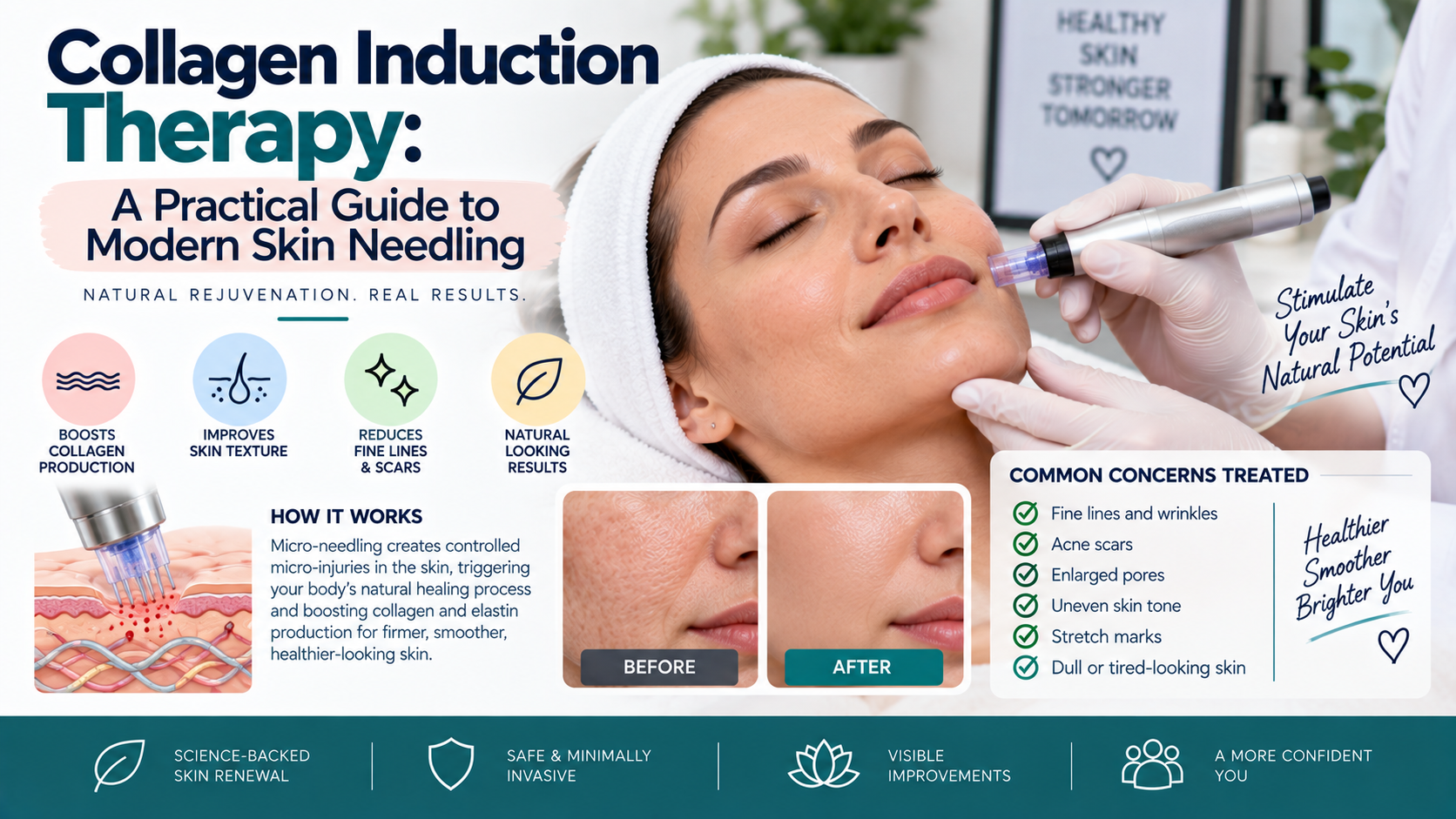
The idea that injuring skin on purpose can improve it sounds counterintuitive, yet it underpins some of the most reliable treatments in aesthetic dermatology. Controlled micro injury triggers the body’s own repair cascade, and that cascade produces new collagen and elastin. Understanding how that process works helps explain both why the treatment is effective and why a single session rarely delivers the full result.
How Collagen Induction Therapy Works
The procedure uses a device with fine sterile needles that create thousands of microscopic channels in the upper layers of the skin. Each channel is a tiny wound that closes within hours, but the healing response it triggers continues for weeks. Growth factors are released, fibroblasts are activated, and new collagen is laid down beneath the surface. The visible outcome is firmer texture, softened fine lines, refined pores, and gradual improvement in the appearance of certain scars.
Acne scarring is where the technique has some of its strongest evidence. Rolling and boxcar scars, which are essentially areas of tethered or depressed tissue, respond well to repeated sessions because new collagen gradually lifts the depressed area toward the surrounding surface. Deep ice pick scars typically need a different or combined approach, and an experienced practitioner will say so rather than promising uniform improvement.
Depth is the variable that separates a clinical treatment from a cosmetic one. Home rollers with very short needles do little more than mild exfoliation and carry a genuine infection risk if they are not properly sterilised. Professional microneedling uses adjustable depths matched to the area being treated, with thinner skin around the eyes handled very differently from thicker skin on the cheeks or the back.
Recovery, Results, and Treatment Sessions
Recovery is straightforward but not invisible. Expect redness resembling moderate sunburn for one to three days, some tightness, and light flaking as the surface renews. Makeup is usually avoided for the first day, active ingredients such as retinoids and acids are paused for roughly a week, and diligent sun protection is essential because freshly treated skin pigments easily.
A course of three to six sessions spaced four to six weeks apart is standard, because collagen remodelling is slow and cumulative. Patients frequently notice a glow within a week that comes from surface renewal, but the structural improvement they actually came for builds quietly over three to six months. Photographs taken under consistent lighting are far more reliable than daily mirror checks.
Combination protocols are increasingly common. Pairing needling with topical serums applied immediately afterwards takes advantage of temporarily increased absorption, while adding platelet rich plasma introduces the patient’s own growth factors into the treated area. Both approaches have supporters, and neither replaces the fundamentals of adequate depth, appropriate session numbers, and disciplined sun protection between visits.
Safety, Hygiene, and Contraindications
It is also worth asking about device hygiene. Cartridges should be single use and opened in front of the patient, and the handpiece should be disinfected between clients. This is a basic standard rather than an unusual request, and a clinic that answers it comfortably is demonstrating the kind of routine care that rarely goes wrong.
Contraindications deserve attention. Active acne infections, cold sore outbreaks, certain skin conditions, recent isotretinoin use, and a tendency toward keloid scarring all require caution or postponement. A thorough consultation screens for these before treatment rather than discovering them afterwards, and that screening is the clearest sign you are in competent hands.
