

Search for brasssmile and the results are surprisingly inconsistent. Some pages associate the name with dentistry, others describe a lifestyle concept, and still others suggest brass products or decorative accessories. The clearest interpretation comes from looking at the actual web presence behind the name.
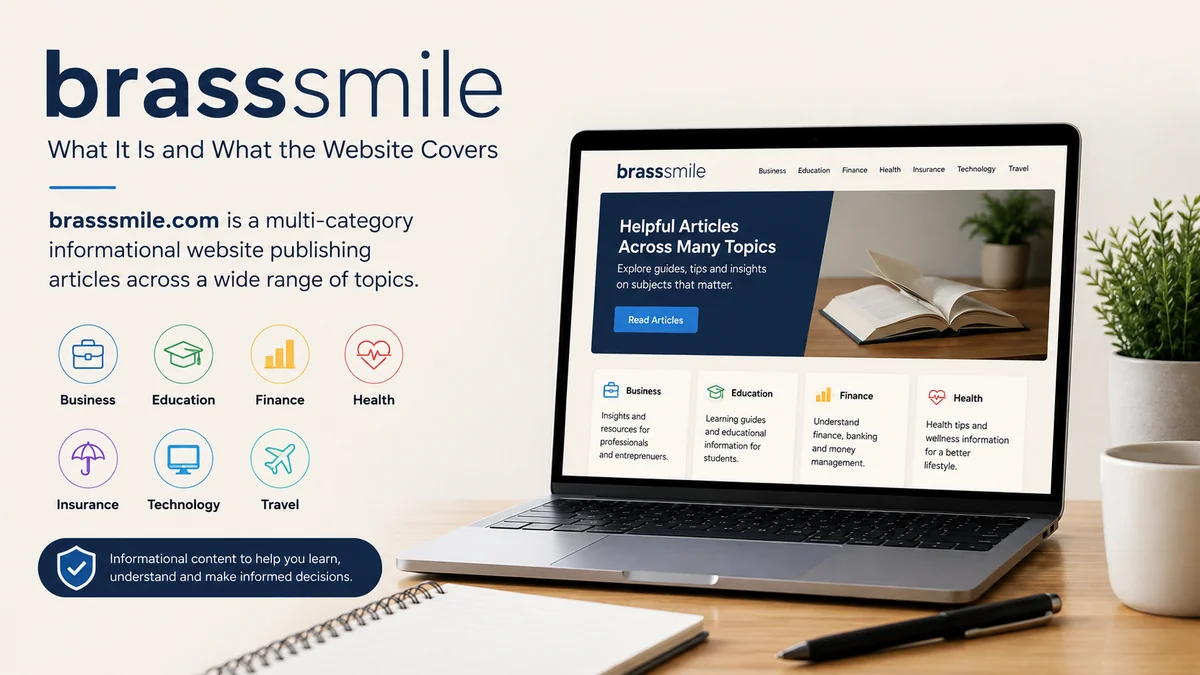
brasssmile is primarily associated with Brasssmile.com, a multi-category informational publishing website. Rather than operating as a dental clinic, whitening treatment, software product, or single-topic brand, the site publishes articles across subjects including business, education, finance, health, insurance, technology, travel, and other general-interest areas.
That distinction matters. A brand name can suggest one thing while the website behind it does something completely different.
What Is brasssmile?
brasssmile is an online name most closely connected with Brasssmile.com, a general-interest content website built around articles, guides, explainers, and other informational material.
The site does not restrict itself to one niche. Current descriptions of its navigation identify categories such as Business, Education, Finance, Health, Insurance, Technology, and Travel. Indexed content also demonstrates a broader mix of general-interest subjects.
In practical terms, it operates more like an online magazine or multi-topic blog than a specialized professional resource.
| Question | Quick answer |
|---|---|
| What is brasssmile? | A name primarily associated with a multi-topic publishing website |
| Main website | Brasssmile.com |
| Is it one specific niche? | No |
| Does it publish articles? | Yes |
| Main subjects | Business, education, finance, health, insurance, technology and travel |
| Is it a verified dental procedure? | No established clinical procedure is identified by this name |
| Why is the term confusing? | Similar names and conflicting third-party descriptions appear in search results |
| Who may find it useful? | General readers looking for introductory information across different subjects |
The safest way to understand the term is therefore to consider the exact domain and the context in which you encounter it.
Why Is There So Much Confusion About brasssmile?
The confusion begins with the name itself.
Without seeing the website, “brasssmile” could reasonably sound like a reference to braces, teeth, cosmetic dentistry, metallic dental work, jewelry, or even brass home décor.
Search results reinforce that ambiguity.
For example, some independent pages have attempted to describe BrassSmile as a dental-care concept involving whitening, braces, aligners, veneers, and other cosmetic treatments. Other results connect similar wording with decorative brass objects or brass-instrument technique.
Those interpretations should not automatically be applied to Brasssmile.com.
A useful rule is:
Do not determine what a website does from its name alone. Check its actual content, categories, authorship, dates, and stated purpose.
When that approach is applied here, the multi-category publishing interpretation is much better supported.
Similar names can refer to different websites
There is another source of confusion: multiple domains use variations of “Brass Smile.”
For instance, Brasssmile.org presents itself separately and currently publishes general blog content while also carrying text referring to brass home décor. Another independently operated site, Brasssmile.info, describes itself as an informational resource about everyday dental care and smile improvement.
These sites should not be assumed to represent the same organization simply because their names look similar.
When researching brasssmile, always check the full domain.
What Does brasssmile Publish?
The defining feature of Brasssmile.com is breadth.
Instead of developing an archive entirely around one subject, it publishes material for readers with different informational needs. Current evidence identifies Business, Education, Finance, Health, Insurance, Technology, and Travel among its principal areas.
Here is what those categories generally mean for readers.
Business and professional topics
Business content can introduce readers to companies, business concepts, professional practices, entrepreneurship, marketing, and operational issues.
This type of material is most useful when you need a starting point.
A business article, for example, may help you understand unfamiliar terminology before you move to industry documentation, government information, or specialist advice.
That distinction between learning and acting is important throughout a general-interest publication.
Education and learning
Education content broadens the audience beyond professionals and consumers.
Depending on the article, readers may encounter learning resources, study guidance, explanations of educational subjects, career-related information, or discussions of institutions and academic issues.
A general publication can be useful for discovering a topic, but university requirements, admissions rules, fees, accreditation details, and official policies should always be confirmed with the relevant educational institution.
Finance and insurance
Finance and insurance are areas where simplified explanations can be particularly useful.
Terms involving loans, banking, insurance coverage, personal finance, business finance, and financial products can be difficult for newcomers. Introductory articles help readers understand the vocabulary and identify questions they need to investigate further.
Brasssmile’s indexed content has included financial and insurance-related material, supporting its broader general-information model rather than a single-niche identity.
The important limitation is that an educational article cannot know your complete financial circumstances.
Use general content to learn. Use official documentation and qualified professionals when making significant financial decisions.
Health and wellness
Health content is another part of the broader editorial mix.
This may initially reinforce the mistaken assumption that brasssmile is a dental or healthcare brand. But publishing health articles does not turn a general website into a healthcare provider.
The same principle applies to any multi-category publication.
A newspaper can publish an article about heart disease without becoming a cardiology practice. A general blog can explain insurance without becoming an insurer.
Health information is best treated as educational background. Symptoms, diagnosis, medication, dental treatment, or other personal healthcare decisions require appropriate professional evaluation.
Technology and digital subjects
Technology articles can cover online services, digital platforms, emerging trends, software-related subjects, and general technology concepts.
This category can be particularly useful for non-technical readers because many people want a plain-English explanation before reading detailed documentation.
Technology also changes quickly. Publication and update dates therefore matter.
A guide describing an online platform accurately in 2025 may contain outdated interfaces, pricing, policies, or functionality in 2026. Whenever a specific product or service is involved, compare the article with current first-party information.
Travel and general lifestyle information
Travel expands the website’s scope into another practical area.
Readers may encounter destination information, planning topics, transportation, accommodation considerations, or other travel-related subjects.
As with technology, freshness matters.
Visa requirements, entry rules, prices, schedules, safety information, and local regulations can change. An informational article may provide context, but time-sensitive details should be verified through airlines, government agencies, accommodation providers, or other authoritative sources.
How Is brasssmile Organized?
A multi-category publication has a basic organizational problem: how do you prevent unrelated topics from becoming one enormous stream of articles?
Brasssmile uses familiar blog structures to solve that problem.
Independent reviews of the current site describe category navigation, dated posts, authors, archives, tags, excerpts, and pagination for accessing older material.
These elements serve different purposes.
Categories narrow the subject
Categories are the fastest way to move from the broad publication to the topic that interests you.
Someone interested in financial information does not necessarily want to browse health or travel articles first. Selecting the appropriate category reduces that noise.
Article dates provide context
Always notice when an article was published or updated.
For evergreen subjects, age may make little difference. A basic conceptual explanation can remain useful for years.
For subjects involving technology, finance, insurance, regulations, prices, travel rules, or rapidly developing events, publication date becomes much more significant.
Authors and bylines provide another verification point
A byline tells you who is presented as responsible for an article.
That is useful, but a name alone should never be treated as proof of expertise.
When expertise matters, look for an author biography, relevant qualifications, editorial information, citations, sources, and evidence that claims can be independently verified.
Tags connect related material
Tags can cut across broad categories.
An article may technically sit under Business while also dealing with technology or finance. Tags and contextual links can help readers follow those connections without returning to the homepage after every article.
Quick Takeaway: Treat brasssmile as a broad publication first. Use its categories, dates, author information, and individual article sources to evaluate specific content rather than assuming the entire domain has the same level of expertise on every subject.
Is brasssmile a Dental Clinic or Dental Treatment?
This is one of the most important questions surrounding the keyword.
Based on the current evidence, Brasssmile.com should not be identified simply as a dental clinic, orthodontic practice, teeth-whitening service, clear-aligner company, or recognized dental procedure. Its visible publishing activity is much broader.
Why, then, do dental descriptions appear?
The wording makes that association easy. “Smile” naturally connects with oral health, while several third-party websites have subsequently developed dental interpretations around the term.
Some pages describe BrassSmile alongside conventional treatments such as:
- teeth whitening
- braces
- clear aligners
- veneers
- dental implants
- preventive dentistry
- restorative dentistry
- cosmetic dentistry
Those treatments are real areas of dentistry. That does not establish “brasssmile” itself as a recognized clinical treatment.
This distinction is especially important with health information.
A familiar collection of legitimate medical or dental terms can make an unfamiliar label sound clinically established. Readers should instead ask whether the terminology is recognized by credible professional organizations, clinical literature, healthcare providers, or other authoritative sources.
If you encounter claims that a “brasssmile treatment” can whiten teeth, correct bite problems, repair enamel, move teeth, or replace professional dental care, verify the underlying treatment with a qualified dentist rather than relying on the label.
Is brasssmile About Brass Home Décor?
There is a historical wrinkle here too.
Domain-information records have indexed a Brasssmile.com meta description presenting the brand as a destination for brass home décor and accessories, even though the site’s indexed publishing activity points toward a much broader article-based model.
That apparent mismatch is a useful reminder that websites evolve.
A domain can change:
- ownership
- design
- editorial direction
- categories
- branding
- homepage copy
- business model
- purpose
Old descriptions may remain indexed by search engines or third-party databases after a website changes.
Consequently, a historical snippet should not automatically override what the current website publishes.
Is brasssmile Related to Brass Instruments?
Not in the primary website interpretation.
Another third-party interpretation connects “BrassSmile” with brass musical instruments and the embouchure used to play instruments such as trumpet, trombone, and horn.
An embouchure is the positioning and use of the lips, mouth, jaw, and surrounding facial muscles when producing sound on a wind instrument.
Some musicians and teachers discuss a “smile” shape when describing lip position. That musical concept, however, should not be confused with the identity of the general-interest Brasssmile.com website.
This is a classic example of why ambiguous search terms need contextual verification.
Who Is brasssmile For?
The site’s broad editorial structure makes it most relevant to general readers looking for accessible introductions to different topics.
That can include students trying to understand an unfamiliar concept, consumers researching everyday questions, professionals getting introductory context outside their expertise, or casual readers exploring topics that interest them.
It is less appropriate as a sole authority for decisions requiring specialized expertise.
Think of the difference this way:
| Need | Role a general publication can play |
| Understand a new concept | Useful starting point |
| Learn basic terminology | Useful |
| Discover related topics | Useful |
| Compare general ideas | Potentially useful |
| Diagnose a medical condition | Not appropriate |
| Make a major investment decision | Verify elsewhere |
| Interpret your legal situation | Consult an appropriate professional |
| Confirm official travel rules | Use government/official sources |
| Verify product specifications | Check the manufacturer |
| Confirm academic requirements | Check the institution |
The value of general information is not that it replaces primary sources. It helps readers understand a subject well enough to know where to go next.
How to Evaluate Information on brasssmile
The most useful question is not simply, “Is this website good?”
A broad publication may have hundreds of articles written at different times, on different subjects, using different sources. Evaluate the specific article and specific claim you are reading.
A practical verification process takes only a few steps.
1. Check the publication and update date
First determine how fresh the article is.
Freshness matters particularly for rapidly changing subjects. Software features, insurance rules, financial products, travel requirements, prices, and regulations can become outdated quickly.
2. Identify the author
Look for a real byline and, where available, an author page.
Then ask whether the subject requires specialist knowledge.
You do not need a medical degree to explain what a toothbrush is, but detailed treatment recommendations demand a much higher level of authority.
3. Look for primary sources
Strong informational content makes important claims verifiable.
Depending on the topic, useful primary sources can include government agencies, universities, professional associations, scientific research, regulators, official company documentation, manufacturers, and recognized industry bodies.
4. Separate facts from recommendations
An article can accurately explain what a product or concept is while still giving questionable advice about what you personally should do.
Watch for the transition from:
“This is how it works.”
to:
“Therefore, you should do this.”
The second claim usually requires more context.
5. Cross-check high-stakes information
The greater the consequences, the stronger your verification should be.
Health, money, insurance, law, and safety deserve substantially more scrutiny than an article about home decoration or entertainment.
6. Check the exact domain
This step is unusually important for brasssmile because several similarly named websites and third-party interpretations exist.
“BrassSmile,” “Brass Smile,” and “brasssmile” appearing in a headline do not prove that the page is discussing Brasssmile.com.
Check the domain before drawing conclusions.
brasssmile vs. a Specialist Website
Neither broad nor specialist publishing is automatically better. They serve different purposes.
| Feature | brasssmile-style general publication | Specialist resource |
| Topic range | Broad | Narrow |
| Audience | General readers | Topic-specific readers |
| Best use | Discovery and introductory learning | Deeper subject research |
| Navigation | Multiple categories | Focused subject structure |
| Technical depth | Varies by article | Often greater |
| Professional authority | Must be evaluated article by article | May be stronger within its specialty |
| Need for external verification | Higher for specialized claims | Still necessary for important decisions |
A broad website has one major advantage: discovery.
You can read about education and then find an interesting technology article or move from a finance topic into insurance.
A specialist site has a different advantage: concentration. Because its entire editorial structure revolves around one field, it can build deeper supporting material around individual questions.
Readers benefit from understanding the difference.
What Makes a Useful brasssmile Article?
A useful informational article should make the reader more informed, not merely keep them on the page longer.
Several qualities matter.
Clear scope
The opening should quickly establish what the article covers and what it does not.
This is particularly valuable when discussing ambiguous terms. Readers should not have to reach the final paragraph before discovering what a term actually refers to.
Verifiable facts
Names, dates, statistics, regulations, medical claims, prices, and other concrete statements should be traceable to credible evidence where the subject requires it.
Appropriate depth
Simplifying a complicated subject is valuable. Oversimplifying it can be misleading.
Good beginner content removes unnecessary jargon without removing qualifications that change the meaning of the information.
Visible limitations
Responsible informational writing knows where its role ends.
A health explainer should not pretend to diagnose a reader. A financial article should not imply that one strategy suits everybody. A legal overview should distinguish general information from advice about a specific case.
Useful next steps
Informational intent does not require a sales pitch.
Often the best next step is simply knowing what to verify: an official policy, professional association, government resource, product documentation, academic institution, or qualified expert.
Common Mistakes When Researching brasssmile
The biggest mistake is treating every search result containing the word as if it describes the same thing.
It does not.
A page discussing dental care may be using the term differently from a page discussing Brasssmile.com. A decorative brass product can share similar wording without having any connection to the publishing website.
A second mistake is trusting a search snippet without opening the page.
Snippets can be old, truncated, automatically generated, or based on outdated metadata. This matters particularly when a website’s focus has changed.
A third mistake is assuming that appearing on a multi-topic site gives an article professional authority.
Publication and expertise are different things.
A health article remains something you should evaluate as health information. A finance article still requires financial scrutiny. The surrounding website does not remove that responsibility.
Why General-Interest Websites Use Multiple Categories
A reader might reasonably wonder why one website would cover business, education, health, technology, finance, insurance, and travel instead of choosing a single niche.
The model is not unusual.
General-interest publishers organize content around reader interests rather than one professional discipline. A single person may research university admissions in the morning, insurance after lunch, and a travel destination that evening.
Category architecture allows one publication to serve those different interests.
The challenge is authority.
A specialist dental publication can establish clear subject expertise because everything revolves around dentistry. A broad publication has to demonstrate credibility at the individual article level across many unrelated disciplines.
That makes sourcing, authorship, editorial review, and transparent limitations especially important.
How to Use brasssmile More Effectively
If you land on the site looking for an answer, start with the relevant category rather than browsing unrelated recent posts.
Then use a simple research sequence:
- Read the article for orientation. Learn the basic terminology and identify the central concepts.
- Note important names and claims. Pay attention to organizations, statistics, regulations, products, dates, and technical terms.
- Follow credible sources. Prefer original documentation where available.
- Check the date. Determine whether the information could have changed.
- Compare another authoritative source. This is particularly valuable when a claim affects an important decision.
- Use a professional when necessary. Educational content cannot account for every personal circumstance.
This approach applies not only to brasssmile but to almost any general-information website.
What Should You Remember About brasssmile?
The simplest answer is also the most useful: brasssmile is best understood in its primary current web context as the name associated with a multi-category informational publication, not as a single established dental procedure, orthodontic product, musical technique, or brass accessory. Current descriptions of Brasssmile.com consistently identify a broad publishing structure spanning categories such as business, education, finance, health, insurance, technology, and travel.
The surrounding confusion comes from ambiguous wording, similar domains, historical descriptions, and third-party pages assigning different meanings to the name.
For readers, that leads to one practical habit: verify context before trusting the label.
Check which Brasssmile domain you are viewing, who wrote the information, when it was published, what evidence supports its claims, and whether the subject calls for a primary source or qualified professional.
Used that way, brasssmile can serve the role that broad informational websites handle best: helping readers discover subjects, understand unfamiliar terminology, and build enough background knowledge to continue their research intelligently.
