

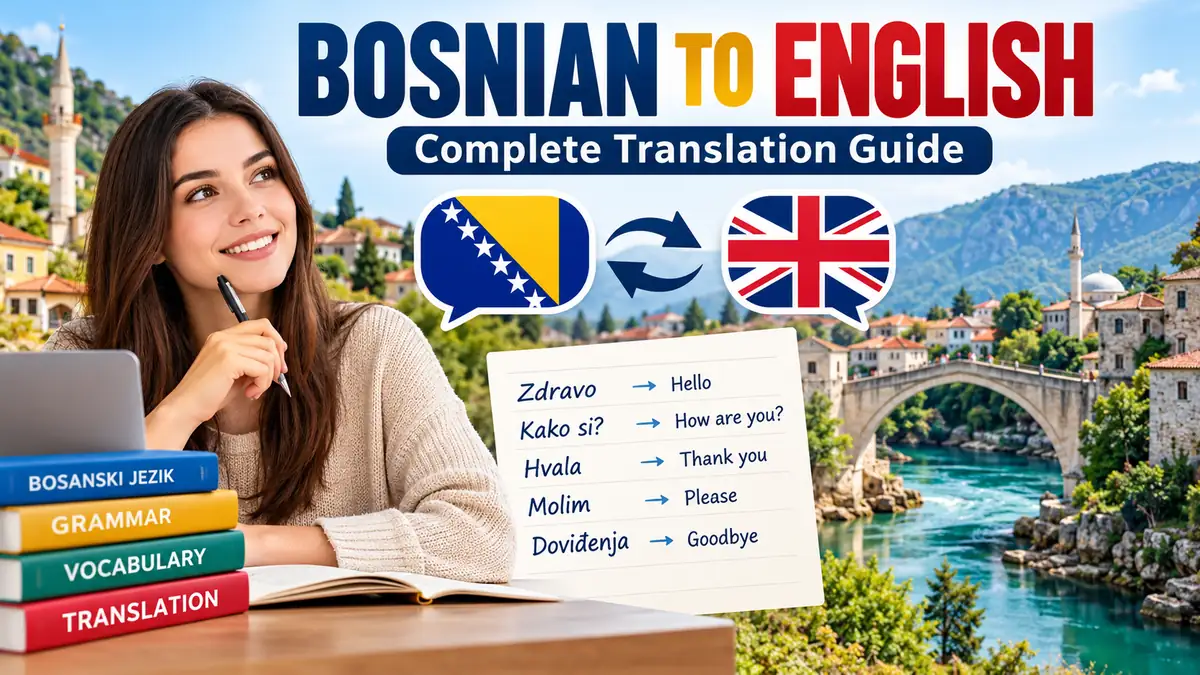
Translating Bosnian into English can seem straightforward until you encounter a sentence that makes perfect sense in Bosnian but sounds unnatural when translated word for word. Differences in grammar, word order, pronunciation, and cultural expressions can change how a message should be understood.
Bosnian to English translation is the process of converting spoken or written Bosnian into accurate, natural English while preserving the original meaning. Effective translation requires understanding Bosnian grammar, its seven grammatical cases, verb forms, vocabulary, and context. Online translation tools can help, but careful review is essential for idioms, formal documents, and complex sentences.
This guide explains how Bosnian works, how to translate common words and phrases, which translation methods are most useful, and how to avoid mistakes that can change the meaning of a sentence.
Understanding the Bosnian Language
Bosnian, known as bosanski jezik in its native form, is a South Slavic language primarily spoken in Bosnia and Herzegovina and among Bosnian-speaking communities worldwide.
It belongs to the Indo-European language family and is closely related to Croatian, Serbian, and Montenegrin.
Where Is Bosnian Spoken?
Bosnian is an official language of Bosnia and Herzegovina, alongside Croatian and Serbian. It also has official or recognized uses in parts of neighboring countries.
Bosnian-speaking communities can be found in:
- Bosnia and Herzegovina
- Serbia, particularly the Sandžak region
- Montenegro
- Croatia
- Germany, Austria, and Switzerland
- The United States, Canada, and Australia
Migration has created a global demand for Bosnian language translation, particularly for family communication, education, immigration, and administrative documents.
Is Bosnian Similar to Croatian and Serbian?
Yes. Bosnian, Croatian, Serbian, and Montenegrin are closely related standard varieties within the South Slavic linguistic continuum.
Speakers generally understand one another without extensive translation, although vocabulary preferences, pronunciation, spelling conventions, and certain grammatical usages differ.
For example:
| English | Bosnian | Croatian | Serbian |
|---|---|---|---|
| Bread | Hljeb | Kruh | Hleb |
| Milk | Mlijeko | Mlijeko | Mleko |
| Beautiful | Lijep | Lijep | Lep |
| Time | Vrijeme | Vrijeme | Vreme |
| Where | Gdje | Gdje | Gde |
These are common standard-language differences, not absolute boundaries. Regional usage overlaps.
For translators, identifying the intended language variety helps preserve the writer’s vocabulary and cultural identity.
How to Translate bosnian to english Accurately
Accurate translation involves more than replacing individual words with dictionary equivalents.
The translator must understand the complete sentence, identify grammatical relationships, and express the intended meaning naturally in English.
Step 1: Read the Complete Bosnian Sentence
Start by reading the entire sentence before translating individual words.
Consider:
Kako si?
A literal interpretation is approximately “How are you?” and the natural English translation is also:
“How are you?”
However, not every expression translates so directly.
Šta ima?
A natural conversational translation is:
“What’s up?” or “What’s new?”
The correct choice depends on the situation and relationship between speakers.
Step 2: Identify the Context
A Bosnian word may have multiple English meanings.
For example, list can mean a leaf, a sheet of paper, or a newspaper, depending on the context.
Similarly, grad means “city” or “town” in ordinary usage, but its meaning in other expressions depends on the surrounding words.
Reading surrounding sentences prevents mistakes caused by translating words in isolation.
Step 3: Check Grammar and Sentence Structure
Bosnian uses grammatical cases to express relationships between words.
English generally relies more heavily on word order and prepositions.
For example:
Dajem knjigu prijatelju.
English translation:
“I am giving a book to a friend.”
The form prijatelju indicates the recipient of the action. English communicates this relationship using “to.”
Step 4: Rewrite the Sentence in Natural English
A grammatically correct translation can still sound awkward.
Consider:
Pada mi na pamet jedna ideja.
A rigid translation might produce:
“An idea is falling onto my mind.”
Natural English:
“An idea just occurred to me.”
Good translation prioritizes meaning over literal structure.
Step 5: Review Names, Numbers, and Formatting
Before finalizing a translation, verify personal names, dates, addresses, measurements, and numerical values.
For example, Bosnian commonly uses a decimal comma, while American English normally uses a decimal point.
| Bosnian formatting | American English formatting |
|---|---|
| 3,5 | 3.5 |
| 1.250,75 | 1,250.75 |
| 12. oktobar 2026. | October 12, 2026 |
The formatting should match the target audience, especially in financial, academic, and official documents.
Common Bosnian Words and Their English Meanings
Learning frequently used vocabulary makes basic translation much easier.
Everyday Bosnian Vocabulary
| Bosnian | English |
|---|---|
| Da | Yes |
| Ne | No |
| Molim | Please / You’re welcome |
| Hvala | Thank you |
| Zdravo | Hello |
| Dobar dan | Good day |
| Dobro jutro | Good morning |
| Laku noć | Good night |
| Izvini | Sorry / Excuse me (informal) |
| Oprostite | Excuse me / Sorry (formal or plural) |
| Voda | Water |
| Hrana | Food |
| Kuća | House |
| Škola | School |
| Posao | Work / Job |
| Prijatelj | Friend |
| Porodica | Family |
| Ljubav | Love |
| Knjiga | Book |
| Danas | Today |
Some words have different meanings depending on the sentence.
For instance, molim can mean “please,” “you’re welcome,” or “pardon?” in different conversational situations.
Common Bosnian Greetings
| Bosnian phrase | English translation |
|---|---|
| Kako si? | How are you? |
| Dobro sam. | I’m fine. |
| Kako se zoveš? | What’s your name? |
| Drago mi je. | Nice to meet you. |
| Vidimo se. | See you. |
| Doviđenja. | Goodbye. |
| Dobro došli. | Welcome. |
| Ugodan dan! | Have a nice day! |
| Šta radiš? | What are you doing? |
| Gdje si? | Where are you? |
These phrases are useful for everyday communication, language learning, and travel.
Bosnian to English Sentences for Everyday Conversations
Complete sentences provide more useful learning examples than isolated vocabulary because they show how grammar and meaning work together.
Basic Conversation Examples
| Bosnian sentence | English translation |
|---|---|
| Ja sam student. | I am a student. |
| Živim u Sarajevu. | I live in Sarajevo. |
| Govoriš li engleski? | Do you speak English? |
| Ne razumijem. | I don’t understand. |
| Možete li mi pomoći? | Can you help me? |
| Koliko ovo košta? | How much does this cost? |
| Gdje je autobuska stanica? | Where is the bus station? |
| Želim naučiti engleski. | I want to learn English. |
| Danas je lijep dan. | Today is a beautiful day. |
| Moram ići kući. | I have to go home. |
Notice that English often requires an explicit subject, while Bosnian can omit one when the verb already identifies the person.
For example, Živim u Sarajevu does not contain a separate word for “I,” but its verb form identifies the first-person singular subject.
Travel and Direction Phrases
Travelers often need quick translations for transportation, hotels, restaurants, and directions.
| Bosnian | English |
|---|---|
| Gdje je aerodrom? | Where is the airport? |
| Trebam taksi. | I need a taxi. |
| Imam rezervaciju. | I have a reservation. |
| Gdje mogu kupiti kartu? | Where can I buy a ticket? |
| Je li ovo put za centar? | Is this the way to the city center? |
| Račun, molim. | The bill, please. |
| Izgubio sam pasoš. | I have lost my passport. (male speaker) |
| Izgubila sam pasoš. | I have lost my passport. (female speaker) |
The final two examples show an important feature of Bosnian: past-tense participles often reflect the speaker’s grammatical gender.
English does not make this distinction in the same way.
Family and Personal Communication
Bosnian speakers communicating with relatives abroad may encounter these expressions:
Mnogo mi nedostaješ.
“I miss you very much.”
Volim te.
“I love you.”
Čuvaj se.
“Take care.”
Jedva čekam da te vidim.
“I can’t wait to see you.”
Pozdravi svoju porodicu.
“Give my regards to your family.”
Emotional expressions should sound natural in English while retaining the warmth or formality of the original message.
Bosnian Grammar Rules That Affect English Translation
One of the biggest challenges in translating Bosnian is its grammatical structure.
Bosnian uses seven nominal cases, three grammatical genders, and two grammatical numbers. Verbs also express distinctions such as aspect, person, and tense.
UCLA
Understanding these features helps explain why a direct translation sometimes produces incorrect English.
The Seven Grammatical Cases
Bosnian nouns, pronouns, and adjectives change form depending on their grammatical function.
| Case | Main function | Example |
|---|---|---|
| Nominative | Subject | Student uči. |
| Genitive | Possession, absence, quantity | Nema vode. |
| Dative | Recipient | Dajem knjigu bratu. |
| Accusative | Direct object | Čitam knjigu. |
| Vocative | Direct address | Prijatelju! |
| Instrumental | Means or accompaniment | Pišem olovkom. |
| Locative | Location or topic with prepositions | U školi. |
Consider:
Student uči.
“The student is studying.”
Vidim studenta.
“I see the student.”
The noun changes from student to studenta because its grammatical role changes.
English usually communicates this distinction through sentence structure rather than noun endings.
Grammatical Gender
Bosnian has masculine, feminine, and neuter grammatical genders.
For example:
- Dobar čovjek — A good man
- Dobra žena — A good woman
- Dobro dijete — A good child
The adjective changes to agree with the noun.
English adjectives generally remain unchanged regardless of grammatical gender.
Verb Aspect and Tense
Bosnian distinguishes between imperfective and perfective verb aspects.
Imperfective verbs commonly describe ongoing, repeated, or habitual actions, while perfective verbs present actions as complete wholes.
Consider:
Pisao sam pismo.
“I was writing a letter” or “I wrote a letter,” depending on context.
Napisao sam pismo.
“I wrote the letter” or “I finished writing the letter.”
The second example emphasizes the completed action.
Translators must use context to choose the appropriate English tense and wording.
Flexible Word Order
Bosnian commonly follows subject-verb-object order, but grammatical endings allow greater flexibility.
For example:
Ana voli Marka.
“Ana loves Marko.”
Marka voli Ana.
“Ana loves Marko.”
The second sentence changes the emphasis without changing who loves whom.
An English translation must preserve the grammatical relationships rather than mechanically copying the word order.
Best Online Tools for bosnian to english Translation
Online translation tools are useful for understanding unfamiliar text, translating messages, and checking vocabulary.
However, no automatic translator should be treated as completely reliable for every sentence.
Google Translate
Google Translate supports Bosnian and English, making it useful for translating everyday text, short phrases, and longer passages. Its interface also provides options for different translation formats, although individual features vary by language and device.
Google Translate
Website: Google Translate
A practical approach is to select Bosnian as the source language and English as the target language, enter the text, and then review the result.
For ambiguous expressions, compare the translation with the surrounding context.
DeepL Translator
DeepL Translator also lists Bosnian among its supported languages. It can be used to compare how another machine translation system interprets the same passage.
How Can We Help You?
Website: DeepL Translator
Comparing translations can be especially helpful when a sentence contains an idiom, unusual grammar, or a word with several possible meanings.
Some advanced features, such as glossary controls and tone adjustments, are not available for every supported language.
Microsoft Translator
Microsoft Translator supports Bosnian text translation. Microsoft’s language documentation identifies Bosnian using the language code bs, with Latin-script support.
Microsoft Learn
+1
Website: Microsoft Translator
Microsoft’s documentation also lists Bosnian among languages supported for certain document translation operations.
Microsoft Learn
Which Translator Should You Use?
| Translation method | Useful for | Main limitation |
|---|---|---|
| Google Translate | Everyday phrases and general text | Can miss context or idioms |
| DeepL | Comparing sentence interpretations | Feature availability varies |
| Microsoft Translator | Text and supported document workflows | Capabilities differ by language |
| Bilingual dictionary | Individual words and meanings | Limited sentence context |
| Human translator | Legal, medical, and official documents | Requires additional time and resources |
For casual communication, automatic translation is often sufficient to understand the general meaning.
For high-stakes documents, a qualified human translator should verify the result.
Bosnian Alphabet and Pronunciation Guide
Bosnian is predominantly written using the Latin alphabet, although Cyrillic also has a historical and regional presence.
The standard Bosnian Latin alphabet contains 30 letters, including several characters and letter combinations that may be unfamiliar to English speakers.
Special Bosnian Letters
| Letter | Approximate English sound | Example |
|---|---|---|
| Č | Ch in “church” | Čaj (tea) |
| Ć | Softer ch-like sound | Ćevap |
| Š | Sh in “ship” | Škola (school) |
| Ž | S in “measure” | Žena (woman) |
| Đ | Similar to j in “judge” | Đak (pupil) |
| Dž | J in “jam” | Džep (pocket) |
| Lj | Palatalized l sound | Ljubav (love) |
| Nj | Similar to ny in “canyon” | Njega (him, in certain contexts) |
The English comparisons are approximations. Some Bosnian sounds, especially ć and đ, do not have exact English equivalents.
Why Diacritical Marks Matter
Diacritics can change the identity or meaning of a word.
For example:
Šuma means “forest.”
Suma means “sum” or “total.”
Removing the accent mark creates a different word.
Likewise, č and ć represent distinct sounds, even though English speakers may initially hear them as similar.
When entering Bosnian into a translation tool, preserve the original spelling whenever possible.
How to Pronounce Bosnian Words
Bosnian spelling is relatively consistent: letters generally correspond to predictable sounds.
This makes reading aloud easier once the alphabet is learned.
However, word stress and pitch accent can still be challenging. Stress patterns are not usually indicated in ordinary written Bosnian.
For better pronunciation, listen to native speakers and repeat complete phrases rather than learning each sound in isolation.
Common bosnian to english Translation Mistakes
Many translation errors come from overlooking grammar, context, or differences in how English expresses familiar ideas.
Translating Every Word Literally
Consider:
Imam 20 godina.
A word-for-word translation might be:
“I have 20 years.”
Natural English:
“I am 20 years old.”
The Bosnian construction uses the verb imati (to have), while English uses to be when stating age.
Confusing Similar-Looking Words
Some Bosnian words resemble English words but have different meanings.
For example:
Aktuelan generally means “current,” “topical,” or “relevant,” not necessarily “actual.”
Eventualno often means “possibly” or “if necessary,” rather than “eventually.”
Simpatija can refer to a romantic crush or someone a person likes, depending on context.
These words are sometimes called false friends because their familiar appearance can mislead translators.
Ignoring Formal and Informal Speech
Bosnian distinguishes between informal singular address and formal or plural address.
For example:
Kako si?
“How are you?” — informal singular.
Kako ste?
“How are you?” — formal singular or plural.
Both sentences may look identical in English, but their social meanings differ.
Formal Bosnian often uses Vi when addressing someone respectfully.
Missing Negation
Bosnian negative constructions can differ significantly from English.
Consider:
Nikad nisam bio tamo.
“I have never been there.”
A literal translation might incorrectly interpret the multiple negative elements as canceling each other.
In standard Bosnian, negative concord is normal. English generally expresses the same meaning with a single grammatical negative.
Overlooking Idioms
Idiomatic expressions often require interpretation rather than direct translation.
| Bosnian expression | Natural English meaning |
|---|---|
| Držim ti fige. | I’m keeping my fingers crossed for you. |
| Nema veze. | Never mind. / It doesn’t matter. |
| Sve u svoje vrijeme. | Everything in its own time. |
| Pala mi je na pamet ideja. | An idea occurred to me. |
| Nije kraj svijeta. | It’s not the end of the world. |
A good translator identifies the purpose of the expression and selects a comparable English phrase.
Translating Bosnian Documents into English
Document translation requires greater precision than casual conversation.
Certificates, academic records, medical reports, and legal documents often contain specialized terminology that must be preserved.
Birth and Marriage Certificates
Common Bosnian administrative terms include:
| Bosnian term | English meaning |
|---|---|
| Izvod iz matične knjige rođenih | Birth certificate / Extract from the birth register |
| Izvod iz matične knjige vjenčanih | Marriage certificate / Extract from the marriage register |
| Datum rođenja | Date of birth |
| Mjesto rođenja | Place of birth |
| Državljanstvo | Citizenship |
| Prezime | Surname |
| Ime | Given name |
| Matični broj | Personal identification number |
The exact English terminology may depend on the receiving country’s administrative system.
For immigration or legal procedures, the organization requesting the document may require a certified translation.
Academic Documents
Students applying to English-speaking institutions may need translations of transcripts, diplomas, or school certificates.
Examples include:
- Svjedočanstvo — School certificate or report, depending on context
- Diploma — Diploma
- Ocjena — Grade
- Prosjek ocjena — Grade average
- Fakultet — Faculty or university-level institution, depending on context
Bosnian grading systems should not automatically be converted into American letter grades.
If a receiving institution requires grade equivalencies, use its approved conversion method or an authorized credential evaluation service.
Legal and Medical Documents
Legal terms can have jurisdiction-specific meanings. A word that appears straightforward may refer to a particular institution, procedure, or legal status.
Medical translation presents similar challenges because small errors in terminology, dosage, or instructions can have serious consequences.
For these documents, use a qualified translator familiar with the relevant subject matter.
Do not rely solely on automatic translation for legal decisions, diagnoses, or treatment instructions.
Translating Scanned PDFs and Images
When the original text exists only as a scanned document or photograph, optical character recognition (OCR) may be needed before translation.
A typical workflow is:
- Scan or photograph the document clearly.
- Extract the text using an OCR tool that supports the relevant script.
- Check the extracted text against the original.
- Translate the corrected text into English.
- Review names, dates, stamps, numbers, and specialized terms.
- Preserve the original document for comparison.
OCR may confuse visually similar letters or omit diacritical marks. This is especially important when processing older documents or low-quality scans.
How to Improve Your Bosnian to English Translation Skills
Translation accuracy improves through vocabulary development, grammar practice, reading, and regular exposure to natural language.
Learn Common Sentence Patterns
Instead of memorizing only individual words, learn complete phrases.
For example:
Želim… — I want…
Trebam… — I need…
Mislim da… — I think that…
Ne znam… — I don’t know…
Možete li…? — Can you…? (formal or plural)
These patterns help learners recognize the structure of unfamiliar sentences.
Practice with Short Paragraphs
Begin with everyday messages, short news passages, or simple conversations.
Translate the passage into English without immediately checking a machine-generated version.
Then compare your translation with another reference and identify differences in meaning, grammar, and tone.
Use Bilingual and Monolingual Dictionaries
Bilingual dictionaries help identify English equivalents, while monolingual Bosnian dictionaries explain meanings within the language itself.
A dictionary is especially useful when a word has multiple senses.
For example, the Bosnian word red may refer to a line, a row, an order, or someone’s turn.
The correct English equivalent depends on how the word is used.
Learn Common Verb Forms
Recognizing frequently used verbs makes sentence translation faster.
| Infinitive | English | First-person present |
|---|---|---|
| Biti | To be | Ja sam |
| Imati | To have | Ja imam |
| Ići | To go | Ja idem |
| Raditi | To work / do | Ja radim |
| Govoriti | To speak | Ja govorim |
| Pisati | To write | Ja pišem |
| Čitati | To read | Ja čitam |
| Znati | To know | Ja znam |
Once you recognize the verb form, you can often identify the subject even when the pronoun is omitted.
Review Translation Quality Systematically
After translating a paragraph, check four elements:
- Accuracy: Does the English preserve the original meaning?
- Fluency: Does it sound natural to an English speaker?
- Completeness: Have any details been omitted or added?
- Consistency: Are names, terms, and formal expressions translated consistently?
This approach is useful for both language learners and experienced translators.
Understanding Cultural Expressions in Bosnian
Language and culture are closely connected, particularly in greetings, hospitality, family relationships, and expressions of respect.
Bosnian contains vocabulary influenced by its Slavic foundations and historical contact with Ottoman Turkish, German, and other languages.
Some expressions have religious or cultural associations, while others are common across different communities.
For example:
Bujrum is often used when inviting someone to enter, sit, eat, or make themselves comfortable.
Depending on context, natural English translations include “Come in,” “Please,” or “Help yourself.”
Merhaba is a greeting used in some communities and settings.
Hvala lijepa is a polite way of expressing thanks, often translated as “Thank you very much.”
These expressions illustrate why cultural awareness matters.
A translator should preserve the speaker’s intended level of friendliness, politeness, and familiarity without adding meanings that are not present.
Can You Translate Bosnian to English Without the Internet?
Yes. Offline translation is possible using downloaded dictionaries, language resources, or translation applications with supported offline language packs.
Microsoft lists Bosnian among the languages with offline support in its Android Translator offering. Availability can depend on the app version and device.
Microsoft Translator
Offline resources can be useful during travel or in areas with limited connectivity.
However, downloaded translation models may not provide the same features or quality as their online counterparts.
For reliable offline use, download the required language resources in advance and test them before traveling.
A small collection of essential phrases can also be useful when a device is unavailable.
Is Machine Translation Accurate Enough for Bosnian?
Machine translation can produce useful results for many everyday Bosnian sentences, particularly when the text is clear and uses common vocabulary.
Accuracy becomes less predictable with regional expressions, humor, ambiguous pronouns, complex grammatical structures, and specialized terminology.
For example:
Ona mu je rekla da će doći.
Possible English translation:
“She told him that she would come.”
Without additional context, however, the future action could potentially refer to someone else. A longer passage may be needed to establish the intended meaning.
Machine translation systems sometimes select one interpretation even when the original sentence allows more than one.
For this reason, translation quality should be evaluated according to the importance of the text.
A casual message may need only a quick review. A contract, medical report, or immigration document requires much more careful verification.
Final Thoughts on bosnian to english Translation
Accurate bosnian to english translation depends on understanding meaning, grammar, context, and cultural expression rather than translating every word separately.
Start with common vocabulary and complete sentences, learn how Bosnian cases and verb forms work, and use online translators as helpful references rather than unquestionable authorities.
For everyday conversations, the examples and methods in this guide provide a practical starting point. For formal or specialized documents, professional review helps ensure that important details remain accurate.
The most effective next step is to practice translating short Bosnian passages into natural English, then compare your work with reliable references and correct the differences.
