

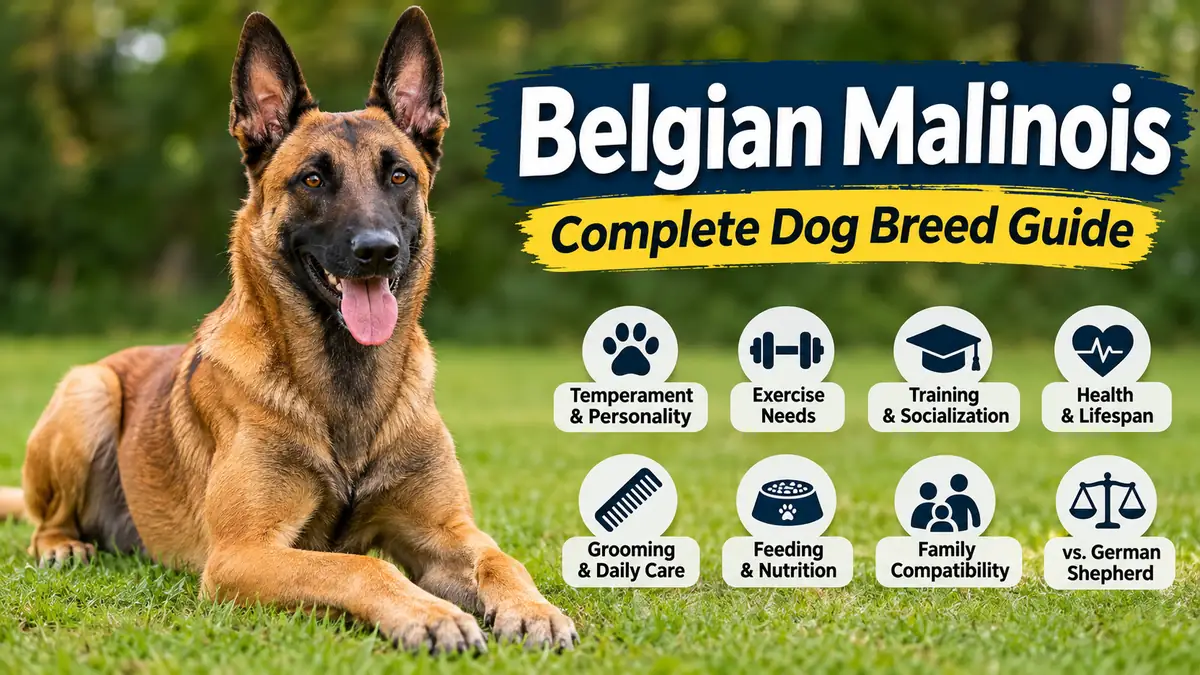
The Belgian Malinois is one of the most intelligent, athletic, and demanding dog breeds in the world. Known for its exceptional working ability, loyalty, and seemingly endless energy, this Belgian herding dog has become a familiar sight in police departments, military units, search-and-rescue operations, and competitive dog sports.
Yet the qualities that make the breed an outstanding working partner can also make it challenging to manage in an ordinary household.
The belgian malinois is a medium-to-large Belgian herding breed recognized for its intelligence, agility, protective instincts, and strong work ethic. Originally developed to herd livestock, it now excels in obedience, detection, tracking, and protection work. It requires extensive daily exercise, structured mental stimulation, consistent training, and an experienced owner who understands working-dog behavior.
Understanding the breed’s temperament, physical characteristics, health needs, and everyday care requirements is essential before deciding whether this energetic dog fits a particular lifestyle.
Belgian Malinois Breed Overview
The Belgian Malinois belongs to the Herding Group recognized by the American Kennel Club (AKC). It is one of four closely related Belgian Shepherd varieties, distinguished primarily by coat type and appearance.
The breed combines physical endurance with remarkable responsiveness to human direction. Unlike many companion breeds, it was developed to remain active, alert, and ready to work for extended periods.
Belgian Malinois Quick Facts
| Characteristic | Details |
|---|---|
| Origin | Belgium |
| Breed group | Herding |
| Male height | 24–26 inches (61–66 cm) |
| Female height | 22–24 inches (56–61 cm) |
| Male weight | 60–80 pounds (27–36 kg) |
| Female weight | 40–60 pounds (18–27 kg) |
| Life expectancy | Approximately 10–16 years, depending on source |
| Coat | Short, straight, double coat |
| Common colors | Fawn to mahogany with black markings |
| Temperament | Intelligent, loyal, alert, energetic |
| Shedding | Moderate, with seasonal increases |
| Exercise needs | Very high |
| Trainability | Excellent with consistent handling |
| Best suited for | Experienced, active owners |
The AKC lists a typical lifespan of 14–16 years, although veterinary and rescue organizations publish somewhat different estimates. American Kennel Club+2
History and Origin of the Belgian Malinois
The Belgian Malinois originated in Belgium during the late nineteenth century, when breeders began developing and standardizing regional sheepdogs.
The breed takes its name from Malines, the French name for Mechelen, a Belgian city associated with its early development.
From Livestock Herding to Working Dog
Early Malinois dogs were valued for their ability to move livestock, guard farms, and respond quickly to their handlers.
Their duties required several qualities that remain central to the modern breed:
- High physical stamina and agility
- Quick decision-making ability
- Strong attention to human commands
- Confidence in unfamiliar environments
- Natural alertness and protective behavior
As agricultural practices changed, these abilities became valuable in other fields.
By the twentieth century, Belgian Malinois dogs were increasingly employed in military service, police work, tracking, and security operations.
Today, they participate in search and rescue, explosives detection, narcotics detection, competitive obedience, and protection sports.
The Four Belgian Shepherd Varieties
The Belgian Malinois is closely related to three other Belgian Shepherd varieties.
| Variety | Distinguishing coat |
|---|---|
| Malinois | Short, fawn-colored coat with black markings |
| Tervuren | Long coat, commonly fawn or mahogany with black overlay |
| Groenendael (Belgian Sheepdog) | Long, predominantly black coat |
| Laekenois | Rough, wiry coat |
The AKC recognizes these as separate breeds, while some international kennel organizations classify them as varieties of the Belgian Shepherd Dog.
Their shared ancestry explains similarities in intelligence, athleticism, and herding behavior. Good Dog+1
Belgian Malinois Appearance, Size, and Coat
Belgian Malinois Dog Breed Guide: Traits & Care
9
The Belgian Malinois has a muscular but relatively lean body, giving it a balanced combination of strength, speed, and endurance.
Its appearance is often compared with that of the German Shepherd, although the Malinois typically has a lighter, more squarely proportioned build.
Height and Weight
Adult males generally measure 24–26 inches at the shoulder, while females measure approximately 22–24 inches.
Males commonly weigh 60–80 pounds, and females weigh 40–60 pounds.
Individual size varies with genetics, sex, body condition, and development.
A healthy Malinois should appear athletic rather than excessively bulky. The breed standard emphasizes balance, functional movement, and physical soundness.
Coat Colors and Markings
The Malinois has a short, straight, weather-resistant double coat.
Its outer coat provides protection from environmental conditions, while the dense undercoat offers insulation.
Typical features include:
- Fawn, rich fawn, or mahogany coloring
- Black facial mask
- Black ears
- Black-tipped hairs creating an overlay
- Dense hair around the neck and tail
The American breed standard permits certain small white markings on the chest and toes.
Coat color alone does not determine a dog’s working ability, health, or temperament.
Belgian Malinois vs. German Shepherd Appearance
Although these breeds share some physical similarities, several differences are noticeable.
| Feature | Belgian Malinois | German Shepherd |
|---|---|---|
| Build | Lean, square, athletic | Generally heavier and more elongated |
| Coat | Usually short | Short to long varieties |
| Common coloring | Fawn or mahogany with black mask | Black and tan, sable, black, and others |
| Movement | Fast, agile, responsive | Powerful, ground-covering |
| Overall appearance | Compact working athlete | Substantial herding dog |
Both breeds have strong working backgrounds, and individual dogs can vary considerably.
Belgian Malinois Temperament and Personality
The Belgian Malinois temperament is defined by intelligence, confidence, loyalty, and intense motivation to work.
These dogs often develop exceptionally close relationships with their handlers. They enjoy cooperation and respond enthusiastically when given clear tasks.
However, a Malinois is not automatically calm, obedient, or socially adaptable simply because it is intelligent.
Its behavior depends on genetics, early development, socialization, training, and everyday management.
Intelligence and Trainability
Belgian Malinois dogs learn quickly and can distinguish complex commands, routines, and environmental cues.
This ability makes them particularly successful in advanced obedience, tracking, scent detection, and dog sports.
However, rapid learning also means they can develop unwanted habits quickly.
For example, a dog repeatedly rewarded with attention for jumping may continue that behavior even when the owner begins discouraging it.
Consistency matters more than constantly introducing new commands.
Loyalty and Protective Instincts
Malinois dogs are frequently described as protective because of their alertness, confidence, and close attachment to familiar people.
A well-adjusted dog should be able to distinguish ordinary situations from genuine threats without displaying uncontrolled aggression.
According to the American Belgian Malinois Club, the breed standard calls for confidence and responsiveness rather than fearfulness or inappropriate aggression. ABMC
Protection work requires specialized professional training. Encouraging suspicion or aggressive responses without appropriate guidance can create serious behavioral and safety problems.
Prey Drive and Herding Behavior
Many Malinois dogs have a strong instinct to chase moving objects.
Common triggers include bicycles, running children, squirrels, and other animals.
Some individuals may also attempt to control movement through circling, chasing, or nipping.
These behaviors are connected to the breed’s working heritage, but they should be managed from puppyhood.
Teaching impulse control, reliable recall, and calm behavior around movement is particularly valuable.
Are Belgian Malinois Aggressive?
Belgian Malinois dogs are not inherently aggressive toward people.
Nevertheless, their intensity, protective tendencies, and physical capabilities mean that poorly managed fear, frustration, or reactivity can have serious consequences.
Early socialization, predictable routines, reward-based training, and responsible supervision reduce behavioral risks.
Owners should seek qualified professional assistance if their dog displays repeated threatening behavior, biting, or escalating reactivity.
Belgian Malinois Exercise and Mental Stimulation
Exercise is one of the most demanding aspects of Belgian Malinois ownership.
These dogs were developed for sustained physical work and generally need considerably more activity than a casual daily walk.
Many adult Malinois benefit from roughly 90–120 minutes or more of daily physical activity, alongside structured training and mental enrichment. This is a general planning guide, not a fixed requirement for every dog.
The appropriate amount depends on age, conditioning, health, and individual temperament. Temperament & Characteristics – Ask Woodgreen+1
Physical Activities for Belgian Malinois
Suitable activities include:
- Brisk walking and hiking
- Controlled running with a physically mature dog
- Agility training
- Fetch with structured breaks
- Swimming where safe and appropriate
- Herding activities
- Tracking and scent-based games
Repetitive jumping, forced running, and strenuous exercise should be limited in growing puppies because their musculoskeletal systems are still developing.
An adult dog’s fitness should also be built gradually rather than through sudden intense exercise.
Why Mental Stimulation Matters
Physical exercise alone does not always satisfy a Belgian Malinois.
A dog can become physically tired while remaining mentally restless.
Useful enrichment activities include food puzzles, scent searches, obedience exercises, hide-and-seek games, and learning new behaviors.
Scent work is especially valuable because it encourages concentration and controlled problem-solving.
Example Daily Routine
| Activity | Example duration |
|---|---|
| Morning walk and training | 45 minutes |
| Scent games or puzzle feeding | 20 minutes |
| Afternoon activity or structured play | 45 minutes |
| Evening obedience and enrichment | 20 minutes |
| Rest and relaxation | Throughout the day |
This example is appropriate only as a flexible framework for a healthy adult dog. It should be adjusted to the individual, and activities should not be performed continuously without rest.
A crucial point: More exercise is not always the solution to an overexcited Malinois.
Dogs also need to learn how to settle, relax, and tolerate periods without constant entertainment. An endless cycle of increasingly intense exercise can produce a fitter dog without improving emotional regulation.
Belgian Malinois Training and Socialization
Classification du Berger Belge Malinois : Dans quelle catégorie se trouve-t-il ? –
Belgian Malinois training should begin early and continue throughout the dog’s life.
Because the breed responds quickly to environmental cues, training is most effective when expectations are clear and rewards are consistent.
Start With Essential Commands
Foundational obedience skills include:
- Sit: Encourages attention and basic impulse control.
- Stay: Develops patience and self-control.
- Come: Builds a reliable recall for everyday safety.
- Leave it: Helps prevent unwanted chasing or object grabbing.
- Place: Teaches the dog to settle in a designated area.
- Loose-leash walking: Makes everyday walks safer and more manageable.
Short, focused sessions often work better than prolonged repetitive drills.
Food rewards, toys, praise, and access to enjoyable activities can reinforce desired behaviors.
Early Puppy Socialization
Socialization means helping a puppy develop comfortable, appropriate responses to unfamiliar experiences.
It should involve gradual, positive exposure to different people, surfaces, noises, environments, and animals.
The objective is not to force the puppy to interact with everyone.
Instead, the puppy should learn to remain composed and responsive around ordinary everyday situations.
Avoid overwhelming exposures, especially when the puppy shows fear or distress.
Discuss safe socialization opportunities and vaccination considerations with a veterinarian.
Common Training Mistakes
Several mistakes can create long-term difficulties:
- Encouraging rough biting during uncontrolled play
- Using punishment that increases fear or frustration
- Neglecting recall training
- Allowing repeated chasing of moving objects
- Providing exercise without teaching relaxation
- Expecting advanced obedience before basic skills are reliable
Positive reinforcement and structured management are especially valuable for this sensitive, responsive working breed.
Can a First-Time Owner Train a Belgian Malinois?
A first-time owner may be able to raise a Malinois successfully with exceptional preparation, consistent professional support, and sufficient time.
However, the breed is generally not recommended for inexperienced owners.
Its combination of energy, strength, prey drive, and rapid learning can make ordinary training mistakes difficult to correct.
The AKC similarly emphasizes the importance of experience, early socialization, and consistent training. American Kennel Club
Belgian Malinois Health Problems and Lifespan
Belgian Malinois dogs are generally athletic and capable, but they can develop inherited and acquired medical conditions.
Preventive veterinary care, appropriate nutrition, responsible breeding, and early detection are important for long-term health.
Hip Dysplasia
Hip dysplasia occurs when the hip joint develops abnormally, potentially causing joint instability, inflammation, and arthritis.
Possible symptoms include stiffness, difficulty rising, reluctance to jump, or changes in gait.
Veterinary assessment may include physical examination and radiographs.
Elbow Dysplasia
Elbow dysplasia involves abnormal development of structures within the elbow joint.
Affected dogs may develop forelimb lameness, discomfort, and degenerative joint disease.
Maintaining an appropriate body condition and avoiding excessive joint stress during growth can support musculoskeletal health, although these measures cannot eliminate inherited risk.
Eye Disorders
Some Malinois dogs may develop inherited eye conditions, including cataracts and progressive retinal atrophy (PRA).
Cataracts affect lens transparency, while PRA describes a group of disorders that progressively damage the retina.
Regular veterinary examinations and appropriate breeding screening help identify concerns.
Epilepsy and Other Health Concerns
Epilepsy, certain cancers, and thyroid disorders have also been reported in the breed.
Not every Belgian Malinois will develop these conditions, and the presence of a disorder in the breed does not establish its likelihood in an individual dog.
The American Belgian Malinois Club recommends discussing family histories of epilepsy, hemangiosarcoma, thyroid disease, and cardiac problems when evaluating breeding lines. Amazon Web Services, Inc.
Recommended Health Testing
The AKC identifies three core evaluations recommended by the national breed club:
| Health screening | Purpose |
|---|---|
| Hip evaluation | Assess hip joint health |
| Elbow evaluation | Identify developmental elbow abnormalities |
| Ophthalmologist evaluation | Screen for eye disorders |
These evaluations may be documented through organizations such as the Orthopedic Foundation for Animals (OFA).
Health testing reduces uncertainty but cannot guarantee that a puppy will never develop a medical condition. American Kennel Club
How Long Do Belgian Malinois Live?
Published Belgian Malinois lifespan estimates vary, commonly ranging from approximately 10 to 16 years.
Longevity depends on genetics, body condition, preventive healthcare, nutrition, environmental factors, and individual medical history.
Maintaining a healthy weight, providing appropriate exercise, and arranging regular veterinary examinations support overall well-being.
Belgian Malinois Grooming and Daily Care
Despite their demanding exercise requirements, Belgian Malinois dogs are relatively straightforward to groom.
Their short double coat does not usually require professional trimming.
Brushing and Shedding
Brushing once or twice weekly is often sufficient during ordinary periods.
During seasonal shedding, more frequent brushing helps remove loose undercoat.
A rubber grooming mitt or suitable deshedding brush can be useful.
Avoid excessive brushing that irritates the skin.
Bathing
Bathe a Malinois when necessary using a dog-appropriate shampoo.
Frequent bathing without a specific reason may remove protective skin oils and contribute to dryness.
Dry the coat thoroughly, particularly in cooler conditions.
Nails, Ears, and Teeth
Routine care should include nail trimming, checking ears for redness or unusual discharge, and maintaining dental hygiene.
Regular toothbrushing with dog-safe toothpaste helps reduce plaque accumulation.
Persistent ear odor, discomfort, or discharge should be assessed by a veterinarian rather than treated with improvised home remedies.
Belgian Malinois Feeding and Nutrition
A Belgian Malinois requires a nutritionally complete diet appropriate for its life stage, activity level, and medical needs.
Because the breed is highly active, nutritional requirements may differ substantially between individual dogs.
A working Malinois participating in demanding daily training may need more calories than a companion dog with a moderate exercise routine.
What Should a Belgian Malinois Eat?
A balanced diet should provide:
- Adequate high-quality protein
- Appropriate dietary fat
- Essential fatty acids
- Vitamins and minerals
- Suitable calcium and phosphorus levels during growth
- Sufficient energy without excessive calorie intake
Choose a complete and balanced dog food formulated for the appropriate life stage.
For puppies, select food suitable for their expected adult size and follow veterinary guidance on growth and body condition.
How Much Should a Belgian Malinois Eat?
There is no universal feeding quantity suitable for every Malinois.
Daily portions depend on weight, age, neuter status, activity, body condition, and the food’s calorie density.
Use the manufacturer’s feeding recommendations as an initial guide, then adjust based on weight trends and veterinary advice.
A visible waist and ribs that can be felt without excessive pressure are useful general indicators of appropriate body condition.
Feeding and Exercise Timing
Avoid strenuous exercise immediately after a large meal.
Large, deep-chested dogs can be at risk of gastric dilatation-volvulus (GDV), a life-threatening emergency in which the stomach distends and may twist.
Symptoms can include unproductive retching, abdominal swelling, restlessness, and sudden weakness.
Seek emergency veterinary attention immediately if GDV is suspected. Meal timing alone cannot prevent the condition.
Belgian Malinois as a Family Dog
A Belgian Malinois can be affectionate and devoted within a family, but it is not an ideal match for every household.
Its suitability depends heavily on the dog’s individual temperament, upbringing, training, and the family’s ability to provide daily structure.
Are Belgian Malinois Good With Children?
Some well-socialized Malinois dogs live successfully with children, particularly in experienced households.
However, the breed’s strength, speed, and tendency to chase movement require careful supervision.
Young children may unintentionally trigger herding or chasing behavior by running or shouting.
Children should never be left unsupervised with a dog, regardless of breed or previous behavior.
Teaching both children and dogs appropriate boundaries is essential.
Can Belgian Malinois Live With Other Pets?
A Malinois may coexist peacefully with other dogs or household animals when appropriately introduced and managed.
Nevertheless, strong prey drive can make interactions with cats and smaller animals challenging.
Early exposure does not guarantee compatibility.
Introductions should be gradual, supervised, and adapted to the animals’ behavior.
Can a Belgian Malinois Live in an Apartment?
Apartment living is possible for some individuals, but it presents significant challenges.
A Malinois needs reliable access to exercise, training opportunities, enrichment, and quiet rest.
Barking, sensitivity to surrounding movement, and limited indoor space may create difficulties.
A large yard can be helpful, but it does not replace structured activity or human interaction.
Can Belgian Malinois Be Left Alone?
Adult Malinois dogs can learn to spend reasonable periods alone, but extended isolation is often unsuitable.
Without sufficient activity and gradual alone-time training, some develop destructive behavior, excessive barking, or separation-related distress.
Mental enrichment, predictable routines, and appropriate rest periods can help.
A dog showing persistent distress when left alone may need support from a qualified behavior professional.
Belgian Malinois vs. German Shepherd: Key Differences
The Belgian Malinois and German Shepherd are both intelligent, versatile working breeds.
Both are used in law enforcement, military service, search and rescue, and competitive dog sports.
However, their typical physical characteristics and working styles differ.
| Characteristic | Belgian Malinois | German Shepherd |
|---|---|---|
| Origin | Belgium | Germany |
| General build | Leaner, more square | Usually heavier and longer-bodied |
| Energy level | Very high | High |
| Working intensity | Often exceptionally intense | High, with substantial variation |
| Grooming | Short double coat | Variable coat lengths |
| Training needs | Extensive | Extensive |
| Family suitability | Best with experienced handlers | Depends on line, temperament, and training |
| Common work | Detection, patrol, sports, herding | Detection, patrol, service, herding, sports |
Neither breed is automatically better.
Working-line and companion-line differences, individual temperament, and early training often matter more than broad breed comparisons.
A Malinois may be particularly well suited to an experienced handler seeking intensive daily training and athletic work.
A German Shepherd may suit a wider variety of roles, although some working-line German Shepherds are equally demanding.
Belgian Malinois Puppies and Development
Belgian Malinois Puppy Guide: Your First 12 Months
Belgian Malinois puppies are energetic, curious, and quick to explore their surroundings.
Their early development has a major influence on how they respond to new experiences as adults.
The First Few Months
During early puppyhood, priorities should include:
- Establishing predictable feeding and sleeping routines
- Gentle handling and positive socialization
- House-training and crate familiarization
- Teaching bite inhibition
- Introducing basic obedience
- Encouraging calm behavior and appropriate rest
Puppies need substantial sleep and should not be expected to perform adult-level exercise.
Adolescent Behavior
Adolescence can be especially challenging.
Young Malinois dogs may become more impulsive, easily distracted, and persistent in testing established routines.
Owners may notice increased chasing, jumping, vocalization, or difficulty settling.
Consistent training and management remain important during this period.
When Is a Belgian Malinois Fully Grown?
Many Belgian Malinois reach much of their adult height around 12–18 months, although physical filling out and behavioral maturity may continue beyond that.
Development varies among individuals.
High-impact conditioning and demanding athletic activities should be introduced gradually, with veterinary guidance when appropriate.
Is a Belgian Malinois the Right Dog for You?
The most important question is not whether the Belgian Malinois is intelligent or loyal. It is whether an owner can consistently meet the needs created by those characteristics.
Signs the Breed May Be a Good Fit
A Malinois may be suitable for someone who:
- Has experience training energetic working dogs
- Enjoys structured outdoor activity
- Can dedicate substantial time to daily training
- Understands canine body language and behavior
- Has access to appropriate exercise environments
- Can provide enrichment, supervision, and rest
- Is prepared for a long-term training commitment
Signs the Breed May Be a Poor Fit
The breed may be unsuitable for someone who:
- Wants a naturally low-energy companion
- Has limited time for exercise and training
- Expects a dog to remain alone for most of the day
- Is uncomfortable managing strong chasing instincts
- Wants a guard dog without ongoing training
- Cannot provide appropriate supervision around children or other animals
A particularly common mistake is choosing a Malinois because of impressive police-dog videos without considering the daily effort behind that performance.
Those demonstrations often represent years of professional training, careful selection, and consistent handling.
Understanding Working Lines and Individual Temperament
Not all Belgian Malinois dogs have identical drives.
Some breeding lines emphasize police or protection sports, while others focus on herding, conformation, or companion suitability.
Even within the same litter, puppies may differ in confidence, sociability, sensitivity, and activity level.
Temperament assessment should consider the individual dog and its family history rather than relying exclusively on breed reputation.
For prospective owners, speaking with experienced handlers, reputable breed clubs, and rescue organizations can provide a more realistic understanding of daily life with a Malinois.
Final Thoughts on the Belgian Malinois
The belgian malinois is an exceptional working breed whose intelligence, athleticism, and loyalty have earned it a respected place in herding, law enforcement, search and rescue, and competitive dog sports.
Those abilities come with considerable responsibility.
A healthy, well-adjusted Malinois needs more than physical exercise. It needs meaningful interaction, consistent reward-based training, mental enrichment, appropriate veterinary care, and opportunities to rest.
For experienced owners who enjoy active training and understand the breed’s intensity, the Belgian Malinois can become a deeply rewarding companion and working partner.
For households seeking a relaxed, low-maintenance dog, a less demanding breed may be a more practical choice.
The best outcome begins with understanding the dog’s needs and choosing a lifestyle capable of meeting them throughout its life.
