

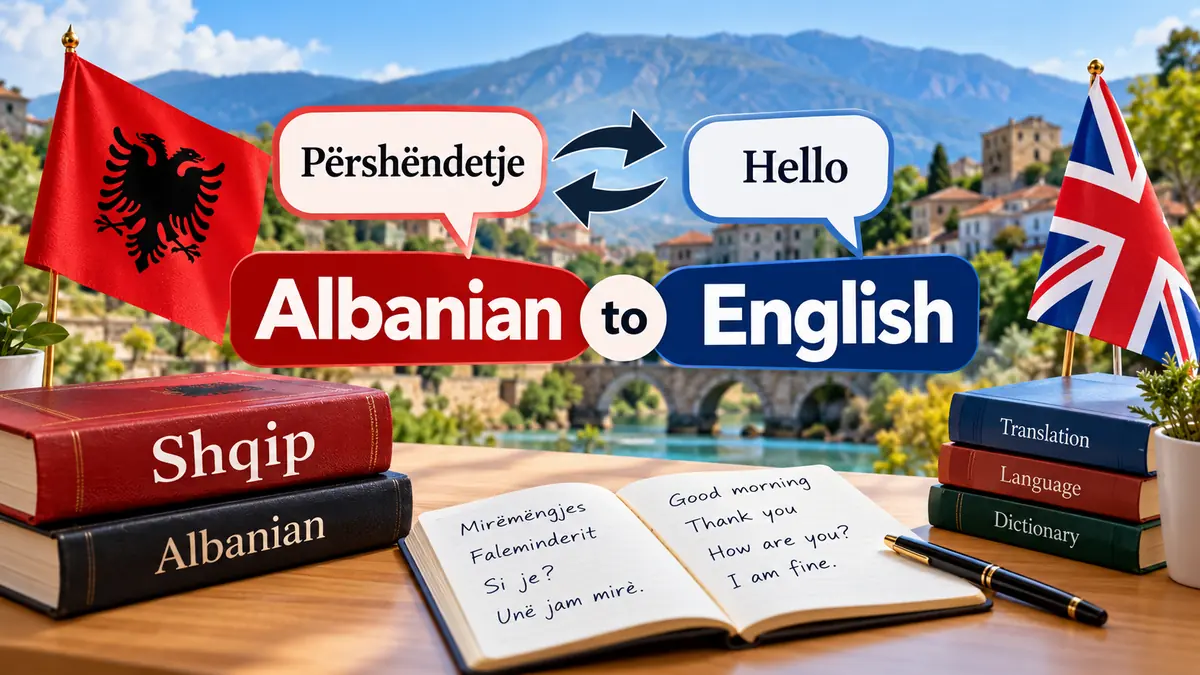
Translating Albanian into English can seem straightforward until you encounter a phrase that makes little sense when translated word for word. Albanian has its own grammar, sentence structures, regional dialects, and expressions that do not always have direct English equivalents.
albanian to english translation means converting words, sentences, or documents from the Albanian language (Shqip) into English while preserving their original meaning, context, and tone. Accurate translation requires understanding Albanian vocabulary, grammatical forms, dialect differences, and idiomatic expressions rather than simply replacing individual words with English equivalents.
This guide explains how Albanian-to-English translation works, introduces common words and everyday expressions, and explores the grammar and cultural details that help produce more natural translations.
How Does albanian to english Translation Work?
Albanian and English belong to the Indo-European language family, but they developed along different linguistic paths.
English belongs to the Germanic branch, while Albanian forms its own independent branch. This distinction helps explain why many Albanian words look unfamiliar to English speakers.
For example:
| Albanian | English |
|---|---|
| Përshëndetje | Hello |
| Faleminderit | Thank you |
| Mirëmëngjes | Good morning |
| Mirupafshim | Goodbye |
| Po | Yes |
| Jo | No |
| Ju lutem | Please |
| Më fal | Sorry / Excuse me |
| Ujë | Water |
| Bukë | Bread |
Some translations are simple, but others depend on the surrounding sentence.
Consider the Albanian word mirë. It can mean “good,” “well,” or “fine,” depending on its grammatical role and context.
Similarly, jam generally means “I am,” but its meaning becomes clearer when combined with other words:
- Unë jam student. — I am a student.
- Jam mirë. — I am fine.
- Jam në shtëpi. — I am at home.
The most reliable approach is to translate complete phrases or sentences instead of isolated words whenever possible.
Understanding the Albanian Language Before Translating
Albanian, known to native speakers as shqip, is the official language of Albania and Kosovo. It also has official status in North Macedonia and is spoken by communities in Montenegro, Serbia, Italy, Greece, and elsewhere.
Understanding its linguistic background can make translation considerably easier.
The Two Major Albanian Dialects
Albanian has two principal dialect groups: Gheg and Tosk.
Gheg is predominantly spoken in northern Albania, Kosovo, and several neighboring Albanian-speaking regions.
Tosk is predominantly spoken in southern Albania and provides the principal historical basis for Standard Albanian.
Standard Albanian is widely used in education, government, publishing, and formal communication.
Dialect differences may affect vocabulary, pronunciation, and grammatical forms.
For example:
| Gheg expression | Standard Albanian | English |
|---|---|---|
| Qysh je? | Si je? | How are you? |
| Çka po bon? | Çfarë po bën? | What are you doing? |
| Me punu | Të punosh | To work |
| Me shku | Të shkosh | To go |
These examples represent common colloquial usage, and exact forms can vary by region.
A translator working with Kosovo Albanian may encounter expressions that differ from those found in formal Albanian textbooks.
The Albanian Alphabet
Modern Albanian uses a Latin-based alphabet containing 36 letters.
Several letters are written as two-character combinations, including dh, gj, ll, nj, rr, sh, th, xh, and zh. Each represents a distinct letter in the Albanian alphabet.
Two particularly important characters are:
- Ë: A vowel that may represent a reduced vowel sound and is sometimes omitted in informal typing.
- Ç: A consonant pronounced approximately like “ch” in the English word “chair.”
These characters can affect spelling and meaning, so preserving them is useful when translating formal text.
Common Albanian to English Words for Everyday Use
Building a foundation of everyday vocabulary is one of the easiest ways to understand Albanian conversations.
Greetings and Polite Expressions
| Albanian phrase | English meaning |
|---|---|
| Përshëndetje | Hello |
| Tungjatjeta | Hello / Greetings |
| Mirëmëngjes | Good morning |
| Mirëdita | Good day |
| Mirëmbrëma | Good evening |
| Natën e mirë | Good night |
| Mirupafshim | Goodbye |
| Faleminderit | Thank you |
| Shumë faleminderit | Thank you very much |
| Ju lutem | Please / You’re welcome |
| Më falni | Excuse me / Sorry |
| Si jeni? | How are you? (formal or plural) |
| Jam mirë | I am fine |
| Gëzohem që ju njoh | Nice to meet you |
The expression ju lutem illustrates why context matters. It can function as a polite request or as a response to someone thanking you.
Family and Relationships
| Albanian | English |
|---|---|
| Familje | Family |
| Nënë | Mother |
| Baba | Father / Dad |
| Motër | Sister |
| Vëlla | Brother |
| Fëmijë | Child |
| Djalë | Boy / Son |
| Vajzë | Girl / Daughter |
| Gjysh | Grandfather |
| Gjyshe | Grandmother |
| Mik | Friend |
| Burrë | Man / Husband |
| Grua | Woman / Wife |
Words such as burrë and grua require context because they may describe a person or a marital relationship.
For example, gruaja ime means “my wife,” while një grua means “a woman.”
Numbers in Albanian
| Number | Albanian |
|---|---|
| 1 | Një |
| 2 | Dy |
| 3 | Tre |
| 4 | Katër |
| 5 | Pesë |
| 6 | Gjashtë |
| 7 | Shtatë |
| 8 | Tetë |
| 9 | Nëntë |
| 10 | Dhjetë |
| 20 | Njëzet |
| 50 | Pesëdhjetë |
| 100 | Njëqind |
| 1,000 | Një mijë |
Numbers are particularly useful when translating prices, dates, addresses, and travel information.
Useful albanian to english Sentences for Conversation
Individual words are helpful, but complete sentences demonstrate how Albanian grammar works in real situations.
Basic Conversation
| Albanian sentence | English translation |
|---|---|
| Si quhesh? | What is your name? |
| Unë quhem Ana. | My name is Ana. |
| Nga je? | Where are you from? |
| Unë jam nga Shqipëria. | I am from Albania. |
| Ku jeton? | Where do you live? |
| Nuk e kuptoj. | I don’t understand. |
| A flisni anglisht? | Do you speak English? |
| Flas pak shqip. | I speak a little Albanian. |
| Mund të më ndihmoni? | Can you help me? |
| Çfarë do të thotë kjo? | What does this mean? |
Notice that Albanian frequently omits personal subject pronouns.
For example, Flas shqip means “I speak Albanian.” The verb form already identifies the subject.
English generally requires the pronoun “I,” so a natural translation must add it.
Travel and Directions
| Albanian | English |
|---|---|
| Ku është aeroporti? | Where is the airport? |
| Ku është stacioni i autobusit? | Where is the bus station? |
| Sa kushton bileta? | How much does the ticket cost? |
| Dua të shkoj në hotel. | I want to go to the hotel. |
| Ku është tualeti? | Where is the restroom? |
| A është larg? | Is it far? |
| Kthehu majtas. | Turn left. |
| Kthehu djathtas. | Turn right. |
| Shko drejt. | Go straight. |
| Kam nevojë për ndihmë. | I need help. |
Travel phrases are particularly useful because their meanings tend to be predictable when the situation is clear.
However, a phrase may still need adjustment to sound natural in English.
For instance, Sa kushton? literally corresponds to “How much does it cost?” but can naturally be translated as “How much is it?”
Shopping and Restaurants
| Albanian | English |
|---|---|
| Sa kushton kjo? | How much does this cost? |
| Dua një kafe. | I want a coffee. |
| Një gotë ujë, ju lutem. | A glass of water, please. |
| A keni një menu? | Do you have a menu? |
| Faturën, ju lutem. | The bill, please. |
| Është shumë e shtrenjtë. | It is very expensive. |
| A mund të paguaj me kartë? | Can I pay by card? |
| Ushqimi është shumë i mirë. | The food is very good. |
In English, politeness sometimes requires a less literal construction.
For example, Dua një kafe directly means “I want a coffee,” but “I’d like a coffee” may be more appropriate in a polite restaurant conversation.
This is an example of translating tone rather than only vocabulary.
Albanian Grammar Differences That Affect English Translation
Grammar is one of the biggest challenges when converting Albanian sentences into natural English.
Albanian uses grammatical structures that English either lacks or expresses differently.
Nouns and Definite Articles
English normally places the definite article “the” before a noun.
Albanian frequently attaches definiteness markers to the end of nouns.
For example:
| Albanian indefinite | Albanian definite | English |
|---|---|---|
| Libër | Libri | A book / The book |
| Djalë | Djali | A boy / The boy |
| Vajzë | Vajza | A girl / The girl |
| Shtëpi | Shtëpia | A house / The house |
| Qytet | Qyteti | A city / The city |
This feature is called a postposed definite article.
A translator must recognize that the ending of a noun can carry information that English expresses through a separate word.
Grammatical Gender
Albanian nouns generally belong to masculine or feminine grammatical categories, with limited remnants of neuter gender.
Gender can influence adjective forms and other grammatical elements.
For example:
- Djalë i mirë — A good boy.
- Vajzë e mirë — A good girl.
The adjective construction changes, but English uses “good” in both cases.
A literal translation that attempts to reproduce every Albanian grammatical distinction may sound unnatural.
Albanian Cases
Albanian uses a grammatical case system that includes nominative, accusative, genitive, dative, and ablative forms.
These cases help express relationships between nouns and other sentence elements.
English relies more heavily on word order and prepositions.
Consider:
I dhashë librin vajzës.
English: “I gave the book to the girl.”
The Albanian noun vajzës carries grammatical information about the recipient. English communicates that relationship using “to.”
Understanding cases is especially useful when translating longer sentences containing several people or objects.
Verb Conjugation and Subject Pronouns
Albanian verbs change according to person, number, tense, and mood.
For example, the present tense of flas (to speak) includes:
| Albanian | English |
|---|---|
| Unë flas | I speak |
| Ti flet | You speak |
| Ai/Ajo flet | He/She speaks |
| Ne flasim | We speak |
| Ju flisni | You speak |
| Ata/Ato flasin | They speak |
Because Albanian verbs often indicate the subject, pronouns can be omitted.
Flasim anglisht means “We speak English.”
When translating into English, the missing subject pronoun normally needs to be restored.
Albanian Verb Moods
Albanian has a rich verbal system, including indicative, subjunctive, imperative, conditional, optative, and admirative forms.
The admirative is particularly interesting because it can express surprise, discovery, or information that the speaker has just learned.
For example:
Qenka ftohtë!
A natural English translation might be “Oh, it’s cold!” or “So it’s cold after all!”
The additional sense of surprise cannot always be conveyed by translating the verb alone.
How to Translate Albanian to English Accurately
Good translation involves more than finding equivalent dictionary definitions.
The following process works for everyday messages, articles, correspondence, and many other types of text.
Step 1: Identify the Albanian Variety
Determine whether the text uses Standard Albanian or a regional dialect.
Formal writing from Albania and Kosovo commonly follows the shared standard, but informal conversations may contain Gheg or Tosk regional forms.
This matters because dialect vocabulary may not appear in ordinary dictionaries.
Step 2: Read the Entire Sentence
Avoid translating every word independently before understanding the complete thought.
For example:
Kam shumë punë.
A natural English translation is “I have a lot of work.”
Translating each word separately can obscure the intended meaning, especially when the phrase contains idioms or grammatical constructions unfamiliar to English speakers.
Step 3: Identify the Subject and Verb
Determine who performs the action and when it occurs.
For example:
Shkova në shkollë dje.
Translation: “I went to school yesterday.”
The Albanian verb shkova already indicates first-person singular past tense.
The English translation requires “I” even though the Albanian sentence does not explicitly contain unë.
Step 4: Translate the Meaning, Not Just the Words
Some phrases require restructuring.
Kam uri.
Literal interpretation: “I have hunger.”
Natural English: “I am hungry.”
Likewise:
Kam etje.
Natural English: “I am thirsty.”
These examples show why grammatical equivalence and natural expression matter more than preserving the original word order.
Step 5: Review Context and Tone
Check whether the original sentence is formal, informal, affectionate, sarcastic, or neutral.
The Albanian pronouns ti and ju can signal differences in familiarity, number, or politeness.
English uses “you” for both, so translators may need to preserve politeness through other wording.
Step 6: Proofread the English Result
Read the translation independently of the Albanian original.
Ask whether it sounds like something a fluent English speaker would naturally say.
Check names, numbers, verb tenses, pronouns, punctuation, and any terms that have multiple meanings.
For official, legal, medical, or financial documents, qualified human review is particularly important.
Best Tools for Albanian to English Translation
Online translation tools can help readers understand unfamiliar text, but their accuracy varies with sentence complexity and language variety.
Google Translate
Google Translate supports Albanian and English and offers text, image, document, and website translation features.
It is useful for understanding short messages, common phrases, and general information.
Its limitations become more noticeable with regional slang, ambiguous expressions, complex sentences, or culturally specific references.
DeepL Translator
DeepL Translator offers text and file translation features. Language availability and individual features should be checked for the selected translation pair.
World’s Most Accurate Translator
As with other machine translation systems, results should be reviewed when the wording is important.
Bilingual Dictionaries
Albanian-English dictionaries are particularly useful when a word has multiple meanings.
A dictionary can help identify:
- Different grammatical forms of a word.
- Alternative English meanings.
- Common expressions involving the word.
- Whether a term is formal, colloquial, or regional.
- Examples of the word used in context.
Dictionaries are especially valuable when learning Albanian because they encourage readers to understand vocabulary rather than rely entirely on automatic translation.
Human Translation
Human translators are generally preferable when a document contains complex terminology, regional expressions, or sensitive information.
Professional translation may be necessary for immigration documents, academic transcripts, legal agreements, and official certificates.
Some institutions require certified or otherwise formally accepted translations, so the receiving organization’s requirements should be checked before submitting documents.
Translating Albanian Documents, Images, and Audio
Not all Albanian text appears in an easily copied format.
You may encounter scanned certificates, photographed signs, handwritten notes, or spoken conversations.
Translating Documents
For digital documents, begin by checking whether the text can be selected and copied.
If it can, the content can usually be processed by a text translation system.
Scanned documents may require optical character recognition (OCR) to extract the text first.
After translation, check proper names, dates, document numbers, and official terminology against the original.
Translating Images
Photographs of Albanian signs, menus, or printed pages can often be translated using image-based translation software.
However, recognition errors may occur when the image is blurry, the text is small, or special Albanian characters are unclear.
The characters ë and ç deserve particular attention.
Translating Spoken Albanian
Speech translation typically involves three stages: recognizing spoken words, converting them into text, and translating the recognized text into English.
Background noise, rapid speech, regional accents, and overlapping speakers can reduce accuracy.
For important conversations, compare the translation with the original audio rather than assuming every recognized word is correct.
Albanian Pronunciation Guide for English Speakers
Understanding pronunciation can help readers recognize spoken Albanian and connect unfamiliar words with their written forms.
Albanian spelling is relatively systematic, although pronunciation varies between dialects.
| Albanian letter | Approximate English pronunciation | Example |
|---|---|---|
| Ç | Ch in “chair” | Çaj |
| Sh | Sh in “ship” | Shqip |
| Xh | J in “jam” | Xham |
| Zh | S in “measure” | Zhurmë |
| Th | Th in “think” | Thotë |
| Dh | Th in “this” | Dhomë |
| J | Y in “yes” | Jam |
| Nj | Similar to ny in “canyon” | Një |
| Ë | Often a reduced vowel, similar to schwa | Është |
These are approximations, not complete phonetic descriptions.
Two sounds that may require extra practice are q and gj. They are distinct palatal consonants rather than exact equivalents of ordinary English “ch” and “j.”
The Albanian letter y also represents a vowel not normally found in standard English pronunciation.
Listening to native speakers is more reliable than relying only on English sound comparisons.
Common Albanian Idioms and Their English Meanings
Idioms demonstrate why literal translation can be misleading.
Albanian contains expressions that reflect cultural traditions, social relationships, and everyday experiences.
| Albanian expression | Natural English meaning |
|---|---|
| Më ka marrë malli. | I miss someone or something. |
| Të lumtë! | Well done! |
| Paç fat! | Good luck! |
| Me gjithë zemër | With all my heart |
| Më bëhet qejfi. | I’m glad. |
| S’ka problem. | No problem. |
| U bë vonë. | It’s getting late. |
| Më ra ndër mend. | It occurred to me. |
Consider Më ka marrë malli për ty.
A natural translation is “I miss you.”
A strictly literal translation would not communicate the emotional meaning effectively.
Another example is Të lumtë dora!, which can express praise or appreciation for something someone has made or done.
Depending on the situation, an English speaker might say “Great job!” or “Well done!”
The best translation preserves the speaker’s intention.
Common Mistakes in Albanian to English Translation
Even simple translations can contain errors when grammatical details or cultural context are overlooked.
Confusing Formal and Informal Language
Albanian distinguishes between informal singular ti and formal or plural ju.
Both usually translate to “you.”
However, the level of politeness may need to be expressed through the overall English sentence.
For example, a polite request might be better translated using “Could you please…” rather than a direct command.
Ignoring Dialect Differences
A translator familiar only with Standard Albanian may misunderstand colloquial expressions from Kosovo or northern Albania.
For instance, the Gheg construction me punu corresponds to “to work,” while Standard Albanian commonly uses constructions such as të punosh or për të punuar, depending on context.
English Made Simple
+1
Recognizing these differences helps prevent unnecessary confusion.
Translating Idioms Literally
Expressions such as Kam uri and Më ka marrë malli should be translated according to their actual meanings.
Word-for-word translation often produces awkward English.
Missing Verb Tense Information
Albanian has multiple past-tense and aspectual constructions.
A translator must distinguish between events that happened once, actions continuing over time, and actions completed before another event.
For example:
- Po lexoj. — I am reading.
- Lexova. — I read (past tense).
- Kam lexuar. — I have read.
The English translation should reflect the relevant time and aspect.
Trusting Automatic Translation Without Review
Machine translation can be useful for general comprehension, but it may misinterpret ambiguous words or overlook regional meanings.
Reviewing important sentences against the original helps identify these problems.
Albanian to English Translation Examples With Context
Comparing complete sentences shows how context changes translation choices.
Example 1: Everyday Communication
Albanian: Sot është një ditë shumë e bukur.
English: “Today is a very beautiful day.”
The adjective e bukur describes the day, while shumë intensifies the description.
Example 2: Making Plans
Albanian: Do të takohemi nesër në mëngjes.
English: “We will meet tomorrow morning.”
The construction do të helps express future meaning.
Example 3: Expressing a Need
Albanian: Kam nevojë për pak kohë.
English: “I need a little time.”
Although kam means “I have,” the entire expression kam nevojë për is naturally translated as “I need.”
Example 4: Asking for Information
Albanian: A mund të më tregoni ku është biblioteka?
English: “Could you tell me where the library is?”
This translation preserves the polite nature of the question.
Example 5: Expressing Emotion
Albanian: Jam shumë i lumtur që të shoh.
English: “I’m very happy to see you.”
The adjective i lumtur is masculine. A female speaker would normally use e lumtur.
English does not change “happy” according to the speaker’s grammatical gender.
How Long Does It Take to Learn Basic Albanian?
The time required to learn Albanian depends on your previous language experience, study habits, and learning goals.
An English speaker may learn basic greetings and everyday expressions relatively quickly, while developing conversational fluency requires much more practice.
Albanian can be challenging because its grammatical cases, verb system, and vocabulary differ considerably from English.
A practical learning routine includes vocabulary review, listening practice, reading short passages, and translating complete sentences.
Example daily practice routine
| Activity | Time |
|---|---|
| Review common vocabulary | 10 minutes |
| Listen to spoken Albanian | 10 minutes |
| Translate short sentences | 10 minutes |
| Practice speaking | 10 minutes |
| Review grammar or mistakes | 5 minutes |
Illustrative 45-minute routine; learning progress varies by individual.
Learners can begin with greetings, numbers, family vocabulary, and simple present-tense sentences before moving to more complex grammar.
Using both Albanian and English examples helps reinforce meaning and sentence structure.
Why Context Matters More Than Literal Translation
One Albanian word may have several possible English equivalents.
For example, kohë can mean “time” or “weather,” depending on the expression.
Compare:
Sa është ora? — “What time is it?”
Nuk kam kohë. — “I don’t have time.”
Koha është e mirë. — “The weather is good.”
The surrounding words determine which interpretation is appropriate.
The same principle applies to pronouns, adjectives, idioms, and verb forms.
A translator should consider the speaker’s purpose, the subject of the conversation, and the intended audience before choosing the final English wording.
For short informal messages, a simple translation may be sufficient. For literature, legal documents, academic writing, or emotionally nuanced communication, greater attention to style and context is necessary.
Final Thoughts on albanian to english Translation
Accurate albanian to english translation depends on understanding both languages rather than substituting words mechanically.
Albanian’s grammatical cases, definite noun endings, verb conjugations, dialect differences, and idiomatic expressions can all influence how a sentence should be expressed in English.
For everyday communication, learning common vocabulary and complete phrases provides a useful foundation. Online translation tools can help with general understanding, while dictionaries and human review improve accuracy when meaning is uncertain.
The most effective next step is to practice translating short Albanian sentences, compare them with natural English equivalents, and gradually work toward longer passages. This approach builds vocabulary, strengthens grammatical understanding, and makes translations clearer and more reliable.
