

Search for adultsrach and you will quickly notice something unusual: different websites give very different explanations. Some describe it as an adult-oriented search or content-discovery concept, others call it an online platform, while several treat it simply as an unexplained internet keyword.
That inconsistency is the most important fact to understand. A keyword appearing repeatedly in search results does not automatically mean there is a verified company, application, search engine, or service behind it.
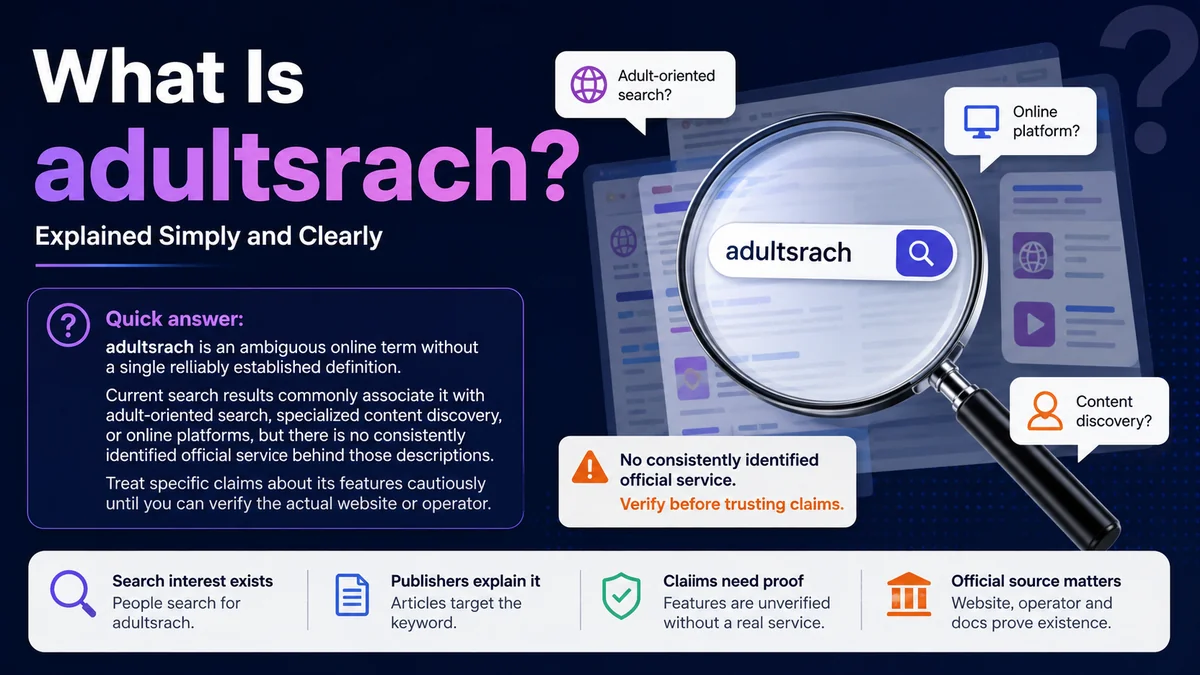
Quick answer: adultsrach is an ambiguous online term without a single reliably established definition. Current search results commonly associate it with adult-oriented search, specialized content discovery, or online platforms, but there is no consistently identified official service behind those descriptions. Treat specific claims about its features cautiously until you can verify the actual website or operator.
What Is adultsrach?
The simplest way to understand adultsrach is as an unusual search term rather than the confirmed name of a widely recognized digital service.
Current search results demonstrate why the distinction matters. One explanation characterizes adultsrach as an ambiguous internet keyword with no universally established meaning. Another describes it as a conceptual niche search system, while other pages associate it with account-based online environments or adult-focused content discovery.
Those descriptions overlap in places, but they do not establish the existence of one particular product.
Think about four separate things:
| What you find online | What it actually establishes |
|---|---|
| People searching for adultsrach | Search interest exists |
| Articles explaining adultsrach | Publishers are targeting the term |
| Claims about features | Unverified descriptions unless supported by a real service |
| Official website, operator and documentation | Evidence that a specific service actually exists |
This distinction prevents an unfamiliar keyword from gradually being treated as an established brand merely because numerous articles repeat similar descriptions.
Is adultsrach a real word?
There is no strong evidence in current search results showing adultsrach as a standard English dictionary term.
Its unusual spelling has encouraged publishers to speculate about its origin. One article, for example, attempts to interpret the ending through medical terminology, while other sources treat the entire expression as a digital keyword, possible typo, or unusual search string.
Without an authoritative origin, these interpretations should remain theories rather than definitions.
That means readers should avoid statements such as “adultsrach officially means X” unless a reliable primary source emerges to establish that meaning.
Why Are People Searching for adultsrach?
Search interest around unfamiliar terms often develops differently from interest around established products.
Someone encounters a strange word, searches for its meaning, finds several articles about it, and creates additional search demand. Publishers notice that interest and produce more explanatory pages. More indexed pages can then make the term look more established than it originally was.
This appears to be an important part of the adultsrach story.
One current result describes the term specifically as a product of digital curiosity and search-engine indexing rather than something tied to a clearly established company or technology.
Several factors could contribute to this pattern.
1. An unfamiliar spelling creates curiosity
People naturally investigate words they do not recognize.
If adultsrach appears in search suggestions, analytics data, a webpage, social post, username, referral URL, or another online context, a user may search the exact spelling simply to determine what it means.
2. It may be related to another search phrase
One plausible interpretation is that adultsrach developed from a misspelling or variation of another phrase, potentially “adult search.”
That connection has not been conclusively demonstrated, however. A spelling resemblance alone is not enough to establish etymology or identity.
3. New articles amplify the keyword
Once publishers identify search interest around an obscure term, explanatory content tends to follow.
That creates an interesting feedback loop:
- An unusual query appears.
- Users search for an explanation.
- Websites publish pages targeting it.
- Search engines index those pages.
- More people encounter the keyword.
- Additional publishers create content around it.
Eventually, a reader can see dozens of pages about something without finding a clear primary source explaining where it originally came from.
4. Adult-related interpretations generate additional interest
Several current pages associate adultsrach with adult-oriented search or content discovery. Others go further and describe mature-content environments.
Because adult-related searches naturally raise questions about privacy, safety and legitimacy, people encountering the term may investigate it before visiting unfamiliar websites.
Is adultsrach an Adult Search Engine?
This is one of the most common interpretations, but it requires an important qualification.
Some publishers describe adultsrach as a specialized or niche search-style environment that organizes targeted content through categories and filtering rather than operating like a broad general-purpose search engine.
However, repeated descriptions do not prove that a single search engine called adultsrach exists.
A real search platform should normally provide independently checkable evidence such as:
- a consistent official domain;
- identifiable ownership or an operator;
- terms of service;
- a privacy policy;
- documented functionality;
- contact information;
- technical or company documentation;
- and, where applicable, verified application listings.
When those signals cannot be consistently connected to the same entity, it is more accurate to say that some websites associate adultsrach with specialized search and content discovery rather than declaring that adultsrach is definitively a search engine.
How would a specialized content search system work?
The concept itself is straightforward.
A niche search or discovery service could collect or index information, organize it into categories, accept user queries, apply filters and ranking rules, and then return a smaller set of targeted results.
A simplified workflow looks like this:
Query → filtering → categorization → ranking → results
Such functionality is common across specialized directories, databases, marketplaces, streaming services and content platforms.
But explaining how a hypothetical niche search system works should not be confused with documenting the technical architecture of adultsrach itself.
adultsrach Claimed Features vs. Verified Information
One of the biggest problems surrounding ambiguous online terms is feature inflation.
An article describes a platform as having filters. Another mentions accounts. A third adds subscriptions and messaging. Eventually, readers see a detailed product description even though the underlying features were never independently verified.
Current adultsrach pages demonstrate this problem. Some discuss content indexing and filtered search, while another describes user interaction, dashboards, accounts and possible subscriptions.
A more responsible interpretation separates claims from evidence.
| Common description online | What you should conclude |
|---|---|
| Specialized search system | A recurring interpretation, not proof of one official search engine |
| Content filters | Plausible for niche discovery tools but not universally verified |
| User profiles | Verify on the exact website before assuming they exist |
| Messaging | Depends entirely on the service being referenced |
| Subscriptions | Never assume payment functionality without checking the operator |
| Privacy controls | Must be evaluated on the actual website |
| Safe browsing | Cannot be determined from the keyword alone |
This approach may seem cautious, but it gives readers something far more useful than an invented feature list.
Is adultsrach the Same as “Adult Search”?
Possibly, but there is currently not enough evidence to treat the two expressions as interchangeable.
The spelling makes the connection tempting. “Adultsrach” could conceivably result from a typo, missing letters, automated text processing, a brand-style spelling, or some other variation.
Search engines encounter malformed queries constantly.
Common causes include:
- typing errors;
- autocomplete mistakes;
- copied misspellings;
- OCR errors from scanned text;
- scraper-generated text;
- machine-generated pages;
- usernames and brand names;
- transliteration;
- and intentionally altered spellings.
One ranking page specifically describes anomalous queries as potentially arising from typos, OCR artifacts, scraping residue, and similar mechanisms.
Yet none of those possibilities proves the origin of adultsrach.
Until a reliable source establishes the relationship, adultsrach and adult search should be treated as separate queries.
How adultsrach Differs From Traditional Search Engines
It is also useful to distinguish discussions surrounding adultsrach from established web search.
Traditional search engines attempt to discover, index and rank enormous portions of the public web. Specialized search systems, by contrast, deliberately narrow their scope.
| General web search | Specialized discovery |
|---|---|
| Broad web index | Narrower content scope |
| Huge variety of topics | Topic-focused material |
| General ranking algorithms | Category-specific relevance |
| Broad audience | Defined audience |
| Millions of possible results | More focused result sets |
| General-purpose filters | Potentially specialized filters |
Articles describing adultsrach as a search concept generally emphasize this narrower, categorized model.
The comparison helps explain what publishers mean when they use phrases such as “specialized search environment.”
It still does not verify a specific adultsrach technology.
Is adultsrach a Real Platform?
Based on the current search landscape, adultsrach should not automatically be treated as the verified name of one established platform.
This is perhaps the biggest content gap among pages discussing the keyword.
A convincing article can easily make an uncertain concept sound concrete. Terms such as “dashboard,” “algorithm,” “membership,” “privacy controls” and “subscription” create the impression that someone has inspected an actual product.
But where is the product?
Where is its official documentation?
Who operates it?
Those questions matter more than how many third-party blogs describe its supposed functionality.
One recent investigation of the term similarly notes that available descriptions do not consistently identify an official website, owner, application listing, company profile, or technical documentation.
Until such evidence is available, readers should distinguish between articles discussing adultsrach and an official adultsrach service.
They are not necessarily the same thing.
Is adultsrach Safe?
Searching the word adultsrach itself is not the primary safety issue. The important question is which website you visit afterward.
Search results can lead to completely unrelated domains, and unfamiliar or adult-oriented websites can carry additional privacy and security concerns.
Before interacting with an unknown site associated with the term, evaluate the actual destination.
Check the exact domain
Look carefully at the address before entering information.
Minor spelling changes, extra characters and unusual subdomains can be used to imitate legitimate websites. Do not assume two pages belong to the same service merely because both mention adultsrach.
Look for identifiable ownership
A credible platform should make it reasonably clear who operates it.
Check its About page, contact details, terms, privacy documentation and company information. Missing ownership information does not automatically prove malicious activity, but it gives you less information on which to base trust.
Review the privacy policy
This becomes particularly important for sensitive browsing.
Check what information the website says it collects, including:
- email addresses;
- account information;
- IP addresses;
- cookies;
- browsing activity;
- device identifiers;
- analytics data;
- payment information;
- and user-generated content.
Also look for information about retention, third-party sharing and account deletion.
Be careful with browser permissions
An unfamiliar website rarely needs unrestricted access to your device.
Be cautious when a page unexpectedly asks for notification permissions, location access, camera or microphone access, downloads, extensions, or other unusual permissions.
Deny anything that is unnecessary for the activity you intended to perform.
Avoid unknown downloads
Do not install software simply because a webpage claims it is required to view content.
Unexpected executable files, browser extensions and mobile application packages deserve particular caution when they come from unknown sources.
Treat payment requests carefully
If a site associated with adultsrach requests payment, first verify the exact business taking the money.
Check the subscription terms, billing frequency, cancellation method and refund policy. Never assume a payment page is legitimate merely because another blog said the platform offers “premium membership.”
Privacy Matters More With Sensitive Searches
Privacy deserves special attention whenever a query may be associated with mature or sensitive material.
There are several layers to online privacy.
Browser history: Browsing activity may remain locally stored on your device.
Website tracking: Sites can use cookies and other technologies for sessions, analytics, personalization and advertising.
Account records: Creating an account may connect activity to an email address or profile.
Network information: Websites normally receive technical information needed to establish a connection, including an IP address.
Third-party services: Advertising, analytics, payment or embedded-content providers may process additional information.
Private or incognito browsing can reduce some local history retention, but it does not make a person invisible to websites, networks or online services.
That distinction is frequently misunderstood.
How to Evaluate an adultsrach Website Before Trusting It
Because the term itself is uncertain, the safest strategy is evidence-based evaluation.
Use this process whenever you encounter a site claiming to represent adultsrach:
- Confirm the domain. Make sure you know exactly which website you are visiting.
- Identify the operator. Look for a real organization, company or responsible party.
- Read its privacy policy. Understand what information may be collected.
- Review its terms. Pay particular attention to eligibility, user content, subscriptions and cancellation.
- Check independent reputation signals. Look beyond reviews published by the website itself.
- Inspect permission requests. Decline unnecessary browser or device permissions.
- Avoid unexpected downloads. Do not install unknown applications, extensions or files.
- Verify payments separately. Check merchant identity and recurring billing terms before providing financial information.
- Use unique credentials. Never reuse an important password on an unfamiliar service.
- Leave when something feels inconsistent. Unexpected redirects, fake warnings and aggressive permission prompts are reasons to close the page.
The key principle is simple: trust the evidence attached to the exact domain, not generic claims attached to the keyword.
Common Warning Signs to Watch For
You do not need advanced cybersecurity knowledge to recognize many questionable websites.
Be especially cautious when several of these signs appear together:
- no identifiable operator;
- no meaningful privacy policy;
- copied or contradictory site information;
- repeated redirects;
- unexpected pop-ups;
- fake virus warnings;
- forced notification requests;
- suspicious downloads;
- unclear subscription pricing;
- difficult-to-find cancellation terms;
- requests for unnecessary personal information;
- or claims that sound much more specific than the available evidence supports.
A professional design is not proof of legitimacy. Modern templates can make almost any website appear polished.
Why Conflicting adultsrach Definitions Matter
The conflicting definitions surrounding adultsrach provide a useful lesson in online information literacy.
Search engines rank webpages. They do not guarantee that every claim appearing across multiple webpages originated from independent research.
Suppose Site A speculates that an unfamiliar term represents a specialized search engine. Site B publishes a similar explanation. Site C then uses both descriptions to create a more detailed guide.
After enough repetition, the original speculation can begin to look like established fact.
This is sometimes called an information cascade: later claims gain apparent credibility because earlier claims have already been repeated.
For obscure digital terms, always search for the primary source.
If ten blogs describe a platform but none can reliably identify its official operator, that absence is meaningful.
Repetition is not independent verification
This is particularly relevant when articles contain remarkably similar sections about:
- features;
- benefits;
- registration;
- dashboards;
- privacy;
- subscriptions;
- safety;
- and “how it works.”
Those topics may simply reflect a common article template rather than direct experience with a product.
Good research asks a different question:
What can actually be verified?
Does adultsrach Require an Account or Subscription?
There is no universal answer because a single official service with standardized functionality has not been reliably established.
Some pages discussing adultsrach refer to accounts, dashboards, user interaction, payments or subscriptions.
That does not mean every website associated with the keyword requires registration.
If you encounter a specific site asking you to create an account, evaluate that site independently. Before submitting an email address or password, check who runs it and what happens to your information.
The same principle applies to subscriptions.
Do not enter payment information based on an article claiming that adultsrach has “premium features.” Confirm the merchant, actual price, renewal schedule, cancellation procedure and refund terms on the service itself.
What Should You Do If You Encounter adultsrach Online?
Start with context rather than assumptions.
If you saw the word in search results, the safest interpretation is simply that it is an ambiguous keyword currently being discussed by multiple publishers.
If you saw it attached to a specific website, investigate that website.
If someone describes it as an application, look for an authentic application listing and developer identity.
If a page describes it as a company, verify the company.
If it claims to provide a particular technology, look for documentation showing that technology actually exists.
This approach works far beyond adultsrach. It is useful whenever you encounter a mysterious product name, viral term, unfamiliar website or newly appearing digital service.
What adultsrach Tells Us About Search Trends
There is another reason this keyword is interesting: it demonstrates how the modern web can create meaning around an unexplained search query.
Search demand does not always begin with a famous person, established company or known product. Sometimes curiosity itself becomes the topic.
An unfamiliar query receives searches. Publishers notice it. New pages appear. Search engines discover those pages. Users see more references to the term and become even more curious.
The result can be a search ecosystem built largely around the question, “What does this word mean?”
That appears to explain at least part of the current adultsrach landscape. Several recent results explicitly focus on its ambiguity, online relevance, viral search interest, or lack of a recognized definition.
It is a useful reminder that search visibility and real-world authority are different things.
The Bottom Line on adultsrach
adultsrach currently has no single reliably established meaning. Search results most commonly connect it with specialized search, adult-oriented content discovery, digital platforms, or simply an unusual internet keyword, but those descriptions are inconsistent.
The most useful approach is therefore not to invent certainty.
Do not assume that adultsrach has specific features, accounts, subscriptions, algorithms or privacy protections unless you can verify them on an identifiable official service. Likewise, do not assume that every website using the term represents the same organization.
If you encounter adultsrach while browsing, focus on the exact domain, operator, privacy policy, permissions, payment terms and independent reputation signals before sharing information or creating an account.
For now, adultsrach is best understood as an ambiguous online search term whose visibility has grown faster than its verifiable identity.
