

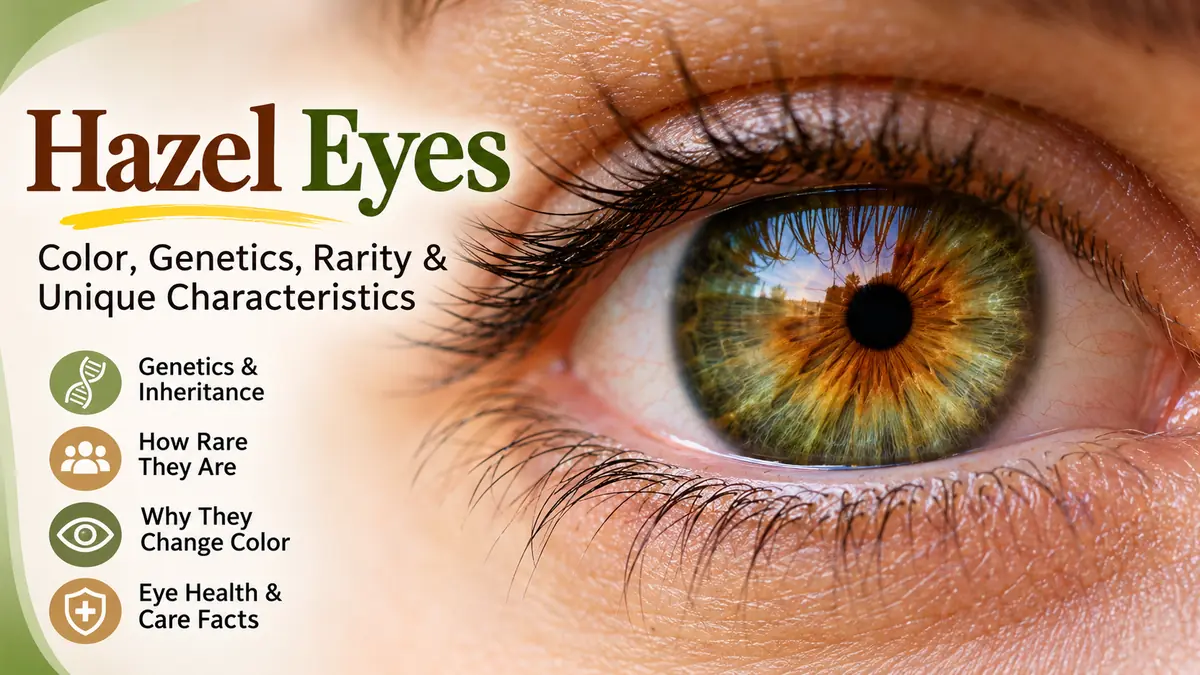
Some eyes look unmistakably brown or blue. Others seem to shift between green, gold, and brown depending on the light. Hazel eyes belong to that second group, making them one of the most visually varied natural eye colors.
What makes this eye color particularly interesting is that its appearance comes from a combination of pigmentation, iris structure, and the way light interacts with the eye.
Hazel eyes are a natural eye color characterized by a mixture of brown, green, and golden tones within the iris. Their appearance results from moderate amounts of melanin, uneven pigment distribution, and light scattering. They may look greener or browner under different lighting conditions, although their actual pigmentation usually remains unchanged.
Understanding how these features work explains why two people with hazel-colored irises can have noticeably different eyes.
What Are hazel eyes?
Hazel is a mixed eye color that typically combines shades of green, brown, and gold. Some irises have a predominantly green appearance with brown near the pupil, while others look mostly light brown with subtle green or amber undertones.
Unlike a uniform eye color, hazel often displays several colors within the same iris.
The Cleveland Clinic explains that hazel coloring results from variations in melanin concentration and can include different combinations of brown, green, and gold. Cleveland Clinic+1
Couleur des yeux : origine et rareté des yeux bleu, verts, noisette, etc.
Die seltensten Augenfarben | Brille24 DE
13
What Color Are Hazel Eyes Exactly?
There is no single shade that defines every hazel iris. Instead, the term describes a family of mixed-color appearances.
Common characteristics include:
- A brown or golden region surrounding the pupil.
- Green, olive, or yellow-green coloring farther outward.
- Amber or copper-colored flecks scattered across the iris.
- Soft transitions between different colors.
- A warmer or cooler overall appearance depending on lighting.
Some people have predominantly brown hazel eyes, while others have green-dominant hazel eyes.
The precise combination depends on how pigment is distributed throughout the iris and how incoming light is absorbed and scattered.
Different Types of Hazel Eye Color
Although there is no universally accepted medical classification of hazel subtypes, several descriptive categories are useful.
| Hazel variation | Typical appearance |
|---|---|
| Green hazel | Predominantly green with brown or gold accents |
| Brown hazel | Light to medium brown with visible green tones |
| Golden hazel | Warm yellow-gold and light brown coloring |
| Amber-hazel | Copper or honey tones mixed with green or brown |
| Dark hazel | Deeper brown coloring with subtle green highlights |
| Light hazel | Pale green, golden, and light brown shades |
These names describe appearance rather than genetically distinct eye-color types.
What Causes Hazel Eye Color?
The appearance of hazel-colored eyes is primarily determined by melanin and the physical structure of the iris.
The iris is the colored circular tissue surrounding the pupil. It regulates how much light enters the eye by adjusting pupil size.
Its color depends on the amount and distribution of pigment, along with the optical properties of its tissues.
The Role of Melanin
Melanin is the pigment responsible for much of the coloring in human skin, hair, and eyes.
In the iris, it plays a major role in determining how dark or light the eyes appear.
Generally:
- Brown eyes contain relatively high concentrations of melanin in the front iris layers.
- Blue eyes contain very little melanin in those layers.
- Green eyes contain comparatively low amounts of pigment.
- Hazel eyes typically have intermediate pigmentation, often distributed unevenly.
This uneven distribution contributes to the mixture of colors associated with hazel irises.
The American Academy of Ophthalmology explains that melanin and light scattering work together to create the appearance of green and hazel eyes. American Academy of Ophthalmology+1
How Light Scattering Affects Hazel Eyes
Eye color is not determined by pigment alone.
When light enters the iris, some wavelengths are absorbed while others are scattered or reflected.
The iris contains a front tissue layer called the stroma. Its pigment content and microscopic structure influence how light behaves.
In lightly pigmented regions, shorter wavelengths of light may scatter more noticeably, contributing to blue or green appearances.
In more heavily pigmented regions, brown tones become more prominent.
This interaction helps explain why a single hazel iris can display several colors simultaneously.
Importantly, human irises do not contain separate green or blue pigments that directly produce those colors. Their appearance arises largely from melanin and optical effects.
How Rare Are hazel eyes?
Hazel eyes are relatively uncommon worldwide, although estimates vary according to the population studied and how researchers classify mixed eye colors.
A 2020 scientific review published in the Journal of Cellular Physiology estimated that approximately 5% of the global population has hazel eyes.
That figure should be treated as an approximate estimate rather than an exact worldwide census. PubMed+1
Estimated global prevalence
5%
of people worldwide have hazel eyes
Approximate estimate from a 2020 scientific review; classification and population differences affect prevalence.
Hazel Eyes Compared With Other Eye Colors
The same scientific review reported the following approximate worldwide proportions.
| Eye color | Estimated worldwide prevalence |
|---|---|
| Brown | 79% |
| Blue | 8–10% |
| Hazel | 5% |
| Green | 2% |
| Gray and other colors | Less common; estimates vary |
These figures are approximate, and different surveys may produce different distributions. PubMed+1
Are Hazel Eyes Rarer Than Green Eyes?
No. Green eyes are generally considered rarer than hazel eyes worldwide.
Hazel coloring is uncommon, but the estimated prevalence of green eyes is lower.
However, the distinction is not always straightforward. Some eyes classified as green in one study may be categorized as green-hazel or mixed in another.
This inconsistency makes exact comparisons difficult.
Where Are Hazel Eyes Most Common?
Hazel-colored eyes occur in populations around the world.
They are often observed among people with European, Middle Eastern, Mediterranean, and other mixed ancestral backgrounds.
They can also occur in people of South Asian, North African, and many other ancestries.
There is no reliable universal ranking of countries with the highest percentage of hazel-eyed individuals, partly because large population surveys do not always distinguish hazel from green or light brown.
Eye color alone cannot reliably establish someone’s nationality, ethnicity, or ancestry.
Hazel Eyes vs. Green, Brown, and Amber Eyes
Distinguishing hazel from neighboring eye colors can be surprisingly difficult.
The biggest clue is usually whether the iris contains multiple noticeable colors rather than a relatively uniform overall shade.
The Pros and Cons of Wearing Contacts | Zenni Optical Blog
Hazel eyes
Mixed green, brown, and gold tones
Green eyes
Predominantly green iris coloring
Brown eyes
More uniform brown pigmentation
Amber eyes
Predominantly golden or copper coloring
Illustrative examples of typical eye-color appearances. Natural irises vary considerably.
Hazel Eyes vs. Green Eyes
Green eyes generally have a more consistently green appearance, although golden or brown flecks may be present.
Hazel eyes usually contain a more noticeable combination of green and brown.
A predominantly green iris with a large brown area near the pupil may be described as green-hazel.
The distinction can be subjective because eye color exists along a continuous spectrum.
Hazel Eyes vs. Brown Eyes
Brown eyes contain more visible brown pigmentation across the iris.
Hazel eyes may look brown from a distance, but closer inspection often reveals green or golden areas.
Light brown eyes can be especially difficult to distinguish from brown-dominant hazel eyes.
A useful approach is to examine the iris under neutral daylight rather than relying on photographs taken with warm lighting.
Hazel Eyes vs. Amber Eyes
Amber eyes typically have a more uniform golden-yellow, honey, or copper appearance.
Hazel eyes are more likely to show a mixture of green and brown alongside warm golden tones.
Because both colors can appear golden, amber and golden-hazel eyes are sometimes confused.
Why Do hazel eyes Change Color?
One of the most frequently noticed characteristics of hazel eyes is their apparent ability to change color.
A person may notice their eyes looking green outdoors, golden near a window, and brown in a dimly lit room.
In most cases, the eye’s actual pigment is not changing.
Instead, the perceived color changes because of lighting, contrast, pupil size, and surrounding colors.
Lighting Conditions
Different lighting environments emphasize different parts of the iris.
Natural daylight may reveal green and golden tones that are less obvious under artificial lighting.
Warm indoor lights can make brown or amber areas appear stronger.
Cooler lighting may emphasize greenish tones.
The effect is especially noticeable when the iris already contains several distinct colors.
Clothing and Surrounding Colors
Clothing and makeup can influence how people perceive eye color through visual contrast.
For example, green clothing may make existing green tones in hazel irises appear more noticeable.
Warm brown or copper colors can emphasize golden areas.
This does not physically change the eye. It changes how the existing colors are perceived.
Pupil Size
The pupil expands and contracts in response to lighting and other factors.
When the pupil changes size, the surrounding iris tissue stretches or compresses.
This can subtly alter the visibility of certain pigment patterns.
As a result, an iris may appear somewhat different when the pupil is large compared with when it is small.
Can Emotions Change Hazel Eye Color?
Emotions do not directly change iris pigmentation.
However, emotional responses can influence pupil size through the autonomic nervous system.
Changes in pupil size, combined with lighting, may make the eye appear slightly different.
Claims that hazel eyes permanently turn green during happiness or brown during anger are not supported by established eye-color science.
The American Academy of Ophthalmology confirms that lighting, clothing, and pupil changes can create the illusion of changing eye color. American Academy of Ophthalmology+1
The Genetics Behind Hazel Eyes
Eye color is inherited, but its genetics are considerably more complicated than the traditional explanation of brown being dominant over blue.
Scientists now recognize eye color as a polygenic trait, meaning multiple genes contribute to the final appearance.
Which Genes Influence Hazel Eye Color?
Two particularly important genes are OCA2 and HERC2, located close together on chromosome 15.
OCA2 influences processes involved in melanin production and storage.
HERC2 contains regulatory regions that can affect OCA2 activity.
Variations in these genes influence iris pigmentation, but they do not fully explain every possible eye color.
Other genes also contribute to pigmentation and the range of colors seen in human populations.
According to MedlinePlus Genetics, multiple genetic variants help determine eye color, making inheritance more complex than a single dominant-recessive pattern. MedlinePlus+1
Can Two Brown-Eyed Parents Have a Hazel-Eyed Child?
Yes.
Two parents with brown eyes can have a child with hazel eyes because both parents may carry genetic variants associated with lighter or mixed pigmentation.
A child’s eye color reflects a combination of inherited variants, not simply the visible colors of the parents’ eyes.
Can Two Blue-Eyed Parents Have a Hazel-Eyed Child?
It is possible, although uncommon.
The familiar schoolbook model that assigns eye color to one brown allele and one blue allele is an oversimplification.
Because several genes influence pigmentation, parental eye color alone cannot determine every possible outcome.
Do Hazel Eyes Skip Generations?
Hazel coloring may appear to skip generations.
A child might have hazel eyes even when neither parent has visibly hazel eyes, particularly if relatives carry genetic variants associated with mixed iris pigmentation.
This does not mean that one hidden hazel-eye gene suddenly becomes active.
Rather, a particular combination of inherited variants can produce a phenotype not visibly present in the parents.
Can You Predict a Baby’s Hazel Eyes?
Not accurately from parental eye colors alone.
Genetic information can help estimate the likelihood of broad eye-color categories, but predicting an exact shade such as green-dominant hazel remains difficult.
Eye color may also develop after birth as pigment accumulates in the iris.
Hazel Eyes and Central Heterochromia
Hazel eyes are sometimes confused with central heterochromia because both can display multiple colors within the same iris.
However, these terms describe different characteristics.
Hazel refers to an overall mixed eye color.
Central heterochromia describes a pattern in which the area surrounding the pupil has a noticeably different color from the outer iris.
Mixed hazel pattern
Colors blend or form irregular patches across the iris.
Pin by Pam Gallego on “EYES” | Hazel eyes, Central heterochromia, Heterochromia eyes
Central heterochromia pattern
A contrasting inner ring is visibly separated from the outer iris.
How Can You Tell the Difference?
A hazel iris may have green and brown distributed in irregular patches or gradients.
Central heterochromia usually features a more clearly defined color difference around the pupil.
For example, someone might have a green outer iris and a distinct amber ring surrounding the pupil.
Both descriptions can sometimes apply to the same eye.
Not every brown ring or natural iris boundary indicates heterochromia, however. Normal iris anatomy can produce contrasting patterns.
The American Academy of Ophthalmology recognizes heterochromia as a variation involving differently colored irises or regions of iris pigmentation. American Academy of Ophthalmology+1
Can Hazel Eyes Change Permanently?
Although hazel eyes can appear to change frequently, substantial permanent changes in adult iris pigmentation are relatively unusual.
Some changes are normal during development. Others may be associated with medication, injury, or an eye condition.
Eye Color Changes in Babies
Newborn eye color is not always permanent.
Some babies are born with relatively light eyes because melanin production and accumulation continue after birth.
As pigmentation develops, their eyes may become darker or change in overall appearance.
For many children, most eye-color development occurs during early childhood, although subtle changes can continue for several years.
A baby whose eyes initially appear blue or gray may later develop green, brown, or hazel coloring.
Eye Color Changes in Adults
Gradual changes in appearance can occur with aging, but a new or pronounced color change should not automatically be considered normal.
Possible causes include:
- Changes in iris pigmentation.
- Eye injuries or inflammation.
- Certain medications, including some glaucoma treatments.
- Conditions affecting the iris or surrounding eye structures.
- Changes in other parts of the eye that alter its apparent color.
The Cleveland Clinic identifies medical conditions and medications among the possible causes of eye-color changes. Cleveland Clinic+1
When Should You See an Eye Doctor?
Seek an eye examination if you notice a new, persistent change in iris color, particularly when it affects only one eye.
Prompt medical attention is especially important if the change occurs alongside pain, redness, blurred vision, light sensitivity, or an injury.
Sudden vision loss or severe eye pain requires urgent assessment.
A normal lighting-related change in the appearance of hazel eyes is different from a genuine alteration in iris pigmentation.
Do Hazel Eyes Affect Vision or Eye Health?
Having hazel eyes does not inherently mean someone has better or worse eyesight.
Visual sharpness depends primarily on factors such as the cornea, lens, retina, optic nerve, and the eye’s focusing system.
Iris color does not determine whether someone will develop nearsightedness, farsightedness, or astigmatism.
Are Hazel Eyes More Sensitive to Light?
Lighter-colored eyes may allow more stray light to pass through or scatter within the eye than heavily pigmented eyes.
This can contribute to differences in glare sensitivity.
Because hazel eyes have variable amounts of melanin, sensitivity may differ from one person to another.
However, eye color alone is not a reliable predictor of photophobia, the medical term for unusual light sensitivity.
Persistent or painful light sensitivity deserves an eye examination regardless of iris color.
Do Hazel Eyes Need Special UV Protection?
All eye colors benefit from ultraviolet protection.
Excessive UV exposure can contribute to eye problems, including certain cataracts and damage to the ocular surface.
Sunglasses labeled as providing 100% UVA and UVB protection, or UV400 protection, can help reduce exposure.
A wide-brimmed hat offers additional protection outdoors.
These recommendations apply to hazel, brown, blue, green, and other eye colors.
Are Hazel Eyes Linked to Specific Diseases?
Researchers have studied associations between eye pigmentation and several eye conditions.
However, having hazel eyes does not independently diagnose a disease or establish an individual’s risk.
Other factors, including age, family history, UV exposure, medical conditions, and overall eye health, are often more important.
Routine comprehensive eye examinations remain more useful than attempting to assess health based on iris color.
How to Identify Hazel Eyes Naturally
Determining whether your eyes are hazel can be difficult when their overall appearance changes under different lighting conditions.
A consistent observation method can help.
Step 1: Use Indirect Natural Daylight
Stand near a window where daylight illuminates your face without shining directly into your eyes.
Avoid direct sunlight, which can cause glare and make iris colors harder to distinguish.
Step 2: Look at the Entire Iris
Examine the area around the pupil and the outer iris.
Notice whether the color is relatively uniform or contains multiple shades.
Look for green, brown, golden, and amber regions.
Step 3: Check the Distribution of Colors
If green and brown appear blended throughout the iris, hazel may be an appropriate description.
If the eye is predominantly green with only a few brown flecks, green may be a more accurate general classification.
If there is a sharply contrasting inner ring, central heterochromia may also describe the pattern.
Step 4: Compare Under Consistent Lighting
Photographs can help, but camera settings sometimes distort color.
Automatic white balance, flash photography, filters, and image processing can make eyes appear warmer or cooler than they are.
A clear photograph taken in indirect daylight is usually more useful than one taken with flash.
Step 5: Avoid Relying on Online Color Tests
Digital eye-color quizzes and automated image classifiers can be entertaining, but they are not standardized medical assessments.
Mixed iris colors exist on a spectrum, and there may not be one universally agreed label for a particular eye.
A person whose eyes fall between green and hazel may reasonably encounter both descriptions.
Interesting Facts About Hazel Eyes
Several features make hazel eye color scientifically interesting.
Hazel Eyes Do Not Contain Hazel Pigment
There is no separate pigment called hazel pigment.
The characteristic appearance develops through melanin distribution, iris structure, and interactions with light.
Two Hazel Irises Can Look Very Different
One person may have predominantly olive-green eyes with golden centers.
Another may have light brown eyes with small green areas.
Both may fall within the hazel category despite having different overall appearances.
Hazel Eyes Can Look Different in Photographs
Changes in lighting, camera exposure, and white balance can substantially affect how mixed iris colors appear.
A photograph that makes an iris look brown does not necessarily mean its green tones are absent.
Hazel Eyes Are Not Exclusive to One Ancestry
Although eye-color frequencies vary among populations, hazel coloring can occur across diverse ancestral backgrounds.
No single ethnic or geographic group exclusively possesses this eye color.
Eye Color Does Not Determine Personality
Claims that people with hazel eyes are naturally more adventurous, creative, mysterious, or independent are not established scientific facts.
Eye pigmentation does not reliably predict personality, intelligence, emotional behavior, or compatibility.
Such associations are cultural interpretations rather than biological conclusions.
Final Thoughts on hazel eyes
Hazel eyes are a distinctive example of how human eye color emerges from the interaction of genetics, pigmentation, iris anatomy, and light.
Their mixture of green, brown, and golden tones makes them difficult to place into a single uniform color category. They are relatively uncommon worldwide, and their appearance can vary considerably between individuals.
The most important distinction is that hazel eyes generally do not change pigment simply because the lighting, clothing, or emotional state changes. Instead, those conditions influence how existing colors are perceived.
If you want to identify your own eye color, examine the iris in indirect natural daylight and pay attention to the distribution of green, brown, and gold. And if you notice a genuine new change in eye color, particularly in one eye, have it assessed by an eye care professional.
