

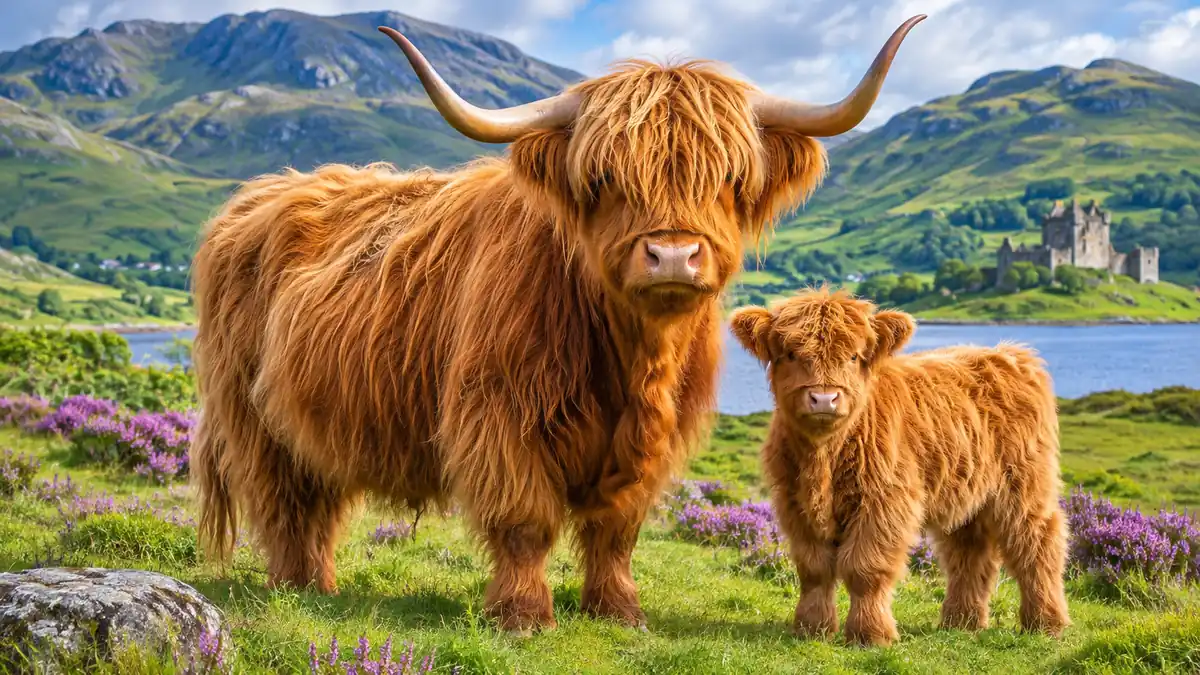
With their shaggy coats, sweeping horns, and long fringes covering their eyes, Highland cows are among the most recognizable cattle in the world. Their charming appearance has made them popular in photographs and on social media, but these animals have a fascinating history that goes far beyond their looks.
A highland cow is a female of the Highland cattle breed, a hardy Scottish breed famous for its thick double coat, long horns, calm temperament, and ability to survive in challenging environments. Originating in the Scottish Highlands and Western Isles, these cattle are primarily raised for beef, breeding, and conservation grazing.
Highland cattle are often affectionately called Heilan coos, a Scots-language expression associated with their homeland. Although their fluffy appearance makes them look like oversized teddy bears, they are powerful farm animals with distinctive physical and behavioral characteristics.
What Is a highland cow?
The Highland cow belongs to a traditional Scottish cattle breed scientifically classified as Bos taurus. Highland cattle developed over centuries in the mountainous landscapes and coastal islands of western Scotland.
Their natural environment shaped nearly every aspect of their appearance. Long hair protects them against wind and rain, strong legs help them navigate uneven terrain, and their ability to digest rough vegetation allows them to graze where more demanding cattle breeds may struggle.
The breed is also known as Highland cattle, Scottish Highland cattle, or Kyloe cattle, although Kyloe historically referred particularly to animals associated with Scotland’s western islands.
Quick facts about Highland cattle
| Characteristic | Details |
|---|---|
| Breed name | Highland cattle |
| Origin | Scottish Highlands and Western Isles |
| Scientific species | Bos taurus |
| Primary purpose | Beef production and conservation grazing |
| Typical mature cow weight | 900–1,300 lb (408–590 kg) |
| Typical mature bull weight | 1,500–2,000 lb (680–907 kg) |
| Coat | Long, shaggy, double-layered |
| Common colors | Red, black, yellow, white, dun, brindle |
| Horns | Naturally horned in both sexes |
| Temperament | Generally calm and manageable |
| Productive lifespan | Many breeding cows remain productive into their late teens |
| Climate adaptation | Particularly well suited to cold, wet conditions |
These weight ranges are reported by The Livestock Conservancy; actual size depends on genetics, nutrition, sex, age, and management. The Livestock Conservancy+1
History and Origin of Highland Cattle
Book Loch Lomond Day Trip from Edinburgh
Scotland Tours | 2026/2027 packages
12
The history of Highland cattle is closely connected to Scotland’s rural communities, traditional farming practices, and difficult climate.
For centuries, cattle provided food, income, and valuable livestock to families living in the Scottish Highlands. Farmers needed animals capable of surviving long winters, wet grazing land, and limited feed supplies.
Highland cattle developed through generations of adaptation to these conditions.
The original Highland and Kyloe cattle
Historically, there were two recognizable regional types:
- West Highland or Kyloe cattle: Generally smaller animals associated with the western islands, often black or brindle.
- Mainland Highland cattle: Typically larger animals, frequently displaying reddish coats.
Over time, these regional types became recognized as one Highland breed.
The term Kyloe is sometimes linked to the narrow sea passages that cattle crossed while being transported from Scottish islands to mainland markets.
When did Highland cattle become an official breed?
The Highland Cattle Society was established in Scotland in 1884, and its first herd book was published in 1885.
The herd book documented pedigrees and helped preserve recognizable breed characteristics, including coat type, horn shape, physical structure, and ancestry.
The breed later spread internationally, with Highland cattle becoming established in the United States, Canada, Australia, New Zealand, and several European countries.
Today, organizations such as the Highland Cattle Society and the American Highland Cattle Association maintain breed information, registration systems, and breeding standards. Highland Cattle Society+2
Physical Characteristics: What Makes Highland Cows Unique?
Highland cattle are easy to recognize, even from a considerable distance.
Their distinctive appearance is the result of several physical features that developed in response to Scotland’s challenging environment.
The famous fluffy double coat
One of the most remarkable features of Highland cattle is their thick, two-layered coat.
The outer layer consists of long, coarse hair that helps shed rain and snow. Beneath it lies a softer, woolly undercoat that provides insulation.
This combination offers several advantages:
- Protection against cold temperatures and strong winds.
- Reduced exposure to rain and snow.
- Insulation without requiring an exceptionally thick layer of body fat.
- Protection against some insects and vegetation.
- Seasonal adjustment as the animals shed part of their winter coat.
The long fringe of hair hanging over the forehead is called the dossan. It helps shield the eyes from insects and harsh weather.
Highland cattle generally develop heavier coats in colder environments and shed substantial hair during warmer months.
Why do Highland cows have long horns?
Both male and female Highland cattle naturally grow horns.
Their horns are useful for manipulating vegetation, scratching, establishing social relationships, and defending themselves when threatened.
Horn shape also helps distinguish mature cows from bulls.
| Feature | Highland cow | Highland bull |
|---|---|---|
| Horn direction | Often extends outward and curves upward | Usually extends outward with a more forward orientation |
| Horn appearance | Frequently longer-looking and more graceful | Generally thicker and heavier at the base |
| Body structure | Smaller, more refined frame | Larger, muscular frame |
| Typical behavior | Maternal and generally calm | May be more territorial, especially during breeding |
Horn shape varies between individual animals, so it should not be used as the only method of determining sex.
The Highland Cattle Society recognizes different acceptable horn configurations, particularly among females. Highland Cattle Society
What colors do Highland cows come in?
Highland Cow posing center to the frame, staring into camera
Red
Black
Yellow
▷ Highland Cow Yearling (L) par Randal Ford, 2024 | Photographie C-print | Artsper
White
A close up of a brown cow with long hair photo – Free Animals Image on Unsplash
Dun
Heartland Highland Cattle Association – Brindle Colored Highlands
Brindle
Although reddish-brown cattle are the most familiar, Highland cattle appear in several recognized colors.
Red is especially popular in photographs and traditional Scottish imagery. However, black was historically prominent among island cattle.
Other colors include yellow, white, dun, and brindle, while some breeders describe particular pale shades as silver.
Coat color does not reliably indicate temperament, health, or overall quality. A healthy animal should be evaluated through its physical condition, structure, behavior, and breeding history rather than appearance alone.
Highland Cow Size, Weight, and Lifespan
Highland cattle are generally medium-sized compared with many modern commercial beef breeds.
Their long hair can make them appear larger than their actual body frame.
How big does a Highland cow get?
A mature female commonly weighs approximately 900–1,300 pounds, while a mature bull may weigh 1,500–2,000 pounds.
However, individual animals can fall outside these ranges.
Size depends on several factors, including:
- Genetics and family lineage.
- Age and stage of physical development.
- Available pasture and forage quality.
- Seasonal feeding conditions.
- General health and reproductive status.
Highland cattle also mature more slowly than many commercial beef breeds. This is an important consideration when comparing growth rates or reproductive development.
How long do Highland cows live?
Highland cattle are widely recognized for longevity.
Some cows remain productive beyond 15 years of age, and the Highland Cattle Society reports examples of females breeding beyond 18 years and producing as many as 15 calves.
That does not mean every Highland cow will live or reproduce for that long. Longevity depends on health, nutrition, disease prevention, environmental conditions, and veterinary care.
Their extended productive life is one of the characteristics that distinguishes the breed from many faster-maturing commercial cattle. Highland Cattle Society+1
How fast do Highland calves grow?
Highland calves grow steadily but are generally slower to reach full maturity than many intensively selected beef breeds.
Growth rates depend heavily on milk availability, pasture quality, genetics, and seasonal conditions.
Young animals gradually develop their distinctive horns and shaggy coats as they mature.
A calf should be evaluated using appropriate breed-specific growth expectations rather than assuming that its smaller frame indicates poor health.
Highland Cow Temperament and Behavior
Despite their intimidating horns, Highland cattle are generally known for their calm disposition.
Many become comfortable around familiar handlers when managed consistently and respectfully.
However, calm temperament does not make them harmless.
Are Highland cows friendly?
Highland cattle can be friendly or curious toward humans, particularly when they have experienced regular, positive handling.
Some individuals willingly approach people, while others prefer maintaining their distance.
Their behavior depends on previous handling, age, social environment, and individual temperament.
Highland cows are not domesticated pets in the same sense as dogs or cats. They are large livestock animals capable of causing serious injuries through pushing, kicking, or horn movements.
Are Highland cows dangerous?
Highland cattle can be dangerous under certain circumstances, even when they appear relaxed.
Potentially risky situations include approaching newborn calves, entering confined spaces with unfamiliar cattle, handling breeding bulls, or standing between animals and their escape routes.
A cow protecting her calf may become defensive, while a bull may react unpredictably when competing with other males.
Visitors should avoid touching, feeding, or approaching cattle without permission from the owner.
Are Highland cattle intelligent?
Highland cattle are observant animals that can learn familiar routines, recognize regular handlers, and respond to consistent training.
Like other cattle, they develop social relationships within their herd.
They may learn to follow feed routines, move through handling facilities, and respond to halter training.
Their reputation for intelligence is supported by breeders’ practical observations, although claims that they are universally more intelligent than other cattle breeds should be treated cautiously.
The American Highland Cattle Association describes the breed as generally docile and manageable with appropriate handling. AHCA
Diet and Feeding Habits of Highland Cattle
Highland cattle are natural grazers and browsers, capable of eating a wider variety of vegetation than many highly specialized livestock breeds.
Their ability to utilize rough forage is one of the main reasons they have remained valuable in mountainous and marginal farming environments.
What do Highland cows eat?
Their natural diet primarily includes grass, hay, and other suitable fibrous vegetation.
Depending on the environment, they may also consume:
- Pasture grasses and meadow plants.
- Hay and conserved forage during winter.
- Suitable herbs and broadleaf vegetation.
- Certain shrubs and woody plants.
- Coarse grasses that other cattle may avoid.
Highland cattle are ruminants, meaning their digestive systems contain four stomach compartments: the rumen, reticulum, omasum, and abomasum.
Microorganisms in the rumen help break down fibrous plant material, allowing cattle to obtain energy from vegetation humans cannot digest.
Can Highland cattle survive on grass alone?
Highland cattle can maintain good condition on suitable forage-based diets, but grass alone is not automatically nutritionally complete.
Pasture quality changes throughout the year. During winter, drought, or periods of poor grass growth, supplementary forage may be necessary.
Cattle also need clean drinking water and an appropriate supply of minerals.
The nutritional requirements of pregnant cows, lactating females, growing calves, and breeding bulls differ.
Although Highland cattle are efficient foragers, this does not mean they should be expected to survive indefinitely on inadequate feed.
Do Highland cows need grain?
Grain is not always necessary.
Highland cattle are well suited to forage-based feeding systems, and excessive energy supplementation can contribute to undesirable weight gain.
However, grain or other supplementary feeds may be appropriate in certain circumstances, depending on forage analysis, body condition, and veterinary or livestock nutrition advice.
A balanced feeding program should prioritize animal health rather than assuming the breed’s hardiness eliminates nutritional requirements.
Highland Cow Habitat, Climate, and Care
Highland cattle developed in cold, wet environments, making them particularly well adapted to outdoor living in temperate and northern climates.
However, their ability to withstand difficult weather does not mean they require no management.
Can Highland cows live in hot climates?
Yes, Highland cattle can live in warmer regions when provided with suitable conditions.
They are raised in parts of the southern United States and Australia, demonstrating their adaptability.
Nevertheless, their thick coats make heat management especially important.
During hot weather, cattle should have access to:
- Adequate natural or artificial shade.
- Constant supplies of clean drinking water.
- Good airflow and ventilation.
- Suitable pasture without overcrowding.
- Regular monitoring for heat stress.
Signs of heat stress include rapid breathing, excessive salivation, reduced appetite, unusual lethargy, and open-mouth panting.
Severe heat stress requires immediate intervention and veterinary assistance.
Highland cattle naturally shed some of their winter coat as temperatures rise, but seasonal shedding alone does not eliminate the risk of overheating. Australian Highland Cattle Society+2
Do Highland cows need shelter?
Although Highland cattle tolerate cold conditions remarkably well, they still benefit from access to appropriate shelter.
Windbreaks, trees, well-drained resting areas, and open-sided livestock structures can protect animals during severe weather.
Shelter becomes especially important for newborn calves, sick animals, and cattle exposed to prolonged rain, extreme heat, or unusual storms.
The appropriate shelter depends on the local climate and the condition of the animals.
How much land does a Highland cow need?
There is no universally correct acreage requirement for every Highland cow.
Land requirements depend on pasture productivity, rainfall, soil quality, grazing season, animal weight, and whether supplementary forage is available.
A productive pasture may support more animals per acre than poor upland grazing.
Overstocking can damage vegetation, increase parasite exposure, and reduce available nutrition.
Farmers should assess local stocking rates and develop grazing plans that allow vegetation to recover between grazing periods.
Essential health and maintenance needs
Routine livestock care remains necessary even for a hardy breed.
Important management practices include monitoring body condition, checking hooves, maintaining appropriate parasite-control programs, and providing veterinary attention when animals become ill.
Owners should also maintain suitable fencing and handling facilities.
Because Highland cattle have prominent horns, handling equipment must provide adequate space and minimize the risk of animals becoming trapped or injured.
Highland Cow Breeding, Pregnancy, and Calves
Family on the Meadow – Scottish Cattle and Calf
Highland cows are known for strong maternal instincts and relatively long reproductive lives.
Their reproductive characteristics developed in environments where successful calving and calf survival were essential.
How long is a Highland cow pregnant?
Like other domestic cattle, Highland cows have a gestation period of approximately 283 days, or about nine months.
The actual duration varies depending on genetics, calf sex, and individual circumstances.
Pregnant cows require adequate nutrition, suitable calving areas, and appropriate observation as delivery approaches.
Are Highland cows good mothers?
Highland cows generally have a reputation for attentive maternal behavior.
They commonly remain close to newborn calves, provide milk, and defend their offspring against perceived threats.
Their maternal instincts are valuable in extensive grazing systems where cattle may spend considerable time outdoors.
However, these same instincts can make approaching a cow with a newborn calf dangerous.
What are baby Highland cows called?
A baby Highland cow is called a calf.
Female calves are known as heifer calves, while male calves are bull calves.
Young Highland calves often have especially soft, fluffy coats and comparatively short horns that become more noticeable as they grow.
Their coats may change in appearance as they mature, particularly through seasonal shedding.
At what age can Highland cows breed?
Highland cattle mature relatively slowly compared with many commercial beef breeds.
The New Zealand Highland Cattle Society’s breed standard notes that females in their traditional home environment may not be bred until around three years of age to allow adequate physical development.
Breeding decisions should depend on body weight, maturity, nutritional status, and veterinary guidance rather than age alone.
Because Highland cows may remain reproductively productive for many years, their slower maturation can be offset by a long breeding life. Breed Standard AGM June 2011
Highland Cattle Uses and Environmental Benefits
Although Highland cattle are famous for their appearance, they also have important agricultural and ecological roles.
Beef production
Highland cattle are primarily classified as a beef breed.
Their meat is often described as flavorful, with a relatively lean carcass and desirable marbling.
Because their thick coats provide insulation, Highland cattle do not rely on the same degree of external fat cover for warmth as some other breeds.
However, the nutritional composition of Highland beef varies with genetics, diet, age, and processing methods. It should not automatically be assumed to have lower cholesterol or saturated fat than every other type of beef.
Highland cattle generally grow more slowly than some commercial beef breeds, making them particularly suited to production systems that value hardiness and efficient forage use.
Conservation grazing
One of the most interesting modern uses of Highland cattle is conservation grazing.
This involves using livestock to manage vegetation and help maintain particular habitats.
Highland cattle can graze coarse grasses, browse certain shrubs, and move through uneven terrain.
Their grazing activity can help:
- Reduce excessive growth of coarse vegetation.
- Limit scrub encroachment in suitable habitats.
- Maintain open grassland environments.
- Create varied vegetation structures.
- Support habitat management objectives.
For example, conservation organizations use grazing animals to manage grasslands, heathlands, wetlands, and other environments where unchecked vegetation growth can change habitat conditions.
However, conservation grazing must be carefully planned. Excessive grazing, inappropriate stocking densities, and poorly timed livestock access can damage sensitive ecosystems. Forestry and Land Scotland+1
Traditional farming and cultural heritage
Highland cattle remain an important symbol of Scotland’s agricultural heritage.
Their distinctive appearance is associated with Highland landscapes, rural traditions, and historical livestock farming.
The breed is also a familiar attraction on farms and in countryside tourism, where visitors can observe these animals in their natural grazing environment.
Their cultural significance is closely connected to their practical agricultural history.
Highland Cow vs. Other Cattle Breeds
Highland cattle differ from several other familiar breeds in coat type, physical appearance, and traditional farming purpose.
| Feature | Highland cattle | Angus cattle | Galloway cattle |
|---|---|---|---|
| Origin | Scotland | Scotland | Scotland |
| Coat | Long, shaggy double coat | Relatively short coat | Thick, often curly double coat |
| Horns | Naturally horned | Naturally polled in standard Angus | Naturally polled |
| Main use | Beef and conservation grazing | Beef | Beef and grazing |
| Cold tolerance | Excellent | Good with suitable management | Excellent |
| Growth | Generally slower-maturing | Often faster-maturing | Moderate, depending on genetics |
| Distinctive appearance | Long horns and flowing hair | Compact, smooth-coated body | Thick coat and hornless head |
These are general breed characteristics rather than guarantees about every individual animal.
Highland cow vs. miniature Highland cow
Miniature Highland cattle have become increasingly popular in online photographs and discussions.
However, the term miniature Highland cow needs careful interpretation.
Some animals advertised as miniature Highlands are naturally smaller individuals, while others may be crosses involving smaller cattle breeds.
The standard Highland breed is already moderate in size compared with some large commercial cattle.
A small calf should not automatically be described as a miniature animal simply because it looks compact and fluffy.
Breed registration, mature parental size, and documented ancestry are more reliable indicators than photographs or promotional descriptions.
Are Highland cows the same as yaks?
No. Highland cattle and domestic yaks are different animals.
Highland cattle belong to the domestic cattle species Bos taurus, while domestic yaks are generally classified as Bos grunniens.
Both animals have adaptations that help them survive cold environments, including substantial hair coverage.
However, yaks are associated primarily with high-altitude regions of Central Asia, whereas Highland cattle originated in Scotland.
Their body structures, traditional uses, and environmental adaptations differ.
Interesting Highland Cow Facts
Several lesser-known characteristics make Highland cattle especially fascinating.
1. Their famous red color was not always dominant. Historical island cattle were often black, and black remains a recognized traditional color.
2. Both cows and bulls grow horns. Unlike some cattle breeds, Highland cattle are naturally horned in both sexes.
3. Their long hair serves a practical purpose. The outer coat helps repel moisture, while the inner coat provides insulation.
4. Highland cattle can live productive lives well into their teens. Some breeding females remain productive beyond 18 years.
5. Their horns help them access vegetation. Cattle can use their horns to move or manipulate branches and other plants.
6. They are skilled at utilizing rough forage. Their ability to graze and browse coarse vegetation makes them useful in certain low-input farming systems.
7. They are found far beyond Scotland. Highland cattle populations exist across North America, Europe, Australia, and New Zealand.
8. Their shaggy appearance changes with the seasons. They typically develop heavier coats during colder periods and shed hair as conditions become warmer.
9. Highland cattle have an established pedigree history. Their first official herd book appeared in 1885.
10. Their conservation status has improved. The Livestock Conservancy reports that Highland cattle graduated from its Conservation Priority List in 2019 after population and registration numbers increased. The Livestock Conservancy
Common Misconceptions About Highland Cows
The popularity of Highland cattle has also created several misconceptions.
Are all Highland cows small and fluffy?
No. Highland cattle are substantial livestock animals, and mature bulls can weigh considerably more than 1,500 pounds.
Their fluffy coats and relatively compact frames can make them appear smaller or softer than they actually are.
Do Highland cows need almost no care?
No. Although the breed is hardy and efficient at grazing, it still requires proper nutrition, clean water, health monitoring, suitable fencing, and veterinary attention.
Hardiness should never be confused with complete independence from human care.
Are Highland cows always gentle?
Not necessarily.
Highland cattle are generally calm, but individual temperament varies.
A frightened animal, protective mother, or breeding bull can behave aggressively.
Can Highland cows live anywhere?
They can adapt to a variety of environments, but their natural strengths are most apparent in cool and temperate climates.
Hot and humid conditions require additional management to protect animal welfare.
Are Highland cows endangered?
Highland cattle are not generally considered an endangered breed worldwide.
Their populations have expanded internationally, and the breed’s status has improved in conservation assessments.
However, population levels, breeding diversity, and registration patterns can differ between countries.
Conclusion
The highland cow is much more than a photogenic animal with a fluffy coat and impressive horns. It represents centuries of adaptation to Scotland’s challenging landscapes and remains an important part of the country’s agricultural heritage.
From its weather-resistant double coat and distinctive horn structure to its calm temperament, strong maternal instincts, and ability to utilize rough vegetation, Highland cattle possess a remarkable combination of characteristics.
Their contributions to traditional farming, beef production, and conservation grazing demonstrate why this historic Scottish breed continues to attract attention around the world.
Understanding their natural behavior, physical needs, and environmental adaptations offers a deeper appreciation of these animals—and a reminder that beneath their charming appearance stands a resilient and capable breed of cattle.
