

Spain and Argentina represent two of international football’s most influential traditions. Both have produced World Cup champions, exceptional midfielders, iconic attackers, and teams capable of controlling matches against elite opposition.
The spain vs argentina rivalry gained renewed attention in 2026, when the two national teams were due to contest the Finalissima and subsequently met in the FIFA World Cup final.
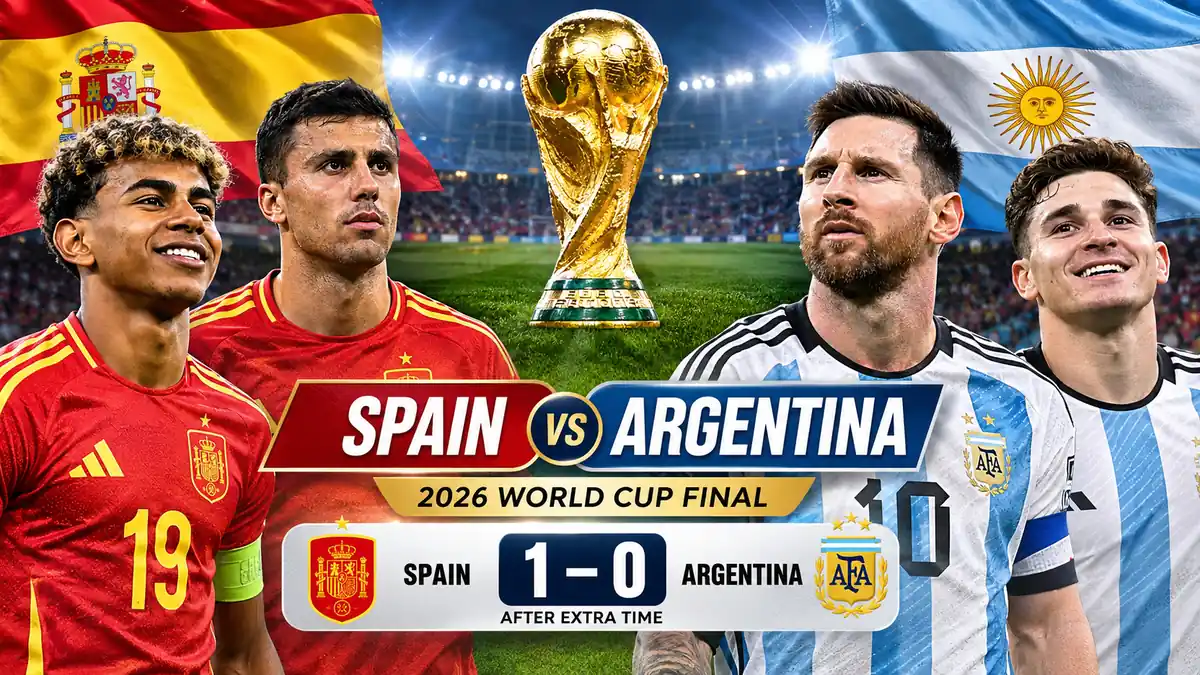
Spain defeated Argentina 1–0 after extra time in the 2026 FIFA World Cup final on July 19 at MetLife Stadium. The result gave Spain a narrow advantage in their historical head-to-head record. Their previously scheduled Finalissima, originally planned for March 27 in Qatar, had been cancelled because of regional security concerns and disagreements over alternative arrangements. 11v11+2
spain vs argentina: Latest Match Result and Overview
Spain
1 – 0
After extra time
2026 World Cup Final
Argentina National Team logo PNG & SVG download | FootyLogos
Argentina
Match date
July 19, 2026
Venue
MetLife Stadium, USA
Competition
FIFA World Cup
Result
Spain won after extra time
Historical match records: National Football Teams+1
The World Cup meeting carried significance beyond the result. Spain and Argentina had entered 2026 as the reigning European and South American continental champions, respectively, following their successes in 2024.
Their contrasting football identities helped make the encounter compelling. Spain’s reputation rests heavily on coordinated possession, technical midfield play, and positional movement. Argentina combines technical quality with tactical flexibility, defensive commitment, and individual creativity.
Although the World Cup final ended with only one goal separating the teams, the result reinforced how closely matched these footballing nations have been historically.
Spain vs Argentina Head-to-Head Record
The historical record shows a competitive rivalry rather than sustained dominance by either country.
According to the international match database 11v11, their record through July 2026 stands at:
7
Spain wins
2
Draws
6
Argentina wins
15 recorded meetings, including the 2026 World Cup final. 11v11
Notable previous results
| Year | Match | Result |
|---|---|---|
| 1966 | Argentina vs Spain | Argentina 2–1 Spain |
| 2006 | Spain vs Argentina | Spain 2–1 Argentina |
| 2009 | Spain vs Argentina | Spain 2–1 Argentina |
| 2010 | Argentina vs Spain | Argentina 4–1 Spain |
| 2018 | Spain vs Argentina | Spain 6–1 Argentina |
| 2026 | Spain vs Argentina | Spain 1–0 Argentina (AET) |
11v11+1
These matches demonstrate how dramatically the balance can shift between generations. Argentina recorded a convincing victory in 2010, only for Spain to respond with an even larger win eight years later.
The 2026 result was different: a narrow victory in a competitive World Cup final rather than a high-scoring friendly.
What was the biggest Spain vs Argentina victory?
Spain’s 6–1 victory in Madrid on March 27, 2018, remains the largest winning margin in the recorded senior men’s meetings.
Isco scored a hat-trick as Spain produced an outstanding attacking performance. Argentina, playing without Lionel Messi, struggled to contain Spain’s movement and finishing.
Argentina’s memorable 4–1 victory in Buenos Aires on September 7, 2010, came shortly after Spain had won its first World Cup.
These two results are useful reminders that individual matches do not necessarily indicate the long-term strength of either national team.
Why Was the Spain vs Argentina Finalissima Cancelled?
One of the biggest stories surrounding the rivalry in 2026 was the cancellation of the Finalissima.
The match was designed to bring together the winners of Europe’s and South America’s major international championships.
Spain qualified by winning UEFA Euro 2024, while Argentina qualified by winning the 2024 Copa América.
The fixture was originally scheduled for March 27, 2026, at Lusail Stadium in Qatar.
Why the original venue became unavailable
Security concerns and disruption in the Middle East made staging the match in Qatar impractical.
UEFA and CONMEBOL explored alternative arrangements, including venues in Europe. However, the parties could not reach a final agreement on the location and date.
UEFA announced the cancellation on March 15, 2026. UEFA.com
Disagreement over alternative arrangements
UEFA stated that it had considered several possibilities, including a match at the Santiago Bernabéu in Madrid and a neutral European venue.
The Argentine Football Association and CONMEBOL emphasized their preference for neutral ground. They said Argentina had accepted a proposed venue in Italy but requested moving the date from March 27 to March 31.
UEFA maintained that the alternative date was unworkable. As a result, the match did not take place.
Both sides publicly expressed disappointment, although their accounts differed over responsibility for the failed negotiations. Copa América+2
What is the Finalissima?
The Finalissima is an international championship match between the reigning winners of the UEFA European Championship and CONMEBOL Copa América.
The modern competition returned in 2022, when Argentina defeated Italy 3–0 at Wembley Stadium.
Its historical predecessors included the European/South American Nations Cup, contested in 1985 and 1993.
Unlike the FIFA World Cup, the Finalissima is a single match between two continental champions rather than a tournament involving multiple national teams. BBC Sport
Spain vs Argentina: Playing Styles and Tactical Comparison
Spain and Argentina have different footballing traditions, but both place enormous value on technical ability, intelligent movement, and control of important moments.
Spain generally aims to dominate the ball and dictate the rhythm of matches. Argentina is comfortable combining possession with quick transitions, direct attacking movements, and disciplined defensive organization.
| Tactical aspect | Spain | Argentina |
|---|---|---|
| Traditional identity | Positional possession football | Technical, adaptable attacking football |
| Build-up play | Short passing and structured movement | Flexible combinations and progressive passing |
| Midfield | Ball retention and positional control | Creativity, pressing, and defensive balance |
| Attacking approach | Wide combinations and movement between lines | Central combinations and individual creativity |
| Defensive approach | Coordinated pressing and compact positioning | Organized defensive blocks and selective pressing |
| Key strength | Sustained territorial control | Tactical adaptability and decisive moments |
These are broad tendencies rather than fixed rules. Both teams can press aggressively, counterattack, or play more directly depending on their opponents.
Spain’s possession-based philosophy
Spain’s modern football identity developed around tiki-taka, a style associated with short passing, constant movement, and maintaining numerical advantages around the ball.
The approach became particularly influential during Spain’s extraordinary international success between 2008 and 2012.
Players such as Xavi Hernández, Andrés Iniesta, Sergio Busquets, and Xabi Alonso helped Spain dominate possession and control matches through midfield.
Under Luis de la Fuente, Spain’s attacking approach became more varied. Wide players such as Lamine Yamal and Nico Williams introduced pace, dribbling, and directness alongside the country’s established technical qualities.
This combination allows Spain to attack through the middle or stretch opponents across the pitch.
Argentina’s tactical flexibility
Argentina has traditionally relied on technically gifted attackers supported by competitive midfielders and strong defensive organization.
Lionel Scaloni’s successful teams demonstrated an ability to adjust their formations and pressing strategies for different opponents.
During Argentina’s 2022 World Cup triumph, the team combined Lionel Messi’s creativity with the midfield energy of Rodrigo De Paul, Alexis Mac Allister, and Enzo Fernández.
Rather than depending exclusively on possession, Argentina frequently adjusted its approach to the state of the match.
That adaptability is particularly valuable in knockout football, where opponents may present completely different tactical problems.
Key Players Who Defined the Rivalry
The history of Spain vs Argentina includes several generations of influential footballers.
Season 2024 | UEFA EURO 2024 | UEFA.com
Lamine Yamal — Spain
An explosive winger known for close control, creative passing, and cutting inside from wide positions. His ability to attract defenders can create opportunities for teammates.
Rodri: profilo e statistiche del giocatore | Sky Sport
Rodri — Spain
A controlling midfielder whose positioning, passing decisions, and defensive awareness illustrate Spain’s emphasis on midfield stability.
Lionel Messi :: 2026 – Argentina – Informações e Estatísticas do Jogador
Lionel Messi — Argentina
One of football’s most accomplished players, Messi has shaped Argentina’s attacking identity through dribbling, chance creation, and goalscoring.
Argentina Portraits – FIFA World Cup Qatar 2022
Julián Álvarez — Argentina
A mobile forward who contributes through pressing, intelligent runs, and movement across the attacking line.
The importance of midfield battles
Matches between technically accomplished national teams are often decided by the midfield.
Spain’s approach depends on players finding passing angles, receiving under pressure, and moving opponents out of position.
Argentina can challenge that system through aggressive midfield pressing, close marking, and rapid forward passes after recovering possession.
A team that controls the central areas can often determine where and how the opposition attacks.
However, possession alone does not guarantee victory. The quality of chances, defensive transitions, and efficiency in front of goal remain equally important.
Spain and Argentina’s International Football Achievements
Both countries have established themselves among the most successful national teams in football history.
Their achievements demonstrate different periods of dominance across international competitions.
FIFA World Cup history
Spain won its first men’s FIFA World Cup in 2010, defeating the Netherlands 1–0 in the final in Johannesburg.
Andrés Iniesta scored the winning goal in extra time, completing a remarkable tournament for Vicente del Bosque’s side.
Argentina won its first World Cup in 1978 and added another title in 1986, when Diego Maradona led the national team to victory in Mexico.
The country claimed its third title in 2022 after defeating France in a dramatic penalty shootout in Qatar.
Spain’s victory over Argentina in the 2026 final added another defining chapter to the nations’ international histories.
European Championship and Copa América success
Spain has enjoyed exceptional success in the UEFA European Championship.
Its victories in 1964, 2008, 2012, and 2024 reflect the country’s ability to produce championship-winning teams across multiple generations.
Argentina has an equally distinguished history in the Copa América, winning the competition repeatedly and securing consecutive titles in 2021 and 2024.
These achievements helped establish the 2026 Finalissima as an anticipated meeting between continental champions.
Comparison of major achievements
| Achievement | Spain | Argentina |
|---|---|---|
| FIFA World Cup titles through 2026 | 2 | 3 |
| Continental championships through 2026 | 4 European Championships | 16 Copa América titles |
| First World Cup victory | 2010 | 1978 |
| Famous historical era | 2008–2012 | 1978–1986 |
| Recent continental success | Euro 2024 | Copa América 2024 |
| 2022 World Cup | Round of 16 | Champions |
| 2026 World Cup | Champions | Runners-up |
The comparison illustrates why both teams command such respect. Spain has been particularly influential in shaping modern possession football, while Argentina’s history includes several generations of outstanding attacking talent and major tournament success.
Spain vs Argentina: Most Memorable Matches
Although the two countries have not met as frequently as some traditional international rivals, several encounters have left a lasting impression.
Argentina 2–1 Spain — 1966 World Cup
The countries met at the 1966 FIFA World Cup in England.
Argentina secured a 2–1 victory during the group stage, with Luis Artime scoring both goals.
This remains an important historical meeting because it took place in football’s biggest international tournament rather than a friendly.
Argentina 4–1 Spain — 2010 friendly
Argentina defeated Spain 4–1 in Buenos Aires in September 2010, shortly after Spain had become world champions.
Lionel Messi, Gonzalo Higuaín, Carlos Tévez, and Sergio Agüero scored for Argentina.
The result showed that even a reigning World Cup champion could struggle against a talented opponent playing with intensity and attacking confidence.
Spain 6–1 Argentina — 2018 friendly
Spain delivered one of its most impressive attacking performances against Argentina in March 2018.
Isco scored three goals, while Diego Costa, Thiago Alcântara, and Iago Aspas also found the net.
Nicolás Otamendi scored Argentina’s only goal.
The match highlighted Spain’s attacking movement and Argentina’s defensive problems on the night.
Spain 1–0 Argentina — 2026 World Cup final
The July 2026 meeting at MetLife Stadium was particularly significant because it was a World Cup final.
Spain emerged victorious after extra time, adding another major international title to its history.
Unlike the high-scoring friendlies of 2010 and 2018, this contest was decided by a single goal.
The result also changed the overall historical balance in Spain’s favor. 11v11+1
What Makes Spain vs Argentina Such an Important Football Rivalry?
The appeal of this matchup extends beyond individual results.
Spain and Argentina represent two major football cultures with different historical influences, tactical identities, and international achievements.
European and South American football traditions
Spain competes within UEFA, while Argentina belongs to CONMEBOL.
European international football has historically emphasized structured competition between national teams with different tactical traditions.
South American football has produced generations of technically gifted players, creative attackers, and intensely competitive international rivalries.
However, modern football has also brought these traditions closer together.
Many Argentine players develop their careers in European leagues, while Spanish clubs have played a major role in the careers of Argentine stars.
Shared football history
Spanish football clubs have maintained strong connections with Argentine players for decades.
Alfredo Di Stéfano became a legendary figure at Real Madrid, while Lionel Messi established himself as one of football’s greatest players during his career at Barcelona.
These connections have helped create a shared football culture between the countries.
Fans are familiar with players from both nations, even when their national teams meet relatively infrequently.
Different approaches to winning
Spain’s most famous teams often controlled matches through sustained possession and passing accuracy.
Argentina’s successful teams have demonstrated the importance of combining attacking brilliance with defensive commitment and tactical flexibility.
Neither philosophy guarantees success.
Tournament football rewards teams that can respond to pressure, adapt to opponents, and convert important opportunities.
That makes meetings between these nations especially interesting from a tactical perspective.
What Can Future Spain vs Argentina Matches Tell Us?
The next meeting between Spain and Argentina will provide another opportunity to examine how their football identities continue to develop.
Several factors are likely to influence future encounters.
Squad development: Younger players can change a team’s attacking patterns, defensive organization, and overall tempo. The emergence of new talent may create a different balance from previous meetings.
Managerial decisions: Formation choices, substitutions, pressing instructions, and midfield selection can substantially influence the outcome.
Player availability: Injuries, suspensions, and match fitness affect both tactical planning and squad depth.
Competition format: A friendly match often allows experimentation, while a World Cup knockout game requires greater attention to risk management.
Set pieces and transitions: Even teams that dominate possession can concede opportunities from corners, free kicks, or counterattacks.
These factors explain why historical results should be treated as context rather than reliable predictions.
A 6–1 result from 2018, for example, cannot determine the likely score of a future encounter involving different players, managers, and competitive circumstances.
How to evaluate a future matchup
A useful analysis should examine recent competitive performances rather than relying only on reputation.
Consider how effectively each team creates high-quality scoring opportunities, prevents dangerous attacks, and controls possession in important areas.
Expected goals, shots on target, defensive recoveries, pressing efficiency, and set-piece performance can provide additional insight.
The strength of recent opponents also matters. Dominating possession against a weaker team does not necessarily indicate that the same approach will succeed against another elite national side.
Ultimately, the strongest assessment combines statistics with tactical observation.
Final Thoughts on spain vs argentina
The spain vs argentina rivalry brings together two of international football’s most respected nations.
Spain’s technical passing tradition, Argentina’s creative attacking heritage, and their remarkable histories of tournament success make their encounters compelling.
The cancellation of the 2026 Finalissima prevented one anticipated meeting, but the countries subsequently faced each other in the World Cup final, where Spain secured a 1–0 victory after extra time.
Their historical record remains closely balanced, showing that neither nation has consistently dominated the other.
For football fans, the most valuable way to understand this rivalry is to look beyond individual scorelines and examine the players, tactical decisions, and footballing traditions that shape each encounter.
