

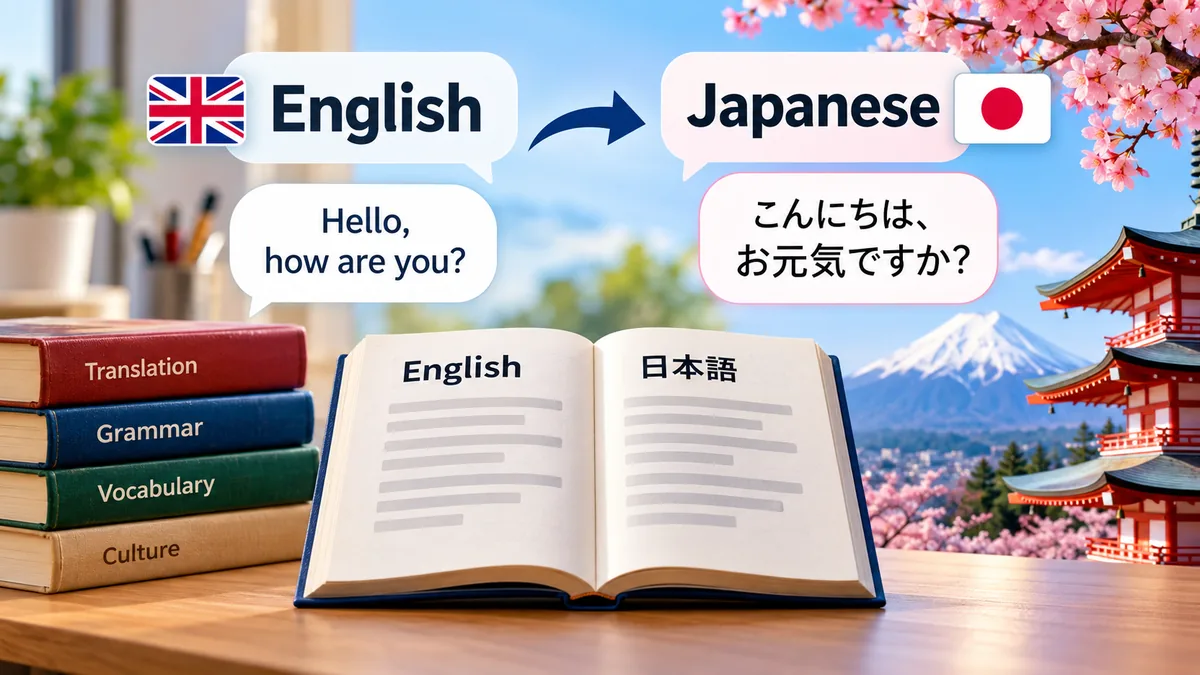
Translating English into Japanese is not simply a matter of replacing one English word with one Japanese word. The two languages organize sentences differently, use very different writing systems, and express politeness and social relationships in ways that often have no direct English equivalent.
english to japanese translation means converting the meaning, tone, and context of English text into natural Japanese using appropriate grammar, vocabulary, writing systems, and politeness levels. A good translation may restructure the original sentence completely while preserving what the English speaker actually intended to communicate.
Modern translation tools can produce useful results in seconds, but understanding a few basic features of Japanese makes it much easier to judge whether a translation sounds natural.
How English to Japanese Translation Works
English and Japanese differ substantially in grammar and sentence construction. English normally follows a subject–verb–object pattern:
I eat sushi.
Japanese commonly places the verb at the end:
私は寿司を食べます。
Watashi wa sushi o tabemasu.
I eat sushi.
A simplified representation of the Japanese structure is:
Subject + Object + Verb
This difference means an English sentence often needs to be reorganized rather than translated word by word.
Japanese also relies heavily on context. Subjects and pronouns that would normally be stated in English may disappear entirely when their meaning is already understood.
For example:
English: I am going home.
A natural Japanese version can be:
Japanese: 家に帰ります。
Romaji: Ie ni kaerimasu.
The Japanese sentence does not need 私 (watashi, “I”) if the speaker is obviously talking about themselves.
That ability to omit information is one reason literal English-to-Japanese translations sometimes sound unnatural.
Japanese Writing Systems Used in Translation
One of the first things people notice about Japanese translation is the script.
Normal written Japanese combines kanji, hiragana, and katakana, rather than relying on a single alphabet. Translation guides and tools therefore need to handle all three appropriately.
Hiragana
Hiragana (ひらがな) is a phonetic script. It is widely used for grammatical elements, native Japanese words, and words whose kanji are not being used.
Examples include:
- こんにちは — konnichiwa — hello
- ありがとう — arigatou — thank you
- です — desu
- ます — masu
Hiragana plays an essential grammatical role in ordinary Japanese sentences.
Katakana
Katakana (カタカナ) is another phonetic script. It is commonly associated with foreign loanwords, foreign names, certain technical terms, and stylistic emphasis.
For example:
Computer: コンピューター
Konpyūtā
Hotel: ホテル
Hoteru
Coffee: コーヒー
Kōhī
English speakers may recognize the origins of many katakana words, but their Japanese pronunciation—and sometimes their meaning—can differ from the original English.
Kanji
Kanji are characters historically derived from Chinese characters and adapted for written Japanese.
Examples include:
- 人 — person
- 日 — day/sun
- 水 — water
- 学校 — school
- 日本 — Japan
A natural Japanese sentence frequently combines kanji and kana.
For example:
私は日本語を勉強しています。
Watashi wa nihongo o benkyō shiteimasu.
“I am studying Japanese.”
Here, different components of the sentence work together rather than everything being represented in a single script.
What Is Romaji?
Romaji represents Japanese sounds with the Latin alphabet.
For example:
Japanese: おはようございます。
Romaji: Ohayō gozaimasu.
English: Good morning.
Romaji can help beginners pronounce Japanese, but it is not a substitute for learning hiragana, katakana, and eventually kanji.
Why Literal English to Japanese Translation Often Fails
Word-for-word translation can produce sentences that are grammatically awkward, socially inappropriate, or simply unnatural.
Consider:
English: How are you?
A beginner might search for a direct Japanese equivalent and expect Japanese speakers to use it exactly as English speakers do.
One possible translation is:
お元気ですか?
Ogenki desu ka?
The meaning is similar, but conversational habits differ between the two languages. The phrase does not necessarily appear in precisely the same situations or with the same frequency as English “How are you?”
Translation therefore involves communicative equivalence, not just dictionary equivalence.
The translator needs to consider:
- Who is speaking?
- Who is listening?
- What is their relationship?
- Is the communication casual or formal?
- Is it spoken or written?
- What does the English expression mean in context?
- Would a Japanese speaker naturally phrase the idea this way?
This contextual approach produces much better results.
English and Japanese Grammar Differences
Understanding basic grammar differences can dramatically improve english to japanese translation.
Word Order
English relies heavily on word order.
Sarah reads books.
Japanese uses grammatical particles to indicate the roles of words and generally places the main verb near the end.
サラは本を読みます。
Sara wa hon o yomimasu.
The particle は (wa) marks the topic, while を (o) marks the direct object.
Japanese Particles
Particles are short grammatical markers attached to words or phrases.
Common examples include:
| Particle | Common Function | Example |
|---|---|---|
| は (wa) | Topic marker | 私は学生です |
| が (ga) | Subject/focus marker | 猫がいます |
| を (o) | Direct object | 本を読みます |
| に (ni) | Time/destination/target | 学校に行きます |
| で (de) | Place or means of action | 電車で行きます |
| の (no) | Possession/connection | 私の本 |
| と (to) | With/and/quotation | 友達と行きます |
The correct particle depends on the grammatical relationship, so translating an English preposition directly into one fixed Japanese particle is unreliable.
Subjects Are Frequently Omitted
English usually requires an explicit subject:
I understand.
Japanese can simply say:
分かります。
Wakarimasu.
The subject is inferred from context.
Repeatedly translating “I,” “you,” “he,” and “she” can therefore make Japanese sound unnecessarily repetitive.
Articles Work Differently
English uses articles such as:
- a
- an
- the
Japanese does not have direct equivalents that operate exactly like English articles.
Therefore:
I bought a book.
can become:
本を買いました。
Hon o kaimashita.
There is no separate Japanese word corresponding directly to “a” in that sentence.
Plurality Is Often Contextual
English frequently marks nouns as singular or plural.
Japanese nouns do not generally require the same kind of plural marking.
For example:
本 (hon)
can refer to “book” or “books,” depending on context.
A translator must determine whether the distinction matters rather than mechanically adding plural information.
Politeness Is Critical in Japanese Translation
Politeness is one of the biggest challenges when converting English into Japanese.
English certainly has formal and informal language, but Japanese encodes social relationships more systematically through vocabulary and grammatical forms.
Japanese honorific speech is commonly discussed through categories including teineigo, sonkeigo, and kenjōgo.
Teineigo: Polite Language
Teineigo (丁寧語) is standard polite speech and commonly uses です (desu) and ます (masu) forms.
For example:
食べる
taberu
to eat
becomes:
食べます
tabemasu
eat/will eat — polite form
For learners, this polite register is often a practical starting point when communicating with people they do not know closely.
Sonkeigo: Respectful Language
Sonkeigo (尊敬語) respectfully describes the actions or state of someone being treated with deference.
It may be used when referring to customers, senior colleagues, teachers, managers, or other people whose actions should be expressed respectfully.
For example, ordinary 行く (iku, “to go”) can be replaced by an honorific form such as いらっしゃる (irassharu) in appropriate contexts.
Kenjōgo: Humble Language
Kenjōgo (謙譲語) expresses the speaker’s or the speaker’s group’s actions humbly in relation to another person.
For instance, 参ります (mairimasu) can function as a humble form associated with “go” or “come” in appropriate contexts.
The important distinction is whose action is being described. Respectful language elevates the relevant other person, while humble language presents the speaker’s side humbly.
That distinction can completely change how an English business sentence should be translated.
Japanese Honorifics and Names
Names create another translation challenge.
Common Japanese honorifics include:
- さん (san)
- 様 (sama)
- 君 (kun)
- ちゃん (chan)
- 先生 (sensei)
- 先輩 (senpai)
Their use depends on social relationships and context rather than a simple one-to-one mapping with English titles. さん is broadly useful as a respectful name suffix, while 様 expresses a higher degree of respect and appears frequently in customer-facing contexts. 先生 is commonly associated with teachers and certain professionals.
This is why automatically replacing every “Mr.” with san or every professional title with one Japanese suffix can produce mistakes.
Common English to Japanese Translations
Everyday phrases are useful for seeing how meaning changes between the languages.
| English | Japanese | Romaji |
|---|---|---|
| Hello | こんにちは | Konnichiwa |
| Good morning | おはようございます | Ohayō gozaimasu |
| Thank you | ありがとうございます | Arigatō gozaimasu |
| Yes | はい | Hai |
| No | いいえ | Iie |
| Excuse me / Sorry | すみません | Sumimasen |
| Nice to meet you | はじめまして | Hajimemashite |
| Please | お願いします | Onegaishimasu |
| I understand | 分かります | Wakarimasu |
| I don’t understand | 分かりません | Wakarimasen |
| Goodbye | さようなら | Sayōnara |
These translations are useful starting points rather than universal substitutions. The best expression can change with the situation.
For example, すみません (sumimasen) can function as an apology, an “excuse me,” or even an expression carrying a sense of gratitude depending on context.
Translating English Sentences into Natural Japanese
A useful translation process starts with meaning rather than individual words.
Suppose the English sentence is:
“Could you please send me the document tomorrow?”
Before translating, identify:
- The requested action: sending a document.
- The recipient of the request.
- The relationship between speaker and listener.
- The required politeness level.
- Whether this is a conversation, email, or business message.
A casual request between friends should not necessarily use the same Japanese as a message sent to a customer or senior colleague.
This principle applies to almost every sentence.
Step 1: Understand the Entire English Sentence
Do not begin by translating the first word.
Read the complete sentence and determine its intended meaning.
For example:
“That works for me.”
The word “works” does not literally mean operating or functioning here. It means something closer to “that arrangement is acceptable to me.”
A literal dictionary translation of “work” would therefore miss the point.
Step 2: Identify the Context
Ask whether the translation is for:
- casual conversation
- travel
- social media
- school
- business
- customer service
- technical documentation
- legal or official material
Register can change significantly according to context.
Step 3: Restructure the Sentence
Do not force English word order into Japanese.
Move the verb, remove unnecessary pronouns, select suitable particles, and express information in the order a Japanese speaker would naturally expect.
Step 4: Choose the Correct Register
Decide whether the Japanese should be:
Casual:
食べる
taberu
Polite:
食べます
tabemasu
or expressed through a more specialized respectful or humble construction when the situation requires it.
Step 5: Check the Result as Japanese
The final question should not be:
“Does every English word appear?”
Instead ask:
“Does this Japanese sentence naturally communicate the original meaning?”
That distinction separates translation from word substitution.
Translating Idioms and Expressions
Idioms are especially dangerous for literal translation.
Consider:
“Break a leg.”
The intended meaning is not an instruction to physically break someone’s leg. It is a culturally specific way of wishing a performer good luck.
Similarly:
“It’s raining cats and dogs.”
The meaning is simply that it is raining very heavily.
A translator must communicate the intended idea rather than reproduce the literal imagery when that imagery would make no sense to the Japanese reader.
The same principle applies to:
- slang
- jokes
- sarcasm
- metaphors
- phrasal verbs
- internet expressions
- cultural references
Context becomes more important as language becomes less literal.
English Loanwords in Japanese
Japanese contains many loanwords derived from English and other languages, frequently written in katakana.
Examples include:
| English Origin | Japanese | Romaji |
|---|---|---|
| computer | コンピューター | konpyūtā |
| hotel | ホテル | hoteru |
| taxi | タクシー | takushī |
| restaurant | レストラン | resutoran |
| internet | インターネット | intānetto |
However, recognizing the English origin does not guarantee that a word has exactly the same meaning in Japanese.
Some borrowed expressions have developed Japanese-specific meanings or usage patterns. These are sometimes discussed under terms such as wasei-eigo, referring to Japanese expressions constructed from English-derived elements.
That makes apparently familiar vocabulary another area where translators need context.
Using Online English to Japanese Translators
Online translation services are useful for obtaining quick translations.
Resources such as DeepL Translator and Cambridge English–Japanese Translator provide English-to-Japanese translation interfaces. Cambridge also links translated text with dictionary resources, while DeepL supports text and additional translation modes.
Machine translation can be particularly useful for:
- understanding the general meaning of text
- everyday messages
- travel phrases
- vocabulary checks
- creating a first draft
- comparing possible translations
However, an automatically generated sentence should not automatically be assumed to be the best Japanese for every context.
How Accurate Is Machine Translation for Japanese?
Modern machine translation can produce impressively fluent Japanese, especially when the English input is clear and provides enough context.
Problems are more likely when the source contains:
- ambiguous pronouns
- slang
- humor
- idioms
- cultural references
- specialist terminology
- unusual names
- highly contextual conversation
- complex honorific relationships
Japanese’s tendency to omit information creates an additional challenge. An English sentence may explicitly identify a subject, gender, or number that Japanese would naturally leave implicit—or the English source may omit contextual information that Japanese needs to establish the right register.
For low-risk everyday communication, machine translation may be perfectly useful.
For contracts, medical information, important business communication, publication-ready material, or other high-stakes content, professional review by someone proficient in Japanese is safer.
How to Get More Accurate English to Japanese Translation
Better source text usually produces better translation.
Write Clear English
Avoid unnecessary ambiguity.
Instead of:
“Tell him it’s fine.”
provide enough context to establish who “him” refers to and what “fine” means whenever possible.
Translate Complete Sentences
A single English word can have several Japanese equivalents.
Consider “light.”
It might refer to:
- illumination
- something that is not heavy
- a pale color
- setting something on fire
A complete sentence reveals which meaning is intended.
Specify the Desired Tone
If you are using an AI-assisted translator, indicate whether you need:
- casual Japanese
- neutral Japanese
- polite Japanese
- business Japanese
- customer-facing Japanese
Tone instructions can prevent an otherwise accurate translation from sounding socially inappropriate.
Check Names and Technical Terms
Proper nouns, company names, product names, abbreviations, and specialist vocabulary deserve extra attention.
Some names are transliterated into katakana, while established brands or organizations may already have preferred Japanese spellings.
Back-Translate Carefully
Translating the Japanese result back into English can sometimes reveal missing information or obvious errors.
It is useful as a diagnostic technique, but it is not proof of accuracy. Two machine translations can reproduce similar errors or simplify the same nuance.
Compare More Than One Source
For an important phrase, compare a translator with dictionary entries and authentic Japanese examples.
If multiple tools produce different results, investigate why rather than automatically selecting the most common version.
English to Japanese Translation for Business
Business Japanese requires special care because grammatical correctness alone may not produce an appropriate message.
The relationship between the writer and recipient influences:
- greetings
- requests
- apologies
- honorific vocabulary
- humble expressions
- sentence endings
- name suffixes
- closing expressions
Keigo is particularly relevant in professional and customer-facing communication because Japanese distinguishes polite, respectful, and humble language through grammatical and lexical choices.
An English sentence such as:
“Please check the attached document.”
can therefore have several reasonable Japanese renderings depending on whether it is addressed to a friend, colleague, manager, customer, or external business partner.
For professional translation, context should be supplied along with the source text.
English to Japanese Translation for Travel
Travel translation usually requires simpler language.
Useful information includes:
- directions
- hotel questions
- transportation
- restaurant orders
- shopping
- emergencies
- basic greetings
Examples:
Where is the station?
駅はどこですか?
Eki wa doko desu ka?
How much is this?
これはいくらですか?
Kore wa ikura desu ka?
Please help me.
助けてください。
Tasukete kudasai.
Where is the bathroom?
トイレはどこですか?
Toire wa doko desu ka?
Polite forms are generally useful for travelers because they allow straightforward communication without requiring advanced knowledge of social registers.
English to Japanese Translation for Language Learning
Translation can be a valuable Japanese-learning exercise when it is used to examine structure rather than simply obtain an answer.
Try this process:
- Write a short English sentence.
- Translate it yourself.
- Compare it with a reliable translation tool or reference.
- Identify differences in particles and word order.
- Check which pronouns disappeared.
- Examine the verb form.
- Look at the mixture of kanji and kana.
- Read the Japanese sentence aloud.
For example:
English: I study Japanese every day.
Japanese: 毎日日本語を勉強します。
Romaji: Mainichi nihongo o benkyō shimasu.
Notice that the Japanese version does not need 私 (watashi) when “I” is already obvious from context.
Observing these differences helps learners think in Japanese sentence patterns rather than continually rebuilding English sentences with Japanese vocabulary.
Common English to Japanese Translation Mistakes
Several errors appear repeatedly.
Translating Every Word Literally
Languages organize meaning differently. Preserve the message rather than forcing every source word into the result.
Overusing 私 and あなた
English uses “I” and “you” frequently.
Japanese often omits pronouns when context makes the participants obvious. Repeating 私 (watashi) or あなた (anata) in every sentence can sound unnatural.
Ignoring Politeness
A translation can be grammatically correct yet inappropriate for the relationship between speakers.
Always consider who is talking to whom.
Choosing Words Without Context
Dictionary entries list possible meanings, not necessarily the correct word for your particular sentence.
Translate complete ideas whenever possible.
Ignoring Japanese Punctuation and Formatting
Japanese writing has its own conventions, including punctuation such as:
。 Japanese full stop
、 Japanese comma
「 」 quotation brackets
Professional translation should consider presentation as well as vocabulary.
Assuming Katakana Equals English
A katakana word may originate from English without preserving precisely the same meaning or usage.
Check how the word actually functions in Japanese.
Trusting One Automatic Result Blindly
Machine translation is a tool, not an infallible authority.
For important material, check terminology and context and obtain human review when the consequences of an error are significant.
What Makes a Japanese Translation Sound Natural?
Natural translation communicates the same message in the way a Japanese speaker would reasonably express it.
That usually means getting five things right:
- Meaning — the original message remains intact.
- Grammar — Japanese sentence structure is correct.
- Context — implied information is interpreted properly.
- Register — politeness matches the relationship.
- Style — the sentence reads as Japanese rather than translated English.
The best translation can therefore look surprisingly different from the source sentence.
That difference is not necessarily an error. It may be evidence that the translator has moved beyond literal substitution.
Final Thoughts on english to japanese translation
Accurate english to japanese translation requires more than vocabulary. English and Japanese differ in word order, particles, pronoun use, writing systems, cultural conventions, and levels of politeness. Japanese also combines kanji, hiragana, and katakana, while context often determines information that English states explicitly.
Online translators are useful for quick everyday translations, but important text deserves an additional check for meaning, tone, terminology, and social context. The most reliable approach is simple: understand the English message first, rebuild it naturally in Japanese, and judge the finished sentence as Japanese—not as a word-for-word copy of English.
