

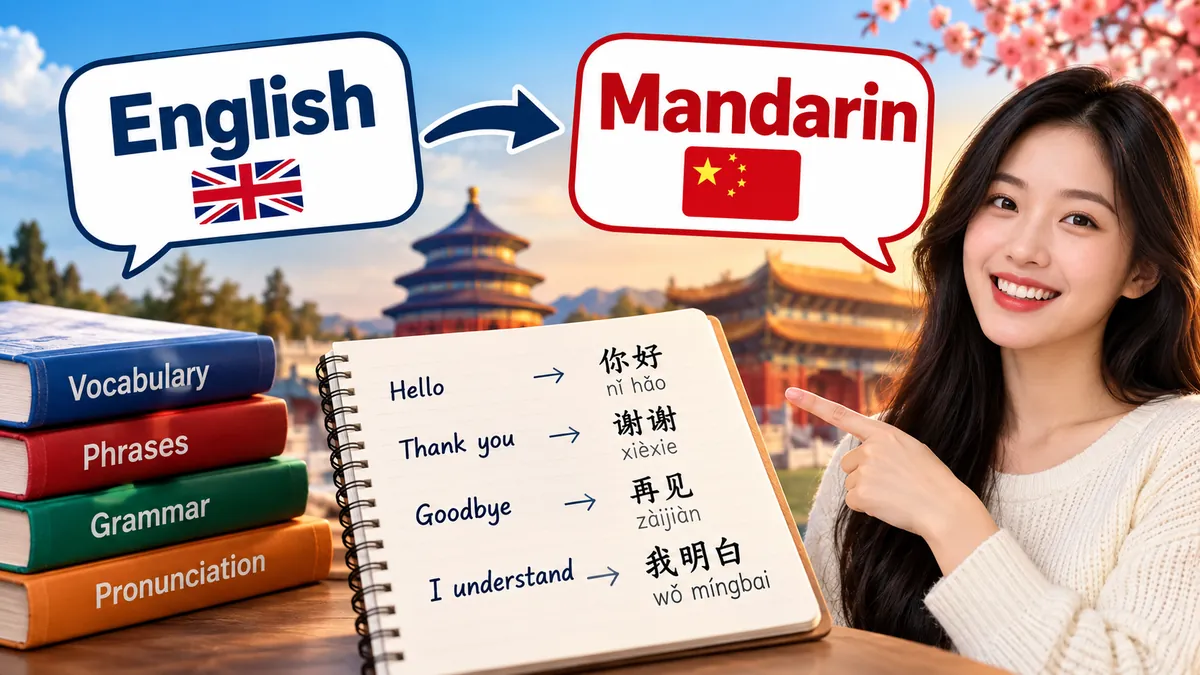
Turning English into Mandarin is not simply a matter of replacing one English word with one Chinese word. The two languages organize meaning differently, and Mandarin adds features that English speakers may not be used to—Chinese characters, Pinyin, lexical tones, measure words, particles, and context-dependent vocabulary.
If you are working with english to mandarin translation, start by identifying the intended meaning and audience, then choose the appropriate Chinese script, translate the idea rather than individual words, and check pronunciation through Pinyin. Mandarin normally uses four main lexical tones plus a neutral tone, so pronunciation can change meaning. British Council
This guide explains the process from basic words and everyday phrases to sentence structure, pronunciation, Simplified versus Traditional Chinese, and common translation mistakes.
What Does english to mandarin Translation Mean?
English to Mandarin translation means expressing English-language content in Mandarin Chinese while preserving its intended meaning.
The output can appear in several forms:
- Chinese characters: 你好
- Pinyin: nǐ hǎo
- English meaning: hello
Pinyin is the standard Romanization system used to represent Mandarin pronunciation with Latin letters. Tone marks placed over vowels help show how individual syllables should be pronounced. British Council
For example:
| English | Chinese | Pinyin |
|---|---|---|
| Hello | 你好 | nǐ hǎo |
| Thank you | 谢谢 | xièxie |
| Goodbye | 再见 | zàijiàn |
| I | 我 | wǒ |
| You | 你 | nǐ |
| China | 中国 | Zhōngguó |
| Chinese language | 中文 | Zhōngwén |
| I understand | 我明白 | wǒ míngbai |
These three layers—meaning, characters, and pronunciation—are especially useful for beginners.
Is Mandarin the Same as Chinese?
Not exactly.
Chinese can refer broadly to a family of Sinitic language varieties and to the written language. Mandarin refers to a major branch of Chinese and, in everyday learning contexts, usually means Standard Mandarin.
This distinction matters because someone requesting a “Chinese translation” may need Mandarin, but that should not automatically be assumed in every regional context.
Mandarin is also not Cantonese. They have substantial differences in pronunciation and spoken vocabulary, even though speakers may use the same or closely related written forms in many contexts.
English to Mandarin: Simplified or Traditional Chinese?
Before translating, decide which writing system your audience expects.
The two major systems are Simplified Chinese and Traditional Chinese.
| Feature | Simplified Chinese | Traditional Chinese |
|---|---|---|
| Example: China | 中国 | 中國 |
| Example: language | 语言 | 語言 |
| Character forms | Generally fewer strokes | Traditional forms retained |
| Commonly associated with | Mainland China, Singapore | Taiwan, Hong Kong, Macau |
Translation resources commonly make this distinction when allowing users to select a Chinese output script. ThePureLanguage
The spoken Mandarin word does not necessarily change simply because the character form changes.
For example:
Simplified: 中国
Traditional: 中國
Pinyin: Zhōngguó
Meaning: China
This is why “Simplified” and “Traditional” primarily describe writing systems, not two separate spoken languages.
Which Script Should You Choose?
For an audience in mainland China, Simplified Chinese is normally appropriate.
For a Mandarin-speaking audience in Taiwan, Traditional Chinese is generally expected.
Regional language usage can involve more than script, however. Vocabulary and preferred expressions may differ between mainland China and Taiwan, so professional localization should consider the target region rather than merely converting characters.
How Pinyin Helps With English to Mandarin Translation
If your goal is to speak Mandarin rather than simply display written Chinese, Pinyin is extremely useful.
Hanyu Pinyin represents Mandarin sounds using the Latin alphabet.
For example:
你好 → nǐ hǎo
Someone who cannot yet read 你 or 好 can use the Pinyin to learn approximately how the phrase is pronounced.
Pinyin is therefore particularly valuable for:
- beginner Mandarin learners
- pronunciation practice
- vocabulary study
- dictionaries
- language classes
- phrase guides
- preparing spoken presentations
- identifying the pronunciation of unfamiliar characters
Collins, for example, includes Pinyin throughout its Mandarin dictionary alongside Simplified and Traditional Chinese characters. Collins Dictionary
Pinyin should not be treated as an English-style phonetic spelling system, though. Its letters represent Mandarin sounds according to specific pronunciation rules.
Understanding the Four Mandarin Tones
One of the biggest differences between English and Mandarin is the role of lexical tone.
Mandarin has four main tones, along with a neutral tone. Changing a tone can change which word a syllable represents. British Council
A classic example uses the syllable ma:
| Tone | Pinyin | Example character | Meaning |
|---|---|---|---|
| First | mā | 妈 | mother |
| Second | má | 麻 | hemp |
| Third | mǎ | 马 | horse |
| Fourth | mà | 骂 | scold |
| Neutral | ma | 吗 | question particle |
The first tone is high and relatively level. The second rises. The third is conventionally described as dipping, although its actual pronunciation changes depending on context. The fourth falls sharply. The neutral tone is lighter and shorter.
Why Tone Marks Matter
Consider:
买 — mǎi — buy
and
卖 — mài — sell
The spelling without tone marks looks very similar: mai. But the meaning is almost the opposite.
That is why beginners using an English to Mandarin translator for speaking practice should look for output containing both Chinese characters and tone-marked Pinyin rather than relying on unmarked Roman letters.
How English and Mandarin Sentence Structure Differ
English and Mandarin can both use subject-verb-object order in straightforward sentences.
For example:
English: I love coffee.
Mandarin: 我喜欢咖啡。
Pinyin: Wǒ xǐhuan kāfēi.
The structure looks familiar:
我 = I
喜欢 = like/love
咖啡 = coffee
But this similarity can be misleading. Longer sentences reveal important grammatical differences.
Mandarin Verbs Do Not Conjugate Like English Verbs
English verbs frequently change according to tense or grammatical context:
- eat
- eats
- ate
- eating
- eaten
Mandarin verbs generally do not change form this way.
The verb:
吃 — chī — eat
remains 吃 rather than receiving a new ending for past or future time. Time expressions, context, aspect markers, and other grammatical devices communicate when or how an action occurs. The British Council highlights the absence of English-style verb conjugation as a major difference between the languages. British Council
Compare:
我今天吃米饭。
Wǒ jīntiān chī mǐfàn.
I eat rice today.
我昨天吃了米饭。
Wǒ zuótiān chī le mǐfàn.
I ate rice yesterday.
The basic verb 吃 does not become a different “past-tense” form comparable to ate.
This is one reason literal word-by-word translation can fail: Mandarin expresses grammatical information differently from English.
Word Order Matters
Although Mandarin grammar eliminates some complications familiar to English speakers, it has its own patterns.
Time expressions often occur earlier in the sentence.
For example:
English: I will go to Beijing tomorrow.
A natural Mandarin version is:
我明天去北京。
Wǒ míngtiān qù Běijīng.
Literally, the structure is closer to:
I + tomorrow + go + Beijing.
Trying to preserve English word order mechanically can therefore produce awkward Chinese.
Mandarin Uses Measure Words
Measure words, also called classifiers, are another important concept.
English sometimes uses similar constructions:
- a piece of paper
- a cup of coffee
- a pair of shoes
Mandarin uses classifiers much more systematically when quantities or certain determiners are attached to nouns.
The general pattern can be:
number + measure word + noun
For example:
一个人
yí ge rén
one person
Here 个 (ge) functions as a common measure word.
Another example is:
三本书
sān běn shū
three books
本 (běn) is a measure word commonly associated with bound printed materials such as books.
A translation system that merely substitutes English words without understanding these grammatical relationships may produce unnatural output.
Context Determines the Correct Mandarin Word
One of the most important principles in english to mandarin translation is that English words often have multiple possible Chinese equivalents.
Take the English word bank.
It can mean a financial institution:
银行 — yínháng
But “river bank” requires a different expression, such as:
河岸 — hé’àn
Translation resources may therefore offer multiple candidate translations for ambiguous English words rather than assuming one meaning. ThePureLanguage
The same issue appears constantly with words such as:
- light
- right
- match
- charge
- spring
- current
- fine
- point
- address
- issue
A translator needs the sentence, not merely the isolated word.
Translate Meaning, Not Individual Words
Consider the English expression:
How are you?
A common Mandarin equivalent is:
你好吗?
Nǐ hǎo ma?
But everyday conversation can use other expressions depending on the relationship and situation.
The goal is not to reproduce the English structure perfectly. The goal is to communicate the same intention naturally.
This principle becomes even more important with idioms.
An English expression such as “piece of cake” normally means something is easy. Translating only the literal meanings of piece and cake would miss the intended message.
Useful English to Mandarin Words
Here are common words beginners frequently need:
| English | Mandarin | Pinyin |
|---|---|---|
| Yes | 是 / 对 | shì / duì |
| No / not | 不 | bù |
| Please | 请 | qǐng |
| Thank you | 谢谢 | xièxie |
| Sorry | 对不起 | duìbuqǐ |
| Person | 人 | rén |
| Friend | 朋友 | péngyou |
| Water | 水 | shuǐ |
| Food | 食物 | shíwù |
| Tea | 茶 | chá |
| Coffee | 咖啡 | kāfēi |
| Home | 家 | jiā |
| School | 学校 | xuéxiào |
| Teacher | 老师 | lǎoshī |
| Student | 学生 | xuésheng |
| Today | 今天 | jīntiān |
| Tomorrow | 明天 | míngtiān |
| Yesterday | 昨天 | zuótiān |
Notice that a single English word does not always have exactly one Mandarin equivalent. Yes is a good example: Mandarin responses often depend on the verb or proposition in the question rather than relying on one universal word equivalent to English “yes.”
Common English to Mandarin Phrases
Individual vocabulary is useful, but phrases provide more context.
Greetings
Hello.
你好。
Nǐ hǎo.
Good morning.
早上好。
Zǎoshang hǎo.
Goodbye.
再见。
Zàijiàn.
Thank you.
谢谢。
Xièxie.
You’re welcome.
不客气。
Bú kèqi.
Introductions
My name is David.
我叫 David。
Wǒ jiào David.
What is your name?
你叫什么名字?
Nǐ jiào shénme míngzi?
Nice to meet you.
很高兴认识你。
Hěn gāoxìng rènshi nǐ.
Basic Communication
I don’t understand.
我不明白。
Wǒ bù míngbai.
Please speak slowly.
请说慢一点。
Qǐng shuō màn yìdiǎn.
Can you speak English?
你会说英语吗?
Nǐ huì shuō Yīngyǔ ma?
I am learning Chinese.
我在学中文。
Wǒ zài xué Zhōngwén.
Travel
Where is the subway station?
地铁站在哪里?
Dìtiě zhàn zài nǎlǐ?
How much is this?
这个多少钱?
Zhège duōshao qián?
I would like this one.
我要这个。
Wǒ yào zhège.
These examples also demonstrate why learning complete phrases can be more effective than memorizing isolated word pairs.
How to Translate English to Mandarin More Accurately
For casual communication, an online translator can be convenient. For learning or important communication, a more careful workflow produces better results.
1. Write Clear English
Start with a sentence that has an obvious meaning.
Instead of:
“Can you get it done by then?”
provide context:
“Can you finish the report by Friday?”
The second sentence gives the translation system much more information about it and then.
2. Translate Complete Sentences
Avoid translating each word separately.
Sentence-level translation provides context for:
- word meaning
- grammar
- pronouns
- particles
- word order
- idioms
- formal versus informal wording
3. Choose Your Target Region
Determine whether the reader is in mainland China, Taiwan, Singapore, or another Chinese-speaking community.
This helps determine the appropriate script and regional vocabulary.
4. Check Key Vocabulary
Look up important terms independently in a reliable dictionary.
Cambridge’s English–Chinese dictionary, for example, provides meanings and translated example sentences, while Collins includes Pinyin and both Simplified and Traditional characters. Cambridge Dictionary
This is especially useful when translating words with multiple meanings.
5. Check Pinyin and Tones
If the sentence will be spoken, review its Pinyin.
Do not remove tone marks while learning unless you already know the correct pronunciation.
Compare:
请 — qǐng — please
with toneless:
qing
The second version removes information needed to identify the intended tone.
6. Read the Chinese as a Complete Sentence
Ask whether the output sounds like natural Mandarin rather than translated English.
Machine-generated text can be grammatically understandable yet still sound unusual because it follows English phrasing too closely.
7. Back-Translate Important Content
For an additional check, translate the Mandarin output back into English.
If the resulting meaning differs substantially from the original, inspect the Mandarin translation again.
Back-translation is not proof of accuracy, but it can expose obvious changes in meaning.
8. Use Human Review When Accuracy Really Matters
Machine translation is useful, but automated systems can make mistakes, particularly with ambiguous words, proper names, specialized terminology, and context-dependent expressions. ThePureLanguage
Human review is advisable for material such as:
- legal documents
- medical information
- contracts
- immigration documents
- academic publications
- technical instructions
- public-facing corporate communications
- important marketing campaigns
The higher the consequences of an error, the less you should depend on an unreviewed automated translation.
English to Mandarin Grammar Mistakes to Avoid
Several mistakes appear repeatedly when English speakers begin translating into Mandarin.
Translating Every English Article
English relies heavily on:
a, an, the
Mandarin does not have direct equivalents that are inserted in every corresponding position.
Trying to translate every occurrence mechanically creates problems.
Adding English-Style Verb Tenses
Mandarin does not turn verbs into forms equivalent to walked, walking, and walks through English-style conjugation. British Council
Instead, learn how time expressions, aspect markers, and context communicate temporal information.
Ignoring Measure Words
Writing a number directly before every noun can produce incorrect or unnatural Mandarin.
Learn common classifiers together with nouns whenever possible.
Ignoring Tones
Recognizing Pinyin letters without learning their tones is incomplete pronunciation practice.
Tone is part of the spoken word.
Assuming Every English Word Has One Equivalent
It does not.
The correct Chinese expression depends on meaning and context.
Translating Idioms Literally
Idioms, slang, jokes, and figurative expressions often require an equivalent idea rather than a literal translation.
Assuming Simplified Chinese Means Mandarin
Simplified Chinese is a script, while Mandarin is a spoken language variety.
Keep the concepts separate.
English and Mandarin: Key Differences
Understanding the structural differences between the languages makes translation easier.
| Feature | English | Mandarin |
|---|---|---|
| Writing | Latin alphabet | Chinese characters |
| Pronunciation | Stress and intonation important | Lexical tones distinguish words |
| Main tones | Not lexical in the Mandarin sense | Four main tones + neutral tone |
| Verb conjugation | Extensive | No comparable tense conjugation |
| Articles | a, an, the | No direct equivalent system |
| Measure words | Limited | Frequently required |
| Basic simple order | Often SVO | Often SVO |
| Romanization | Native alphabet | Pinyin used for pronunciation |
| Written variants | One standard alphabet | Simplified and Traditional characters |
Chinese writing and English writing are fundamentally different systems. Research literature describes English as alphabetic, whereas Chinese characters function as the basic units of a logographic writing system. Springer
That difference explains why becoming comfortable with Mandarin requires more than learning a new alphabet.
Should You Learn Characters or Pinyin First?
For beginners, Pinyin provides an accessible route into pronunciation.
You can learn:
nǐ hǎo
before confidently recognizing:
你好
But relying exclusively on Pinyin eventually becomes limiting.
Chinese contains many homophones and near-homophones. Characters help distinguish meanings that may appear very similar when represented only through Roman letters.
A practical progression is:
- Learn pronunciation through Pinyin.
- Learn the four tones and neutral tone.
- Associate basic Pinyin words with characters.
- Study characters inside useful words rather than entirely in isolation.
- Practice complete sentences.
- Gradually read without depending on Pinyin.
Pinyin is best treated as a pronunciation system and learning aid, not a replacement for Chinese writing.
How to Use an English to Mandarin Translator Effectively
A translator works best when you give it enough context.
Suppose you enter:
“That’s cool.”
The word cool could describe temperature or express approval. Without context, a translation engine has to infer which meaning you intend.
Instead, write:
“Your new design looks really cool.”
Now the intended meaning is much clearer.
The same principle applies to:
- business terminology
- slang
- phrasal verbs
- technical vocabulary
- product names
- abbreviations
- jokes
- idioms
- pronouns
For study purposes, a particularly useful translator output contains all three layers:
English → Chinese characters → Pinyin
That lets you compare meaning, spelling, and pronunciation together. Some translation tools specifically provide aligned Chinese characters, Pinyin, and English meanings for this reason. ThePureLanguage
Dictionary vs. Machine Translator
A dictionary and a translation engine solve different problems.
A dictionary is particularly useful when you want to understand a word, its possible meanings, and example usage.
A sentence translator is more useful when you need to understand how several words interact in context.
For example, searching a dictionary for run may reveal many possible meanings. A sentence translator can distinguish more effectively between:
I run every morning.
She runs a company.
The machine is running.
The road runs along the river.
Each use of run expresses a different concept.
For serious learning, use both approaches rather than treating them as interchangeable.
How Accurate Are English to Mandarin Translators?
Modern translation tools can handle many everyday sentences effectively, but no automated translator should be assumed to be correct in every context.
Accuracy generally improves when:
- the English source is grammatically clear
- complete sentences are supplied
- sufficient context is available
- vocabulary is common
- the intended region is known
Translation becomes harder with:
- ambiguous words
- idioms
- humor
- slang
- culturally specific references
- names
- specialized terminology
- poorly written source text
- long sentences with unclear references
The problem is not unique to Mandarin. Human language contains ambiguity, and translation requires choosing the meaning that best fits the situation.
A Better Way to Learn Through Translation
If you are using english to mandarin translation as a learning method, do more than copy the output.
Take a sentence such as:
I drink tea every morning.
Translate it:
我每天早上喝茶。
Wǒ měitiān zǎoshang hē chá.
Then break it down:
我 — wǒ — I
每天 — měitiān — every day
早上 — zǎoshang — morning
喝 — hē — drink
茶 — chá — tea
Next, change one component:
我每天早上喝咖啡。
Wǒ měitiān zǎoshang hē kāfēi.
I drink coffee every morning.
Then change the time:
我晚上喝茶。
Wǒ wǎnshang hē chá.
I drink tea in the evening.
This turns translation into pattern recognition rather than simple copying.
Final Thoughts on english to mandarin Translation
Good english to mandarin translation preserves meaning rather than mechanically replacing words. Start with clear English, translate complete ideas, choose Simplified or Traditional Chinese for the appropriate audience, and use Pinyin with tone marks when pronunciation matters.
For learners, combine Chinese characters, Pinyin, dictionary examples, listening, and complete sentences. For everyday communication, translation tools can be extremely helpful, but ambiguous expressions, idioms, regional vocabulary, and high-stakes documents deserve extra checking. Once you understand how Mandarin handles tones, word order, context, measure words, particles, and time differently from English, both translation and language learning become much more reliable.
